
The 100 Works of Art That Defined the Decade, Ranked: Part 2
This is the second part of a series looking at the art of
the 2010s. The first part is here.
75.
Pierre Huyghe, Untilled (Liegender Frauenakt)
(2012)
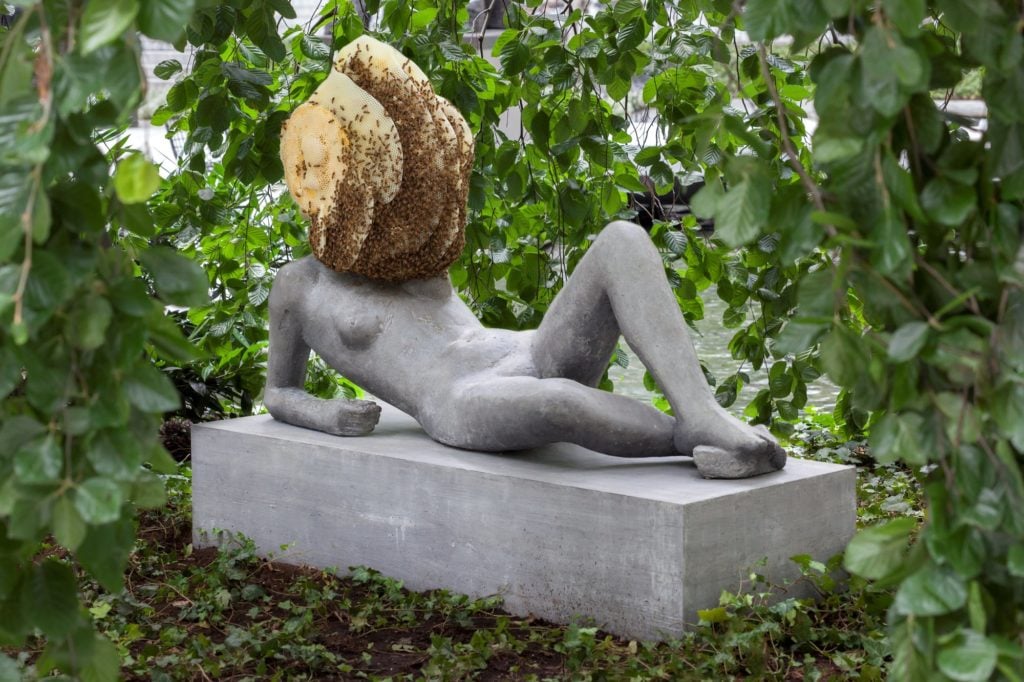
Pierre Huyghe’s, Untilled (Liegender
Frauenakt) (2015). Courtesy of MoMA.
Originally created for the immensely
well-liked Documenta 13 in 2012, and becoming one of the
images most associated with it, the French artist’s bee-headed
sculpture has had a fertile afterlife.
74.
Jacob Hashimoto, Gas Giant (2013)
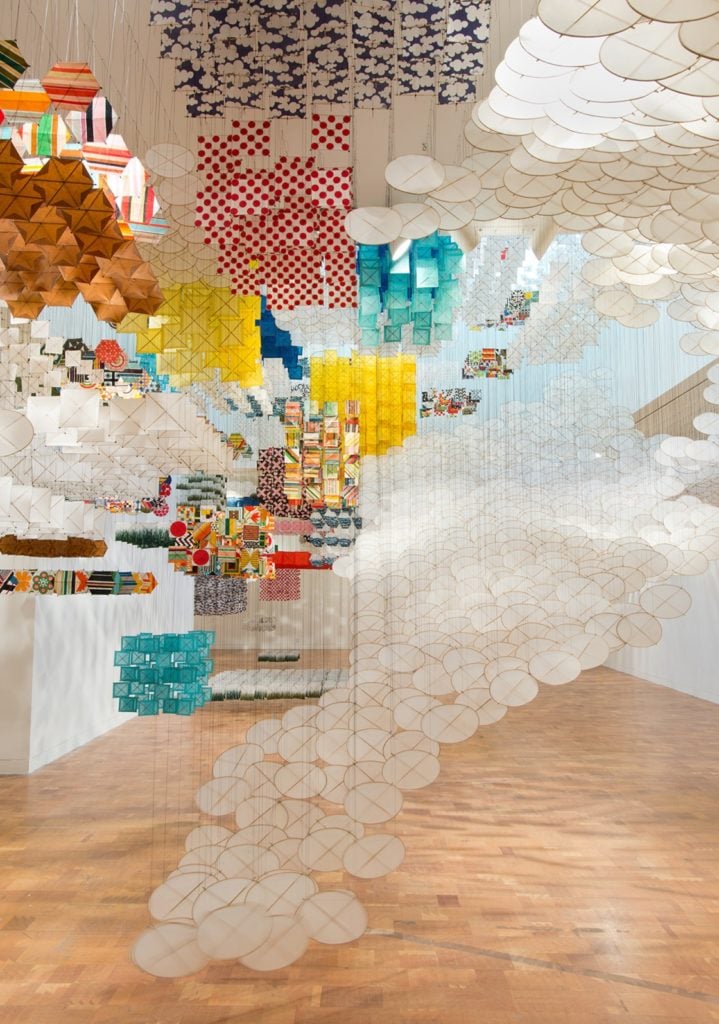
Installation view of Jacob Hashimoto,
Gas Giant at MOCA Pacific Design Center. Photo by Brian
Forrest, courtesy of the Museum of Contemporary Art, Los
Angeles.
“Gas Giant” is actually the name of a trio of installations by
Hashimoto, made between 2012 and 2013, making spectacular use of
Japanese kite-making techniques. The installation is memorably
delightful, a fresh kind of kinetic abstraction.
73.
Maurizio Cattelan, Comedian (2019)
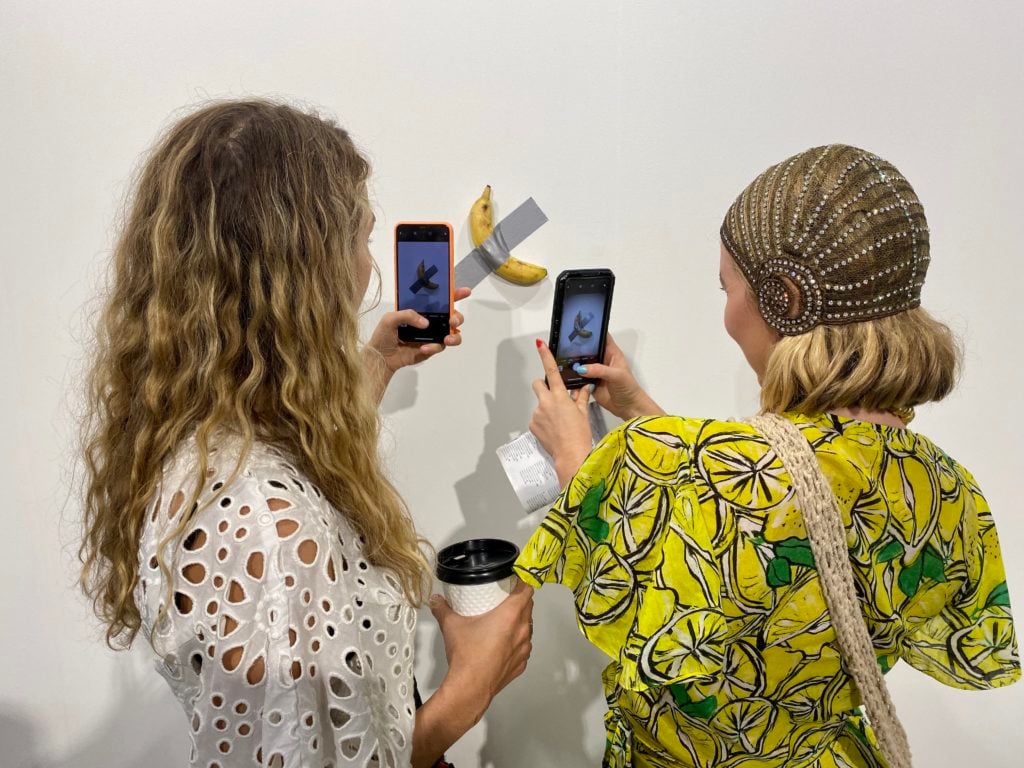
Fairgoers take pictures of Maurizio
Cattelan’s Comedian, for sale from Perrotin at Art Basel
Miami Beach. Photo by Sarah Cascone.
I knew that a work by Cattelan would be on this list, because
his sour, media-smart humor has proved a major influence in the
2010s (despite his purported retirement). I was thinking it would
be America (2018), his gold toilet at the
Guggenheim. But I give in: The self-annihilating irony of the
$120,000 banana at Art Basel Miami Beach is a one-liner, but it
is a one-liner that people will be telling each other for a long
time.
72.
Gina Beavers, Cake (2015)
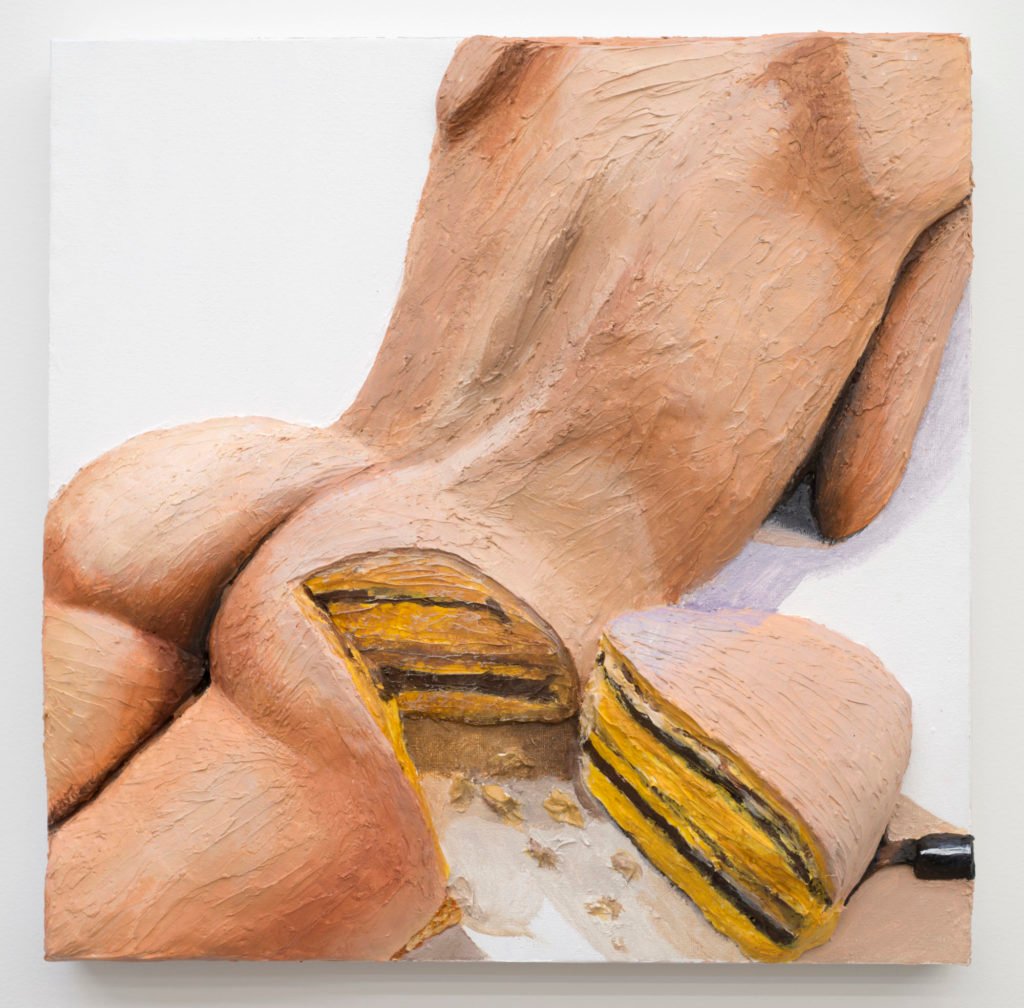
Gina Beavers, Cake (2015).
Courtesy the artist
Just a tremendously weird, resonant painting, riffing on
different kinds of appetites, and also giving a double meaning to
Beavers’s thick, frosting-like surface. Try forgetting the
image.
71.
Michael Pinsky, Pollution Pods
(2017)
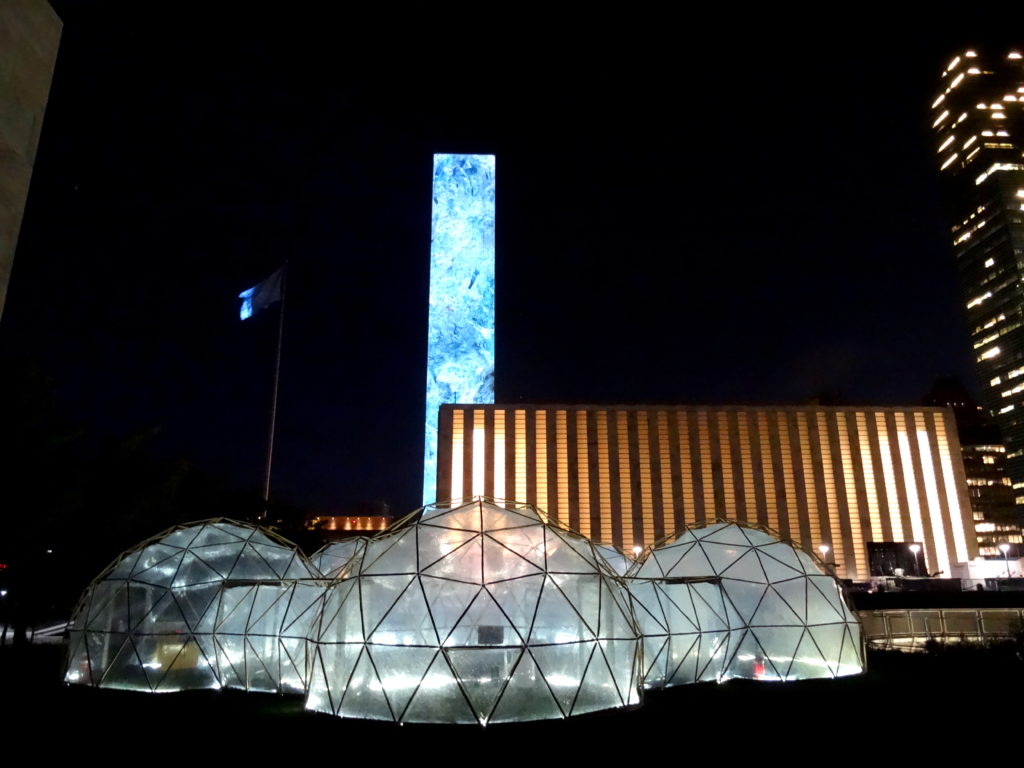
Michael Pinsky, Pollution Pods
at the 74th United Nations General Assembly in partnership with the
World Health Organization. Photo by David Buckland of Cape
Farewell.
The product of a four-year Climart initiative to
see if art can change minds about environmental issues and now
tailing environmental summits
around the world, Pinsky’s pod-environments are designed to
give those who pass through them a literal whiff of the air quality
in various cities around the world: London, Beijing, New
Delhi, São Paolo, and Tautra, Norway (where it began its life). It
takes the strengths of “immersive” installation art and puts them
to agitational ends.
70.
Titus Kaphar, Shifting the Gaze (2017)
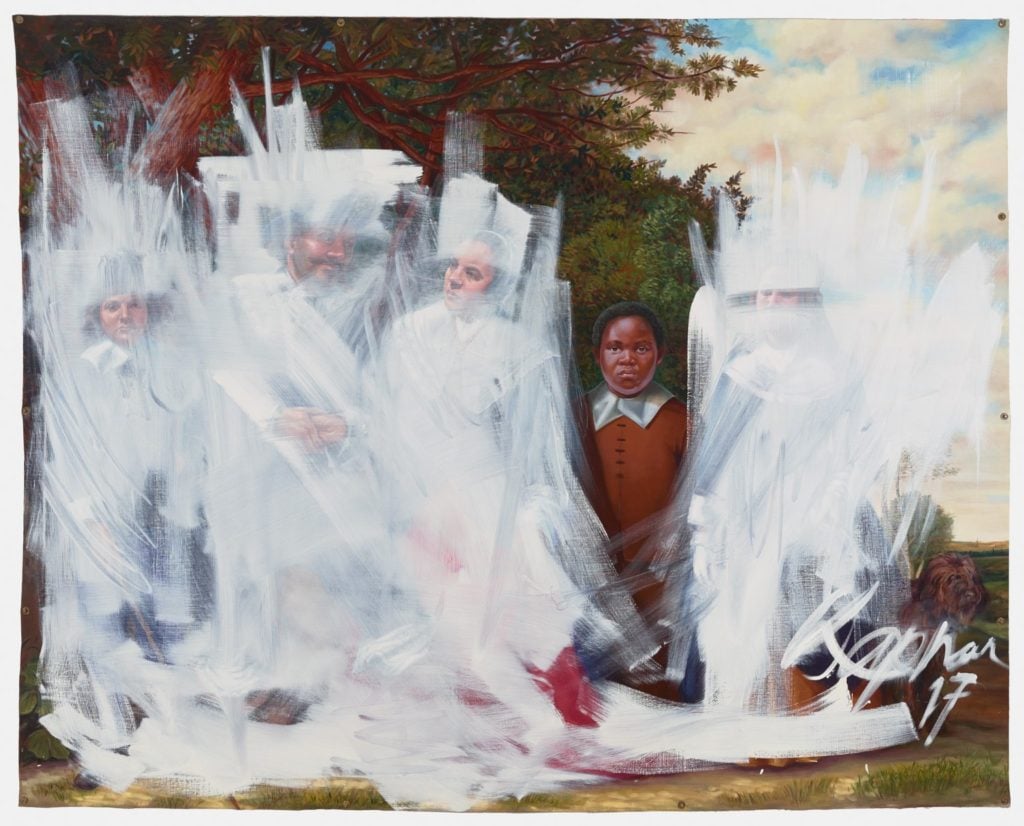
Titus Kaphar, Shifting the Gaze
(2017). Photo: Jack Shainman Gallery, courtesy of the Brooklyn
Museum.
Kind of an anti-painting painting, and symbolic of a much larger
conversation: Working onstage during a 2017 TED Talk seen
by about 1.5 million people, Kaphar displayed a copy of a
17th-century Dutch portrait by Frans Hals, Family Group in a
Landscape (ca. 1645-48), explicating its compositional
language and gradually painting over the principal figures to leave
only the black figure otherwise overlooked in the background
visible.
69.
Ryan McNamara, ME3M: A Story Ballet About the
Internet (2013)
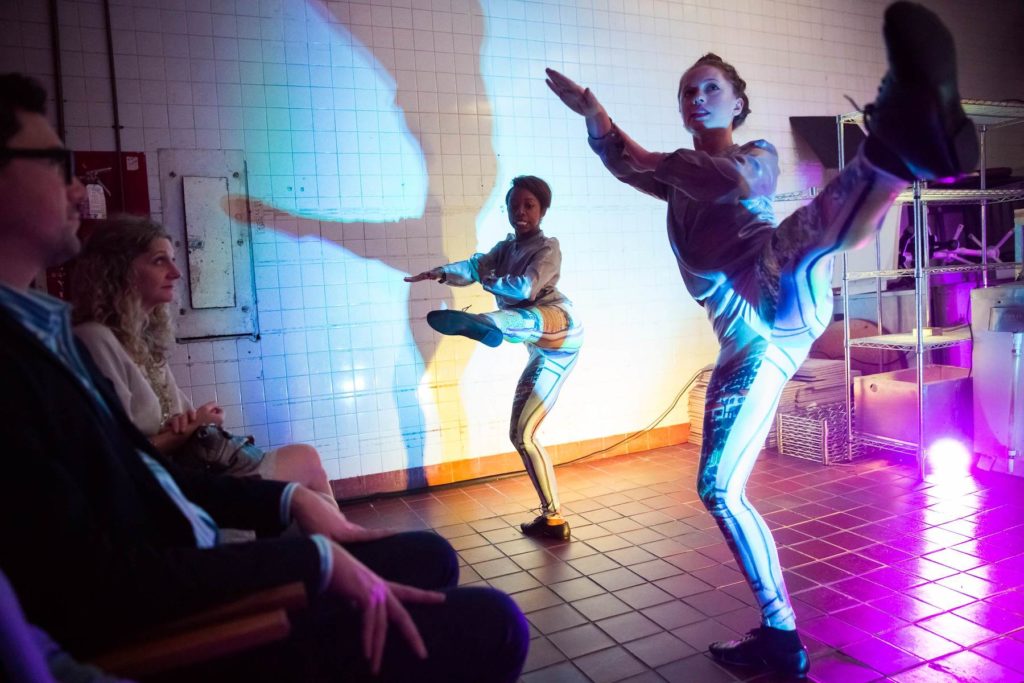
Dancers performing MEƎM 4 Miami: A
Story Ballet About The Internet by Ryan McNamara. Image
courtesy of the artist.
The winner of Performa 2013’s Malcolm
McLaren Award, McNamara’s inventive dance/immersive
performance featured viewers in movable chairs, being shuttled from
one dance tableaux to the next, a groovy attempt to use the
resources of live-ness to reflect on the gibbering, dispersive, but
mesmerizing landscape of the internet.
68.
Dayanita Singh, Museum Bhavan (2013)
“It took me 30 years to find a form that allowed me to free my
images from the wall, from the matt and the frame,” the artist
writes. Famed for her lyrical
documentary images, Singh has this decade gone about rethinking the
way she takes charge of the meaning of her archive, hitting upon
the idea of these folding, handmade wooden frames, housing hundreds
of images in temporary configurations as mini-“museums” of themes
(one is on view in the MoMA’s Sixth Floor now). These can be
reordered, opened up, or locked together to form labyrinths of
images—encouraging a viewer to think of the photos as literal
building blocks of meaning that exist in the world with you.
67.
Tania Bruguera, Immigrant Movement International
(2011)
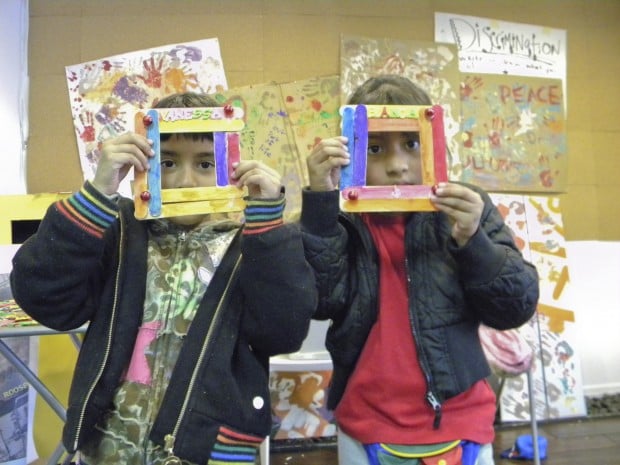
Kids art class. Image courtesy Immigrant
Movement International.
With Creative Time and the
Queens Museum, Bruguera founded the Immigrant Movement
International as a test case of her idea of “Arte Útil,” pushing the “social practice”
turn towards direct social-service provision to a limit. Her
community service center for immigrants in Corona, Queens, has
endured, and I gather it continues
to evolve without her. (For the doubters, it’s worth checking out
the Art21 documentary
featuring painter Aliza Nisenbaum, talking about her experience
teaching English through art to undocumented immigrants at the
space.)
66.
Josh Kline, Freedom (2015)
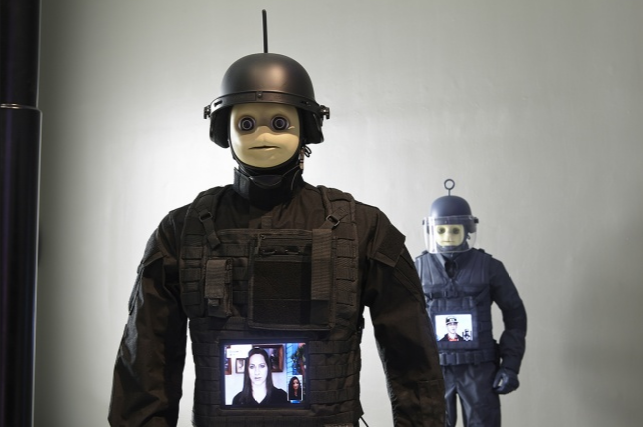
Josh Kline, FREEDOM (2015).
Image: Benoit Pailley.
In contrast to the internet-themed Pop art of a decade ago,
which was generally much more ironic and light-hearted, Kline’s
work in general—and his Teletubby riot police specifically (seen at
the New Museum Triennial in 2015)—provided the image of the new
sensibility, in which our love of ironic junk came back to
terrorize us.
65.
Ian Cheng, Emissaries (2015–17)
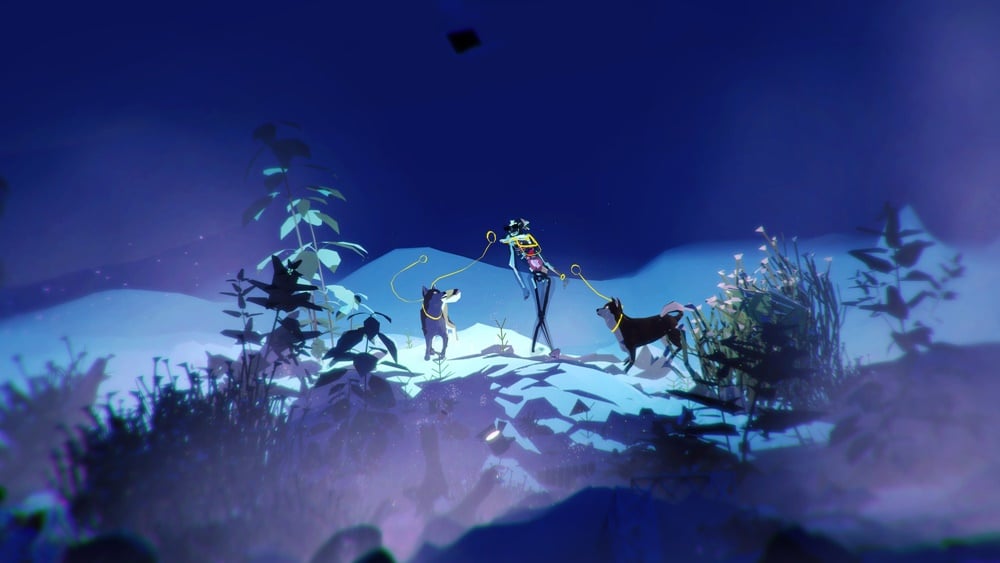
Ian Cheng, Emissary Forks at
Perfection (2015–16). Courtesy of MoMA.
Each chapter of Cheng’s “Emissaries” trilogy features a
different animated digital landscape in which tiny AI-powered
cartoon figures wander aimlessly as if they have been cut free from
the background of some huger narrative. It has a slight
retro-gaming aesthetic, but the entropic mystique has stuck around
in my head, the retardataire feeling of its graphics starting to
feel more and more meaningful as a symbol of being lost in a world
of simulated memories and identities built around rootless
mythologies.
64.
Jon Rubin and Dawn Weleski, Conflict Kitchen
(2010–17)

Conflict Kitchen’s Schenley Plaza
location, decorated for an Afghan menu in 2014. Image courtesy
Wikimedia Commons.
Serving dishes from countries in conflict with the United
States, Conflict Kitchen was both a functional food stand in
Pittsburgh and an informational kiosk promoting understanding and
serving as a locus for debate with each new iteration. Rubin
and Weleski, the artists behind it, are on to new things now,
but the idea lives on as an example of art providing literal “food
for thought.”
63.
LaToya Ruby Frazier, The Notion of Family
(2014)
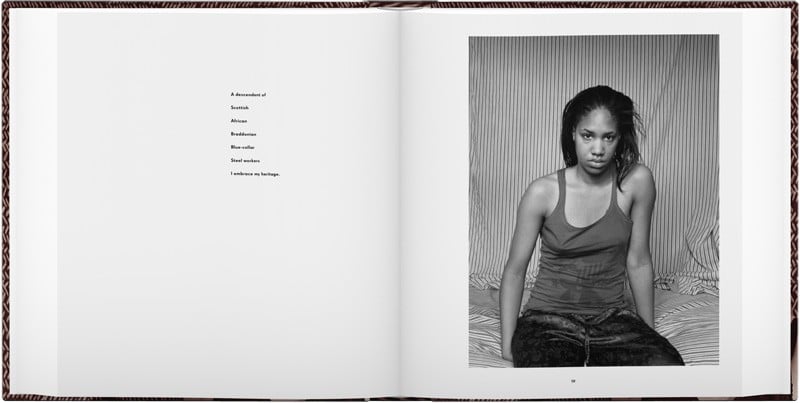
Spread from LaToya Ruby Frazier, The
Notion of Family (2014). Image courtesy Aperture.
The story Frazier tells in the photos of The Notion of
Family relates to the bleakness and abandonment of Braddock,
Pennsylvania, the majority African American town where she grew up.
The series is notable for the way that it combines the directness
of black-and-white social documentary with a wrenchingly personal
approach, returning again and again to the artist herself, her
mother, and her grandmother. There’s just an overwhelming heaviness
to The Notion of Family, everyone pinned still as if
trapped.
62.
Otobong Nkanga, Carved to Flow (2017)
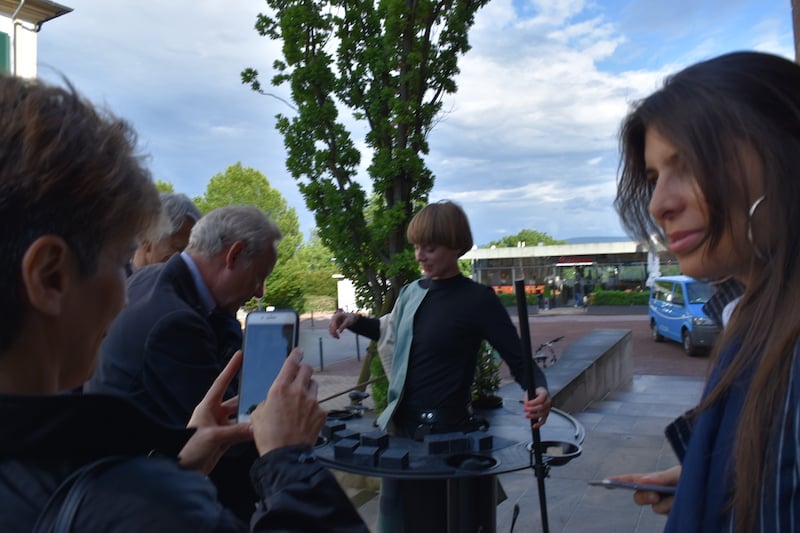
A performer offers samples of Otobong
Nkaga’s O8 Black Stone soap, produced in Athens for Documenta 14,
outside the Neue Galerie in Kassel. Image: Ben Davis.
A work of wheels-within-wheels complexity, Carved to
Flow is difficult to easily
explain. It involved a soap-making workshop in Athens that
became a project to have performers/vendors hawking Nkanga’s 08
Black Stone soap in Kassel, and then was finally meant to recycle
those profits into the Carved to Flow
Foundation in Akwa Ibom, Nigeria, which focuses on local
ecologies. What I will say is that I think that Nkanga’s
sensibility, where the discrete object is less important that the
awareness about the networks of labor, business, and environmental
impacts that flow into and out of it, is the emergent cultural
mindset of the future.
61.
Anicka Yi, You Can Call Me F (2014)
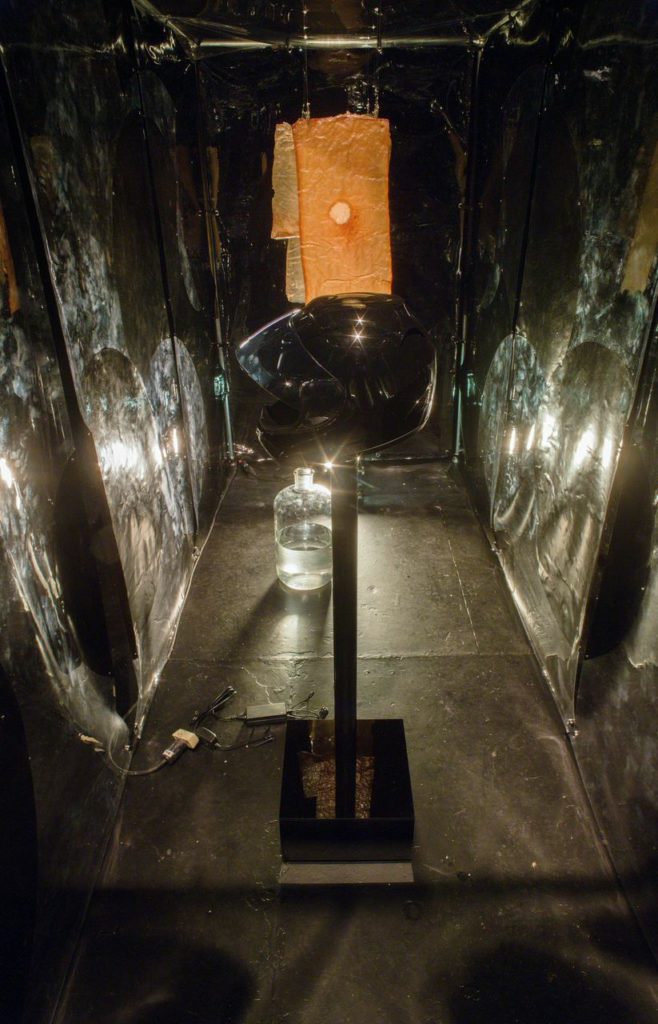
Installation view of Anicka Yi, You
Can Call Me F at the Kitchen. Image courtesy the artist and
the Kitchen.
Yi’s installation of quarantine tent-like enclosures and
ramshackle assemblages, incubating biological samples donated by
some 100 other female-identifying artists, augured a whole new era
of conceptually disorienting bio-art.
60.
Michael Heizer, Levitated Mass (2012)
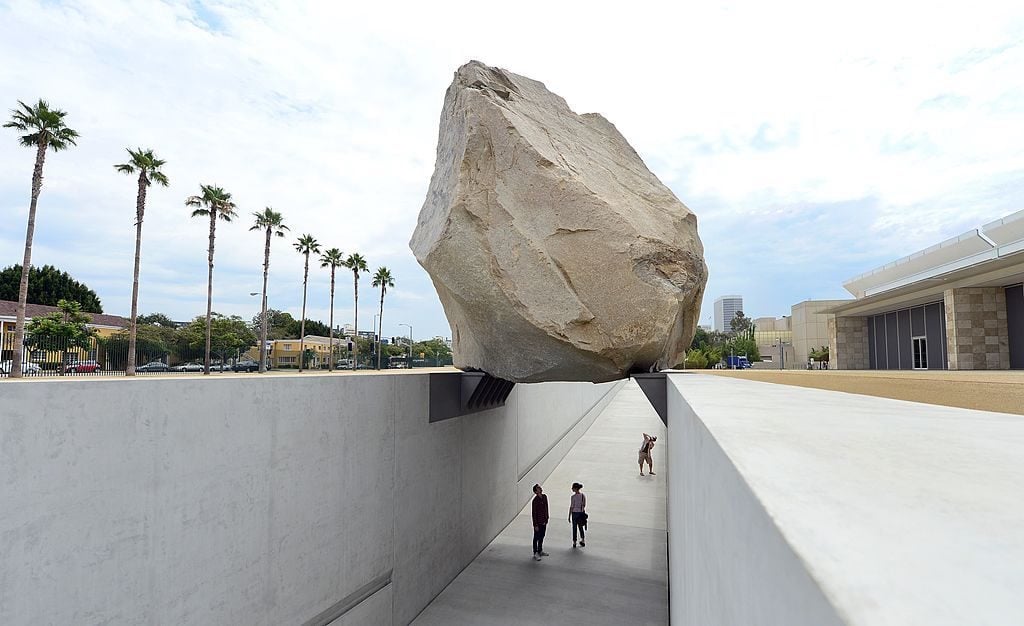
Michael Heizer, Levitated Mass
(2012). Courtesy of Frederic J. Brown/AFP/Getty Images.
A completion of a certain symbolic journey for Land Art, with
Heizer’s massive rock making the journey back to LACMA to
loom—sublime nature tamed as an urban photo op. Its transit to the
site became a sort of grand civic spectacle all on its own.
59.
Hiwa K, This Lemon Tastes of Apple
(2011)
There’s something unforgettable about the gonzo grit of Iraqi
artist Hiwa K’s performance This Lemon Tastes of
Apple, which saw him walk into the thick of anti-corruption
demonstrations on April 17, 2011 in Sulaimany, in the Kurdish
region of Iraq, harmonica in hand playing an Ennio Morricone riff
from Once Upon a Time in the West, as events rage around
him. “The work,” writes the artist, “occurred within the protest
and is not a work about the protest.”
58.
Zach Blas, Facial Weaponization
Suite (2011)
Blas’s multi-pronged project, making aggregated data of facial
features into eerie, melted wearable abstractions, is both
unnerving as an image and a practical protest against the biases
baked into facial recognition software (well, semi-practical).
57.
Favianna
Rodriguez, Migration is Beautiful
(2012)
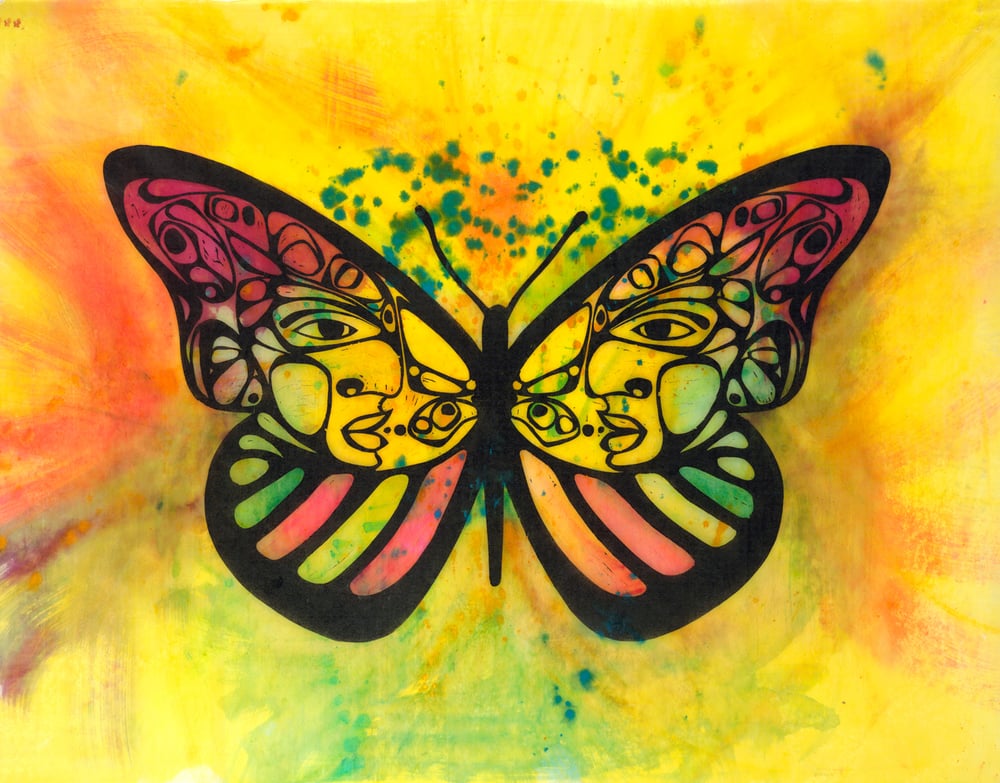
Favianna Rodriguez, Migration
is Beautiful (2013). Image courtesy Favianna Rodriguez.
Oakland-based Rodriguez, a printmaker, activist, and
founder of CultureStrike, developed the image of
the Monarch butterfly, which naturally migrates between Mexico and
California, into a metaphor for immigrant solidarity in 2012, as a
response to President Obama’s record-breaking deportations. It
caught on. It’s
still inspiring
people in the age of Trump.
56.
Jennifer Packer, Say Her Name (2017)
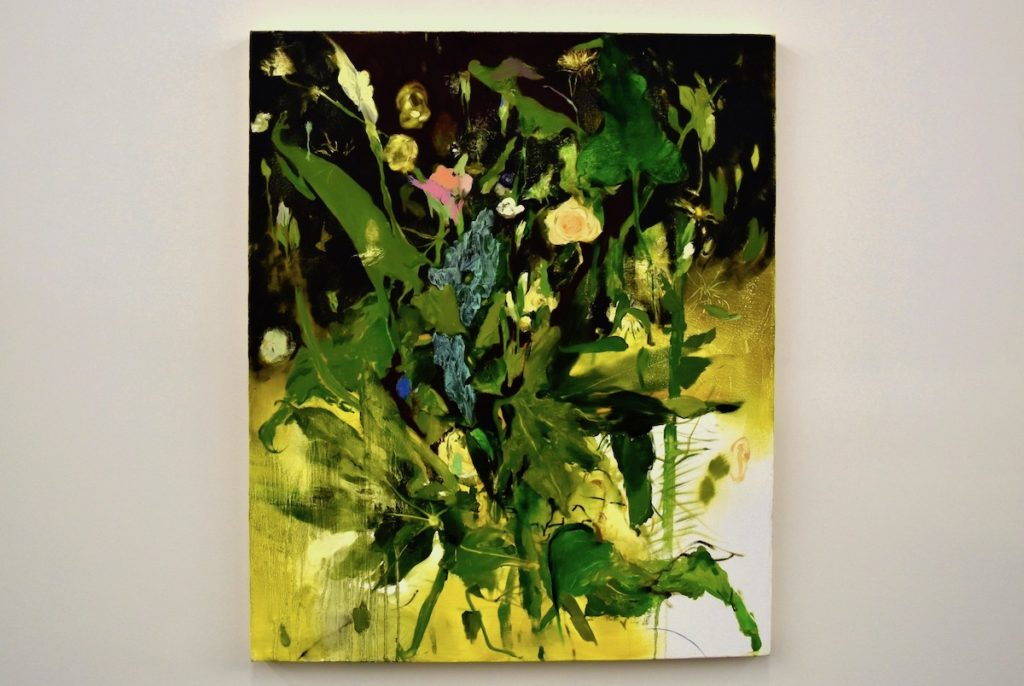
Jennifer Packer, Say Her Name
(2017). Image courtesy Ben Davis.
As a slogan, “Say Her Name” was a response to media silence
around cases of police brutality against black women and caught
fire around the case of Sandra Bland, whose death in a Texas jail
touched off a national outcry in 2015. Packer’s quietly vivid
still life goes the other way, letting a painted funeral bouquet
for Bland stand on its own, contemplated as an act of
memorialization, withdrawing the case from the spectacular
circulation of traumatic imagery.
55.
Jill Magid, The Barragán Archives
(2013–19)
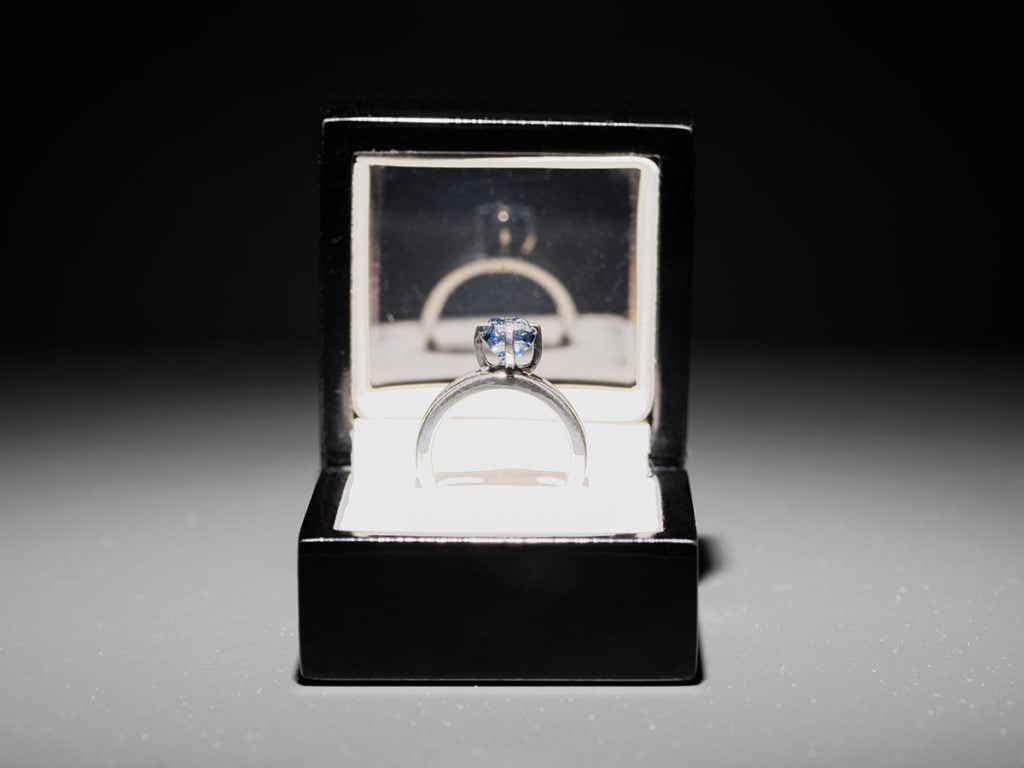
Image from Jill Magid, The
Proposal, blue diamond ring with inscription, “I am
wholeheartedly yours.” Courtesy of the artist; LABOR
RaebervonStenglin; and Galerie Untilthen.
Magid’s attempt to repatriate the
archives of beloved Mexican architect Luis Barragán to Mexico,
involving her successful quest to turn part of his ashes into a
diamond engagement ring as a ploy (it’s too complex to explain
here, and the New Yorker has
done a better job of it anyway) sounds like something an artist
would do in a movie. And, indeed, Magid has made a film of her quest, which is worth
seeing on its own.
54.
lauren woods, A Dallas Drinking Fountain Project
(2013)
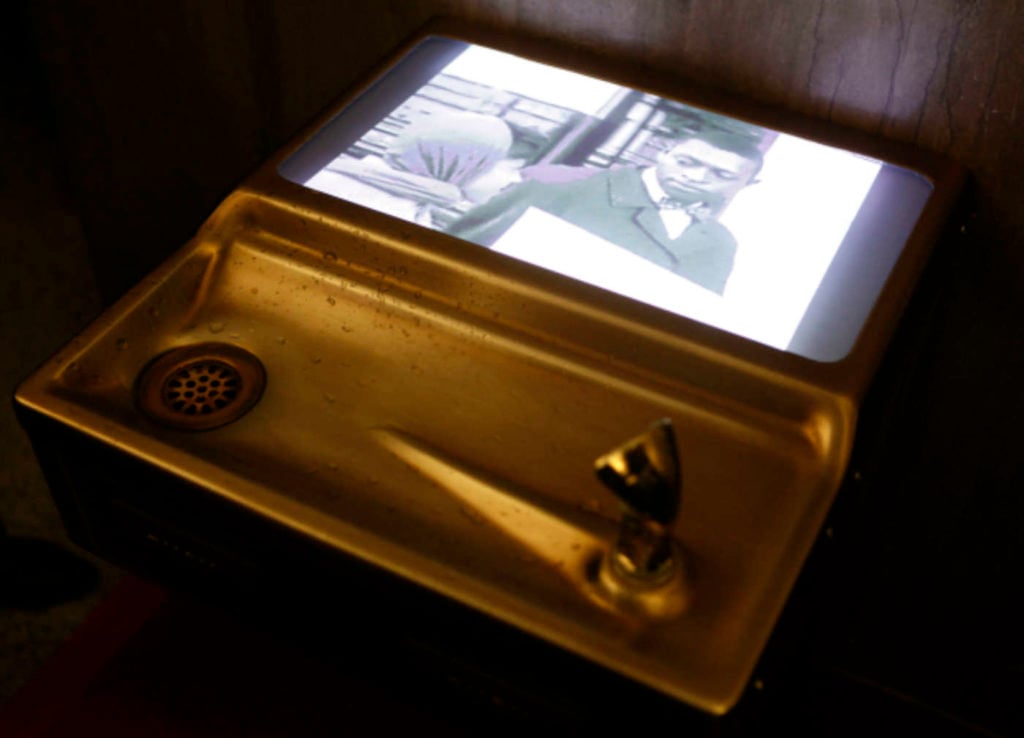
lauren woods, A Dallas Drinking
Fountain Project (2015). Image courtesy the artist and
Creative Capital.
woods has become a go-to figure for the
counter-monument movement in the United States. She is on to much
bigger things now, with her “American MONUMENT” project, an audio
archive relating to police killings of black victims. Still, her
“interventionist multimedia
monument” at the old Dallas County Records building offered a
deft new way to engage history in public space: marking the traces
of a “White Only” sign lingering over a drinking fountain, it
caused a video to activate about the history of Civil Rights
struggle when you hit the button for water, an inconvenience that
insists on the importance of not letting the past be washed
away.
53.
Maria Gaspar, Radioactive: Stories from Beyond the
Wall (2018)
The name of the “96 Acres” project, founded by Gaspar, refers to
the immense space taken up by the Cook County Jail in Chicago,
effectively a city-within-a-city. It produced an acclaimed, years-long
series of “community-engaged, site-responsive art,” among them
Radioactive, which involved workshops with inmates on how
to tell their story that became animated projections using the
exterior walls of the jail as a screen. Gaspar’s impulse has
inspired prison art-making initiatives elsewhere.
52.
Khaled Hourani, Picasso in Palestine (2011)
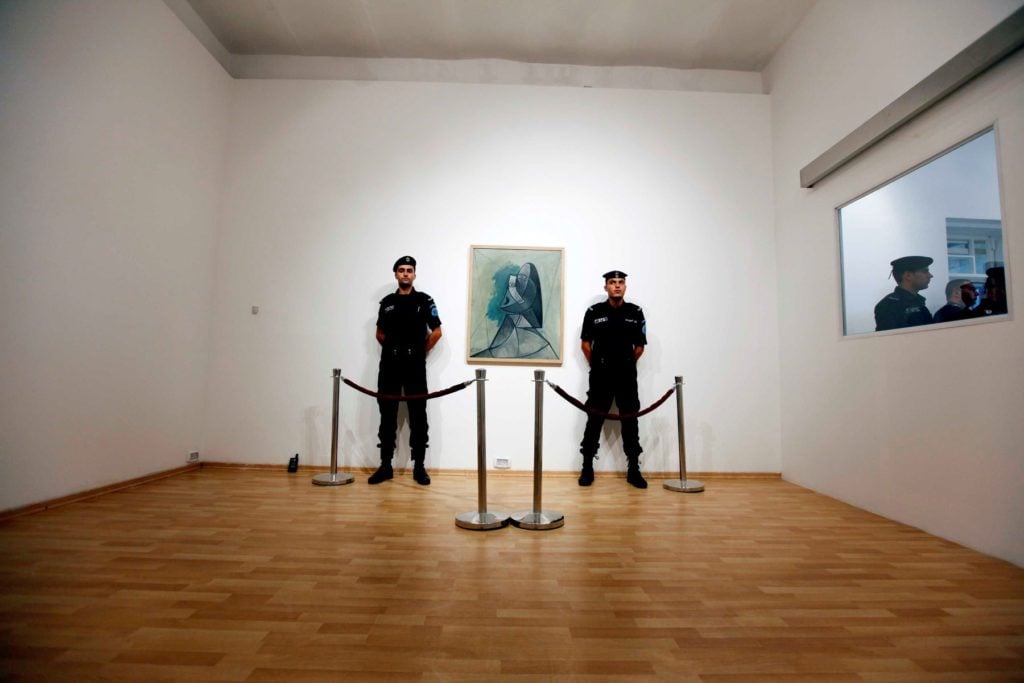
A still from the video for Khaled
Hourani’s Picasso in Palestine (2011). Image courtesy the
artist.
Artist and curator Khaled
Hourani’s elaborate efforts to get Buste de Femme, a
1943 work by Picasso in the collection of the Van Abbemuseum in
Eindhoven, to be seen at Ramallah’s International Academy of Art,
has become, among other things, a widely seen documentary and a
series of paintings. But really the entire project was consciously
designed as a kind of critical gesture, a way to use the
value of art and the difficulty of
transporting it as a way to throw into relief the absurdities
of life under occupation.
51.
Danh Vo, We The People (2010–14)
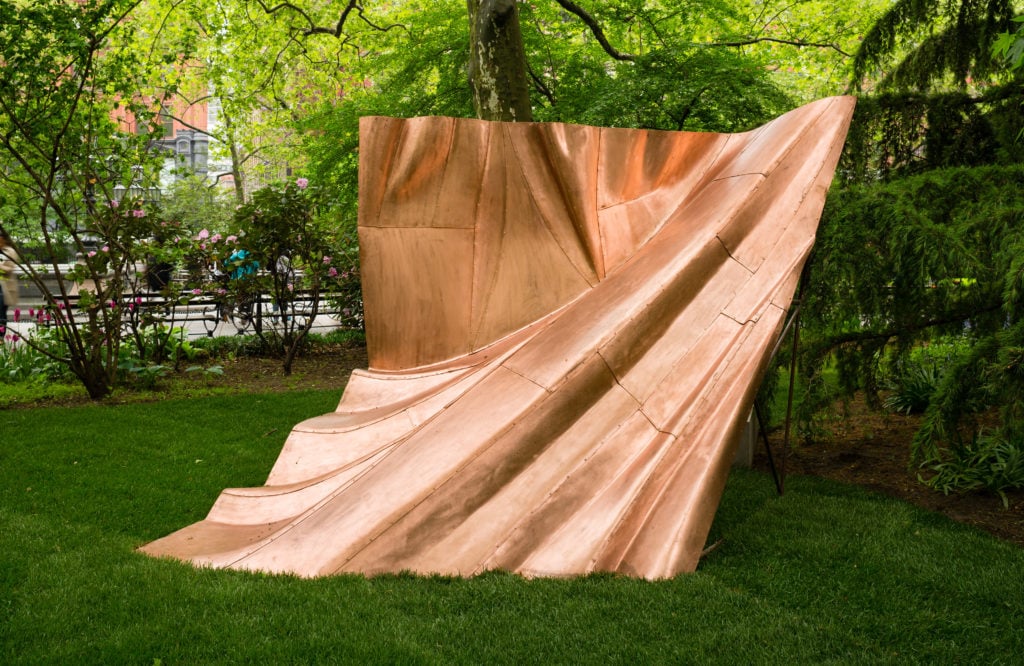
Danh Vo, We The People (detail)
(2011–14). Photo: James Ewing. Image courtesy the artist and
Galerie Chantal Crousel.
Danh Vo’s idea for We The People—remaking the cladding
of the Statue of Liberty, but disassembled, so that the plates
become abstractions—is so elementally evocative and symbolically
potent that you are amazed that it hasn’t been done before.
The post The 100 Works of Art That Defined the Decade,
Ranked: Part 2 appeared first on artnet News.
Read more https://news.artnet.com/opinion/100-works-that-defined-the-decade-part-2-1738773
Further reading


Leave a comment