
The Art World Works From Home: Whitney Curator Chrissie Iles Is Doing Kundalini Yoga and Reading About Historical Plagues
The art world may be on lockdown, but it certainly does not
stop. During this unprecedented time, we’re checking in with
art-world professionals, collectors, and artists to get a glimpse
into how they are working from home.
We recently caught up with Chrissie Iles, the Anne and Joel
Ehrenkranz curator at the Whitney Museum of American Art.
Recognized as an authority on both contemporary moving-image work
and the (somewhat) more traditional art of the 1960s and ’70s, Iles
has long understood the importance of versatility and variety. So
it’s no surprise that, even during the shutdown, she’s managing to
balance everything from deep scholarly research and remote visits
with artists, to kundalini yoga and Moroccan cooking.
Read on to learn how the shutdown is influencing the next
exhibition on her agenda, and which edgy thriller she’s using to
offset her array of Zoom meetings and YouTube conference
viewings.
Where is your new “office”?
It’s an extension of the quiet space I create at home when I’m
writing: a desk, computer, books, lamp, a plant, music on
headphones, papers, and notes.
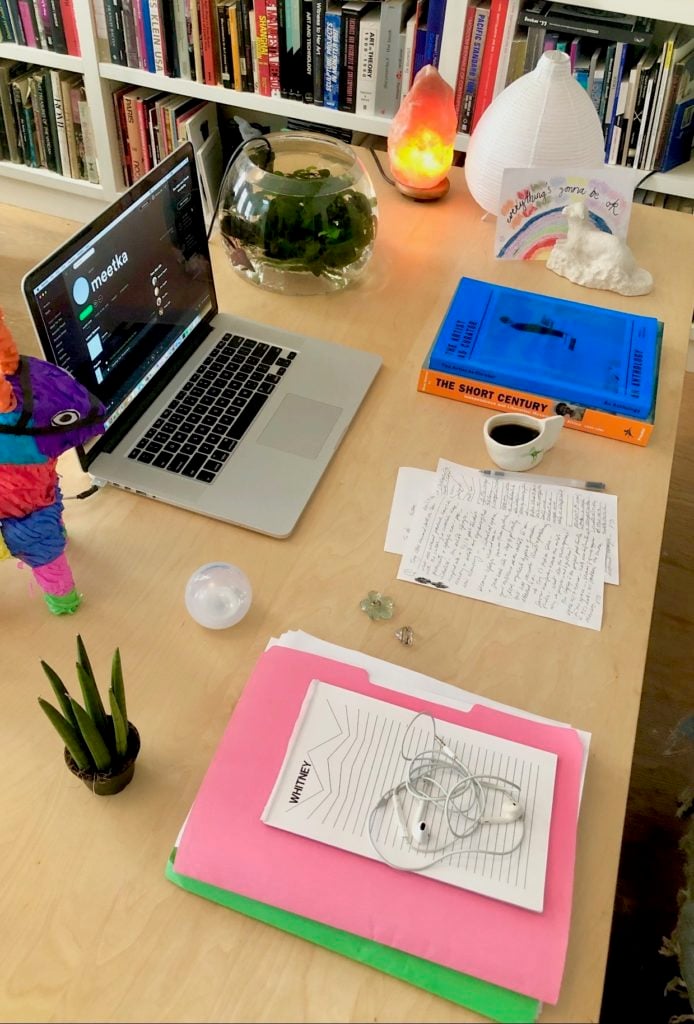
Chrissie Iles’s home office. Courtesy of
Chrissie Iles.
What are you working on right now (and were any projects
of yours interrupted by the lockdown)?
I’m curating a solo show of Madeline Hollander’s work, featuring
her first video installation, Flatwing, which we acquired
last year. During this hiatus, senior curatorial assistant Clémence
White and I have been having remote studio visits with Madeline
with long discussions of her work, including the issues around
climate change that it addresses, which the current crisis has
thrown into sharp focus.
Cauleen Smith’s exhibition “Mutualities” had just opened,
alongside “Vida Americana,” when the lockdown happened. We were so
excited, and Cauleen was discovering many resonances between the
two shows. We were about to screen her film Chronicles of a
Lying Spirit (by Kelly Gabron) as well as Passing
Through, by LA Rebellion filmmaker Larry Clark, then follow
with a discussion between her and film scholar Michael Gillespie.
And we were collaborating with the High Line, which was due to show
four of Cauleen’s films each evening from March until May. So we
all felt like we were interrupted in mid-flow.
How has your work changed now that you are doing it from
home?
The biggest change is not being in the museum, and not being
able to visit artists’ studios and see shows. These are mainstays
of my work and life, and they are all interconnected. My work at
home is focused on initiatives to show art to audiences while we’re
closed, as well as upcoming shows, taking care of newly acquired
works and the moving-image part of our collection, research, and
planning. Like everyone, our meetings have transferred from
in-person to remote, and I’m always happy to see everyone’s faces
online. I miss all my colleagues!
Last week I attended a Zoom discussion between Tony Cokes and
Christoph Cox, organized by the Carpenter Center at Harvard. It was
surreal to see some of the audience live and others as black
squares because they’d chosen not to switch on their cameras, like
a hybrid of live TV and radio.
What are you reading, both online and off?
Online, I’m reading Daniel Defoe’s Journal of the Plague
Year and articles about the Antonine Plague during the Roman
period, searching for a historical context for the current
situation. In book form, I’m reading Slow Down
Fast, A Toda Raja, a conversation between Camila
Marambio and the Chilean artist Cecilia Vicuña, whose arguments
feel particularly urgent. I’m also reading Anna of all the
Russias, a biography of the poet Anna Akhmatova. I pick up
books according to my mood each quarantine day.
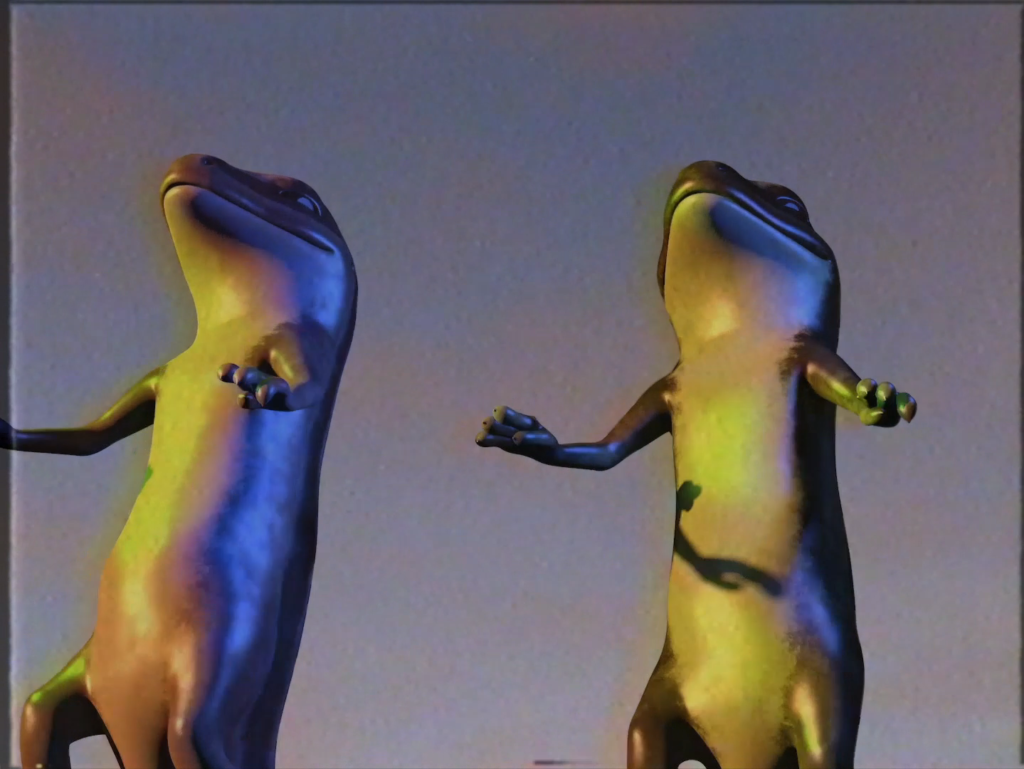
Orian Barki and Meriem Bennani, still
from 2 Lizards Episode 1 (2020). Courtesy of the artist.
Have you visited any good virtual exhibitions
recently?
Meriem Bennani’s 2 Lizards episodes on Instagram. I
love their dark humor, and the way they express what we’re all
feeling in the moment. Also, Elizabeth Jaeger and ICU nurse Cady
Chaplin’s project of inviting artists to make posters of support
for the nurses in ICU units in hospitals. Each new drawing is
rolled out by Elizabeth and other artists online as it is made,
making it an ongoing virtual show. It’s such a generative and
thoughtful action, and Meriem seamlessly wove it into her latest
2 Lizards episode.
In LA, Cauleen Smith has uploaded eight of her films on her
instagram feed for her ongoing “shut-in film festival.” And Celia
Hollander organized a drive-in remote live radio broadcast
performance from a parking lot in Echo Park. I’m watching a lot of
the online projects and screenings that artists, spaces, galleries
and film centers are streaming. The number of films currently
available online is cinephile heaven! BAM is streaming films
curated by Ashley Clark, Gina Duncan, Jesse Trussell, and Natalie
Erazo, for example. There’s a lot of sharing, talking, and
imaginative connecting. So many great projects are being initiated
by artists; the community remains strong under pressure, but it
needs support.
Have you taken up any new hobbies?
I’m using this time to practice being a Minimalist, but the
siren call of online shopping persists.
What is the first place you want to travel once this is
over?
I want to cycle to the museum and see everyone again, and see
all my friends. And then fly to England and Italy, to see my family
and friends there. We will never stop traveling, but I wonder if we
will ever travel in such a carefree way again.
If you are feeling stuck while self-isolating, what’s
your best method for getting un-stuck?
It depends. Sometimes it’s spatial—going up to the roof resets
everything. Sometimes it’s internal, and talking with my partner,
friends, or family re-establishes perspective. Sometimes it’s
physical; live kundalini yoga and meditation classes are great for
re-balancing. Connecting with friends and communities online is
key, and so are virtual studio visits with artists.
What was the last TV show, movie, or YouTube video you
watched?
I just started the new season of Killing Eve, a crazy,
dark British spy thriller that puts two powerful women in charge of
the narrative. The last YouTube video I watched was the symposium
“The Black Outdoors: Fred Moten and Saidiya Hartman” at Duke
University, a game-changer for art history.
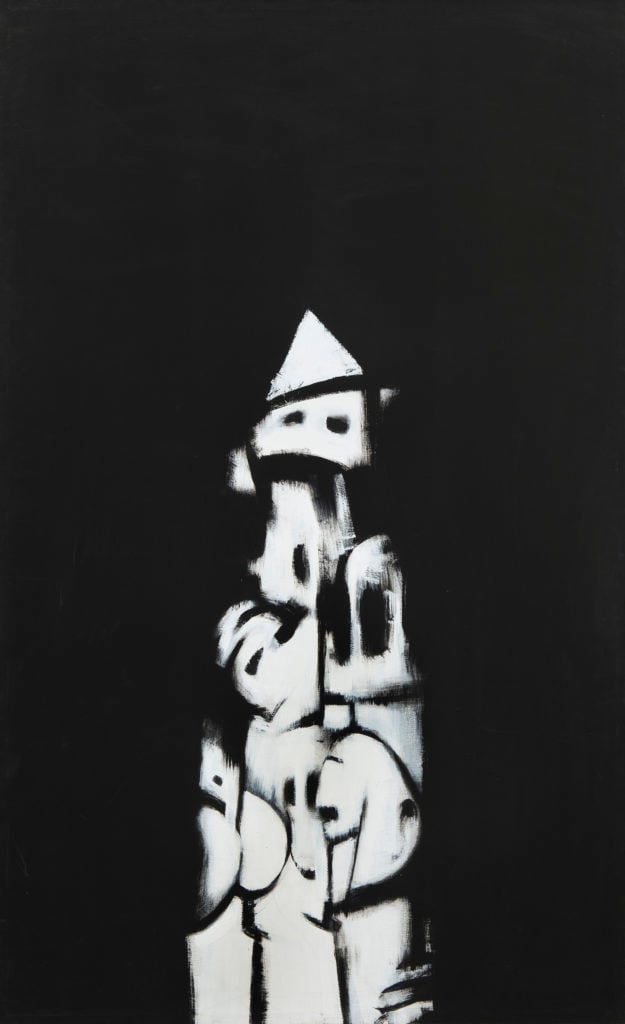
Norman Lewis, American Totem,
1960, in the collection of the Whitney Museum of American Art. ©
Norman Lewis. Courtesy Michael Rosenfeld Gallery LLC, New York.
If you could have one famous work of art with you, what
would it be?
Norman Lewis’s American Totem (1960), from the
Whitney’s collection. I look at it every day at the museum, and
it’s dignified, haunting figure is a sobering reminder of how much
work there is to be done. It’s one of the most important paintings
of the 20th century.
Favorite recipe to cook at home?
Instagram has become a hive-mind quarantine cookery class. I’m
learning how to make chicken tagine from a recipe that the
artist Dora Budor shared, originally by Felicity Cloake in
The Guardian.
Many of the ingredients are staples of our kitchen: lemons, garlic,
coriander, herbs, spices, and olives.
(Serves 4-6 people)
3 tbsp olive oil
2 red onions, thinly sliced lengthways
3 garlic cloves
2 tsp ground ginger
½ tsp saffron, in a little warm water
1 tsp cinnamon
Juice of ½ lemon
2 small preserved lemons
2 tbsp chopped parsley
1 small bunch of fresh coriander
6 chicken thighs
3 tbsp violet olives
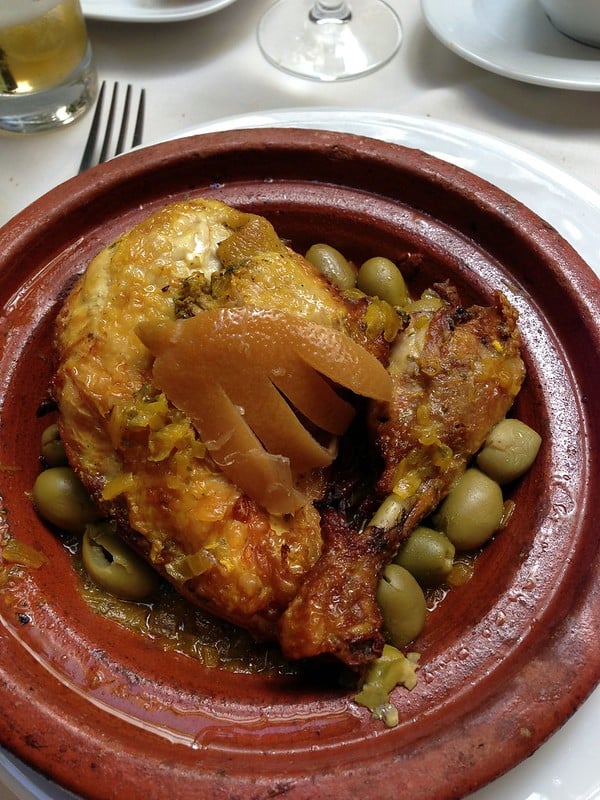
Voilà! Chicken tagine. Photography by
David Berkowitz, courtesy of Flickr.
Heat a tagine or heavy-bottomed shallow lidded pan on a low
heat and add the oil, followed by a layer of onion. Mash the garlic
with ½ tsp salt and add to the pan. Sprinkle over the ginger,
saffron water, and cinnamon, followed by the lemon juice, and
coarsely chopped pulp of one preserved lemon and the rind of both,
cut into slivers. Add the parsley and 2 tbsp chopped coriander and
toss it all together well.
Arrange the chicken on top and scatter over the olives. Pour
175ml water into the pan, cover tightly, and simmer very gently for
about 45 minutes until the chicken is cooked through.
Season to taste and top with the remaining coriander,
chopped. Serve with couscous.
What are you most looking forward to doing once social
distancing has been lifted?
Seeing my friends, family, and colleagues again, and hugging
them. For those of us lucky enough to be healthy, able to work from
home, and not in acute financial distress, this slowing-down of
time is an opportunity to reflect on our responsibility to each
other, and to artists. The world needs the culture that they are
creating now more than ever, and I can’t wait to see it— and
them—again in person.
The post The Art World Works From Home: Whitney Curator
Chrissie Iles Is Doing Kundalini Yoga and Reading About Historical
Plagues appeared first on artnet News.
Read more https://news.artnet.com/art-world/the-art-world-works-from-home-chrissie-iles-1839069
Further reading


Leave a comment