
The British Museum Defends BP Sponsorship in a Public Debate With Climate Activists Following the Resignation of a Trustee
The British Museum’s chair of
trustees defended the institution’s continued partnership with the
oil giant BP in a public debate with climate change activists held
yesterday in London. The unprecedented event follows the
high-profile resignation of a trustee who cited the institution’s
relationship with the company as one of her reasons for reluctantly
stepping down.
During the debate, chair of
trustees Richard Lambert cited cuts to public funding as the reason
the British Museum needed support from big business, but climate
campaigners are unhappy that he did not offer an ethical
justification for its controversial partnership with BP.
Despite years of high-profile
demonstrations by the climate activists BP or not BP?, and Greenpeace, seeking to put an end to the
company’s sponsorship of the museum, the debate on Wednesday, July 31, marked the
institution’s first public engagement with climate change
campaigners.
Museum Ethics
Chris Garrard, the co-director
of Culture Unstained, a campaigning group seeking to end fossil
fuel sponsorship of cultural institutions, debated the issue with
Lambert and the UK head of BP, Peter Mather. During the discussion,
Garrard questioned the ethics of the partnership, calling for the
museum to develop ethical practices that are “defensible” to a
public increasingly concerned by climate change.
He specifically highlighted BP’s
lobbying of the Trump Administration to expand the company’s
drilling in the Arctic, saying that this is “at odds” with the
British Museum’s planned exhibition about culture and climate in
the region. (The exhibition opening in May 2020 is not sponsored by
BP.)
Garrard tells artnet News that
the British Museum’s chairman of trustees made no ethical
justification for continuing to “endorse and promote” BP during
their discussion. “The debate exposed just how ethically conflicted
the British Museum is,” Garrard says. “According to Richard
Lambert, the museum ‘accepts that climate change is the great issue
of our time,’ and yet it won’t act on the simple truth that a
company planning to stay 97 percent invested in fossil fuels will
only exacerbate that crisis.”
Garrard said that the discussion
made it clear that the museum is “simply unwilling to back up its
words with meaningful action.”
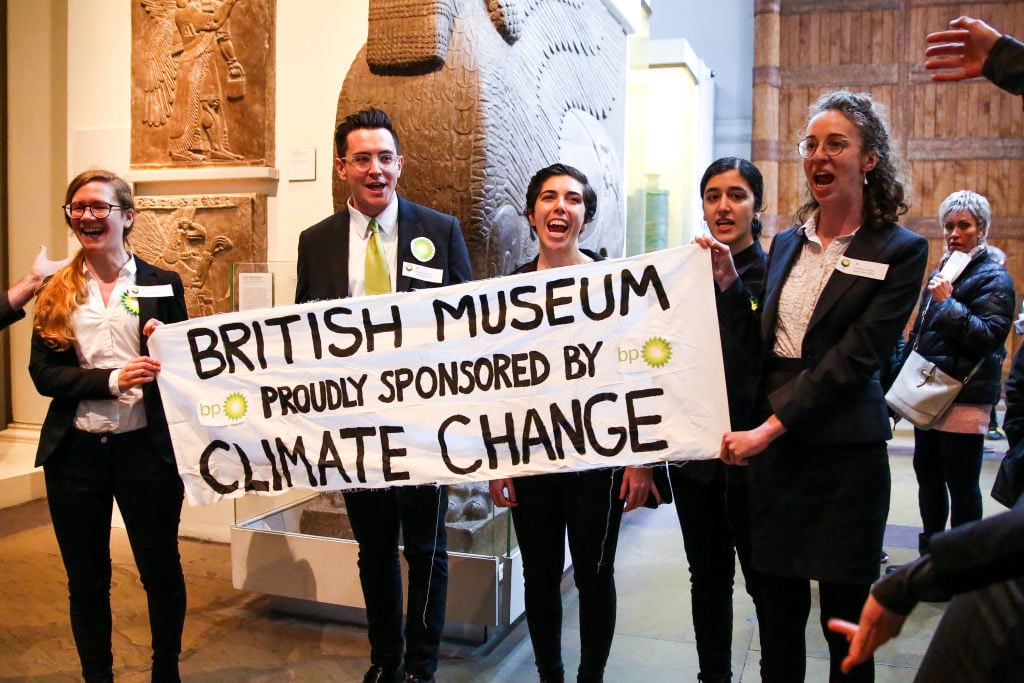
Activists protesting BP’s sponsorship of
the British Museum. Photo by Dinendra Haria/SOPA Images/LightRocket
via Getty Images.
In the public forum, Lambert
focused on the “tight” financial pressure the museum is facing
after years of cuts to public funding. A spokeswoman for the museum
confirms to artnet News that it is facing “considerable” financial
pressure from the reduction in real terms of grant-in-aid from
government, with its public funding cut by 30 percent since
2010.
“Temporary exhibitions are
expensive to plan and stage,” the museum spokeswoman says. “The
money we receive from BP and other supporters allows us to
successfully plan exhibitions long-term and deliver public
benefit.” She adds that these exhibitions often focus on “less well
known cultures.” such as the Scythians or Assyrians,
which “would not happen” without external support.
During the discussion at the
London offices of Tortoise Media yesterday, Peter Mather of BP said
that the company recognizes climate change as “the defining issue
of our era.” He emphasized its commitment to changing how they
drill for oil, and cited its investment in renewable energies
including solar power. artnet News reached out to BP for comment,
but did not hear back by press time.
Trustee Resignation
The debate came a week and a
half after British Museum trustee Ahdaf Soueif
stepped down from the board, citing publicly the museum’s relationship
with BP among other reasons for her departure. In a powerfully
worded comment piece, she said she regretted the institution’s lack
of engagement with “the legitimate and pressing concerns of young
people across the planet.”
“We have a formidable group of
trustees who speak their minds and challenge the museum, that is
very much a part of their role,” the museum spokeswoman says. While
the board has not met since Soueif’s departure, the spokeswoman
stressed that “questions around sponsorship are debated and
discussed.”

The artist activist group Bp-or-not-Bp
stage a ceremonial performance at the British Museumin 2016. Photo
by Kristian Buus/In Pictures via Getty Images Images.
All this comes at a time of
increased public scrutiny of arts and culture sponsorship in the
UK. After escalating campaigns against museum funding from the
Sackler foundations, led by Nan Goldin’s activist group P.A.I.N.,
museums led by the South London Gallery and the Tate have rejected
future sponsorship from the family linked to the opioid crisis. The
National Portrait Gallery in London is another prestigious
institution that will forego Sackler money.
A year ago, a group of artists and designers removed their work
from an exhibition about politically-engaged art at the Design
Museum after it emerged the institution had hosted a reception for
arms dealers. The museum attempted to distance itself from the
event but has not signaled that it will change its venue-hire
policy.
“It is right that these
questions are debated and discussed and of course museums and
galleries should be open to scrutiny,” the British Museum
spokeswoman says.
How Much Funding?
The BM receives funding from BP
each year, although exactly how much is a matter of speculation. It
is part of a wider £7.5 million ($9 million), five-year commitment
from the company that sees it also supporting the Royal Opera
House, the Royal Shakespeare Company, and the National Portrait
Gallery through 2022. BP or not BP? estimates that if this funding
was distributed evenly it would amount of 0.3 percent of the
British Museum’s annual income. In November, the Aberdeen Art
Gallery reopens in Scotland with £1 million ($1.2 million)
sponsorship from BP. The museum’s BP Galleries will host the BP
Portrait Award in 2020.
The British Museum also raised
eyebrows when it accepted sponsorship from the Japanese tobacco
giant JTI to support an acquisition fund for modern Japanese
objects. The museum spokeswoman stressed that JTI “does not fund
exhibitions or promote their brands in the museum.”
The post The British Museum Defends BP Sponsorship in a
Public Debate With Climate Activists Following the Resignation of a
Trustee appeared first on artnet News.
Read more https://news.artnet.com/art-world/british-museum-bp-climate-1614934
Further reading


Leave a comment