
The Business of Being an Art Collector: A Roundtable Discussion With Three Top Patrons About How the Pursuit Has Changed
This story originally appeared
in the fall 2019 artnet Intelligence Report.
Thirty years ago, buying
contemporary art was the leisurely pursuit of a cosmopolitan elite.
Today, it is more like a competitive spectator sport. The massive
growth of the market for new art—driven by the spread of
international art fairs, the proliferation of auctions, and the
establishment of mega-galleries on multiple continents—has been
fueled by the arrival of a wave of new buyers. Today, hedge-fund
investors keen to diversify their portfolios, property developers
looking to add cultural cachet to their buildings, deep-pocketed
collectors from non-Western emerging economies, and those simply
wanting to gain access to a glitzy social scene all vie to acquire
contemporary art.
Several of these new buyers have
amassed massive collections—often in a remarkably short time—and
put their spoils on public display in cities from London to
Shanghai to Hobart, Tasmania. We have not seen such an epic period
of private gallery construction since industrialists like Solomon
Guggenheim and John Paul Getty were building museums bearing their
names in the mid-20th century.
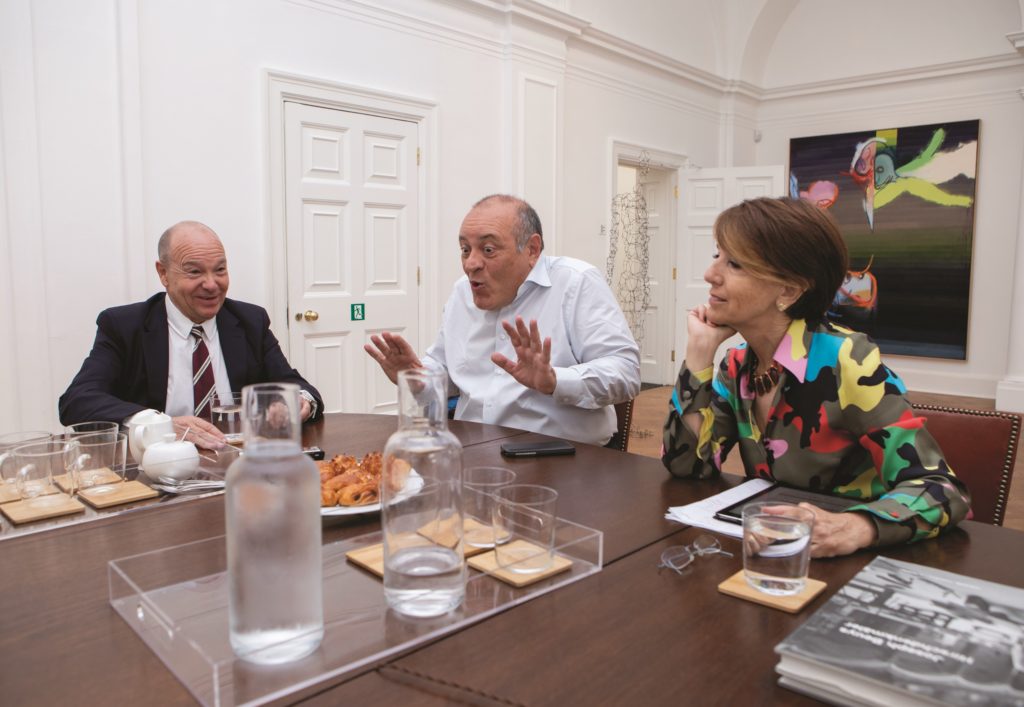
From left: Dr Paul Ettlinger, Dimitri
Daskalopoulos, Patrizia Sandretto Re Rebaudengo. Photo © David
Owens Photography.
To better understand this
critical moment, we spoke to three patrons who are each at a
different stage in their collecting careers: Patrizia Sandretto Re
Rebaudengo of Turin, Dimitris Daskalopoulos of Athens, and Paul
Ettlinger of London. The trio met one recent morning in Mayfair
over coffee and pastries to discuss the rise of private
collector-run museums, changes to the art market (and how they
negotiate them), and the future of their own collections at a time
of increased scrutiny of private collectors.
New collectors entering the market today often complain about
not getting access to the work they want. They may have the money
to buy it, but if a gallery doesn’t know them, they are unlikely to
get the opportunity. What was it like for you when you first
started collecting?
Patrizia Sandretto Re
Rebaudengo: When I started in the 1990s, the market was
very slow. I remember coming to London and all the galleries were
so friendly and welcoming—they introduced me to artists, they took
me to their studios. I’m not sure if it’s the same if you start to
collect now and a gallery doesn’t know you.
Paul
Ettlinger: It might
be similar if you’re collecting very young artists from younger
galleries, because they’re looking to establish relationships with
collectors who are going to buy that artist’s work in depth. But if
you’re going for a more established contemporary artist, unless you
have an advisor or unless the gallery knows you, it is quite
difficult to walk in off the street and just buy art, regardless of
how much money you have. At the very beginning of my collecting, my
advisor gave me access to galleries, and that was really important
because in the early days I probably wouldn’t have been able to buy
what I wanted.
Dimitris
Daskalopoulos: I
had the opposite experience, because I have always bought the
things that nobody else wants, so I have always had easy access. I
had the gratitude of galleries who were able to get rid of some of
their huge installations that are so hard to sell. One of them
confided in me that when I bought a specific artwork, they opened a
bottle of champagne as soon as I left the gallery.
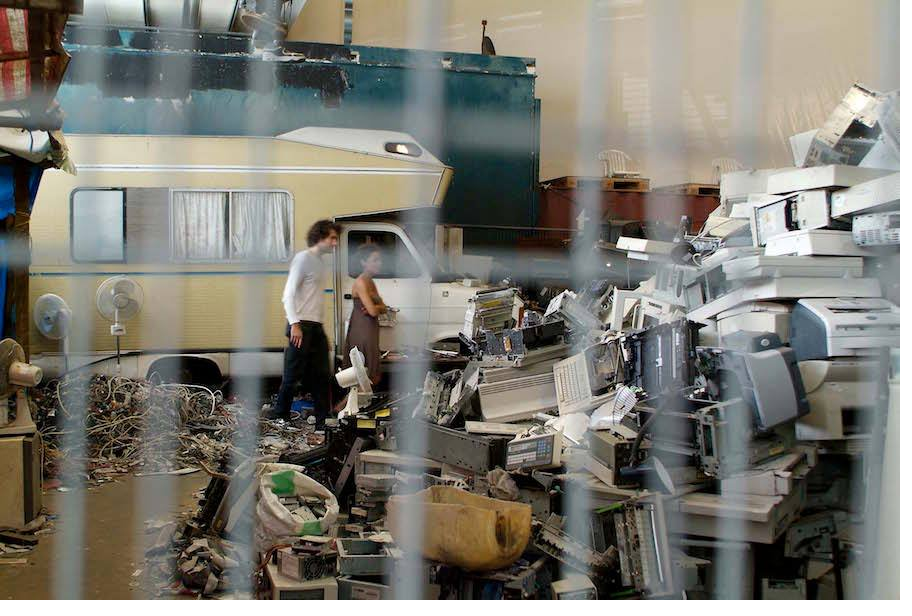
Christoph Büchel’s Unplugged (Simply
Botiful) (2007) when it was part of Art Basel’s Unlimited.
Courtesy Art Basel.
You’re one of the few private collectors I can think of who
has bought a Christoph Büchel installation.
Daskalopoulos: Which takes two containers to store. We’ve
shown it in Athens once, for a two-month period as part of a summer
festival. I’m glad we have it, but it’s very hard to
show.
And when you show it, presumably Büchel has to come and
supervise the process?
Daskalopoulos: Oh, yes—it costs more money again to put it
up.
Over the past 15 years, an increasing number of collectors
have opened galleries to show their art. Chris Dercon, the former
director of Tate Modern and now head of the Grand Palais in Paris,
has said that collectors should be supporting public museums
instead of establishing their own spaces, because they do not have
the accumulated expertise of major institutions. What’s your
response?
Re
Rebaudengo: It’s
true that many private museums have opened in recent years. And
many have already closed. Some collectors opened a space because it
was fashionable and then realized that running a gallery is not an
easy job. But I think we have to consider where these private
spaces are located. In Italy, the first national contemporary art
museum, MAXXI in Rome, opened in 2010. It was important that many
private collectors decided to establish spaces long before that,
because in many places it was the only way for the public to see
contemporary art. Maybe in cities where there are many important
museums, it’s not so necessary for private collectors to open a
museum.
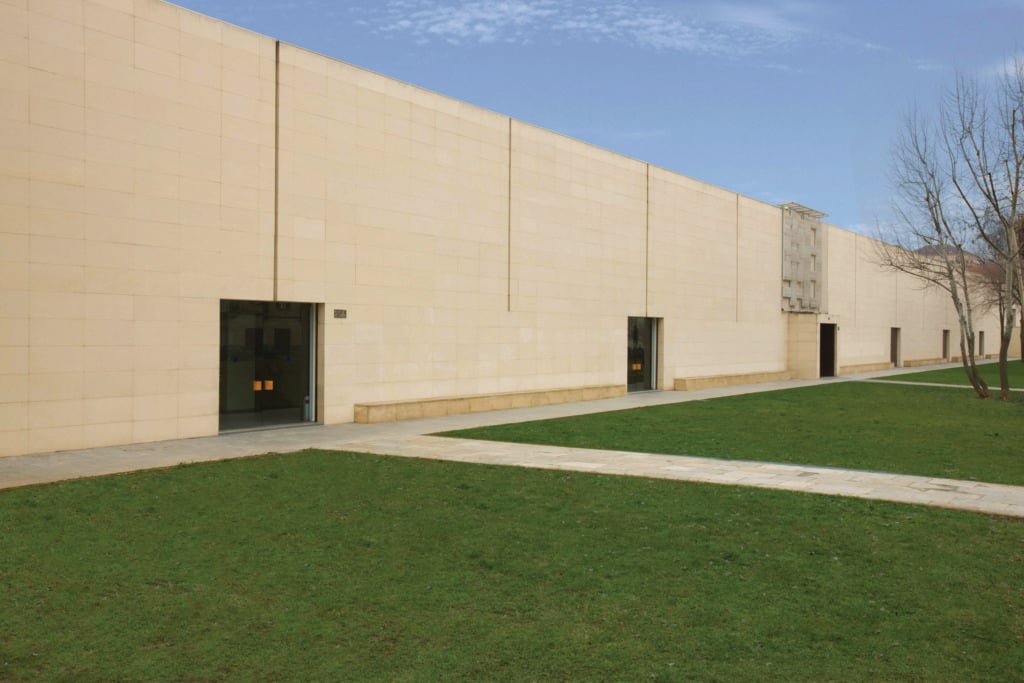
Fondazione Sandretto Re Rebaudengo,
Turin, Italy. Photo: Maurizio Elia.
Ettlinger: I don’t agree with Dercon, because many
collectors support museums and institutions while also forming
their own collections. Museums are very welcome to borrow the works
we collect, and some of us bear the expenses of that, like shipping
and insurance, when we lend to them. So, in reality, there isn’t a
dichotomy there. The more that art that can be shown in accessible
places, the better. We shouldn’t be criticizing the fact that
people want to have their art on public display. There might be a
point in asking how accessible individual private museums are. Are
they only open one day a year because they’ve been set up to reduce
one’s taxes? But that is a different point.
Daskalopolous: It’s important to point out that in Europe we
generally don’t have tax benefits for giving art to museums or
opening foundations—in fact, we have tax burdens. When you give
something worth €10,000, for example, to a charitable organization
or museum in Greece, you then also have to give half a percentage
point to the state as a donation tax.
Re
Rebaudengo: In
Italy, it’s the same. We don’t have any fiscal advantages. For tax
purposes, my foundation is considered a commercial activity. It’s
very expensive to run.
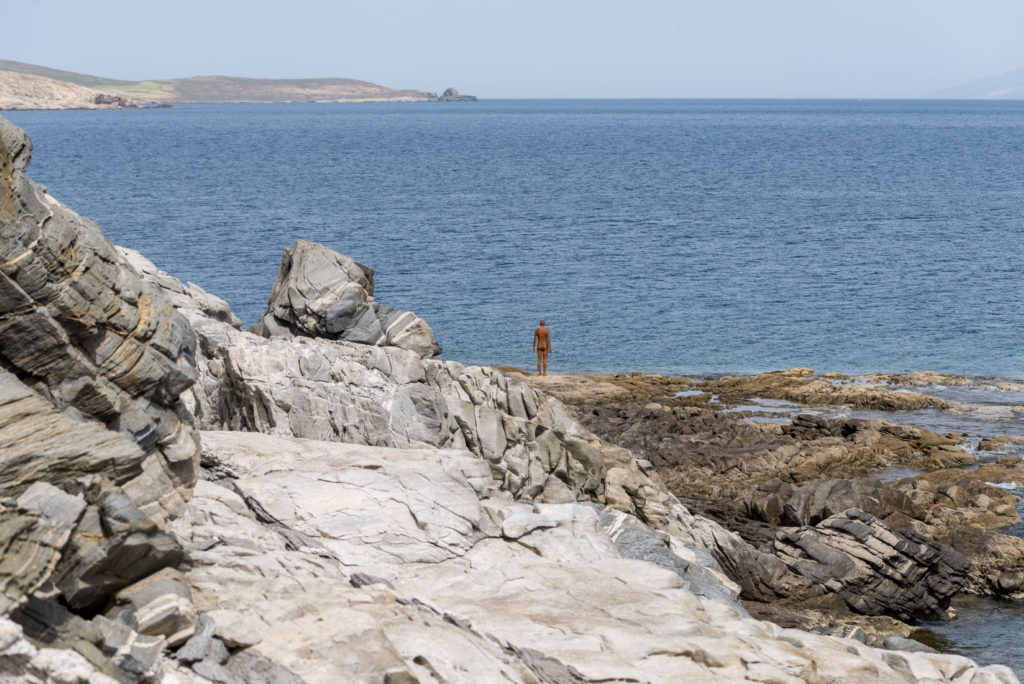
“SIGHT | ANTONY GORMLEY” Archaeological
site of Delos, 2019 | © Oak Taylor Smith | Courtesy NEON; Ephorate
of Antiquities of Cyclades & the artist.
Daskalopolous: I don’t think that it’s less expensive to
organize pop-up shows instead. My team tells me that every time we
do a project, it’s like setting up a museum and then taking it
down. For our current project on the island of Delos, we will spend
two months after the installation closes taking down 29 sculptures
by Antony Gormley. I don’t have a gallery for my collection because
I think it’s more valuable to do different projects in different
places where they are needed.
And when I think about the
future of my art in the long term, I think public institutions are
definitely much better placed to keep whatever is valuable in my
collection in dialogue with what will come in the future, and to
preserve it so it can be shown. Public institutions are much better
than any structure that we, as individuals, can leave behind. I
think I’ve created a collection which has a theme and coherence. I
don’t need to be adding to it anymore. Now I want to devote the
rest of my activity around the collection to give these artworks
and the artists who made them some kind of future.
And how will you do that? Can we expect to see some of your
works in the collection of Tate or MoMA?
Daskalopolous: Maybe, yes. Unfortunately, there are some
artworks that we as private collectors own that probably do not
have a future because they are too big to be shown or too difficult
to store, so they may stay in the dark forever. The question is:
What do we do with them? How do we work with museums or with the
artists themselves to find a destination for these
works?
Re
Rebaudengo: I think
there is a solution. In 2015, the city of Sheffield [in England]
organized a great event called “Going Public.” They invited four collectors,
including me, to show part of their collections there and then
organized two days of talks. The idea was to show works that
collectors keep in storage, or that they only loan to important
museums in major capital cities. We should start to imagine that
collectors could give their art to places like Sheffield for free.
The ownership would remain with us, but if cities like Sheffield
have spaces to display works, they could show our collections. I
think it’s important that people should be able to see the art we
own.
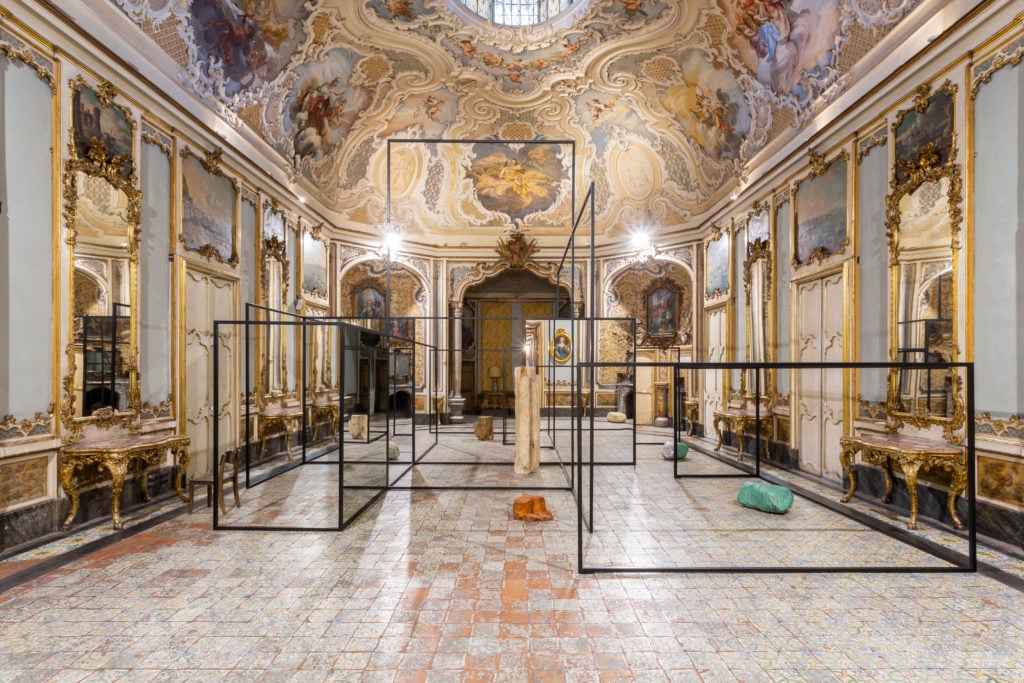
Alicja Kwade, WeltenLinie (2017),
installation view, Palazzo Biscari, Catania. On loan from Patrizia
Sandretto Re Rebaudengo.
Daskalopolous: That is the most important thing. That’s why
I’m worried about this. I am very open to lending. I consider my
collection a repository, accessible to anyone. But it’s very rare
to get loan requests for large installations. And even if you’re
willing to gift them to a museum, I think it’s sometimes a burden
for institutions, because these large works need storage and
insurance, and everybody’s money is running out.
Re
Rebaudengo: I am
also increasingly thinking about the future of my collection. I
really hope that it can remain together. Public museums have a lot,
a lot, a lot of work that they cannot show. So, in the end, to give
art to museums for them to put it in storage is not ideal. I have a
space, and I hope to keep my collection on display there. I also
have two sons who sit on the board of my foundation and are very
involved in art, so I’m quite positive about my collection’s
future— although you never know what will happen in the long
term.
Paul, would you like to open a space?
Ettlinger: Yes, sooner rather than later, although I
suspect it’s going to be later. I would love to have a space where
we have our works out of storage. We do show the art in our home to
family, friends, and visitors and organize evenings with artists,
and we very much enjoy this. We looked at a former printing
facility in Margate as a potential home for the collection, but if
I’m going to put my works on public display, I want to have easy
access to them so I can go and see them—that’s part of the passion
for me. I don’t want to have to get on a train.
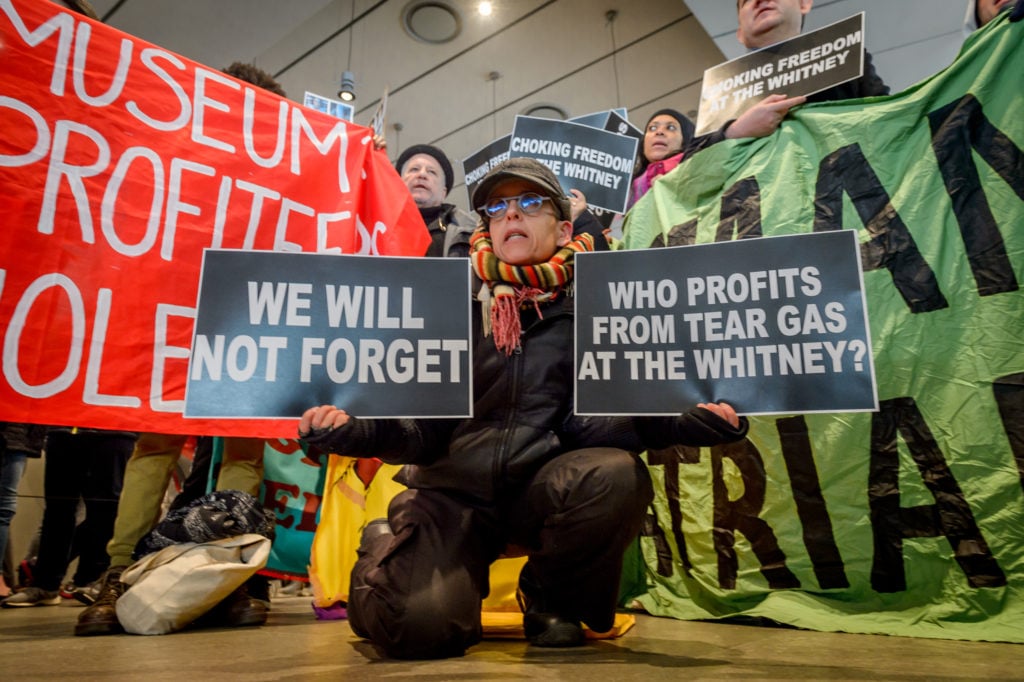
Activists took over the lobby at the
Whitney to protest Warren B. Kanders. (Photo by Erik
McGregor/Pacific Press/LightRocket via Getty Images)
A major shift we’ve seen over the last 18 months is the way
that museum benefactors are being scrutinized, from the Sacklers to
Warren Kanders at the Whitney, and the way institutions are
systematically being pressured to sever ties with patrons who are
deemed problematic. Do you think this will put rich people off from
donating to museums?
Daskalopolous: Is there such a thing as purely clean money?
How do we define that? If we open this discussion, what mechanism
will we establish to define what clean money is?
The discussion is open, so the question is: How do museums
respond to it?
Daskalopolous: The thing I fear about people in important
jobs, needing to respond very quickly under the pressure of
activism and social media is that we will enter a climate of
fear—fear of doing anything new, for example—because we’re trying
to be too correct in everything. This will stifle creativity. I
think what is wrong with all this is that these activist groups are
too quick to make too big a fuss without actually proposing a
solution or an alternative for the problem at hand. They are also
outsourcing their cause, which is something I totally disagree
with.
What do you mean by that?
Daskalopolous: I mean that instead of directly targeting what
they are against, they put sensitive intermediaries like museums in
the [firing line] to blackmail them into doing something that they
hope will bring about the good cause they’re campaigning for. They
don’t realize that they may be depriving themselves and their peers
of the benefits of money that has ended up being used for good
causes and for the public.
Ettlinger: I slightly disagree with that. Because you
could be saying that it’s acceptable to launder money: “If you do a
bad thing but then later do a good thing by donating money to a
museum, it makes up for the bad thing you’ve done.” But it’s a
complicated issue. We all know about the scandal of opioids in
America today. But at the time the Sacklers gave money to museums,
we were not so well informed, and that money was accepted by
museums in good faith.
Do you think this increased scrutiny will stop people from
donating to museums?
Ettlinger: Almost certainly. If people have something to
hide, they will think twice about donating. But maybe that’s not a
bad thing. Maybe this is where private museums come in. Maybe these
individuals will set up their own private museums
instead.
Daskalopolous: It goes beyond individuals donating to museums.
With some corporations, for example, the objection about accepting
their money is that they do not do enough for a specific cause, a
good cause that is dear to the public, such as climate change. What
is enough? Who defines it? If, as a corporation, you suddenly
decide, “We’re not doing enough—we’re going to double what we’re
doing,” will that be enough? Climate change is very important for
all of us, and certainly we’re not doing enough, because we have
not solved the problem. But let’s not destroy other good things in
society because we have a good cause to advance. If donors become
afraid and stop giving money to museums, who is going to lose? The
public. So in pursuing a good cause, we’re maybe doing wrong
somewhere else. Activism and idealism are useful in pushing us to
do more and sooner. But in themselves, they should not be judgment
mechanisms or justice mechanisms.
Let’s turn to the workings of the art world, and the market
in particular. You have all been buying art for many years. Are
there some aspects of the market that you find antiquated and
unprofessional?
Ettlinger: It would be helpful to have more understanding
of how galleries work and how they pay their artists. A young
artist recently told me he’s not expecting to get paid by his
gallery for works of his that it sold. I was quite saddened by
that, and I think there’s sometimes a problem with the way
galleries and their artists handle their relationships; it seems as
if some of them don’t have written agreements. Maybe that’s why we,
as collectors, need to look after the artists whose work we collect
and help them so that they feel supported.
Re
Rebaudengo: Everything in the art market happens so quickly
now. The day before a fair opens, galleries send us PDFs of all the
works that will be for sale there. If you don’t immediately call or
email the gallery and say, “I want this,” then when you arrive at
the fair they’ll tell you, “I’m sorry, it’s sold.” Before, we had
the time to think about a work, discuss it with our advisor. Now,
there’s no time.
Daskalopolous: I think the fundamentals of the art market have
never changed. We are talking about creativity that there is no
objective value to. We are talking about a market that’s based on
intelligent people deciding to put their money somewhere of their
own free will with a handshake. These fundamentals have never
changed and never will. It is unorganized, it is inexplicable, but
it keeps happening. If I feel sometimes I’ve overpaid for
something, I would not blame anyone but myself. I would never go
back to the gallery and say, “You overcharged me.”
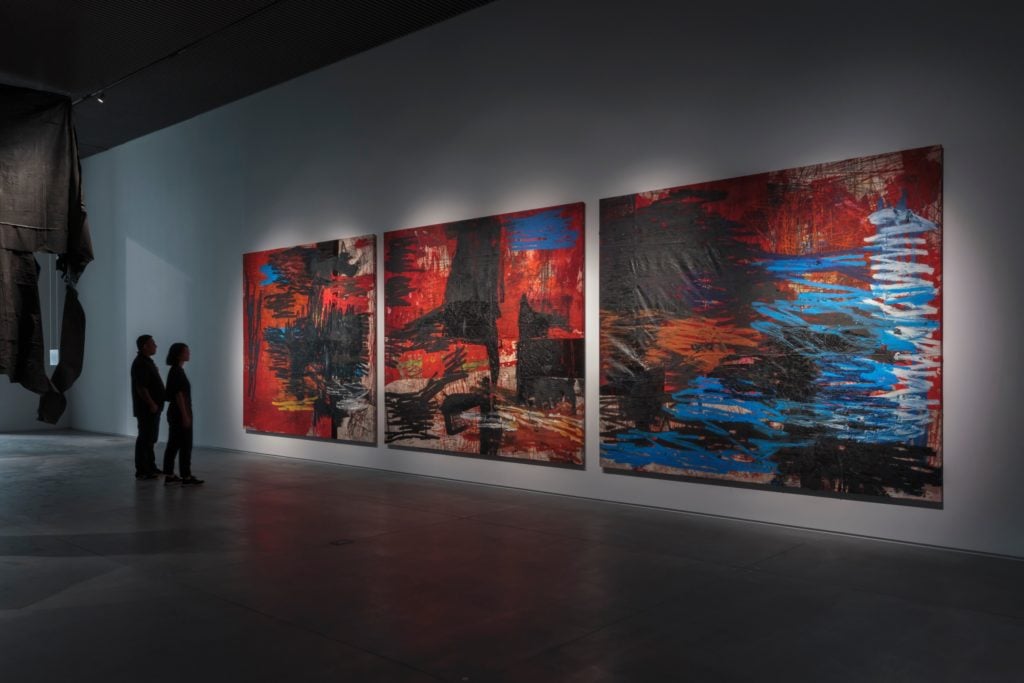
Installation view of “Oscar Murillo:
Collision/Coalition” at the Shed. Photo: Stan Norten, courtesy
David Zwirner.
One of the things people complain about in the art market
today is the speculators, who buy just so they can flip work and
make a profit.
Daskalopolous: Again, I say it’s a free market with
intelligent players acting of their own free will buying and
selling art. We have organized stock markets to speculate legally,
so we shouldn’t be surprised that people do it in the art
market.
It’s not great for the artists.
Daskalopolous: That is something we need to correct. We should
find a way for artists to benefit from secondary sales. I know some
people who say that when they resell art they give a portion of the
profit to the artist.
Re
Rebaudengo: You say
the market has not changed, but it’s a lot bigger than it used to
be. In the 1990s, it was much smaller, and prices were not like
they are today. If you collect the work of young artists, as I do,
the market has changed quite a bit, because today some of these
artists are invited to join important galleries at the beginning of
their career, and this can be problematic. The moment of
speculation is not when the artist joins Zwirner or Gagosian, it’s
when rumors start circulating about a particular artist’s joining a
large gallery. This is the moment in which collectors can buy their
work for a good price and you can make a lot of money. Take Oscar
Murillo. You could buy his work for just a small amount of money
before, and now that he is with Zwirner, prices have more than
doubled.
Daskalopolous: Yes, but how many collectors have bought work
by young artists and then the work never went anywhere? There are
countless cases. The press only writes about the success stories,
not the multitude of unsuccessful ones. There are a lot of ways to
influence some artists’ prices upwards, but in the end, I think it
has been proven throughout the centuries that the art that lasts
and becomes valuable over time is the better art.
Re
Rebaudengo: We do
have to think about what happens when artists leave the small
galleries that supported them at the beginning of their careers.
This is a very big problem. In the [European] football world, when
a young player moves to another team, there is a transfer fee
payable to the team he is leaving. In the art market, there are no
transfer fees—so if you are a young gallerist, you lose out. Maybe
you’re lucky because you have some works by the artist in storage
so you can benefit from the price rise: But if you don’t, you’ll
lose everything you worked for.
Ettlinger: I agree. I have often thought there should be
transfer fees paid by big galleries to smaller ones, but it is also
up to the artist to ensure fairness exists. However, big galleries
can dictate their own terms. In Oscar Murillo’s case, even though
he joined Zwirner, he does still work with the smaller London
gallery Carlos/Ishikawa, which has been with him since the
beginning.
Daskalopolous: So the art market should function more like
soccer?
Re
Rebaudengo: Yes.
How many young galleries have closed? They started with artists
that are well-known today, yet the gallery that discovered them is
unable to continue to operate. It’s also not good for the artists
to join a big gallery when they are too young, because when you’re
in a small gallery, you can experiment, you can fail, you can grow.
When you’re with a big gallery, you have to constantly prove that
you are good. Auctions can also be a problem. When I started buying
art, it was mainly Impressionists that were selling at auction. Now
young artists are there too, and it’s rarely good for them. In the
primary market, your work might be selling for €50,000 and then,
six months later, your work is suddenly selling for €500,000 at
auction—and then what happens? How do you ensure people don’t buy
your work from the gallery just to flip it at auction? This is also
a very big change.
ABOUT THE
COLLECTORS
Patrizia Sandretto Re
Rebaudengo
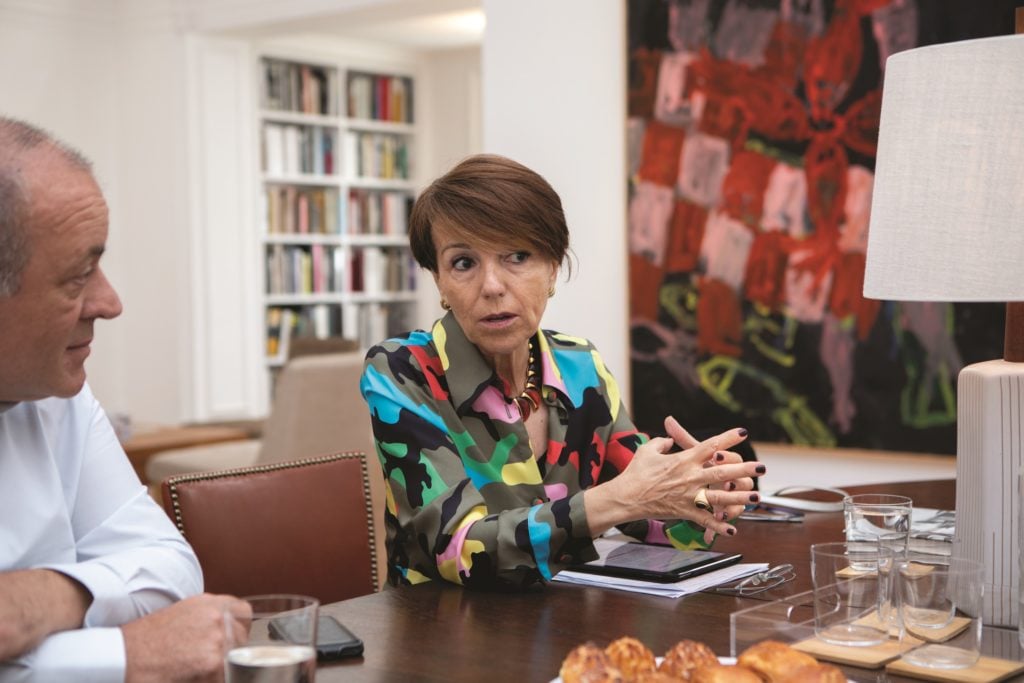
Patrizia Sandretto Re Rebaudengo. Photo:
© David Owens Photography.
Patrizia Sandretto Re Rebaudengo
began buying art on a trip to London in 1992. Just three years
later, she established a foundation to support young artists with
her businessman husband, Agostino, scion of an aristocratic
Piedmontese family. Today, she operates two spaces for her
collection and programming: one in an 18th-century
palazzo in Guarene, 30 miles southeast of Turin, and one in the
city itself. A keen commissioner of new art, she is also a generous
lender of works from her 1,500-piece collection, which includes
major pieces by Ian Cheng, Josh Kline, and Lynette Yiadom-Boakye.
She has also amassed a trove of some 3,000 photographs, ranging
from historic images of Italy and early daguerreotypes to the work
of Cindy Sherman.
Dimitris
Daskalopoulos
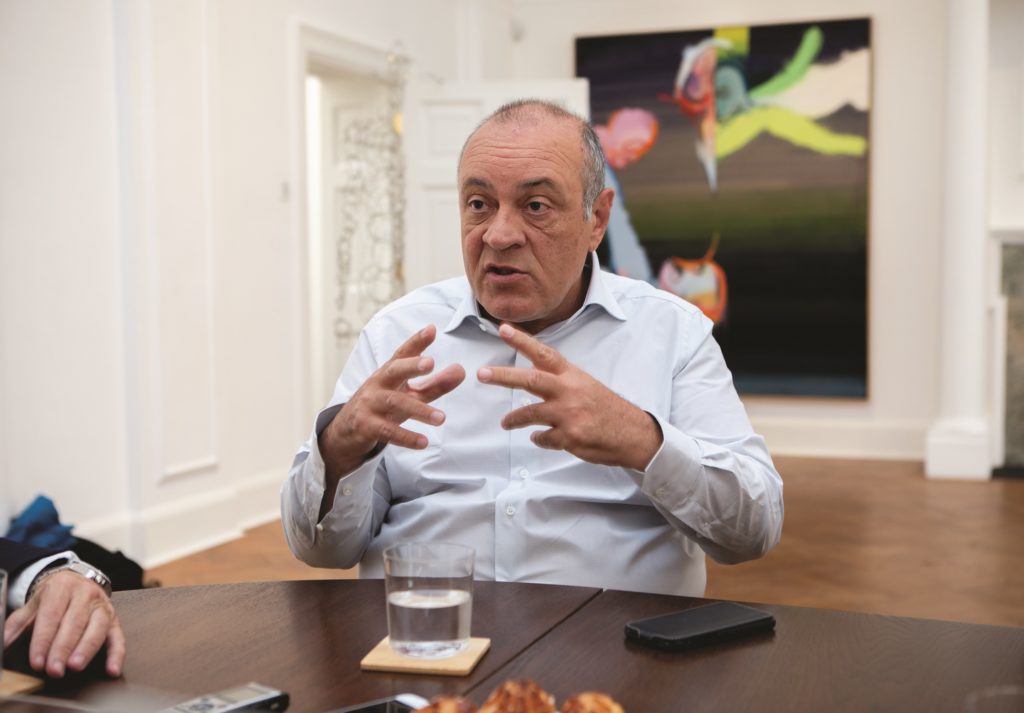
Dimitri Daskalopoulos. Photo: © David
Owens Photography.
Dimitris Daskalopoulos, a Greek
entrepreneur who founded and runs the financial services and
investment company DAMMA Holdings SA, has been collecting
contemporary art for around 25 years and owns some 500 works. He
favors large, difficult installations such as the Swiss-Icelandic
artist Christoph Büchel’s
5,000-square-foot Unplugged (Simply
Botiful) (2007),
which contains a bar, sleeping areas, and vast mountains of
junk. In 2013, he launched
NEON, a foundation that organizes pop-up art shows around Greece.
(The organization recently placed 29 sculptures by Antony Gormley
on the uninhabited island of Delos.) He has shown his collection at
the Whitechapel in London, the National Galleries of Scotland, and
the Guggenheim Bilbao. He serves as vice president of the board of
the Solomon R. Guggenheim Foundation in New York.
Paul
Ettlinger
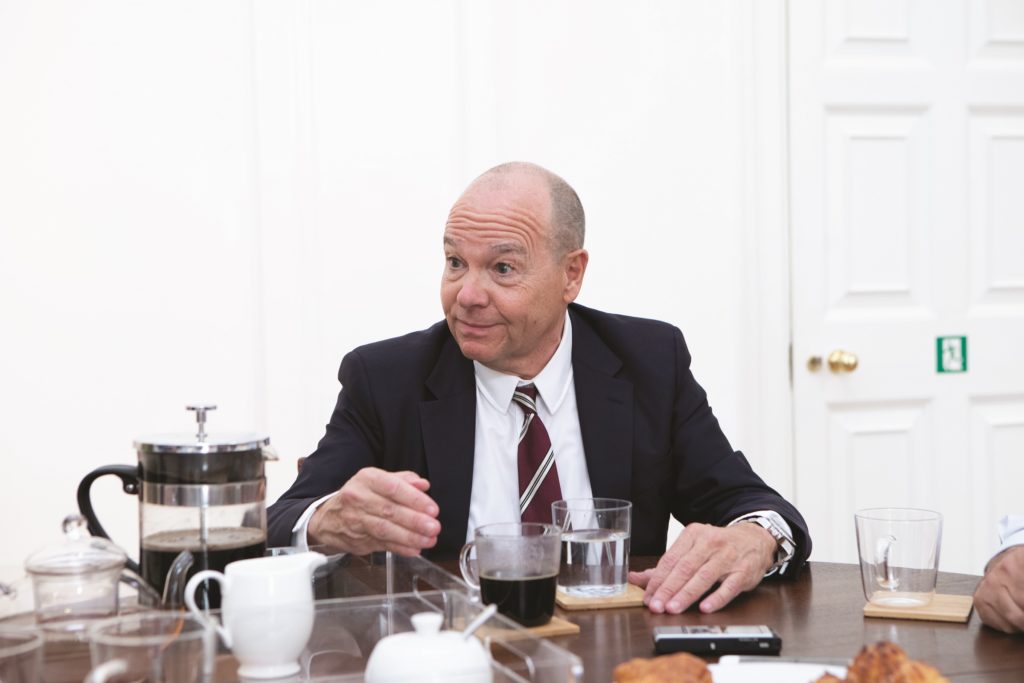
Dr Paul Ettlinger. Photo: © David Owens
Photography.
Paul Ettlinger, a British doctor
who founded and works at the London General Practice and the London
Global Practice in Harley Street, has been collecting contemporary
art for around 10 years, with a particular focus on the work of
young, emerging artists. An early collector of the work of the
Colombian artist Oscar Murillo, he helped fund a show of the
artist’s work at the South London Gallery in 2013. Ettlinger’s
250-piece collection also includes work by such established artists
as Sarah Lucas, George Condo, Rebecca Warren, and Isa
Genzken.
This story originally appeared in the fall
2019 artnet Intelligence
Report. To download the full report, which has juicy details on
the most bankable artists, a guide to the market for contemporary
African art, and a look inside the shrinking business of auction
guarantees, click here.
The post The Business of Being an Art Collector: A
Roundtable Discussion With Three Top Patrons About How the Pursuit
Has Changed appeared first on artnet News.
Read more https://news.artnet.com/art-world/collector-roundtable-1663849
Further reading


Leave a comment