
The Formidable Artist Christo Has Always Dreamed of Wrapping the Arc de Triomphe in Fabric. What’s It Like to Have That Dream Come True?
He can slip from people’s minds,
and years may pass between the realization of major works. But in
one way or another, most corners of the planet have been touched by
the remarkably talented hand of Christo.
The Bulgarian-born artist
Christo Vladimirov Javacheff has spent more than 50 years making
spectacular temporary fabric-wrapped monuments that have captivated
imaginations the world over. But he says he never thinks about the
impact he has on the younger generations of artists. It’s a modest
reply from someone whose legacy is as formidable as his: Christo
was among the first to abandon the traditional gallery space and
take his art to far-flung places ranging from the Australian
coastline to the German parliament. He draped curtains across
valleys, floated them over islands, and weaved them around
bridges—nothing seemed unconquerable.
But he’s not particularly
interested in recounting the past. “I don’t like to look back,” he
tells me at his home in Tribeca.
Still, he is going to
anyway—although it’s unclear when. The opening of the Centre
Pompidou’s exhibition “Christo & Jeanne-Claude, Paris,” dedicated
to the artist and his late collaborator wife, has been indefinitely
postponed due to the ongoing global health situation. Nevertheless,
Christo is still swamped with work. If all goes well, the
Pompidou’s “ghost show,” as the French press has now dubbed it,
will be topped off with one of the most anticipated public art
events of the year: Christo wrapping the Arc de Triomphe between
September 19 and October 4.
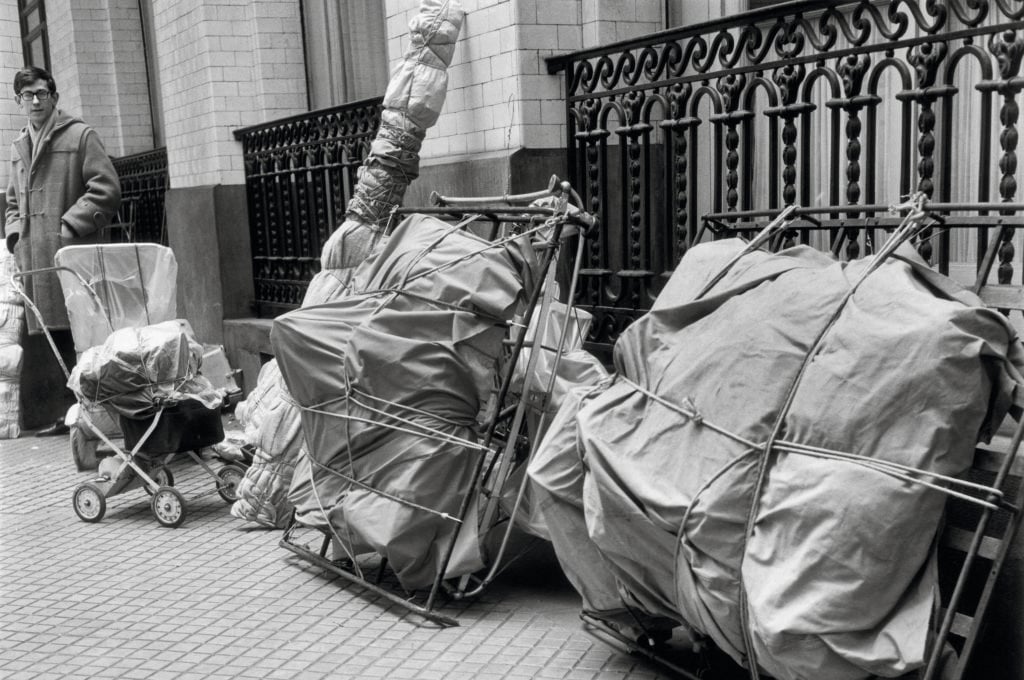
Christo with his recent works in the
courtyard of 4, avenue Raymond-Poincaré, Paris, 16th arr., 1962. ©
Christo 1962. Photo © Shunk-Kender. © J. Paul Getty Trust. Getty
Research Institut, Los Angeles.
The Nomad
Despite his professed antipathy
for retrospection, Christo does reminisce throughout our animated
discussion. We meet in a casual reception room inside the
multi-story building he has owned since 1964 and used to share with
his wife. He calls it the
“brain of the project,” referring to all of the major artworks he
and Jeanne-Claude conceived and produced there. Christo
charismatically bubbles over with information about his life and
work in broken English mixed with a spattering of French
and—despite being in poor health—little regard for the passing
time.
Alternating between bellows and
whispers, the 84-year-old’s eyes widen within his lanky frame as he
refuses to answer simple questions with simple answers. After
escaping communism in Bulgaria, a country behind the Iron Curtain
at the time, Christo headed to Western Europe in 1957 by hiding in
a freight car. It’s little wonder that he doesn’t bother with
confines of any sort. He notes that, even today, he has not yet
decided if he’s a painter, an architect, or whatever other word one
might use to describe him.
Eventually he arrived in Paris,
where he lived between 1958 and 1964. He survived there by painting
portraits of socialites while making smaller, wrapped objects using
fabric and twine in his spare time. (“I am an educated Marxist,” he
says. “I use the capitalist system to the very end… It’s
economical, clever, and it’s stupid not to do it.”)
It was in Paris where he met
Jeanne-Claude Denat, who became his wife and collaborator until she
died in 2009. Denat, who was commonly known as Jeanne-Claude,
helped Christo scale up and realize larger projects; her spirit is
alive in the Pompidou show, which covers these early Parisian
years, including the duo’s wrapping of the Paris bridge Pont Neuf
from 1985.
To understand Christo’s work,
the former refugee says that he sees all the projects the two
undertook over the years as ultimately marked by nomadism. “The
cloth is the principal element to translate this,” he says. “The
projects have many sturdy parts, but the fabric is very fast to
install, like the tents of Bedouins in nomadic tribes.”
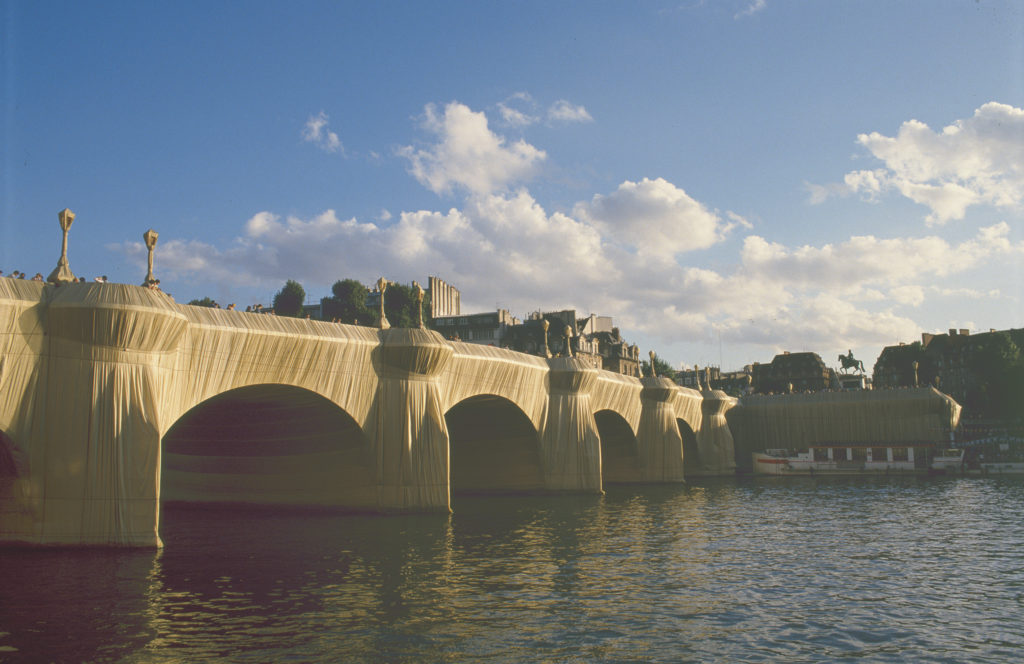
The Pont-Neuf Wrapped, Paris,
1975–85. © Christo 1985. Photo © Wolfang Volz.
Wrapping the Arc
On the periphery of several art
movements like New Realism and Land Art, Christo’s reputation
nevertheless began to grow when he illegally blocked the narrow rue
Visconti street in Paris in 1962 with Wall of Oil Barrels – The Iron
Curtain, a work
consisting of 89 oil barrels stacked 4.3 meters (14 feet) high to
protest against the building of the Berlin Wall. Years later,
projects like The
Gates, which was
installed in Central Park in 2005, saw some 7,500 saffron-colored
vinyl panels hung over the park’s walkways like an elevated river.
Overnight, it made the duo world-famous.
Another gate of sorts, the Arc
de Triomphe, will be transformed and remain only as an outline once
its wrapped up this fall. “It’s built on a colline [hill], an elevation. This provides an enormous
and unique perspective,” says Christo, who stands up, a bit short
of breath, and points to details in one of his larger drawings of
the monuments. “During the funeral of Victor Hugo, it was covered
with black fabric, like a veil,” he says.
At the time of our meeting,
Christo is furiously working to complete drawings of the new
project site, sketches which hover between technical and
architectural studies. “When you leave, I’m going upstairs to
draw,” he tells me. “That is really the only place where I’m alone.
I don’t see anybody [when I am] thinking how to
solve.”
He does have some complex
problem-solving to do. The Parisian archway will be veiled with
30,000 square meters (323,000 square feet) of recyclable
polypropylene fabric in silvery blue, and 7,000 meters (23,000
feet) of red rope. The timing is planned to protect nesting
falcons, and Christo is covering all costs, which are estimated to
be upwards of €12 million ($13 million).
This “very important gate,” as
Christo calls the Arc de Triomphe, is a project that he says he has
been imagining since 1961 while living in a small maid’s room not
far from the monument. He admits he “never expected” the project
would ever come to fruition. “The site is so powerful. The Arc has
an incredible light and history… It cannot be substituted,” he
tells me. “We don’t just wrap things; we don’t wrap Eiffel Tower,
or the Sacré Coeur. We wrap something profound.”
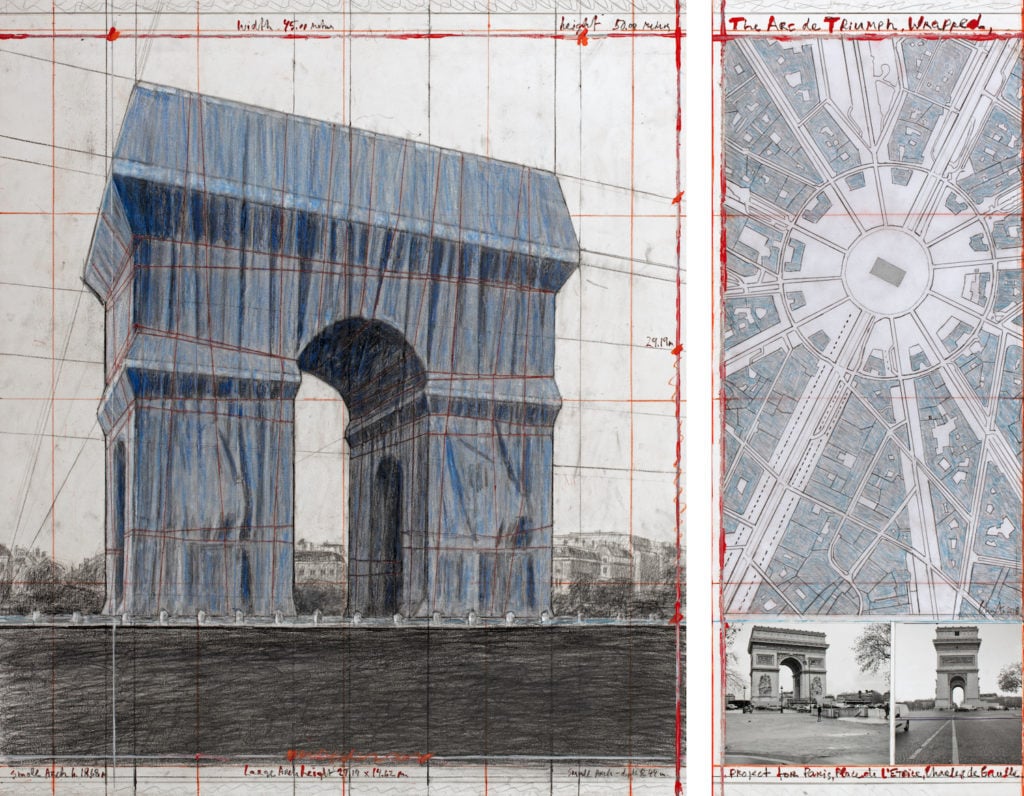
Christo The Arc de Triumph (Project
for Paris, Place de l’Etoile – Charles de Gaulle) Wrapped.
Photo: André Grossmann. © 2018 Christo.
Real Life, Wrapped Up
Overt political messages, like
his Iron
Curtain of barrels, are
rare for Christo. If a message comes across, that’s because,
according to him, the works puncture the art-world
bubble.
“The Reichstag was very
political project, but I don’t do it for the politics. It’s not
illustration of politics, it’s real politics; real debate in the
parliament [over whether to permit the German parliament’s
wrapping] … It’s not about filming water, it’s about the real water
with real wind and real cold!” he says, adding that he cannot stand
“television images, because they’re not real.”
These are not performances, he
points out, though his final artworks are temporary events; they
are instead sculptures that cannot be owned. In that regard, he
thumbs his nose at the art market (at least, he does with respect
to his grandiose final productions—preparatory drawings and
materials from the productions are for sale through his dealer,
mega-gallery Pace).
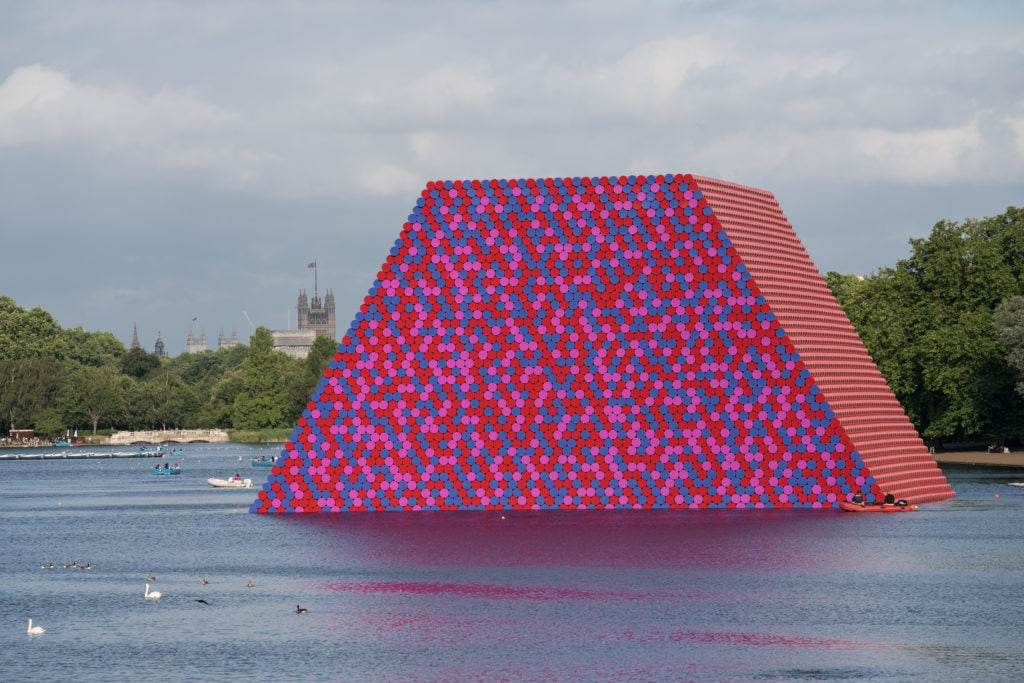
Christo and Jeanne-Claude, The London
Mastaba, Serpentine Lake, Hyde Park (2016-18). Photo by
Wolfgang Volz. © 2018 Christo.
Christo’s works require an
outrageous investment of both time and money. First, he must gain
building permission and set up independent financing schemes. The
duo has always refused to work on commission; so Christo foots the
bill by incorporating himself. “For each project we have thousand
people who try to help us, and thousand people who try to stop us!”
he cries.
That is particularly true for
concerns about the environmental impact of his work. The political
conversation has come a long way since Christo wrapped 2.4
kilometers (1.5 miles) of the Australian coast near Sidney with
synthetic erosion control fabric in 1969. But in 2017, Christo
delighted some animal-rights groups when he called off a planned
project to suspend polypropylene fabric over nearly 9 kilometers (6
miles) of the Arkansas River in Colorado. Despite already having
approval, Christo cancelled the project because he did not want to
work with the country’s new “landlord,” Donald Trump.
Disasters have happened, too. A
485-pound umbrella from Christo’s 1991 project
The Umbrellas
flew out of its base and killed a
woman in California. At the time, Christo expressed his sadness and
said he would dedicate a book and film about the project to the
victim, 34-year-old Lori Keevil-Mathews. A second death occurred
during the removal the umbrellas piece from its second location in
Japan, when a worker was electrocuted while manipulating a
crane.
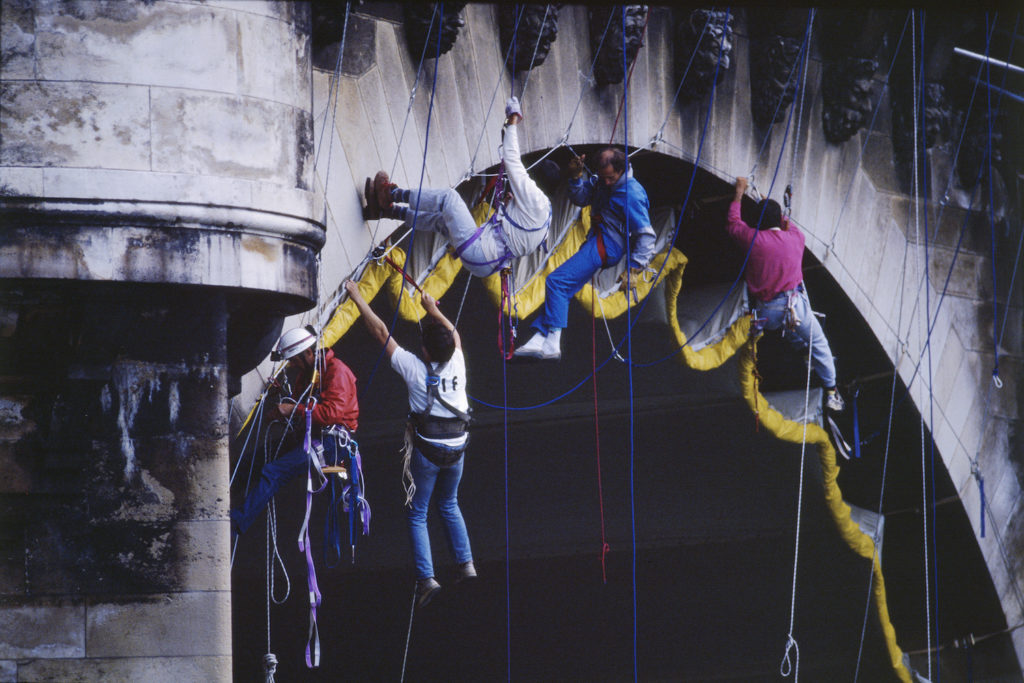
Climbers attach the fabric hoisted under
one of the arches and adjust the tension of the straps sewn onto
the fabric, making it hug the lines of the vault. © Christo 1985.
Photo © Wolfang Volz.
Beyond horrible tragedies,
public debate is nevertheless integral to Christo’s artistic
endeavor. He insists that “the work of art is revealed through the
process of gaining permission.” Many attempts have failed. Despite
Jean-Claude’s skills as a fantastic negotiator, of the 23 projects
made over 50 years, there were 47 that could not be
realized.
Though most projects required
years of jumping through bureaucratic hoops, the Arc de Triomphe
plan was swiftly approved within about a year, “thanks to young
president,” says Christo. But when asked if this was a sign of
greater understanding and acceptance of his work in France, he
interjects with an unequivocal no.
“All our projects are totally
irrational, totally useless. Nobody needs them. The world can live
without them. They exist in their time, impossible to repeat,” he
says. “That is their power, because they cannot be bought, they
cannot be possessed… They cannot be seen again.”
Considering his age, the latter
may be true of his brilliant temporary craft in general. Nothing
lasts forever. The Arc de
Triomphe and ambitious
endeavors like it could be among his final projects. Not that he
shows any sign of slowing down too soon. The difficulty and the
complexity he seems to endure now has always a part of the beauty
of his work. “We are not masochists,” he adds, still referring to
Jeanne-Claude as his partner. “We would like the easy way, but the
reality is, this is how it has to be done.”
The post The Formidable Artist Christo Has Always Dreamed of
Wrapping the Arc de Triomphe in Fabric. What’s It Like to Have That
Dream Come True? appeared first on artnet News.
Read more https://news.artnet.com/art-world/christo-pompidou-arc-de-triomphe-1812408
Further reading


Leave a comment