
The Gray Market: What Artists Could Learn From Pop Star Taylor Swift’s Battle With Her Former Record Label (And Other Insights)
Every Monday morning, artnet
News brings you The Gray Market. The column decodes important stories from the
previous week—and offers unparalleled insight into the inner
workings of the art industry in the process.
This week, asking if art stars
could learn from a pop star…
BAD BLOOD
On Monday, after polarizing
pop supernova Taylor Swift took to Twitter to tell
her fans she might be unable to perform a career-spanning set at
the upcoming American Museum Awards due to a dispute with her
former record label, the Hollywood
Reporter relayed
that Big Machine Label Group would grant all necessary licenses for
the performance after all. But the broader rift between Swift and
her former label—which has resulted in both death threats and
comments from presidential
candidates—could open up a radical option for contemporary
artists who want to capitalize on their own resale
markets.
For the uninitiated, this volcano erupted after Scooter Braun,
the powerful music manager whose clients include Justin Bieber and
Ariana Grande, acquired Big
Machine Label Group earlier this year for a reported $300 million.
The deal gave Braun’s Ithaca Holdings control of the group’s full
slate of current contracts and past releases, including the master
recordings (or just “masters,” in industry speak) of Swift’s first
six multiplatinum albums, which she made with Big Machine Records
through a contract she signed as a teenager. (Big Machine is the
namesake, but not only, label in the group.)
Aside from Swift’s longstanding antipathy for Braun and, more
recently, Big Machine Label Group president Scott Borchetta, it was
the acquisition of Swift’s masters that ignited what the
New York
Times’s (essential)
Popcast dubbed “the pop music civil
war of 2019.” (Click
through for more background; like eating a fresh mango with only
your bare hands, it’s juicy, but complicated.) And it is Swift’s
unorthodox attempt to regain control of her old work that chefs up
food for thought for star-level painters, sculptors, and other
artists working in traditional media.
![Andy Warhol, Double Elvis [Ferus Type] (1963). Courtesy of Christie's Images Ltd.](https://news.artnet.com/app/news-upload/2019/05/double-elvis-new2-660x1024.jpg)
Andy Warhol, Double Elvis [Ferus
Type] (1963). Courtesy of Christie’s Images Ltd.
I KNEW YOU WERE TROUBLE
Now, the business of music is arguably just as arcane and
potentially exploitative as the business of fine art, if not more
so. For efficiency’s sake, here are the absolute basics you need to
know to understand Swift’s potential relevance to the art
market.
A record makes money through royalties, which have to be paid
anytime the record gets purchased (as a hard copy or MP3), played
or performed in a public setting (including on the radio, in a
sports arena, or at another artist’s concert), or used as a
soundtrack for moving images (meaning in a movie, TV show, or
commercial).
The key is that different royalties are worth different amounts,
and they go to different parties based on who holds which form of
copyright on a record. (Again, it’s complicated, but here’s a
primer
on music royalties for my fellow
knowledge maniacs.)
The most valuable copyright, literally and figuratively, belongs
to whoever owns the masters—the original, finalized recordings that
all other copies are made from. (Obviously, the notion of “copies”
gets a little squishy in the streaming era, but suffice it to say
intellectual property attorneys have been paid obscene amounts of
cash to figure out answers.)
When you own the masters of a record, you get the final say in
how that record can be licensed out in the world, and you get the
meatiest royalties from those licensing deals. And in a classic
example of pro-management standard-setting, the masters normally
belong to the person who financed the recording of the music, not the person who
wrote or performed it—meaning, almost invariably, the record label.
Prince put this arrangement in the most bracing terms during a dispute
with his then-label,
Warner Bros., in the ‘90s: “If you don’t own your masters, your
master owns you.” (He also memorably took to scrawling the word
“slave” on his face before public appearances during this
stretch.)
In essence, then, the recording industry has been designed to
operate so that artists normally don’t receive the most lucrative
part of the upside when their careers take off. Why? Because
someone much richer owns the valuable physical manifestations of
their talent, which can be resold to the highest bidder—sometimes for tens, even hundreds, of millions
of dollars.
Is this starting to sound familiar? Would it help to think back
to, I don’t know, the over $1.1 billion in New
York auction sales at Christie’s, Sotheby’s, and Phillips earlier
this month, all of which
went to private sellers, dealers, and the houses thanks to
America’s lack of an artist resale royalty right?
"background: #FFF; border: 0; border-radius: 3px; box-shadow: 0 0 1px 0 rgba(0,0,0,0.5),0 1px 10px 0 rgba(0,0,0,0.15); margin: 1px; max-width: 540px; min-width: 326px; padding: 0; width: calc(100% - 2px);">
View this post on Instagram
#deflationarypolicy
#ifiliveauction #nofilter
BETTER THAN REVENGE
It is from this wormhole linking the music industry and the art
industry that, surreally, Taylor Swift emerges with a plan that may
be useful to both.
In August, Swift confirmed in an interview with
CBS that, starting in
November 2020, she will exercise a clause in her contract that
allows her to re-record the first five albums she made with Big
Machine. (Reputation, the sixth and final record released through
her old label, seems to be ineligible.)
Crucially, Swift herself will own the masters of the re-recorded
albums, giving her the power to effectively replace nearly all of
the songs now controlled by Braun and Big Machine—and to
redirect the accompanying royalties into her own pocket.
Swift’s strategy begs a question: Could commercially successful
artists claim a new measure of control over their market by
remaking some of their valuable earlier works?
There is precedent for this conundrum in the art world. In 2014,
artist Wade Guyton’s glitchy canvases, often made by disrupting the
functions of large-format printers, were an auction-market
sensation. The heat led Loic Gouzer, then rising through the ranks
at Christie’s, to include Guyton’s Untitled (Fire, Red/Black U)
(2005) in the first and most
infamous of his themed sales, “If I Live I’ll See You Tuesday,” at
an estimate of $2.5 million to $3.5 million.
Apparently not thrilled with his work going under the hammer,
Guyton became something of an art-world folk hero by Instagramming a series of photos showing his studio
continuously printing additional versions of the painting from the
master file. He even trolled Christie’s in the captions with
hashtags like #ifiliveauction, #deflationarypolicy, and
#firestormtopurify.
The message seemed clear: auction the painting if you want, but
I’ll devalue the crap out of it by retroactively reducing it from a
unique work into a potentially unlimited edition.
However, to my knowledge, Guyton’s retaliation deviates from
Swift’s in one crucial way: he didn’t monetize the new versions of
Untitled. (I wrote to his New York gallery, Petzel, to
try to confirm whether the canvases were destroyed, and a
spokesperson replied that
Guyton was unavailable to comment.) His mass-printing barrage could
have only obliterated value for someone else, not recaptured it for
himself.
Yet another, closer parallel to Swift’s strategy re-emerged from
the depths of art history last week: the one and only Jasper Johns,
all the way back in 1964.
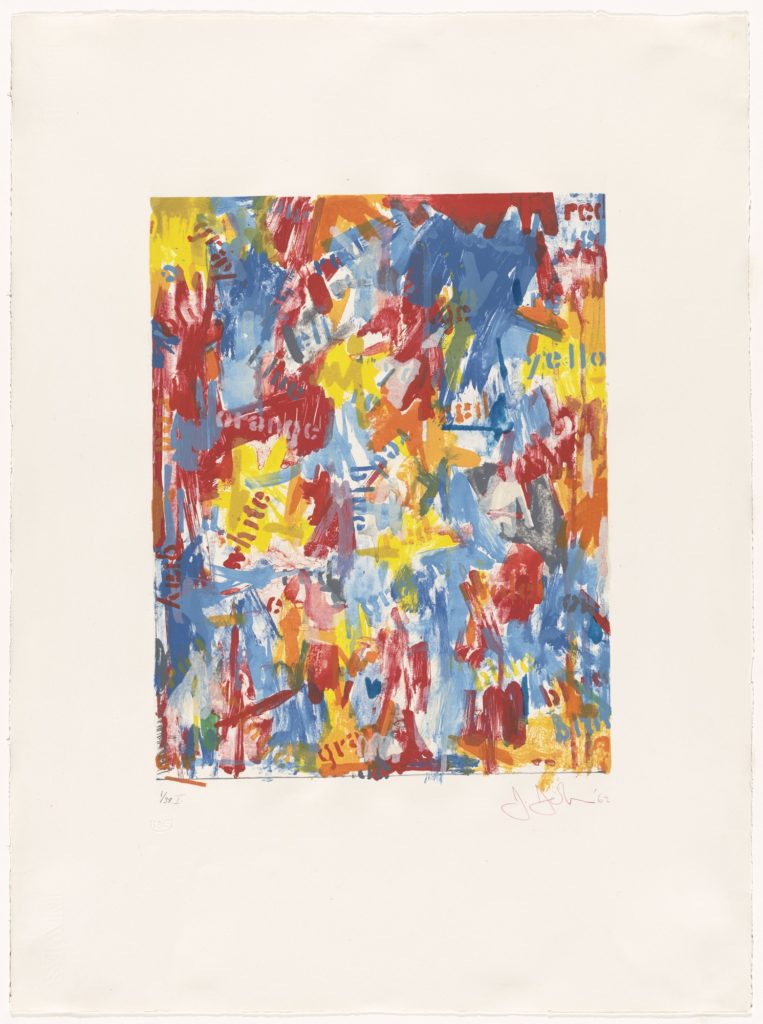
Jasper John’s False Start (1962).
Courtesy of the Museum of Modern Art.
YOU BELONG WITH ME
On Tuesday, ARTnews ran a deep dive after my own heart, in which
Greg Allen unwound the fascinating behavioral-economic knot tying
Johns’s first dealer, the legendary Leo Castelli, to two
philosophically opposed collecting couples: old-money Burton and
Emily Tremaine, and new-money Robert and Ethel Scull.
Allen’s launchpoint is a provocative paper in the
Columbia Journal of Law & the
Arts called
“The Gallerist’s
Gambit.”
There, co-authors Michael Maizels
and William Foster argue that Castelli supercharged his artists’
careers early on partly by engineering ethically dubious appraisals
to deliver massive tax breaks to collectors, which in turn spurred
them to donate certain acquisitions to the Museum of Modern Art.
Allen uses additional research into the Castelli archives to plug
that element into a larger story about the psychology and
incentives that warp the high-end art market into the pretzel of
madness that it is today.
One theme that emerges in Allen’s piece is that the Sculls were
simultaneously crucial to Castelli and Johns’s transformation into
art-historical juggernauts… and borderline-toxic to deal with at
times. Case in point: As an aside, Allen mentions digging up
information that “the temperamental
Sculls threatened to withhold” certain important works they owned
from Johns’s 1964 Jewish Museum survey “for so long, the artist
remade some key paintings as potential
replacements.”
Allen was gracious enough to pinpoint the specifics for me in an
email exchange over the weekend. In an oral history in the Archives of
American Art, Castelli
intimated that Johns tried to backstop Scull’s possible refusal to
lend the vibrantly colored meta-painting False
Start (1959)
by making Arrive
Depart (1963–64). While the latter isn’t an identical
replacement, it looks an awful lot like False Start with a toned-down palette and a skull (get it?)
in one corner.
If there were other failsafes, neither Allen nor I know what
happened to them. My email inquiry about this episode went
unanswered by Johns’s dealer Matthew Marks, and I didn’t have time
to rampage through the artist’s catalogue raisonné of paintings to
see if it harbored any answers. The Sculls ended up agreeing to the
loan requests at the eleventh hour, which would have made any other
potential replacements superfluous too.
But suppose the Sculls didn’t loan the works. Suppose Johns
painted even closer remakes. Suppose he included them in this
important museum show. And suppose he kept them after the
exhibition ended, while his career went nuclear in the succeeding
decades.
Wouldn’t the replacements parallel Swift’s planned re-recordings
of her back catalog? Regardless of whether the Sculls went on to
sell the first versions, wouldn’t Johns have had the opportunity to resell the replacements himself for a
healthy price, either privately or at auction? Isn’t it even
plausible that the replacements might have become perceived
as more valuable than the
originals, since they
would have been the actual works installed in the Jewish Museum
survey?
It’s all a giant counterfactual, of course. But it’s worth
noting here that Guyton’s implied
threat of mass-production did not buzzsaw the value of
Untitled (Fire, Red/Black
U) at auction. The
original, but perhaps no longer unique, painting still sold for
just over its $3.5 million high estimate. So much for the economics
of scarcity.
All of this to say, if you’re a famous artist (justifiably)
pissed off about the fact that collectors, secondary-market
dealers, and auction houses are capturing the gargantuan upside on
one-of-a-kind works you sold for fractions of the resale price
years earlier, maybe it’s worth asking whether Jasper Johns was
onto something… and whether Taylor Swift is taking it to its
logical conclusion.
For the sake of your reputation, just tell people you got the
idea from Jasper. Your secret’s safe with me.
Reporter |
ARTnews]
That’s it for this week. ‘Til next time, remember: sometimes
what matters most is the will to do what the other guy won’t.
The post The Gray Market: What Artists Could Learn From Pop
Star Taylor Swift’s Battle With Her Former Record Label (And Other
Insights) appeared first on artnet News.
Read more https://news.artnet.com/opinion/gray-market-taylor-swift-1713825
Further reading


Leave a comment