
The Gray Market: Why Pace Gallery’s New Tech Initiative Could Worsen One Art-World Problem by Solving Another (and Other Insights)
Every Monday morning, artnet News brings you The Gray Market. The column decodes
important stories from the previous week—and offers unparalleled
insight into the inner workings of the art industry in the
process.
This week, squinting into an
uncertain future…
PACE OF CHANGE
On Tuesday, Pace announced the launch
of PaceX, the
international mega-gallery’s latest initiative exploring synergies
between contemporary art and technology. Given the scarce details
available in the announcement, it’s fair to say that, at this
point, the project raises far more questions than it answers—and
some of those questions are monumental, in the most literal
sense.
What do we know about PaceX so
far? Mostly, we know its key personnel. Pace CEO Marc Glimcher is
the endeavor’s chairman. Christy MacLear, who was last
seen heading up Art
Agency, Partners’s advisory division for artists’ estates and
foundations, is its CEO. Mollie Dent-Brocklehurst, the former
president of Pace London, is its co-founder and chief creative
officer. And Kathleen Forde, the former creative director of
Istanbul’s time-based-media-centric Borusan Contemporary, will be
its curator of experiential art.
What will PaceX
do, though? A Pace spokesperson declined my
inquiry requesting additional details on Thursday, so right now
we’re left with nothing but sound bites and speculation.

Pace Gallery president and CEO Marc
Glimcher. Photo by Kris Graves, courtesy of Pace Gallery.
When ARTnews (which had the story first) inquired about what
types of projects PaceX would pursue, MacLear’s response
was, “Bold ones. Projects
which match the issues like climate change or social justice that
drive artists to new tools and canvases, such as cities or
immersive spaces.” To be diplomatic, I will define that answer as
“incrementally helpful.”
Forde gave readers at least a
little more by emphasizing PaceX’s interest in artwork where the
“essential quality” is a
“time-based experience with related awareness of its immediate
effects on perception. Additionally, it is intended to connect an
audience in a larger shared community experience, leading to a
democratization of art.”
But the closest PaceX’s
leadership has gotten to revealing anything concrete comes courtesy
of Glimcher. He has now been publicly teasing wider adoption of
paid ticketing for the gallery’s technologically inclined artists
for the better part of a year. (He touched on the point in
the ARTnews
story, a March
interview with artnet
News’s editor-in-chief Andrew Goldstein, and at last
December’s “The Art of
Blockchains” conference—an event surreal enough that, by its end, I
felt like I must have some rudimentary understanding of what it’s
like to microdose LSD.)
Although his comments to
ARTnews were more general, the other two cases saw
Glimcher delve into specifics. He argued that the gallery system of
the 1970s failed to establish an economic model to sustain
“phenomenological” and performance-based artists, who, in his
cosmology, were doing much of the era’s most important work. As a
result, painting, which had been declared dead by the vanguard,
clawed its way out of the grave to regain control of the market and
the central conversation.
It seems plausible to me that
PaceX will be the gallery’s attempt to prevent art history—and more
to the point, art-market history—from repeating this mistake. And the
organization seems to have its proof of concept on its roster
already.
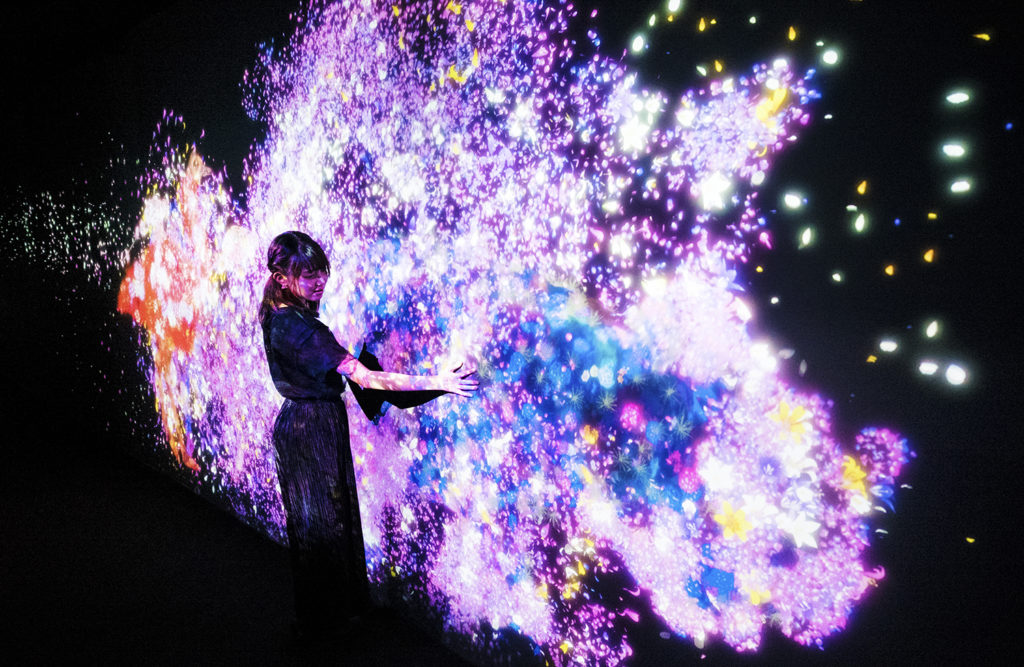
Art from the Digital Art Museum: teamLab
Borderless. Photo courtesy of teamLab.
TEAMWORK MAKES THE DREAM WORK
Back in 2014, Pace began working
with teamLab, the Tokyo-based, over-600-people-strong digital-art
collective. Today, teamLab is best known for creating
site-specific, 360-degree,
software-driven spectaculars, most of which funnel kinetic (and sometimes
interactive) nature imagery through a super-saturated, pleasantly
psychedelic color palette.
According to Glimcher, teamLab
generates about 90 percent of its revenue from ticket sales, versus
only about 10 percent from sales of artworks. And it stands to
reason that most of the works changing hands are the type Pace
frequently shows at art fairs: those contained within individual,
domestically sized screens.
teamLab’s ticketing business
appears to be thriving. In the earlier-mentioned interview with
Goldstein, Glimcher confirmed that the collective sold roughly half
a million tickets, at $20 each, across shows held at Pace’s
locations in Beijing, London, and Palo Alto. Earlier this month,
teamLab also claimed that its permanent museum in Tokyo, called
teamLab Borderless, had sold 2.3 million tickets, at the equivalent
of $30 a pop, in its opening year—and in the process,
snatched the title
of the most-visited single-artist museum on the
planet.
Obviously, that would make
teamLab a multimillion-dollar-per-year business even if it never
sold a single artwork to a private collector or institution. And
the collective isn’t even the only one in Pace’s stable that has
been able to print money by selling tickets to a one-time-only
audience.

MoMA PS1 presented Random
International’s Rain Room in 2013 as a major component of
“EXPO 1: New York.” (TIMOTHY CLARY/AFP/Getty Images)
Random International, which Pace
describes as an “art group” that “runs a collaborative studio for
experimental practice in contemporary art,” had its first show at
the gallery in 2016. The outfit is best known for
Rain Room, a 1,000-square-foot-plus indoor installation
in which an actual deluge of water falls constantly… except on
visitors, no matter where they stand or walk in the
space.
Rain Room
was an instant hit in every major
city in which it appeared; at the Los Angeles County Museum of Art
in 2015, it sold over 190,000 tickets during its initial 15-month
run. Another edition of the
work moved 20,000 tickets at $30 each just days after its launch in
Melbourne earlier this month, according to the Guardian.
Given these results, I think
it’s safe to assume that charging admission for at least some of
its projects will be a part of PaceX’s platform. And I also know
from drifting around the art world over the past several years that
Glimcher isn’t the only one who sees this tactic as genuinely
disruptive, and potentially transformative for the careers of
artists specializing in time-based or interactive
media.
Do I think it’s a bad thing for
galleries to sell tickets for these kinds of exhibitions?
Definitely not. But we should be clear about the limits of, and
incentives for, the strategy, too.

Rendering of Pace Gallery’s new
headquarters at 540 West 25th Street, New York. Image courtesy of
Bonetti /Kozerski Architecture.
MASS EFFECT
Time-based media work is
notoriously tough to sell even in its most familiar forms (film and
video). The degree of difficulty only rises when sellers and buyers
alike have to grapple with more advanced technology, which is
inherently in flux and will inevitably become obsolete—possibly
sooner than anyone involved realizes or wants to
acknowledge.
Paid tickets stiff-arm that
problem by monetizing a temporary experience of the work rather
than its permanent ownership and long-term maintenance. In that
sense, they are an unqualified good for some specialists in these
sales-challenged avenues.
However, “some” is the key word
here. In all likelihood, the ticketed model is only a solution for
a narrow tranche of artists.
Selling tickets attempts to
transform the viewing experience into a mass-market
proposition—something that the commercial gallery world has long
frowned upon. As Glimcher acknowledged in his interview with
Goldstein:
The disruption always at
first looks like the art form is being debased. But we have to
follow the artists, and if they want to go out and connect to a
mass audience, that does not debase their work. If you try to
create sacred objects and have them connect to a mass audience,
that might be riskier in terms of debasing the work—just look at
some of the stories of artists’ overproduction and so
forth.
This rationale begs an obvious
question: What kind of content are artists, producers, and
distributors incentivized to gravitate toward when pursuing a mass
audience?
Although there are exceptions,
the answer across art forms has generally been “bombastic, high
production-value crowd-pleasers,” not works that rely on
introspection or nuance—let alone that challenge any status quo
beyond the technical.
Now, I would never argue that
legitimately great (or at least interesting) works can’t also
appeal to a wide audience, or that anyone should ever be
embarrassed about enjoying simple (or even straight-up trashy)
pleasures. But I do feel comfortable saying it’s an exceedingly
rare achievement for something to be both artistically great
and popular, even when the work in question doesn’t
need to cross international borders to achieve
scale.
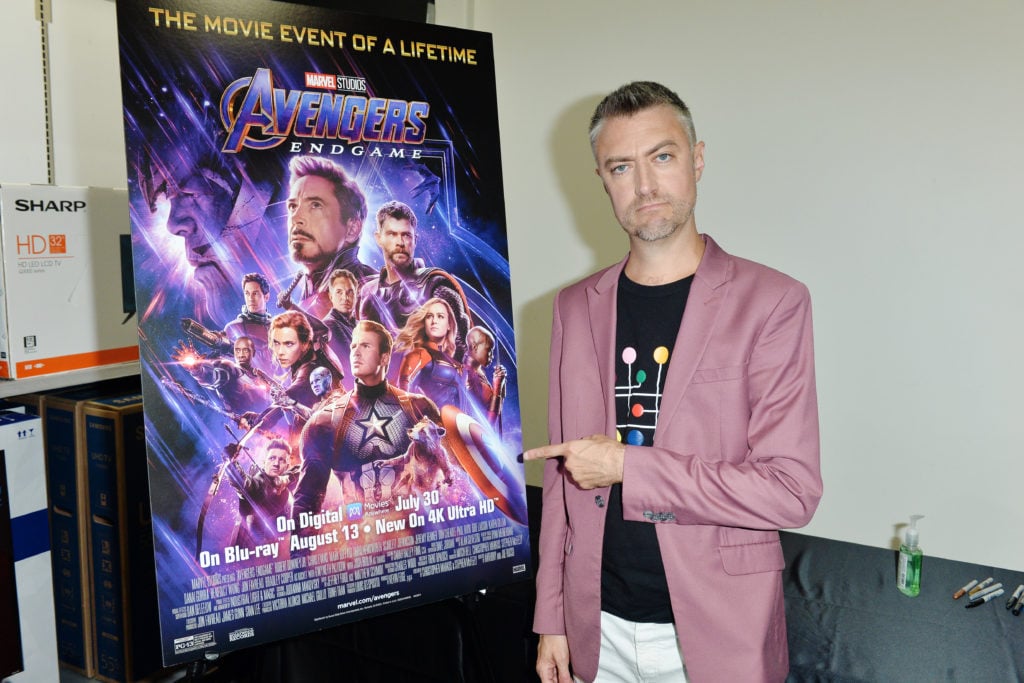
Actor Sean Gunn with a poster for
Marvel’s Avengers: Endgame. (Photo by Jerod
Harris/Getty Images)
Other media drive home this
point. According to Box Office
Mojo’s year-to-date
figures, 2019’s top five feature films by gross ticket sales
worldwide are all either comic-book adaptations
(Avengers:
Endgame,
Captain
Marvel, and Spider-Man: Far From
Home) or Disney remakes
(The Lion King
and Aladdin).
Results are even more telling on
the small screen. Per Variety, only two of the past year’s top 50 American
TV series by total viewership—Game of Thrones (#4) and The Walking Dead (#44)—could even liberally be considered
“prestige TV.” The rest of the list is a slaughterhouse of elevated
taste led by NFL Sunday
Night Football,
nerd-bashing network sitcom The Big Bang Theory, and military-crime procedural
NCIS. Oh, and after Game of Thrones, the top five is rounded out by
Young
Sheldon, which, for the
uninitiated, is a spinoff of… The Big Bang Theory.
What about in the traditional
art world, though? A glance at the Art
Newspaper’s most recent
annual museum-attendance survey would seem to balance the scales a bit, with
the Met’s “Heavenly Bodies” fashion show and Michelangelo taking
the top slots. But the picture gets more unsettling if you broaden
the scope of the inquiry. As my colleague Ben Davis noted in
part one of his
far-reaching “State of the Culture” series, Instagram said
at the end of 2017 that the Museum
of Ice Cream “was the 10th
most photographed museum in the world, already in the same league
as the Louvre, the Metropolitan Museum, and the Los Angeles County
Museum of Art; the Mona Lisa on the same level as a pool
filled with plastic ice cream toppings.”
If you missed it, the Museum of
Ice Cream also closed a round of investment this past week
that valued the company
at $200 million. This,
too, is the “democratization of art” in action.
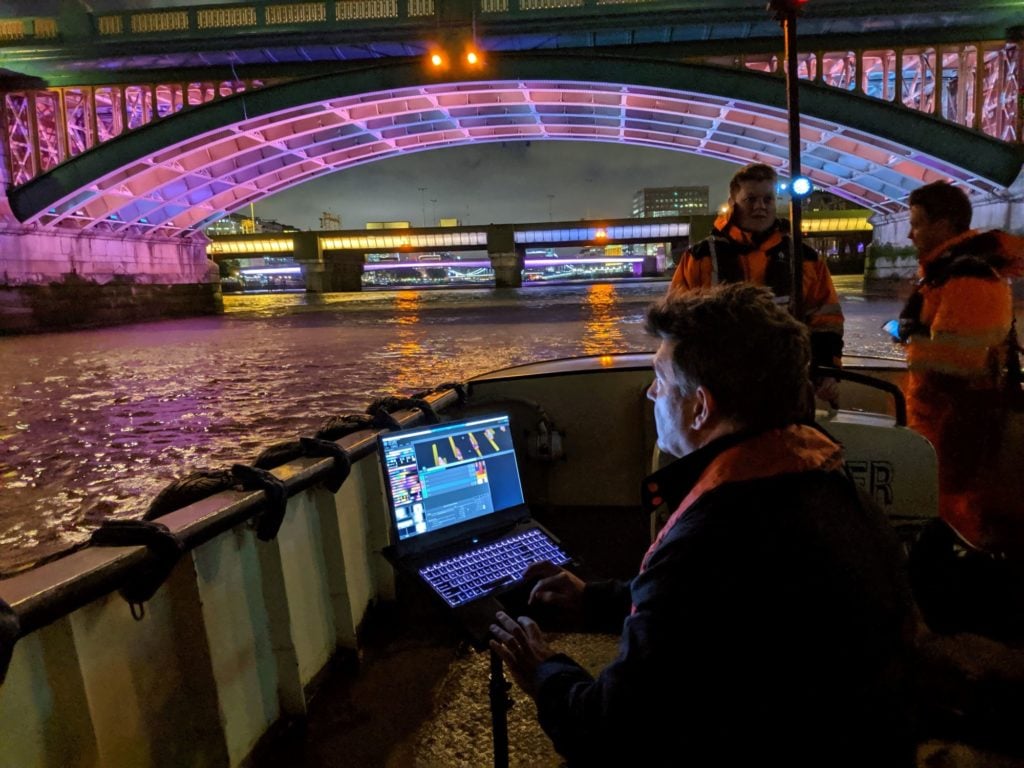
Pace artist Leo Villareal working on
Illuminated River. Copyright Illuminated River.
COMMON DENOMINATOR
To be clear, I’m not necessarily
saying that teamLab is the Big Bang Theory of time-based media, or that Pace is the Disney
of contemporary galleries. And even the harshest critic would be
hard-pressed to conflate PaceX with the Museum of Ice Cream.
However, I do think it’s noteworthy that most, if not all, of the
Pace artists who look primed for PaceX projects have a tendency to
go big and spectacular with their work.
Aside from teamLab and Random
International, Leo Villareal is out here lighting up
bridges, Studio Drift
is levitating cement
monoliths, and Michal
Rovner is no stranger to dominating a gallery with a monumental, graphic video
installation.
Even the gallery’s godfathers of
phenomenological art thrive on monumentality. Robert Irwin, a few
weeks away from turning 91, has been warping our
perceptions of entire spaces for decades, while James Turrell has spent more
than 30 years transforming Roden Crater into a “naked-eye observatory” partly through
commissions for Skyspaces and room-commanding
light installations.
Although I’d personally argue
that stark differences separate Irwin and Turrell (two of my
all-time favorites) from teamLab and Random International, Glimcher
placed all four in the same lineage during his interview with
Goldstein. From a superficial standpoint, I know what he’s
saying.
Which is exactly my point: the
types of technologically or “experientially” inclined artists who
will benefit from ticket sales are the ones whose works can (and
often already do) consistently draw crowds with awe-inducing,
Instagram-ready visuals, whether they communicate something more
revelatory or not.
In my experience, many, if not
most, young artists working with technology and time-based media
embraced those tools because they either wanted to do, or felt they
were only capable of doing, something quieter, weirder, and/or more
revolutionary than what would appeal to even the mainstream
collecting
public—itself already a
niche audience—let alone the mainstream public
overall.
PaceX is not going to hurt these
other artists if it embraces ticket sales in hopes of attracting a
mass audience. But it isn’t necessarily going to help them, either.
And while there’s nothing wrong with that, it does set distinct
limits on the model’s impact. So until we know what other ideas
PaceX may have in store, I think it’s fair to conclude that the art
market’s future still looks a lot like its recent past.
[artnet News
| ARTnews]
That’s all for this week. ‘Til
next time, remember: history doesn’t necessarily repeat itself, but
it often does rhyme.
The post The Gray Market: Why Pace Gallery’s New Tech Initiative
Could Worsen One Art-World Problem by Solving Another (and Other
Insights) appeared first on artnet News.
Read more https://news.artnet.com/opinion/gray-market-pacex-1628053
Further reading


Leave a comment