
The Gray Market: Why the Coronavirus Canceled Art Basel Hong Kong When the Protests Couldn’t (and Other Insights)
Every Monday morning, Artnet
News brings you The Gray Market. The column decodes important stories from the
previous week—and offers unparalleled insight into the inner
workings of the art industry in the process.
This week, dredging the wonkiest
depths for something of value…
CANCEL CULTURE
On Thursday, Art Basel and its
parent company, the MCH Group, officially canceled Art Basel
Hong Kong’s 2020 edition (previously slated to run March 19–21). A
statement by the MCH Group attributed the decision to the “outbreak
and spread” of the 2019 novel coronavirus, which Chinese health
officials announced on Sunday had infected more than 37,000 people
and killed over 810—more
fatalities than the SARS virus caused during its entire rampage in
2002 and 2003.
Since so many Western galleries
and market-watchers reacted to news of the fair’s cancelation with
some version of, “What took them so long?,” I decided to dig into
that question. And after coming back to the surface, I feel
comfortable saying that the answer is more complex than most of us
realized.
Before I go any further, though,
let’s establish an important reality about the situation: no one
involved is really happy about Art Basel Hong Kong disappearing from
this year’s calendar. In the days and weeks leading up to its final
decision, Art Basel was trapped in a vise by two constituencies of
its exhibitors. As badly as most of the Western galleries wanted
the fair “put out of its misery,” as London dealer Richard Nagy
memorably wrote in a January 29 letter
to Art Basel officials,
Hong Kong galleries wanted just as
badly for the fair to soldier on. The tension meant that Art Basel knew for
months that it would infuriate a significant portion of its
clientele no matter what decision it made.
In the end, the cancelation robs
every exhibitor of something. All dealers who had not voluntarily pulled out of
the fair already will receive 75 percent of their respective
booth fees back, meaning a quarter of their investment is gone
forever. Even if they were given a full refund, galleries would
still be forfeiting the sales they were counting on when they
applied to Art Basel Hong Kong months ago, to say nothing of any
real costs they incurred on planning their stands, fabricating
artwork, and making other preparations.
What about Art Basel, though?
Did the coronavirus merely provide a politically agnostic
opportunity to call off an event that many Western exhibitors
alleged had already lost viability after the ongoing
pro-democracy protests convinced a significant
number of their buyers and artists to opt out
months earlier? And if so, did the
organization take until February 6 to decide strictly because its
international galleries were facing shipping deadlines? Or was
something else entirely at work?
To decipher the answers, it
turns out that we may have to look in what many, if not most,
people view as the single unsexiest realm of arcana in the entire
art market: insurance policies. But that sojourn strongly hints
that the outcome, as well as the timing, of Art Basel Hong Kong’s
cancelation resulted more from objective financial and legal
mechanisms than subjective moral or political calculus.
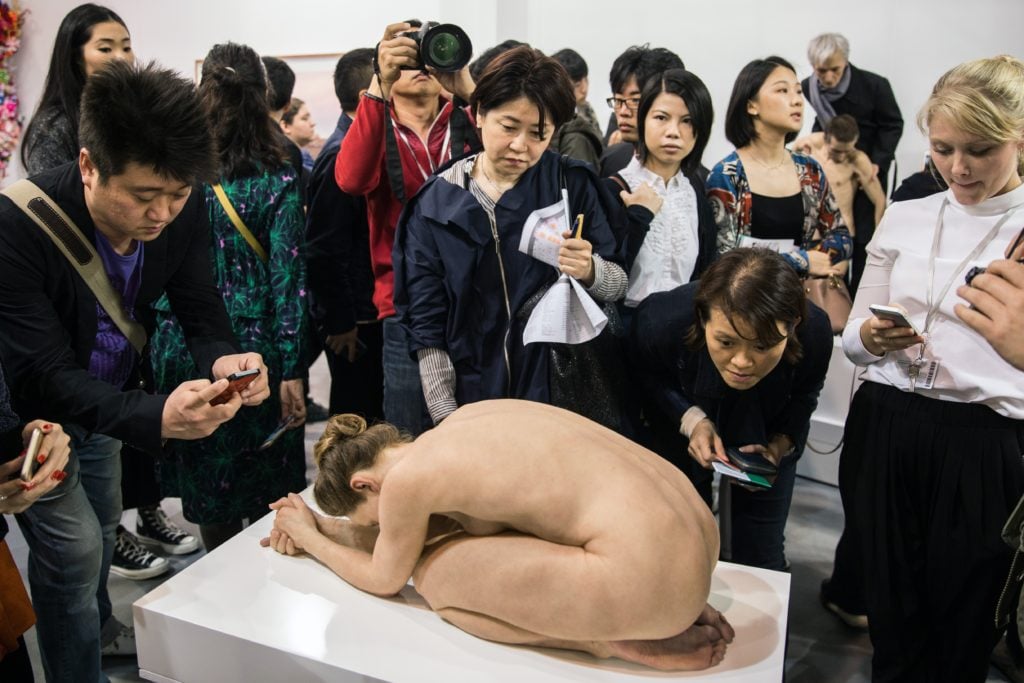
Visitors crowd around Australian artist
Sam Jinks’s Untitled (Kneeling Woman) at Art Basel Hong Kong
2015. AFP PHOTO / ANTHONY WALLACE
COVER ME UP
Now, I’m going to preface
everything that follows with this disclaimer: I have not seen
either Art Basel’s insurance policies or its contract with
exhibitors for the Hong Kong fair. An MCH Group spokesperson
declined my request for details, and my budget
Woodward-and-Bernstein efforts yielded nothing definitive. This
means I’m left to speculate about a host of important elements in
this equation.
That said, I also spent a lot of
time over the weekend trying to make sure it’s the most responsible
speculation possible, including long conversations with multiple
highly placed professionals in the fine-art insurance and legal
sectors. Here’s my best read of the what, why, and when of Art
Basel Hong Kong’s demise based on that reporting and
research.
First, an Art Basel
spokesperson confirmed that the company filed an insurance claim for
the Hong Kong fair. So we know that the company had a policy on the
event, and based on the scale of Art Basel Hong Kong, we can
reasonably conclude that the value of that policy is
substantial.
But what kind of insurance was
it? The likeliest answer is what’s known as event-cancelation
insurance, which covers the policyholder in cases where an event
must—emphasis on
“must”—be kiboshed due
to forces outside the
organizer’s control.
Although an international art
fair is a niche event, event-cancelation insurance is actually not
a niche product. People can (and do) take out these policies on
everything from museum galas to weddings. If there’s a lot of money
riding on the event, and all hell breaks loose if it doesn’t happen
on the scheduled day, you can almost assuredly get this
coverage.
But every insurance policy has
what are known as exclusions: explicitly defined events or
circumstances that are expressly not covered. Exclusions are a pivotal factor in
determining how and when an insurer actually pays out on a
particular claim. And it is very likely that Art Basel’s
event-cancelation policy for Hong Kong excluded the complications
and dangers caused by the protests so far—but not the complications and dangers caused
by the coronavirus.
The main reason is that the
insurance industry offers separate policies for events such as
terrorism, political violence, and political risk (which can
include political violence, but also expands to protect
against problems such as government seizure of property or collapse
of the local financial system). In general, event-cancelation
insurance tends not to guard you against these threats. So if you
as an event organizer don’t have distinct coverage tailored to
these distinct categories of bad news, you are likely left on your
own to face the losses they cause. Good night, and good
luck.
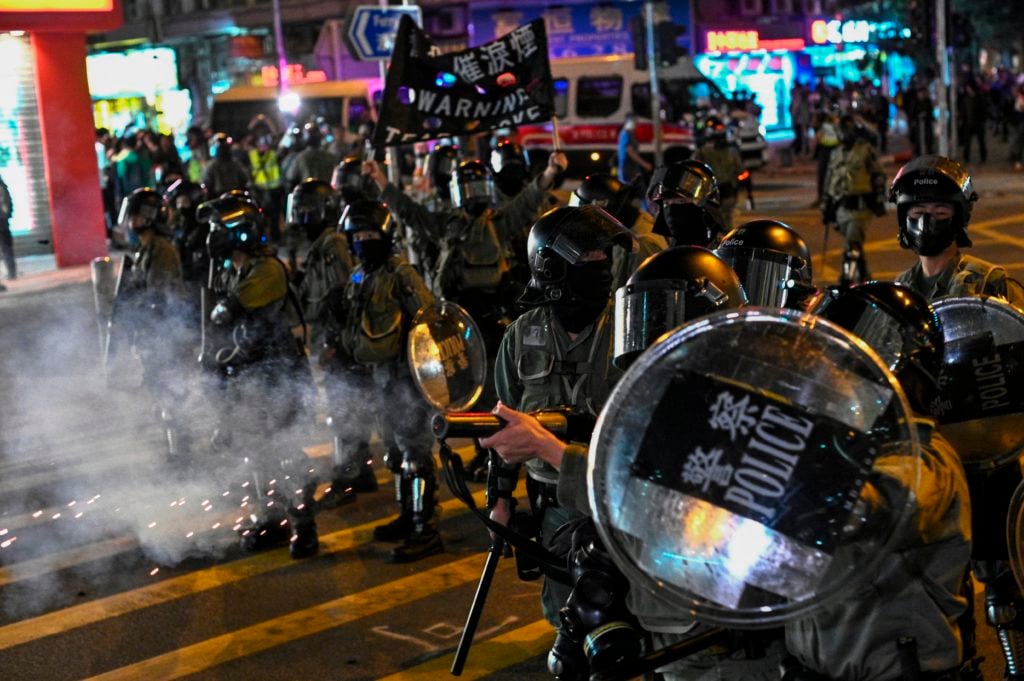
Police fire tear gas during a protest at
Hung Hom area in Hong Kong on December 1, 2019. Photo by Philip
FONG/AFP/Getty Images.
TRIGGER WARNINGS
Now, do I know that Art Basel
didn’t have a separate policy that would have shielded the
organization financially if the Hong Kong protests forced the fair
to shutter? No, nor do I know with 100 percent confidence that its
event-cancelation policy might not have done the
same. In fact, I
suspect one or the other of these possibilities was in
place.
Why? Because Art Basel publicly
committed to refunding 75 percent of exhibitors’ booth fees
if it were forced
to cancel this year’s Hong Kong fair on account of civil
unrest back in
mid-January, before the coronavirus replaced the protests as the
primary risk to the event. That’s too rich a commitment to make out
of goodwill and a sense of fairness.
But even if Art Basel had
coverage that could be triggered by the demonstrations, what were
the triggers? The key is that the way an insurance policy is
written matters just as much as having the policy at all. After
all, insurance policies are contracts—and in
contracts, language is everything.
Consider this example:
Hypothetically, I could buy specialty insurance that would pay me
some amount of cash in the event that I lose my ability to write.
But the policy has to explicitly, objectively define what it means
for me to “lose my ability to write.” Even if both of my hands
devolved into arthritic Tyrannosaurus Rex claws incapable of
navigating a keyboard, my affliction may not be enough to satisfy
the terms of the policy. Couldn’t I use a voice-to-text app
instead, the insurance adjuster would ask? If so, my claim might be
denied, and my gnarled dinosaur digits wouldn’t win me a nickel of
compensation.
In other words, an insurance
policyholder’s general situation can suck… but if it doesn’t
suck in the exact way(s)
defined in the policy,
the insurer pays them nothing.
All of the above means that Art
Basel would have needed specific events to trigger coverage under
any possible insurance against the protests. So it’s entirely
possible that the demonstrations could continue to rage, continue
to intensify—even
dramatically so, in subjective terms—but still fail to meet the
precise criteria that define
when the fair can no longer proceed. Whether or not the company
suffered catastrophic financial losses would all depend on the
contract terms.
The same general framework would
apply to insurance coverage against the outbreak of a deadly
disease like the coronavirus. The difference is that the necessary
trigger(s) for coverage have been hit, and the timeline enables
semi-responsible guesses about what those triggers might have
been.
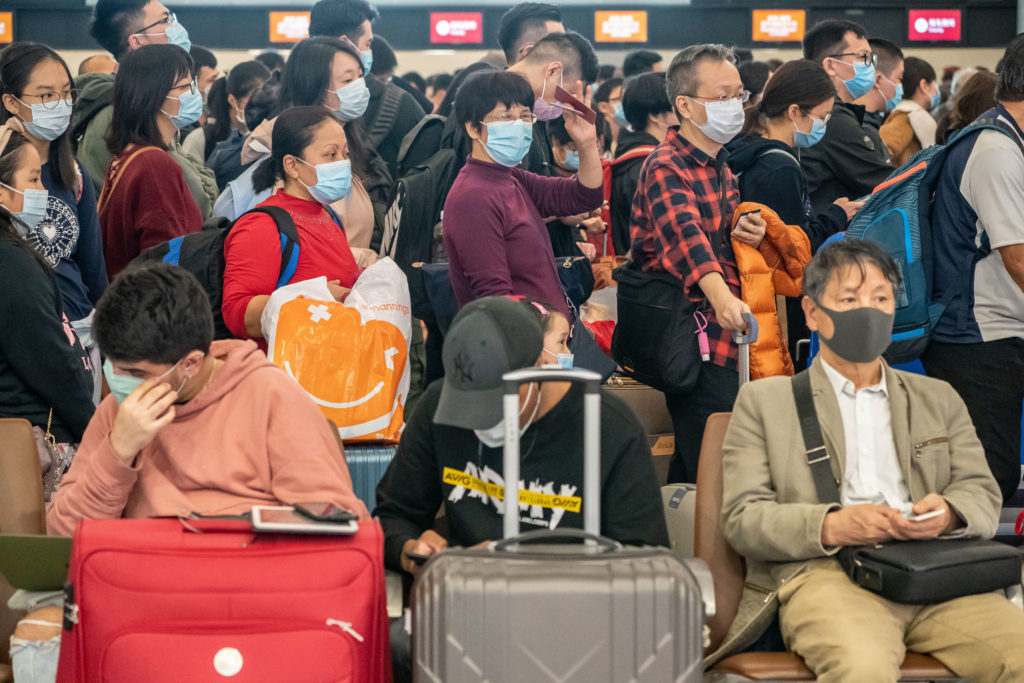
Travelers wearing face mask wait at the
departure hall of West Kowloon Station on January 23, 2020 in Hong
Kong. (Photo by Anthony Kwan/Getty Images)
OUTBREAKS AND PAYOUTS
One piece of recent coronavirus
news seems especially relevant to me in this context. On January
30, the World Health Organization declared the disease a
“public health
emergency of international concern” (PHEIC). This is an official designation that
empowers the WHO to assemble a special committee of researchers and
public-health officials to make specific recommendations to
specific nations about how to contain and combat the illness in
question. Eight days later, Art Basel and the MCH Group announced
the cancelation of Art Basel Hong Kong.
If the gap between those two
events makes you suspicious of any causal link, bear in mind that
any time a policyholder makes an insurance claim, the insurer will
take time to make what’s referred to as a “determination of
coverage.” Remember, insurance is basically institutionalized
gambling: the policyholder places a bet (the insurance premium)
that some awful thing will happen, and the insurer places a bet
(the face value of the policy) that it won’t. If the awful thing
never happens over the course of the policy, the policyholder loses
the bet. But if the awful thing does happen, the insurer loses the bet and pays out
a much higher amount. Before an insurer writes that fat check,
though, it will take time to verify that it absolutely has to under
the terms of the bet (the insurance policy).
How sure am I that the WHO’s
designation of the coronavirus as a public health emergency
triggered coverage under Art Basel’s insurance policy? Not very,
actually.
The vast majority of the WHO’s
advice applied to mainland China. Obviously, there’s a tight
art-market relationship between the People’s Republic and Hong
Kong, but the WHO’s recommendations never mention Hong Kong by
name. The committee also “[did] not recommend any travel or trade
restrictions” based on the information available at the time, and
as of Sunday, had not upgraded the coronavirus to the status of
“pandemic”—a medical term
invoked when a disease infects more than one region on a mass
scale. And justifiably so, since only a few dozen cases have been
verified in any other individual country besides China.
But there’s another angle to
consider here. According to
the National Law
Review, the
coronavirus delivers a rare one-two punch in the insurance arena
because it “includes both a naturally occurring component (the
virus itself) and a government-action component (including the
quarantines and other measures put in place in response to the
outbreak).” In the context of an event-cancelation policy, then,
the disease is outside the organizer’s control, but so too is any
lockdown meant to minimize its damage. So even if the WHO’s ruling
didn’t trigger Art Basel’s insurance coverage, voluntary state
actions might have.
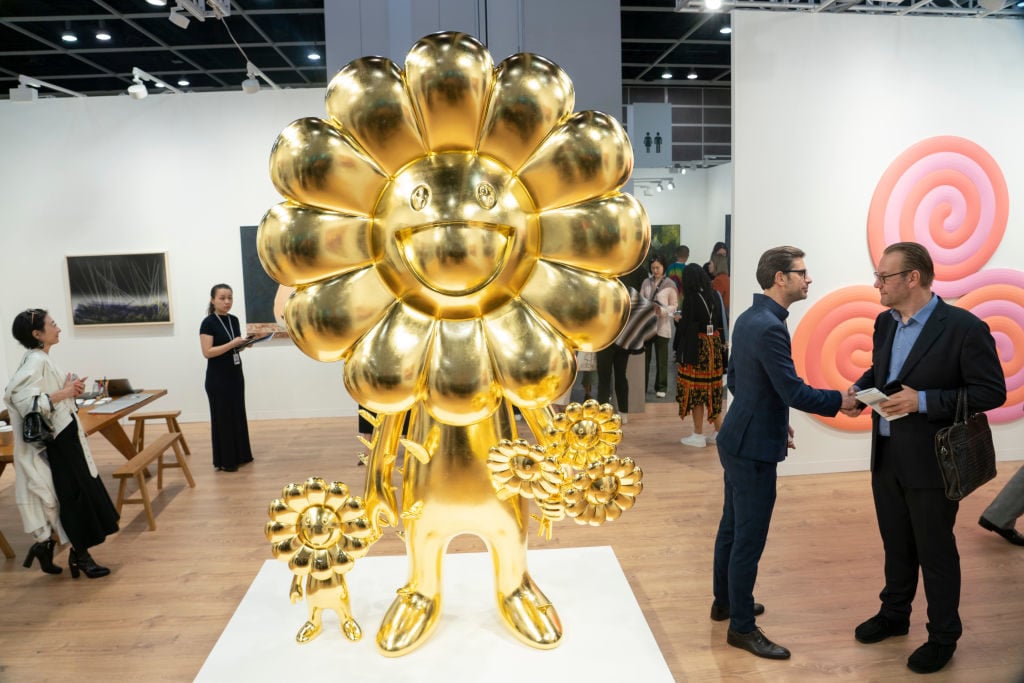
Visitors viewing artwork at Art Basel
Hong Kong on March 27, 2019. (Photo by Theodore Kaye/Getty
Images)
The government action in
question might not just refer to China or Hong Kong, either. As of
Saturday, 62 countries had implemented some form of restrictions on
recent travelers to mainland China, ranging from health checks upon
arrival to outright refusals of entry. Hong Kong is now among them;
two days after Art Basel Hong Kong’s cancelation, the city imposed
a mandatory two-week
quarantine, punishable
by fines and/or prison time, on incoming passengers from anywhere
in China.
Although the
National Law Review
focused on state action in its
description of the coronavirus’s potential insurance impacts,
commercial entities’ decisions could be a factor, too. All those
grounded flights to Hong Kong loom large in my mind, especially if
they extend from passenger flights to air freight. Even if some of
the sellers and buyers could somehow have made it to an art fair,
it wouldn’t do a lot of good if much of the art couldn’t. Case in
point: back on the mainland, many workers still aren’t sure when
they’ll be allowed to return to their jobs, and the
uncertainty could wreak havoc
on international commerce of all kinds.
So while I can’t tell you what
specific coronavirus-related event(s) triggered Art Basel’s
insurance policy in Hong Kong, I feel reasonably confident saying
the following: those event(s) were specifically defined,
objectively verifiable items written into the contract; they only
happened in the 10 days or so immediately preceding the cancelation
announcement; they were just as likely to involve state or
commercial responses to the outbreak as to the disease itself; and
perversely, the financially
beleaguered Art Basel
was probably saved by the virus—because
as troubling and dangerous as the protests have been, they do not
appear to have triggered events that would necessitate an
underwriter paying the organization a cent.
All told, then, this game-theory
exercise illustrates just how complex, high-stakes, and globally
interwoven the art trade has become in 2020, at least at the upper
reaches. And while that generality may not be news at this point,
it reinforces that the decision to call off the fair always hinged
primarily on economics, not ethics.
That’s all for this week. ‘Til
next time, remember: if you’re complaining about losing art deals,
be thankful you’re not among the thousands at risk of losing their
lives or loved ones instead.
The post The Gray Market: Why the Coronavirus Canceled Art
Basel Hong Kong When the Protests Couldn’t (and Other Insights)
appeared first on artnet News.
Read more https://news.artnet.com/opinion/art-basel-hong-kong-insurance-1773276
Further reading


Leave a comment