
The Gray Market: Why the Coronavirus Proves the Art and Fashion Economies Are Different Animals (and Other Insights)
Every Monday morning, Artnet
News brings you The Gray Market. The column decodes important stories from the
previous week—and offers unparalleled insight into the inner
workings of the art industry in the process.
This week, asking about the
limits of a favorite art-market comparison…
COLLAPSE, BUT MAKE IT FASHION
On Thursday, Business of
Fashion relayed that the
Savigny Luxury Index, which
collectively tracks the share prices of nearly 20 top luxury
companies, “went into
meltdown” in February due to fallout from (you guessed it) the
novel 2019 coronavirus. And since there has been a tremendous
amount of talk in recent years about the parallels between the
fashion and art markets, the recent freefall in the former should
reveal something useful about how similar the two businesses really
are.
So what does a “meltdown” of the
Savigny Luxury Index mean in measurable terms? As a unit, the share
prices of its 17 constituent companies dropped 7.1 percent in
February. Three labels—Burberry, Prada, and Tod’s—tumbled 15 percent
or more. Perhaps even more surprising, not a single retailer in the index saw an
uptick on Wall Street last month, marking the first case of
across-the-board decline in more than eight years.
Since share prices and
percentages tend to feel a little abstract, let’s cast this
situation in more concrete figures. According to a separate
Business of Fashion
piece on February 24, a
joint study by Italian luxury-brand committee Altagamma, research
firm Bernstein, and Boston Consulting Group projected that the
global luxury sector could hemorrhage between about $34 billion and
$45 billion in sales in 2020 due to the effects of COVID-19. A
wound of that severity would mean the luxury market only reaches
about $335 billion this year, translating to an industry-wide loss
of between about seven and 10 percent year over year.
For reference, a luxury-market
hit of $34 billion to $45 billion would equate (in dollar terms) to
somewhere between about half and two-thirds the size of the entire
art market in 2019, if you buy the $64.1 billion in
sales touted in the latest Art Basel and UBS
report. Which naturally
begs the question: How worried should art sellers, middlemen, and
art-services businesses be?
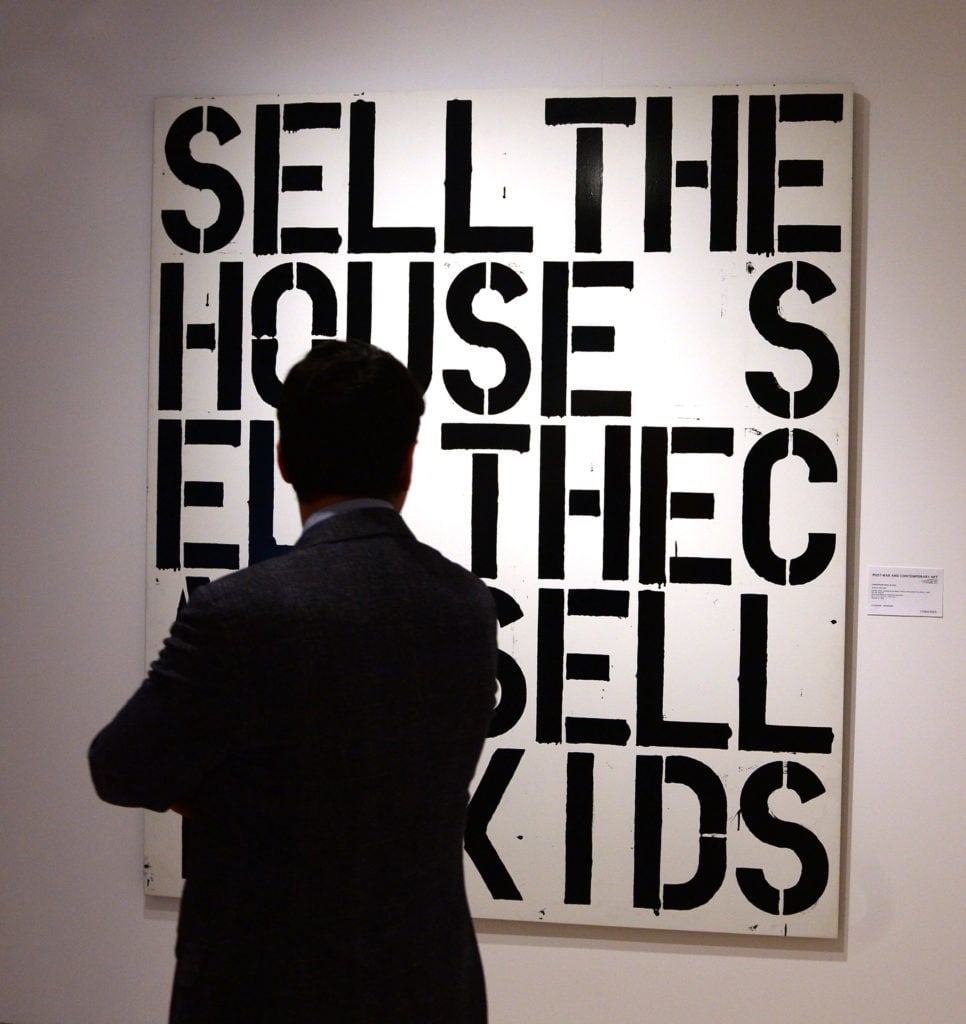
Christopher Wool’s Apocalypse Now
at Christie’s. (Photo by Rune Hellestad/Corbis via Getty
Images)
TWO SIDES TO THE STORY
The case for short- to
medium-term pessimism about art sales this year seems obvious. Like
luxury goods, artworks are discretionary purchases. In strict
utilitarian terms, no one needs them. (Think about the value of a Warhol in a
post-apocalyptic landscape where unwashed brigands are robbing
people at gunpoint for clean water.) This means sales usually drop
off when consumer confidence wavers. It’s a consequence of the
phenomenon known as the wealth effect: people tend to spend more
money when they’re making more money, and spend less when they’re
making less.
When it comes to art buyers
(see: the wealthy), how much money they’re generating at any given
time primarily has to do with the performance of their investment
portfolios. And in case you haven’t been eyeing Wall Street over
the past couple weeks, it’s getting thrashed about as badly as a
Daytona Beach hotel room by a mob of spring breakers. Upon close of
trading on March 6, the S&P 500 was down 12 percent since
February 19. That’s the sharpest downturn since 2011, according to
the New York
Times, and enough to
incinerate $3 trillion in wealth worldwide.
In light of all that, as well as
last month’s synchronized swan dive by fashion companies in the
Savigny Luxury Index, why wouldn’t the art market have to absorb a similar body
blow?
Well, it’s worth noting that the
buyers haven’t fled from major art-market events in droves so far.
Even as the luxury market was plunging, sales results at
Frieze Los
Angeles, Felix, and the
ADAA Art Show in
February were robust. VIP day at last week’s Armory Show
reportedly welcomed in a flotilla
of six- and seven-figure sales, while collectors gobbled up the
(largely) lower-priced works at Independent. And although
attendance faded by 27 percent on TEFAF Maastricht’s
preview day (from 5,500
visitors in 2019 to 4,000, with US museum reps most conspicuously
absent), dealers still confirmed a slew of transactions south of $5
million.
Business has been brisk outside
the fair ecosystem, too. Between February 18 and February
28, Pagavella (the collaborative troika of Pace, Gagosian,
and Acquavella) sold about $300
million of work from the
$450 million Donald Marron collection (as first reported by Katya
Kazakina at Bloomberg). In the auction sector, Phillips’s New Now
sale in New York last week bested the 2019 edition’s total by 52
percent, bringing in a premium-inclusive $7.9
million.
So how exactly are we supposed
to reconcile these conflicting data points?
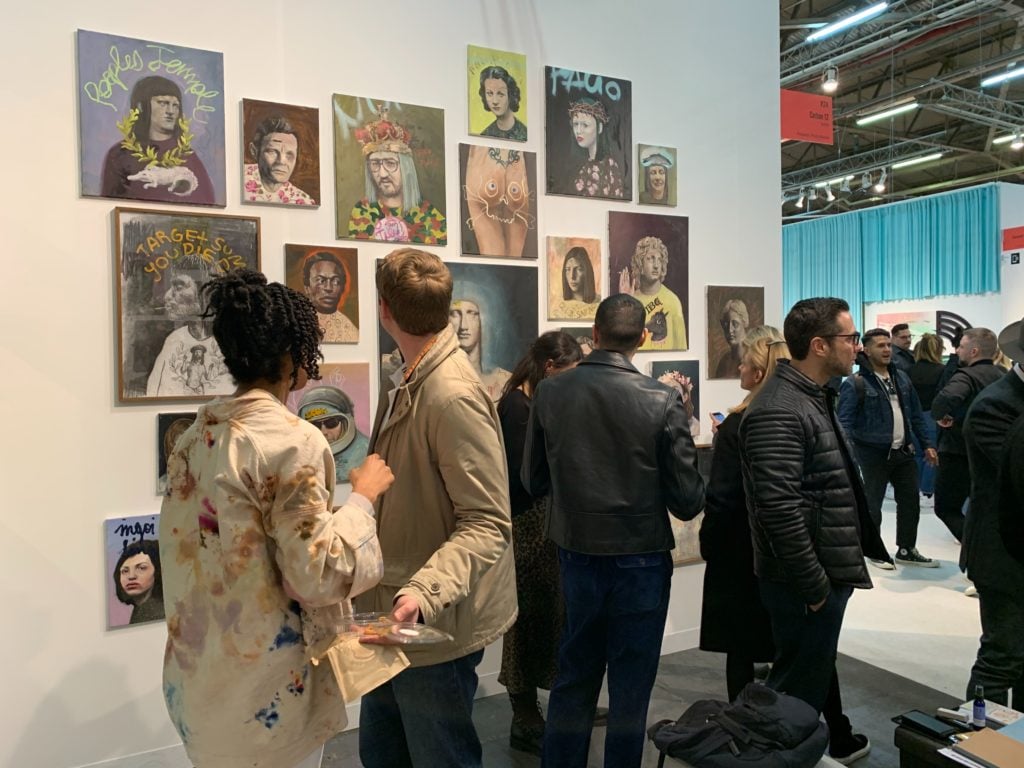
Visitors admire Austrian artist Philip
Mueller’s portraits at the Armory Show booth of Dubai’s Carbon 12
gallery. Photo by Andrew Goldstein.
SORTING IT OUT
There are two obvious counters
to the narrative of continued art-market success in February and
early March. First, no matter how hard my colleagues and I try,
art-fair sales reports are never completely
trustworthy. Even if all
the transactions we hear about actually go through, we’re only ever
able to capture a fraction of the (usually) hundreds of sellers’
experiences at any event. Case in point: I’ve gotten the sense that
sales beyond the preview day at the Armory Show have not been as
robust as in years past for many sellers, but it’s possible I’m
just getting a non-representative sample of tea leaves to
read.
The second obvious point is that
the real challenge for the art market is just beginning. All the
meaningful trade events in January, February, and early March went
ahead as planned. But the now-cancelled Art Basel
Hong Kong would have opened roughly a week after this column’s
publication, and several more market events set to debut in late
March or April have either been postponed, relocated, or shut down over
public-health concerns. In other words, the void yawns open
now.
On the other hand, there are
significant structural discrepancies between the art and luxury
markets that should make the two industries perform at least
somewhat differently in the COVID-19 crisis.
First, even the most revered
luxury retailers still operate as mass-market merchants. Although
the runway pieces suck up most of the attention, a huge part of any
major fashion house’s annual revenue comes from selling accessories
normally priced between $100 and $800, along with
not-much-more-expensive basics including denim and t-shirts. I’m
not saying those items are cheap in an absolute sense. But they are
much cheaper than the artworks that drive the gallery and auction
markets.
This split means fashion houses
depend on high-volume sales. And I think that, in the grip of an
epidemic, a luxury label is much more likely to lose a few hundred
(or thousand) customers who were aspirationally saving up for a
$420 Hermès
scarf or a $795 pair of Louboutin
red-bottom sneakers than, say, Marian Goodman is to have several
clients back out of the waiting list for new Julie Mehretu
paintings, or Sotheby’s is to have grade-A collectors turn down a
chance at a $60 million Francis Bacon triptych this May. (Remember,
high-quality works have still sold well at
auction during recent economic downturns, provided they’re made available.)
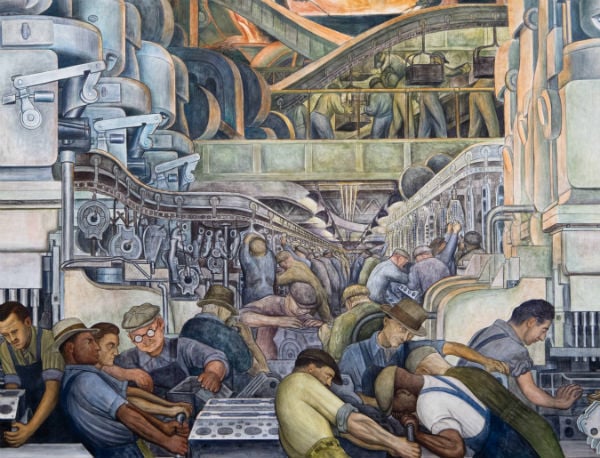
Diego Rivera, Detroit Industry
north wall (detail) (1932) Photo: Courtesy Detroit Institute of
Arts.
Another structural
consideration: while Chinese buyers have become critical to both
art and luxury sellers, the art trade doesn’t overwhelmingly
rely on Chinese supply
chains to bring many, if
not most, of its goods to market. After all, the lion’s share of
the priciest artworks being traded today were actually completed
years ago, if not decades or even centuries back. Trying to ship
them through East Asia may be a problem right now, but sourcing
them from elsewhere in the world shouldn’t be.
Compare that to fashion houses,
whose core business is to continuously sell new gear from new lines
every season. Much of their production and warehousing is
concentrated in mainland China—the
World Trade Organization estimates the People’s Republic
produces more than 30
percent of the world’s clothes today—where thousands of workers are only now
returning to the job from a Lunar New Year holiday extended into a
not-so-stealth quarantine measure. Some analysts estimate Chinese
factories may not be running at full capacity until April, and the
supply chain disruption is already having ripple effects on
retailers worldwide.
In the end, though, these
differences may not matter for art sellers. True, if buyers
actually buy at those rescheduled fairs and auctions I mentioned
earlier, then it’s
conceivable the art market writ large can still salvage
2020. But many galleries,
artists, and staffers don’t have contingency plans for even a few
months of volatility, and most landlords won’t accept a late rent
payment because a trade fair that was important to your quarter got
pushed back a few months. The chaos will only increase if the
domino effect of cancellations and postponements carries over into
the summer, too.
Even if art sales
in the aggregate
don’t quite plummet the same seven
to 10 percent projected for luxury retailers this year, then, the
turbulence may still be enough to guillotine dozens of
small-to-midsize art businesses, as well as justify plenty of
layoffs at the big galleries and auction houses to keep those
operations running through tough times.
So no, I don’t think the fashion
and art businesses should be treated as mirror images of each
other. But in the face of coronavirus volatility, the ultimate
question for sellers in both is the same: How much runway does my
business have left?
Fashion]
That’s all for this edition.
‘Til next time, remember: the only constant is change.
The post The Gray Market: Why the Coronavirus Proves the Art
and Fashion Economies Are Different Animals (and Other
Insights) appeared first on artnet News.
Read more https://news.artnet.com/opinion/coronavirus-art-fashion-economies-1797204
Further reading


Leave a comment