
The Scandal Surrounding Dealer Inigo Philbrick Deepens as Claims on Millions of Dollars’ Worth of Art Keep Piling Up
The tangled mess of overlapping claims that caused now-disgraced
dealer Inigo Philbrick to shutter his gallery spaces in Miami and
London—and then reportedly go into hiding—appears to be
intensifying.
New allegations regarding a $6 million Rudolf Stingel painting
that Philbrick is said to have sold to three separate
entities—amounting to considerably more than 100 percent of the
value—were filed today in New York by collector Aleksandar Pesko
and his business entity Satfinance Investment Ltd. The move comes
just a few weeks after London’s High Court agreed to freeze
Philbrick’s assets at the request of several claimants,
including Pesko.
The current legal tussle comes down to a scramble over who has
the best claim to the art that Philbrick allegedly oversold. In the
latest filing, Pesko presented documents showing that, in January
2016, he paid Philbrick $3.35 million for a 50 percent share in a
2012 Stingel, a photorealist-style portrait of artist Pablo
Picasso. The collector is seeking to refute claims by another
investor, Guzzini Properties, that its claim should take
priority.

Aleksandar Pesko and Alina Baikova.
Photo by Mireya Acierto/Getty Images
The real trouble began for Philbrick when the Stingel at issue
was sold at Christie’s in May. According to legal filings, the
dealer had assured his various clients that the painting would
achieve a record price, as much as $14 million, and that he had
secured a guarantee of $9 million. But when the work sold for only
$6.5 million, the players who believed they had a stake in the
painting became suspicious—and then angry.
For the moment, however, the action has temporarily shifted away
from Philbrick as his claimants fight it out amongst themselves to
get priority access to what he has left behind. “Guzzini has
claimed title to an artwork based on an alleged ‘good-faith,
arm’s-length purchase,’” Pesko’s attorney Judd Grossman told Artnet
News. “But the facts surrounding the transaction, revealed in court
filings today, paint quite a different picture, and we feel
confident that the court will recognize our client’s ownership
interest in this work.”
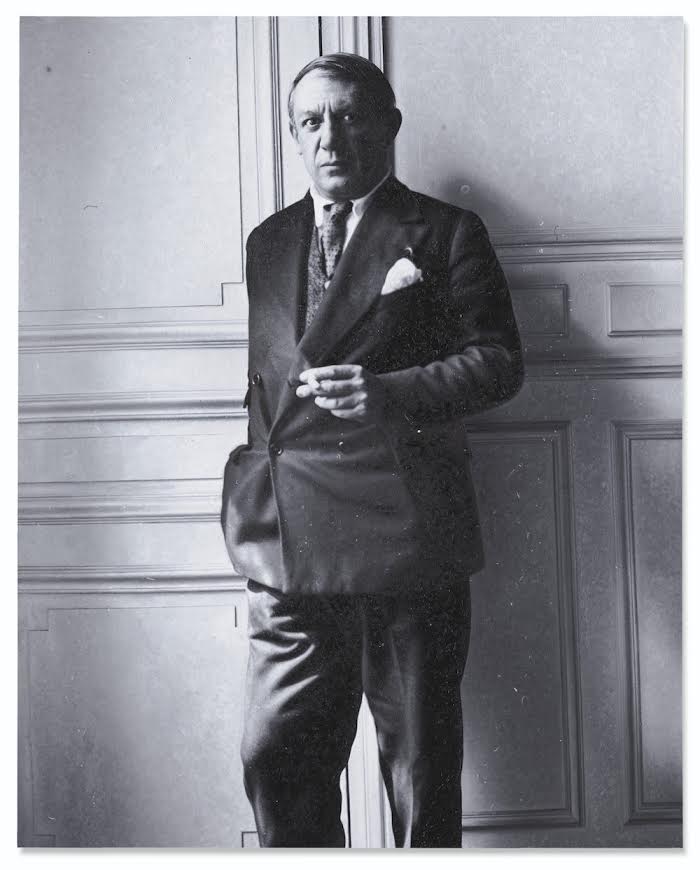
Rudolf Stingel, Untitled (2012).
Image courtesy Christie’s.
Mysterious Owners
The ongoing case lifts the veil on a segment of the market
fueled by increasingly byzantine deals involving anonymous
corporations, partial ownership, and fast flipping. In fact, the
claimant Guzzini remained anonymous even after they filed suit on
November 1.
Earlier this week, Guzzini’s owners were unmasked
by Bloomberg as UK tycoons
Simon and David Reuben, who have a combined net worth
of $12.6
billion, according to the Bloomberg Billionaires Index. According to
letterhead from an agreement with Philbrick viewed by Artnet News,
Guzzini Properties’ registered address is in Tortola in the British
Virgin Islands. The new filing includes correspondence from
October 14 between collector Lisa Reuben, Simon Reuben’s daughter,
and Pesko, in which Pesko appears to offer proof of payment for his
50 percent interest.
Guzzini’s attorney Wendy Lindstrom did not immediately respond
to a request for comment, but she previously told Bloomberg: “My
clients are philanthropic collectors, who, unfortunately, must now
litigate to secure their rightful title to artworks after their
good-faith, arm’s-length purchases.”
That stands in contrast to Pesko’s claim, in which he argues
that Guzzini never purchased the work outright, but instead
accepted it, alongside works by Wade Guyton and Christopher Wool,
from Philbrick as collateral for a loan. Because Guzzini “was
not a buyer in the ordinary course of business,” Pesko contends,
their claim to the painting is “dubious” and was not clearly
represented to the court.
The filing includes a copy of an agreement from August 18 that
appears to specify terms of the loan agreement, including the
insurance value of the three works, a combined $22 million. The
paperwork also lists the provenance of the Stingel: Gagosian
Gallery, New York, a private collection in Russia, and then Inigo
Philbrick.
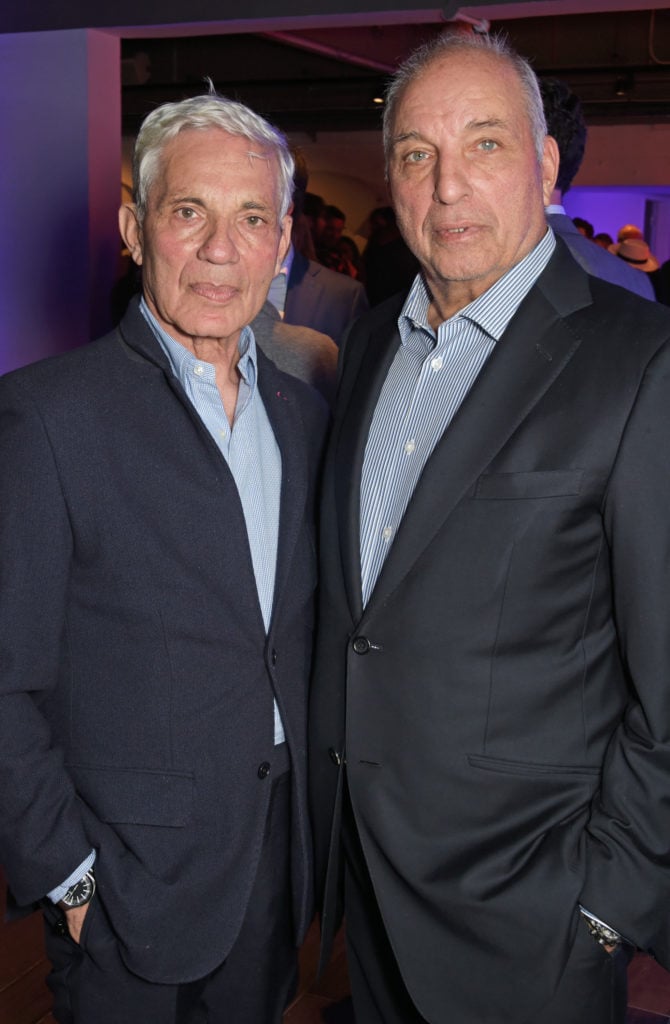
Simon and David Reuben made the mistake
of doing business with the dealer Inigo Philbrick. (Photo by David
M. Benett/Getty Images for Lyric Hammersmith)
What Does Ownership Even Mean?
The catch here? Despite his name listed on the provenance,
Philbrick never owned the work outright. The money to purchase the
work from the Russian collector was ponied up by another
client-turned-claimant, a German finance company called FAP,
or Fine Art Partners. Under the terms of their agreement,
FAP and Philbrick would acquire works, Philbrick would broker the
sales of those works, and they would share the profits. FAP has
also sued Philbrick in Miami in October and is currently trying to
recoup millions of dollars worth of artwork from him (including
that pesky Stingel).
Even as Guzzini consigned the Stingel to Christie’s in May,
Philbrick was still representing to FAP that the German company was
the rightful owner and would receive proceeds from the sale,
according to correspondence in legal filings reviewed by Artnet
News. He lied to FAP principles when he told them he had secured a
$9 million auction guarantee, which he attempted to back up with
documents that Christie’s later told FAP were falsified.
Further complicating matters, at the May 15 auction, New
York-based Stellan Holm Gallery placed the successful bid of $6.5
million for the Stingel. According to Guzzini’s complaint, the
gallery has yet to pay in full for the painting and the work is
currently being held in storage by Christie’s. Christie’s is
not a party to any of the legal action and says it is awaiting
instructions from authorities about how to handle the work.
According to today’s claim, Pesko says that even if Guzzini’s
loan agreement with Philbrick “were to be deemed a sale—to be sure
it was not—the transaction was shrouded by glaring red flags
undermining [Guzzini’s] claims to have been a buyer in the ordinary
course of business.”
The post The Scandal Surrounding Dealer Inigo Philbrick
Deepens as Claims on Millions of Dollars’ Worth of Art Keep Piling
Up appeared first on artnet News.
Further reading


Leave a comment