
The Story of artnet: How Founder Hans Neuendorf Rose From the Rubble of World War II Germany to Transform the Art Market
It’s impossible to talk about the evolution of the
art business into a global industry over the past three decades
without understanding the role played by artnet. Founded in 1989 as
a database of art prices—a groundbreaking innovation in a
marketplace long defined by obscurantism and information
asymmetry—artnet was the first art business to go online; its news
platform, artnet Magazine, became the second-ever online
publication (after Slate); its gallery network served as many
galleries’ first online presence; and its auction platform led the
way for legacy auction houses to enter the digital era. With its
emphasis on transparency and efficiency, artnet did much to create
the conditions for the headlong modernization of the art market.
And it never would have happened if not for the stubborn, quixotic,
and deeply idealistic vision of artnet’s founder Hans
Neuendorf.
Now 82, Neuendorf led an outsize life in the art
world even before artnet. Coming of age in Hamburg amid the
wreckage of World War II and entering the art business while still
in his teens, he organized the first Pop art show in Germany,
championed important artists (like Georg Baselitz) in the face of
widespread skepticism, single-handedly brought Sotheby’s to
Frankfurt, and created a highly successful art fund. In starting
artnet, Neuendorf overcame an unceasing parade of crises and
challenges, keeping the company going by selling artworks to fund
operations and maintaining a conviction—he might call it
naiveté—that success was always right around the corner.
To mark the 30th anniversary of artnet, and to better
grasp the historical context that gave rise to it, artnet News
editor-in-chief Andrew Goldstein sat down with Neuendorf in his
corner office atop the Woolworth Building to talk about his life’s
work. The following interview is the first installment of a
multipart series reflecting the sprawling four-hour
conversation.
You were born in Hamburg in 1937, at a time when the
German war machine was cranking up and the clouds of World War II
were gathering.
Yes, it was before the early days of World War II, and I saw a
good deal of it. I saw the broken army walking home from Russia for
days and days in rows of four—the crippled, badly clad, and sick
army was coming home. Those were young men, and they camped out in
the woods near our home underneath the tall beach trees. The
soldiers hadn’t received any information about where to go or what
to do, nor did they have any money or transportation, so what they
did is they carved little things out of wood they found there, like
nice, complicated walking sticks. As a boy, I would trade with the
soldiers—it was my first attempt at buying and selling
something.
They wanted cigarettes, and there was an American army camp not
very far away where the soldiers received so many cigarettes that
they threw them away half-smoked. As boys, we would go there and
pick them up and put them in a little containers, and I would bring
them into the woods to trade with the German soldiers for a walking
stick or something else, like a warm pair of boots that they were
still carrying around. I would then go to the farmer and trade
these things for a little pig or some other food. That’s how we
survived.
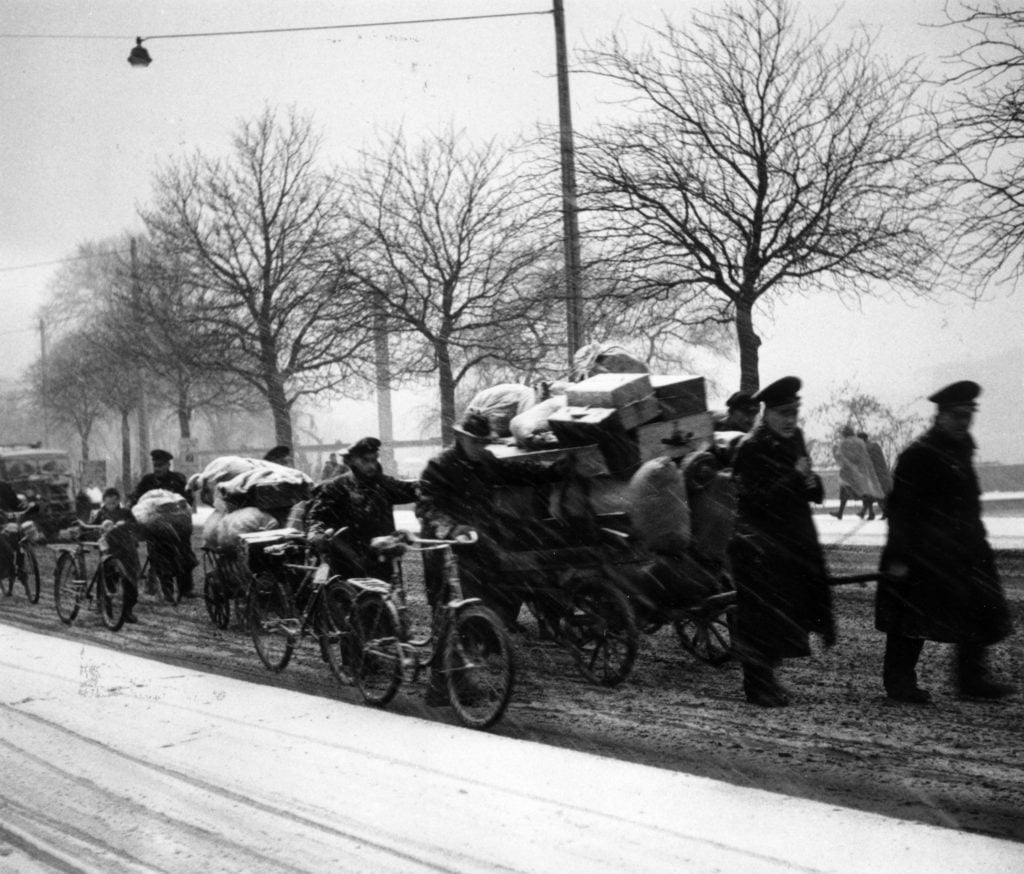
German refugees after the end of World
War II in Europe pass through Hamburg during a snowstorm, dragging
carts piled high with their belongings. Photo by Keystone/Getty
Images.
How old were you at this point?
Well, that must’ve been in 1946. So I was eight.
What were your parents doing at that time?
My father had been in the war. He was in Greece as a service
soldier, and when he returned he had to walk home at night, because
he had to go through territory in Serbia where there were guerrilla
fighters in the bushes who were not in a very good mood about
Germans, and were hunting them down. There were 20 when they left
Greece, and three arrived home alive.
I imagine the Germans had shed there uniforms and were
traveling incognito?
Oh, no. They had nothing else to wear. That’s why they walked at
night. They also didn’t have anything to eat, of course, and were
surrounded by enemies. That’s what my father told me.
What about your mother? What did she do during the
war?
Well, she had three boys—I was the oldest one—and we had been
evacuated from Hamburg when it came under heavy bombing from the
British Air Force. The British were humane in the sense that they
proceeded systematically—they’d bomb one street one night and then
the other side of the street the next night, and so we figured out
when we had to leave. We lived in an apartment, and I remember we
had to evacuate at night in our nightgowns. We got onto a
horse-drawn flatbed that took us to the station, where we caught a
train out into the country. The government provided a little house
for families with children, and we were privileged because my
mother had three boys, and boys were what Hitler wanted. That was
‘43, and I was five or six.
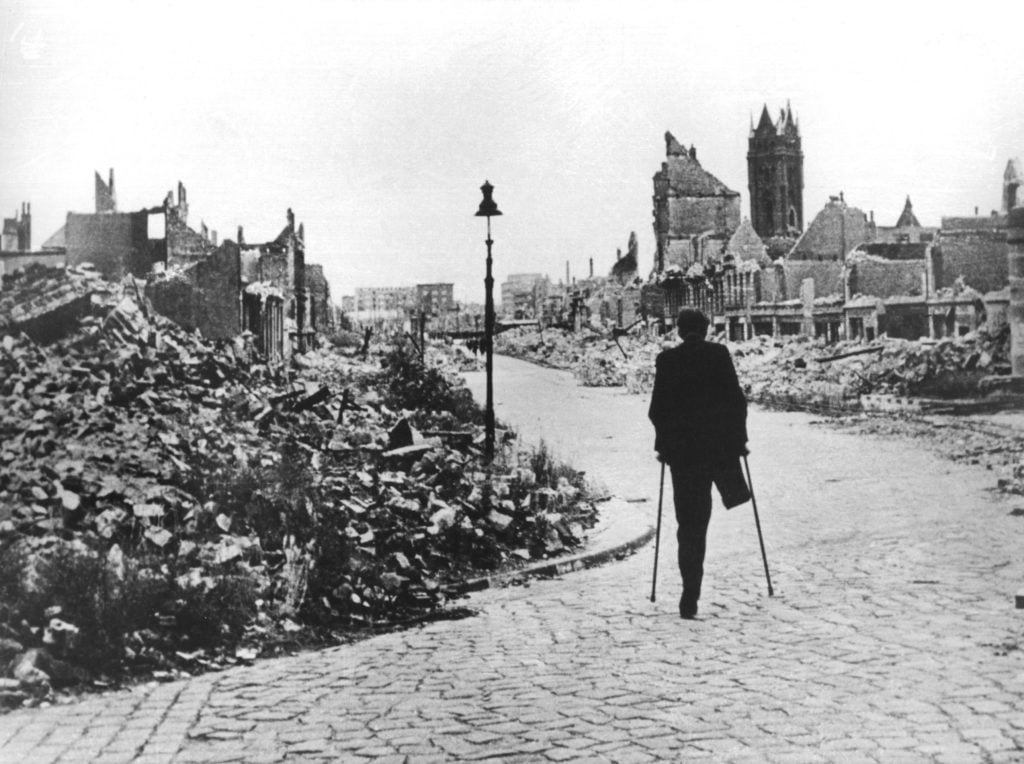
A man traverses Hamburg in the wake of
World War II. Photo by dpa/picture alliance via Getty Images.
How did your parents get reunited?
Well, we were staying in this little hut, and I don’t remember
how long we were there but it was until at least a year after the
war ended. One day my mother sent me into town to fetch some
bread—at that time the way they did bread was to mix sawdust into
the dough—and when I was going there to get that a soldier passed
me in the road, and that was my father.
Incredible.
I didn’t recognize him—I hadn’t seen him in three years, and I
had been a small child—and he called after me because he wasn’t
sure. He said, “Hans.”
Were the roads filled with returning
soldiers?
The whole country was completely in pieces when my father came
back. Many, many fathers didn’t come back. They were fleeing East
Germany, they were fleeing from the Russian army, because the
Russian army had a very bad reputation, with the killing and
everything else that was going on. But we were friends with some of
them. There was a prisoner-of-war camp near where we were, and they
were Russians mostly—very sweet boys, 18, 19 years old. Farm boys,
even. They thought us how to catch fish without a hook: you go very
slowly, and then you have to grab it. They worked for us, chopping
wood for the stove and digging the garden, because we had no
vegetables—we had to grow it all ourselves. I had a little patch. I
was growing tobacco, because I thought that was a good
business.
You were obviously an entrepreneur from a young
age.
Yes. That’s why I began to trade with the farmers, because the
farmers had food and we didn’t have any food. Sometimes, though,
once the farmers had harvested the potatoes they would also invite
townsfolk like us onto the field so we could grab whatever was left
over. So, these were potatoes that had been cut through the middle
and things like that, and we boys would bring these home so we
would have some food. And so we thought, “Oh, it’s good to do that,
but a great idea would be to get the whole potatoes from
the fields that they haven’t harvested yet.”
Good thinking.
So we went at night, my brother and I, and there was a deep
ditch around the field. They dug that on purpose, because if you
fell into the ditch you couldn’t get out. It was slippery and hard
to climb the walls. But we got onto the other side and dug up some
potatoes and put them in a bag. All of a sudden, the place was
ablaze with light, and they were shooting at us. They
didn’t know we were kids. Bang bang. They had to protect the
potatoes. Obviously, other people had tried to steal them. Anyways,
there was no order then, so that’s what we did.
Eventually you left the countryside. Where did life go
from there?
We came back to Hamburg, and I went to school and started
studying.
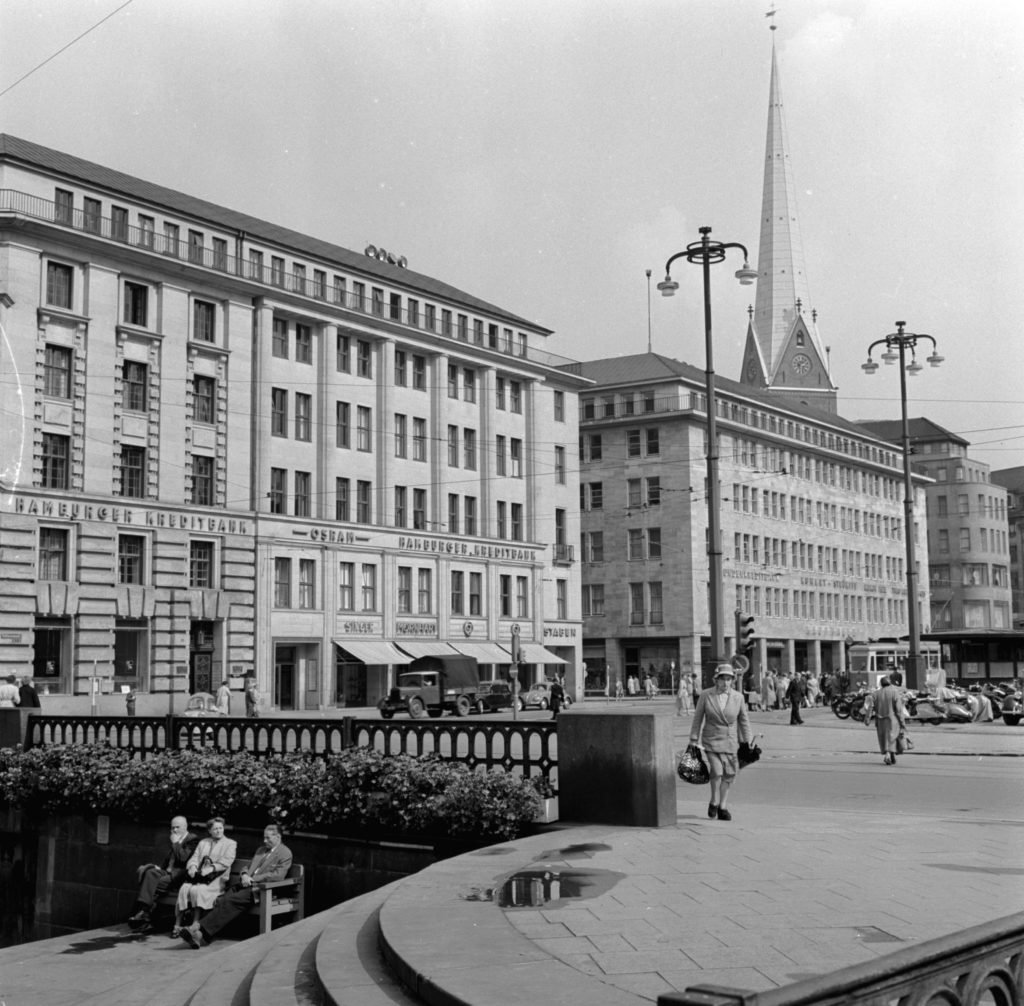
Office buildings in Hamburg that were
rebuilt after destruction in World War II, at the City Hall Market
Square in 1955. Photo by Three Lions/Getty Images.
What did your parents do?
Well, my father’s business was ruined. My father was adopted and
he married my mother against the will of his adoptive father, and
that guy just disinherited him, even though my father had built
their business up. They had an importer of exotic tropical woods.
And so he lost all of that, and that meant he had to go and become
a traveling salesman, selling all kinds of things. Unsuccessfully,
I would say.
What about your mother?
My mother also started to work. She worked for a movie company
that did a weekly newsreels. That was before television of course,
so you had to go to the cinema to watch the news. It had mostly
been used by Goebbels as propaganda for the war, and then
afterwards they had news from all over the world in bits and pieces
where you could actually see some things that you had never seen
before or heard about, because there wasn’t really a press yet and
all that. She was working at the archives, and she had something
that they all liked very much—she had an unusually good memory.
Because they had thousands of cans of film and would say, “Where
was the reel where this or that happened?” and she always knew
where it was. So that’s how she made some money.
How did you start to become interested in
art?
When I was 10, I switched to another school in a different area,
and I had to take the train. And at the train station was a
bookstore, so when I was waiting for the train I would look at
the books. They were tiny little books—the size of a
matchbox—and they had colorful reproductions of artworks on the
cover, which was something I had never seen before. These were
abstract German artist of the time, like Troekes and Cavael, people
you had never heard of. But I thought it was fascinating. I
couldn’t have imagined buying them, but what I ultimately got for
Christmas was Knaur’s Lexicon of Modern Art, and it had
biographies of all the big artists like Chagall, Matisse,
Picasso—all of these people. That’s what really got me interested.
I read that back and forth until I knew it by heart,
practically.
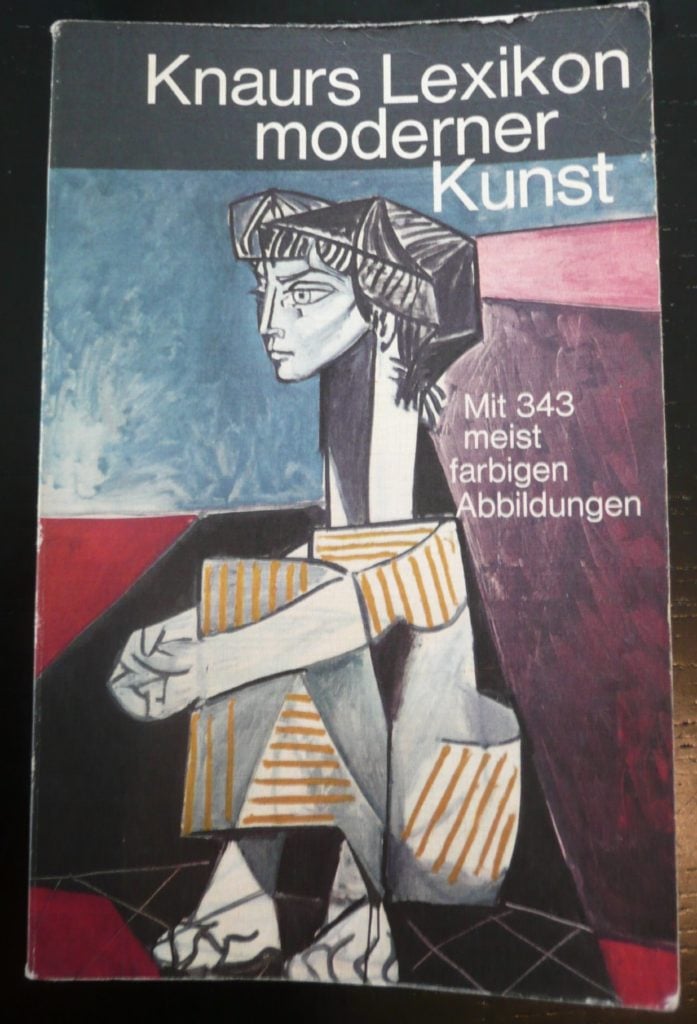
Knaur’s Lexicon of Modern Art. Image
courtesy of Amazon.
Did you go to museums as well?
I went to the museums, but I had a school pal whose father was
an architect, and I used to go over to his house a lot. The father
had a collection of big paintings by Kokoschka, Munk, Kirchner,
Heckel, and all of those. He had kept them through the war, and I
looked at them and I asked him straight out, “How did you do this?
This must have been very expensive.” And he said to me, “You must
buy them when nobody wants them yet.” So that was my ticket.
When did you begin to think about buying your own works
of art?
My father had a friend, he was a Russian cellist. And my father
lent him some money, and before he went away the guy left him a big
trunk of things that he couldn’t take with him as security. And he
never turned up again. We didn’t know if he was alive or dead.
Years afterward, you know what? I found the trunk in the basement.
I opened it up, and I looked around, and there I found a [Lyonel]
Feininger. It was small work, made out to the neighbor’s children I
lived next door to. He made a lot of work for children, including
little model trains he made from wood that he carved and painted.
Anyway, I found this watercolor. And I knew what it was, because I
had read about all the artists.
What did you do?
I said to my father, “Can I try to sell this?” “By all means,”
he said, “go ahead.” So I took it around, and there were only two
galleries in Hamburg at the time—well, one was not really a
gallery, it was an art dealer who lived in a very nice villa. He
must have been quite wealthy. So I showed it to him, and he offered
me 3,000 marks, which was a huge fortune. I asked my father, and
he, “Yeah, go ahead.” The dealer gave me cash, and that’s how I
started.
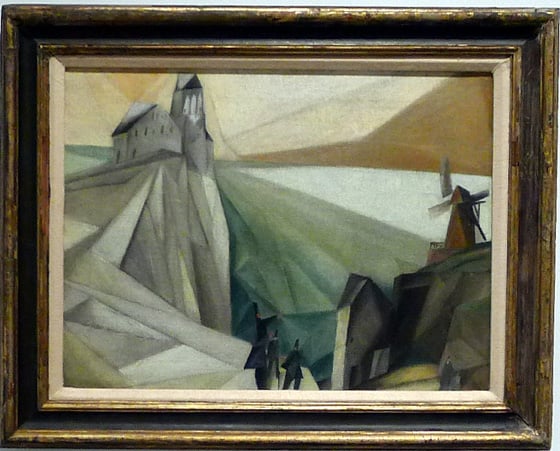
An early cubist painting by Lyonel
Feininger from 1912. Photo: artnet.
How old were you at the time?
I was 18 or so.
That’s pretty precocious.
Well, I was interested in it, and it turns out it was worth
money. Anyway, I gave my father the money, and he lent me 300 of
the 3,000 marks, because I had this idea I wanted to go to Paris
hitchhiking. So I hitchhiked to Paris and I bought some prints by
Matisse, and Picasso, and things like that. Not expensive at the
time.
Which gallery did you buy them from?
Well, among others, Heinz Berggruen. He had a little gallery on
Rue de l’Université. Since then I’ve seen him many times.
Did they think anything was odd about such a young art
collector coming in their gallery?
No, at least they didn’t say so to me. And I paid him cash for
some prints. He, very ungenerously, gave me a 15 percent discount,
even though he could have given me 30, because he had published the
prints himself, you know. Anyway, I took them home and sold them to
my dentist.
Really?
Yes, and fathers of friends and people like that. This was a
time in the ‘50s in Germany when some money was first being
made—mostly by dentists, doctors, lawyers, and people like that.
And they had the education and the desire for some art, which had
been forbidden in Germany for a long time. So, I did quite well.
The price difference, on retail, between Germany and Paris was like
50 percent. So what I was buying for 100 marks I could sell easily
for 200 marks, and I was still below market. So that was how I
financed my studies.
I studied in Munich, mostly, and then I would go to Paris
hitchhiking. There were no autobahns or thruways of any kind.
Sometimes it took me three days in the winter, when it was really
cold. I had to stand on the street, hitchhike, go to Paris, and
then back. In some sense, that’s how I lived.
What did you study when you were going to
school?
At the university, I studied philosophy and art history and
psychology.
Did you think of art as a career path?
I wasn’t thinking of a career, I was just following my instinct
of what I liked. We didn’t think the way we do now—you didn’t do
something for money. That was far-fetched. What you did was you
followed your instinct, what you liked, and somehow maybe something
was going to come of it. Of course, I financed my study with art,
so I was quite aware that you could make money with it.
So, in the beginning, you spent 300 marks on art in
Paris. How much did you make off of that?
I doubled the money in one trip. After that, I traveled back and
forth for three years or so while I was studying, and I did quite
well. I made some money, and I had an inventory of prints, like
Manessier, Bissier, Kokoschka, Hartung, Soulages, and other artists
who were active in Paris at the time. You know, they called it
l’Ecole de Paris. And then I started to think it was embarrassing
to go to see people and unpack the prints and then show them at
their home, and so I thought, “I must have a gallery.”
At the time, there was only one gallery in Hamburg, which was
Brockstedt. Other than that, there were only frame stores that
occasionally had artworks. So I opened a gallery, and that was a
big success. Everybody wrote about it. My first opening was packed
with people. The interest was huge. But there was no merchandise,
and no money. People didn’t have any money.
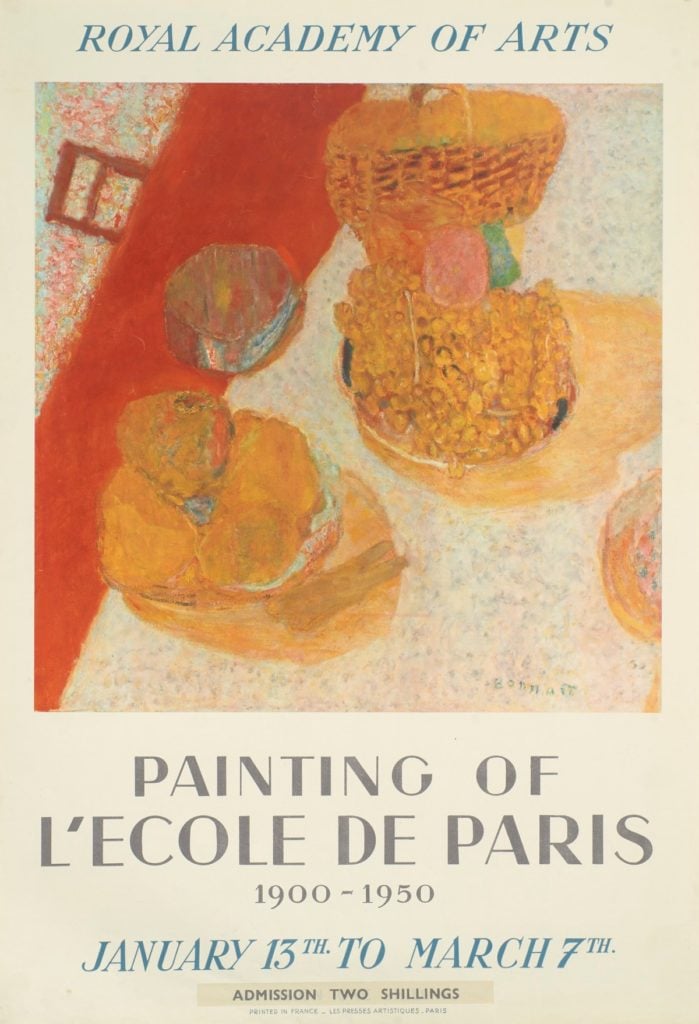
A poster for a show of l’Ecole de Paris
artists. Courtesy of the Royal Academy of Arts.
Did you call it Galerie Hans Neuenderf?
At first, I called it Hamburger Kunstkabinett, which signified
both the smallness of the operation and was also a nod to
Stuttgarter Kunstkabinett, which was my role model. But then I
switched it to Galerie Hans Neuendorf, and it’s been that ever
since.
Where did you open it?
It was an apartment in the same building where we lived. The
first floor had become available, and with the help of my father,
who persuaded the landlord to rent it to me, I was able to get it.
Then, with my brothers, we painted the walls. Suddenly I had the
rooms—but I didn’t have any merchandise, except for a few prints.
So I started showing contemporary Hamburg artists, and that was
very interesting. I got involved, working with the artists, and
that’s how I started.
And you represented them, like a modern
gallery?
No, I just showed them. They were really happy that someone took
an interest, and it was very business-only. “Representation” was
something I didn’t even know existed. And so when I showed them, I
tried to sell their work, and I even sold some of it.
So was it successful?
Yes, it was successful, but very slow. It was successful on a
very, very low level.
How old were you at this time?
I was 23 or 24 when I started the gallery, and by then I was
getting a little bored with the Ecole de Paris. I was even in the
process of writing a book about the end of art.
Really?
That was the big thing then. Hans Sedlmayr was an art historian
who specialized in cathedrals and who was teaching at the
university, and I was remember going to one of his lectures there.
It was in the air that art was decadent, and it couldn’t go on like
this—which is pretty much what I’m feeling again now. So I began to
write this book with my friend who was the son of the architect,
and we never finished it, of course. But we did get bored with the
Ecole de Paris, so I stopped going there and buying these things. I
thought, “If this doesn’t get any better, what do I do?” And then
news arrived from America about Pop art.
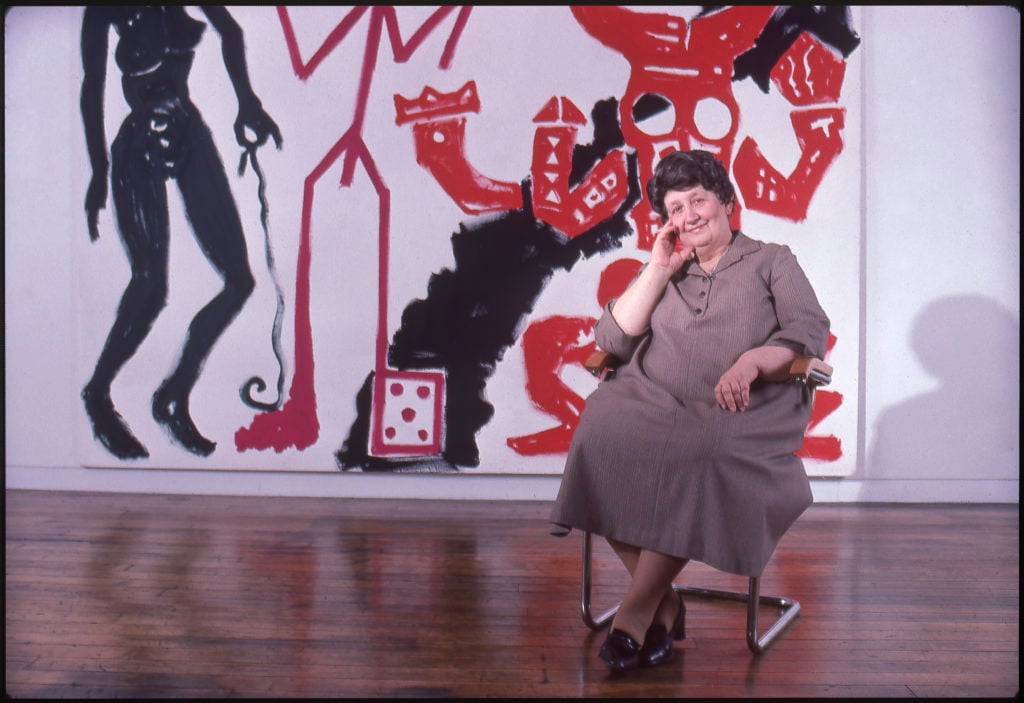
The Romanian-born art dealer Ileana
Sonnabend (1914-2007) in her gallery in front of a large-scale
painting by AR Penck. Photo by Michel Delsol/Getty Images.
How did you hear about it?
Well, it was some article in magazine that went around. And then
there was talk of a gallery in Paris, Ileana Sonnabend. So I
immediately went to Paris and talked to her, and that led to the
first Pop art show in Germany, with paintings by all the great
masters.
How did you manage to bring these artworks into
Germany?
That was kind of adventurous. A friend of mine had a trucking
business, and for deliveries in town he had a small delivery truck
with only canvas around it. He lent it to me, and it took three
days to drive to Paris because the thing was so slow. When we got
to Paris we went to Ileana, because she had promised me the
paintings, and we rode away with these paintings on a rickety
truck. She didn’t blink an eye. She just thought it was perfectly
normal.
Did she sell them or consign them to you?
She consigned them—I didn’t have any money to buy the paintings.
She asked $10,000 for a Jasper Jones—I thought it was insane. She
asked the same for a Lichtenstein. She had protective prices that
nobody would pay, just for insurance purposes, and she actually
didn’t want to sell any of the things. But she gave me some offset
prints, and I sold them for 200 marks, and that’s how I made a
little money out of it. But I didn’t sell any of the paintings.
There were three Rauschenberg paintings, three Jasper Johns
paintings, two or three Warhols, including Four Marilyns,
and two Lichtensteins, one of which was I Know How You Must
Feel, Brad.
This would be around $1 billion in art
today.
Easily, yes.
So you loaded them on the truck and drove them
back?
My brother was with me, so he was sleeping on an air mattress in
the back of the truck. And then in the morning we drove back to
Hamburg. It was a long trip, and we were accompanied by a girl,
Florentine, who became the mother of Jacob [Pabst, today CEO of
artnet]. She was in Paris with a family, learning French, and she
lived in the same building, and she wanted to join us on the trip.
She thought it was so exciting.
How romantic.
That’s how the paintings came to Germany. It was a big success,
in terms of press. They were joking about it, and all of that. They
didn’t take it seriously. But, in particular, the customs officials
didn’t take it seriously.
Did you have trouble getting the art into the
country?
It was difficult. We had to fill out endless papers. The only
way we could make it look like it wasn’t merchandise was to say
that I had painted it, and they commiserated with me, saying,
“That’s very odd.” They were laughing that we thought this was
art.
In the next installment of this interview, Hans Neuendorf
will recount how he helped start the world’s first art fair, and
how David Hockney brought him—and the German art scene—to Los
Angeles.
The post The Story of artnet: How Founder Hans Neuendorf
Rose From the Rubble of World War II Germany to Transform the Art
Market appeared first on artnet News.
Read more https://news.artnet.com/the-big-interview/hans-neuendorf-story-of-artnet-interview-part-1-1664431
Further reading


Leave a comment