
The Story of artnet, Part 2: How Founder Hans Neuendorf Helped Invent the Art Fair in a More ‘Innocent’ Time
When artnet founder Hans Neuendorf was in his
twenties, Germany’s art world was reeling from the country’s recent
defeat in World War II, engulfed by a cloud of shame and guilt. But
German industriousness was beginning to re-emerge, and, for a young
art dealer like Neuendorf, who ran a gallery in his native Hamburg
and soon expanded to Cologne, the world was fresh and full of
possibility. Especially, it seems, when it came to importing the
dynamic art being made in England and America—which were
invigorated by their victory in the war—to sell to German
collectors at home.
After getting a life-changing chance from Ileana
Sonnabend to show Pop art in Hamburg, Neuendorf dove into the
dynamic new currents sweeping the international art scene, becoming
an important node for bringing the work into Germany. Along the
way, he helped found the first-ever art fair (Art Cologne), spent
time in Los Angeles with his friend David Hockney, and bought and
sold a staggering number of artworks that today are considered to
be modern masterpieces.
In the second installment of a multipart interview to
celebrate artnet’s 30th anniversary, artnet News
editor-in-chief Andrew Goldstein spoke to Neuendorf about this
heady chapter of his life, and why he thinks the art world will
never be the same again.
You borrowed about a dozen artworks from the Paris
gallerist Ileana Sonnabend to stage the first Pop art show in
Germany—an assortment of works by Warhol, Jasper Johns,
Rauschenberg, and Lichtenstein that today would be worth at least
$1 billion. And all you were able to sell were the
prints?
That was the only thing Illeana would let me sell. She also made
me show Allan D’Arcangelo—he was less successful than the others,
so she said, “If you want to show the Pop artists, you have to show
him.” That’s why one of my first shows was Allan D’Arcangelo.
Anyway, I really liked these paintings, the highways with the signs
on the side. Beautiful. But he was considered to be second-rate at
the time.
How was Hamburg as a city to sell art?
Well, I didn’t know the difference at the time, but Hamburg was
a very, very tough place. To separate people from their money there
is almost impossible. They’re supposed to be open, friendly to
strangers, and always interested in new things. The opposite is
true. They were money-minded and petty, and they didn’t know what
they were looking at. So I had picked a very bad town. Cologne was
very, very different. But Cologne was Catholic—there’s a different
way of looking at things, enjoying life. The people have a
completely different mindset. So Cologne was much easier. Later on,
I opened a branch in Cologne, so I had two galleries for a
while.
So your business began to spread beyond
Hamburg.
And it’s not like I stayed at the gallery all the time. I locked
it up for half a year and let it sit there and went to New York and
Los Angeles. I was also very much involved with English Pop art. I
showed Allen Jones. I showed a lot of Eduardo Paolozzi. I showed
Richard Hamilton, Colin Self, and David Hockney. David became a
close friend.
Was there any insight you had that helped make your
business successful? How did you make the gallery
work?
I never thought about it. It was an adventure, it was never
business, and I didn’t look at it as a way of making money. In
fact, nowadays dealers are complaining that the big galleries are
making all the money. We weren’t making any money, and we
didn’t have any expectation of making money. We were happy to get
by, to be able to pay the rent, to be close to the artists. The way
we looked at art was very different then. Art developed in
systematic paces, and there was a logical process for how you got
from one movement to the next. So artists would occupy a certain
territory, like they would experiment with moving things, and that
led to Op Art, and then that led to Pop art and all that.
It was an evolution of art, with a target, a goal, and that was
progress. We thought that art moved along what later, looking back,
would be seen as historical lines. And we wanted to be involved in
that. Making money was necessary, but not something that we wanted
to do. Nobody was thinking about money at the time. When you went
to the bars where the artists gathered, they weren’t discussing
money—well, maybe a little bit on the side, but they were mostly
talking about art, which way it would go, was there an opening here
or there. People were thinking about the future and how it was all
evolving, and they were fighting over it. That was the thing.
What was the art that you believed in championing—that
you believed was the right path?
Well, I believed in Pop art. I thought it was so refreshing and
so wonderful. I befriended [Claes] Oldenburg and did multiples with
him. Actually, I did do prints and multiples, and that was an
attempt to make money—because I thought a lot of people couldn’t
afford the originals, but I could sell them the prints. So that was
my first real business.
Did people eventually begin to buy the paintings as
well?
Yeah, slowly, a lot of people did. I did quite well when I
showed the English Pop artists, like Allan Jones and Richard
Hamilton, even though Hamilton was really slow—his production was
almost nothing—so it was very hard to get the paintings. He
wouldn’t let them go. But I also showed other artists, like Dieter
Roth. All the artists who are now famous, I showed them. In
hindsight you would say, “Well, that was very smart, to have found
all the right artists.” But, in fact, everybody was excited about
the same artists—it wasn’t a special discovery. There were other
dealers pursuing the same things, like Heiner Friedrich and Bruno
Bischofberger and Rudolf Zwirner. All these dealers, they were on
the same path. You couldn’t make a mistake, in a way.
Because you would be the one to show the artists in
Hamburg and Cologne, like it was a stop on their tour from city to
city.
Yes. And then we did the first art fair in Cologne.
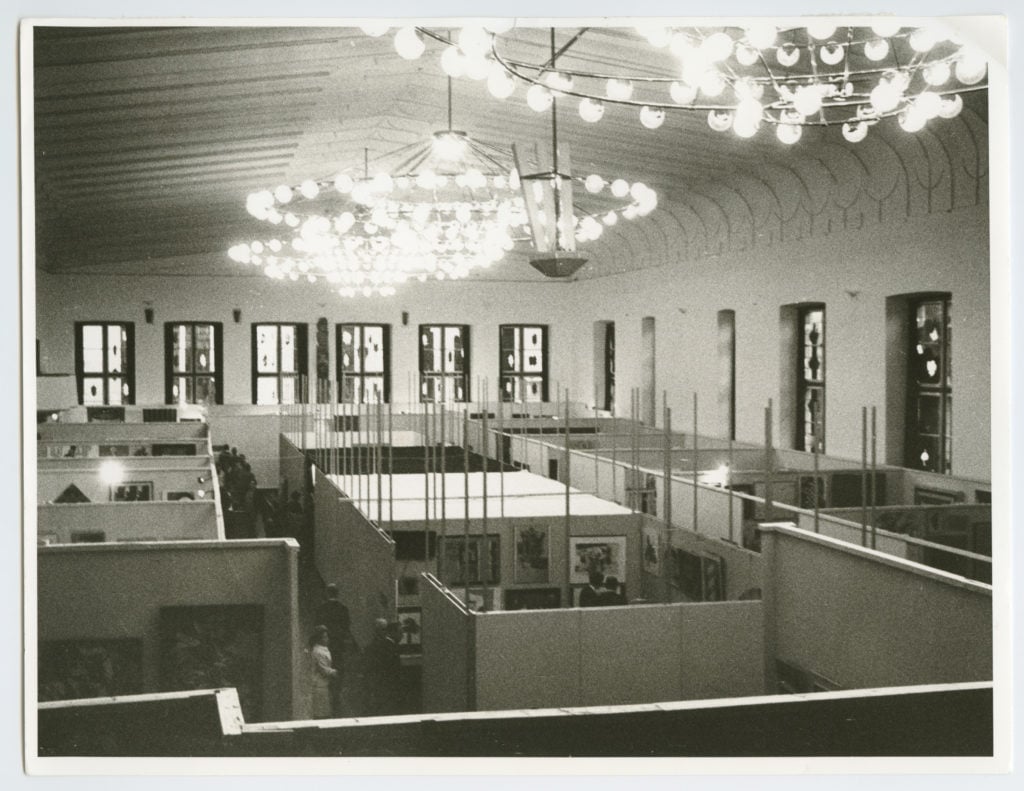
The first edition of Art Cologne, in
1967. Photo courtesy of Hans Neuendorf.
Yes, Art Cologne, the first art fair ever, which you
helped start in 1967 as the Kölner Kunstmarkt. What was the impetus
behind the fair?
It was because we were all separated in various cities—in
Stuttgart and Munich and Cologne—and we said we’d all come together
once a year so that collectors could go to one place and see what
is available in the art world.
One person who did a lot to get the fair off the ground
was Rudolf Zwirner, the father of the dealer David Zwirner. How did
you know him?
He was an old friend. I started working with him in
California—we were traveling together at the time and we did
exhibitions together. He was in Cologne, and Cologne was the city
where most of the activity in contemporary art was happening
because [Peter] Ludwig lived there. He was “the Chocolate King.” He
bought all these Pop art paintings, mostly from Zwirner. He was
voracious. He wanted everything, and he bought contemporary art,
mostly American. The Museum Ludwig in Cologne is now full of his
stuff.
So that’s why everybody went to Cologne and started a gallery
there. There was one gallery in Cologne called Der Spiegel, which
means “the mirror,” and it was run by Hein Stünke. He knew the
secretary of culture in the city, and he told him, “Wouldn’t it be
a good idea to invite all the galleries in Germany”—and there were
about 20 galleries in Germany, total—“to Cologne and have an event
here? It would be great for cultural life in the town.” And that
guy made it possible. So in 1967 we started the first Cologne Art
Fair. It was Stünke and Zwirner who figured it all out, and I was
there and some others who worked closely with Zwirner, and then we
invited others who were a little bit further away. Altogether it
became around 22 galleries, all from Germany.
So that’s how it happened, and then two years later [Ernst]
Beyeler thought this would be smart to do in Basel. At the time,
Germans were bringing their black money to Basel to deposit it
there, so he thought it would be a good idea to sell them some art,
because art is liquid, and you can ship it. Nobody was paying any
attention, because no one thought it was worth anything. So that’s
how Beyeler’s business evolved, with that German black money.
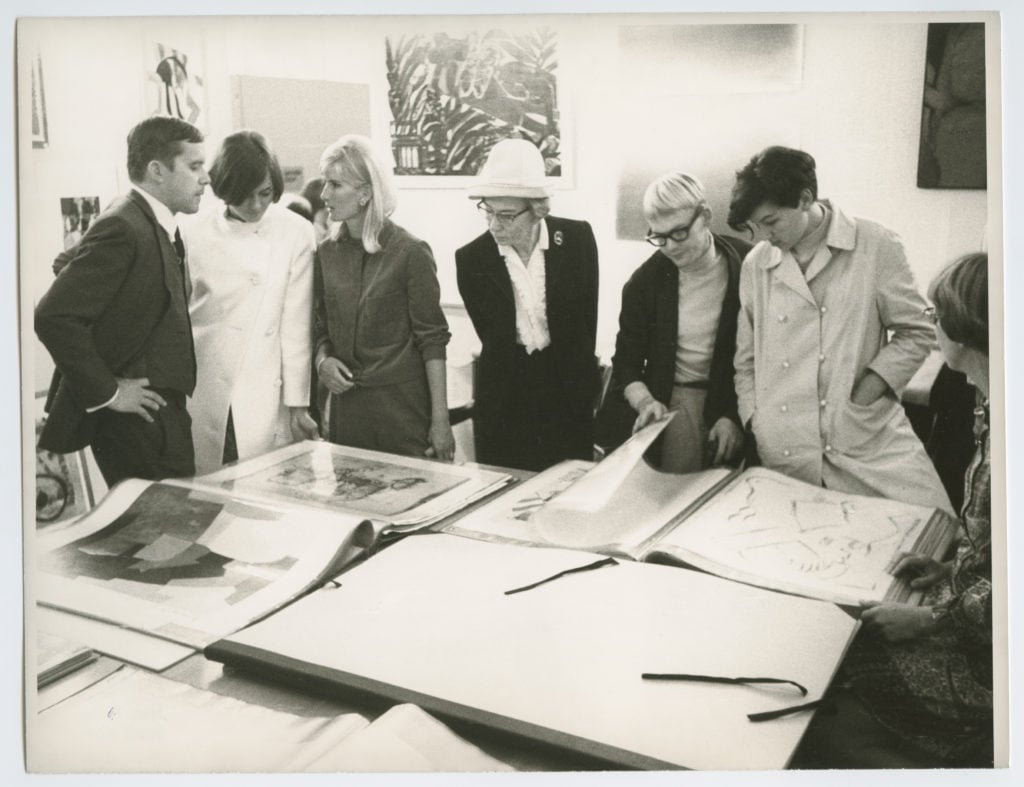
Visitors at the first Art Cologne. Photo
by Peter Fischer.
What do you mean by “black money”?
When you have a business, you can always do a little bit of
business on the side and take cash. Then the cash will accumulate,
and you say, “Well, what do I do with it?” You can’t even spend it
properly—you can’t buy property, because you have to prove where
the cash came from. So they haul it to Switzerland. It was tax
evasion. And then to convert it into paintings was a perfect
business idea. Beyeler thought so, at least. That was how Art Basel
came about.
So, back in Cologne, you had Ludwig, the Chocolate King,
who later went on to found the city’s remarkable Museum Ludwig. How
did you cultivate relationships with important clients like him and
other collectors?
I did exhibitions, and I sent out invitations to a few hundred
people in Hamburg and elsewhere—whoever I knew—and they would call
me or come to the gallery and look at the paintings, and sometimes
they would buy something. We had no other means of publicity. It
was completely unknown. It was really very innocent, and kind of
idiotic. Again, it was more of a cultural event than a monetary
event. I actually think that all the money that’s coming into the
art world now is really distorting the whole thing, to a degree
that is already very dangerous.
But you can’t put the toothpaste back in the
tube.
Yes, that’s true. But usually these things take care of
themselves eventually.
You say you didn’t have any publicity. How important
were the art critics to your gallery?
The critics were very important. We took them seriously, and
they were actually coming to every exhibition. They were writing
about it. That was a very good means of publicity. You’re bringing
up a topic I’m energized about. We don’t have any critics anymore,
honestly. Or hardly any, at least, because it doesn’t count for
anything. What’s important now is popularity, not quality. When
something is popular, it sells, and when it sells, the prices go
up. And then the press has a reason to report on it. That’s how the
art world functions nowadays. That’s very different even from how
it was when I started artnet. At the time, we were still innocent
and idealistic, but this money thing has completely ruined
everything.
Considering how much artnet helped accelerate the
market, you could say it’s the rule of unintended
consequences.
Yes. They call it collateral damage.
Let’s come back to that later. Returning to your story,
tell me about your LA experience. How did you meet David
Hockney?
David Hockney was showing with John Kasmin, the father of [art
dealer] Paul Kasmin. He had the best gallery in London next to
Robert Fraser, which was where the Rolling Stones would show up for
openings and all of that. Kasmin had Frank Stella and all the great
American artists, but he also had Hockney. Well, I wanted to buy a
David Hockney painting—I really liked his work, and I had met
him—so I went to Kasmin, who was really very cagey. He wanted to
sell the paintings himself at retail, he didn’t want to give me a
discount. So we had an unpleasant conversation about it, and he
said, “I don’t have any paintings. I can’t sell you any.” So it
didn’t happen.
Then, when I came to L.A., David was already there, and enjoying
himself. He had this blonde hair, you know, like “blondes have more
fun.” But I needed to get my driver’s license, because I needed to
rent a car—I wasn’t aware when I first went that you needed a car
there, so I didn’t bring my driver’s license. And I needed a car of
my own in order to pass the test, which I thought was kind of
funny. So I asked David, and I passed my driving test in LA in
David’s Ford Falcon. We got a ticket, actually, because I wanted to
get some ice cream from an ice cream truck across the street, and a
policeman gave us a ticket for $10. David was furious. He said,
“You have to pay for this.” I said okay.
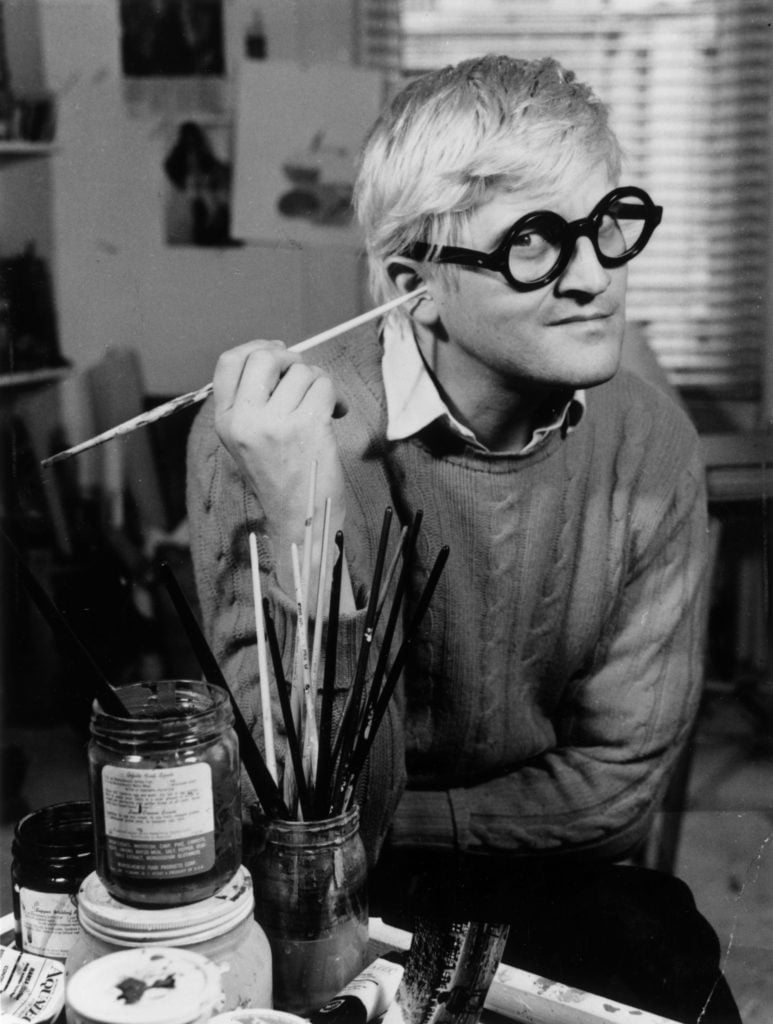
David Hockney in 1979. (Photo by Francis
Goodman/Getty Images)
That’s very funny.
So, David painted in Los Angeles, and his paintings were shown
at Landau-Alan Gallery, and I went there and saw five paintings.
Big paintings. You know, two boys in a swimming pool, boys under
the shower, then some of the buildings on Melrose, and the palm
trees. Exactly what you want. They were priced at between
$3,000 and $6,000, depending on size. I talked to the dealer and
said, “Can you give me a discount?” And he didn’t want to give me a
discount. I mean, David was in demand from day one. They knew they
could eventually sell them at retail. I said, “Okay, I’ll pay you
at retail,” and I bought all five of the paintings. Ever since,
David thinks I’m a really smart guy.
Do you still have them?
No, I don’t—unfortunately I sold them to people in Hamburg and
in other places. I’ve never heard of prices like what he’s selling
for now. I never actually thought they could become very valuable.
I just liked them.
His prices are extraordinary. Those paintings you bought
could be worth $300 million today.
Yeah. There was a guy who was a professor of biology who did
experiments with living rats, or something like that. I didn’t like
that very much, but he was a very serious man, and he came to my
gallery all the time. He wanted to buy a Hockney painting, and then
he wanted to buy another Hockney painting. But he couldn’t pay for
them. So I sold him one large Hockney painting for 12,000 D-Mark,
and he paid it off in monthly installments for one year. Then he
started on the other one, a swimming pool, which was also 12,000
D-Mark.
I don’t know how many million that is worth now. But what I
liked about this guy, who is very sick now, unfortunately, is that
he never sold them. He never sold any of the things that he bought.
He was very deliberate in what he liked and what he didn’t like,
and he lived with these things. He had built himself a little house
outside Hamburg, which is filled with the furniture that he had
used as a student. He has such a very modest way of living, and
he’s got these paintings up on the wall. I’m sure everybody has
been offering him millions for them, but he doesn’t sell them.
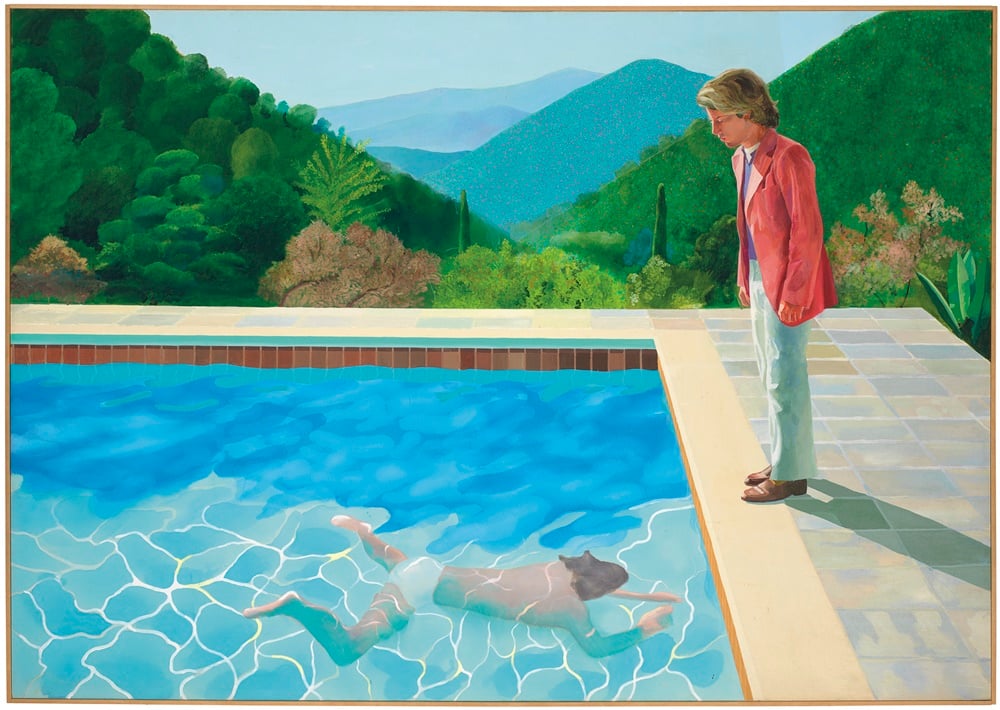
David Hockney’s Portrait of an
Artist (Pool With Two Figures), 1972, sold for $90.3 million at
Christie’s in November 2018. Courtesy of Christie’s Images Ltd.
Amazing.
And then he started buying [Georg] Baselitz. He was the first
one to buy Baselitz from me, and at the time you couldn’t give
Baselitz away.
This was your show of the “Hero” paintings?
Yes, he bought two “Hero” paintings from me, and other Baselitz
paintings, and then he started buying [Markus] Lüpertz, also. He’s
got quite a good collection.
Going back to LA, how long did you stay
there?
I stayed a month or so on my first trip when I bought these
Hockney paintings, and I agreed to exhibitions with several of the
artists the gallery was representing. One of them was Billy Al
Bengston and another was Robert Graham. There were other artists
who were there—Tom Holland, Ron Davis, and Larry Bell. They were
all my friends, and we agreed on these exhibitions, and then I went
back and started preparing a traveling exhibition of West Coast art
to show in the German museums. There was a little catalogue, too.
LA art was not very well known then, and still it’s not very well
known. It never really caught on in Germany. It was just a world
apart. Most of the stuff that I bought, I kept.
You know, a funny thing happened recently. I had just moved my
art to a new storage facility and I found a crate that was eight
feet long, and I opened it up and found two shimmering sheets of
glass. I didn’t know what it was, and someone came to visit me to
buy some paintings, and he saw these and said, “That’s Larry Bell.”
I said, “Really, you think so?” And I looked in my inventory and
found that, yes, there were two glass pieces that I thought had
been lost. So I took them out and I sold them to the guy for
$100,000 each. Later, I went to Larry and asked him, “So, what are
these?” and he explained how to install them like two shelves on a
wall and have a certain light shining down through them so that it
would create a rainbow both above and below.
And he told me, “You know what, it’s really rare that you should
have these.” They had been part of one of my West Coast traveling
exhibitions, and they had never been installed because I didn’t
know how to do it, and I forgot about them. Larry explained that
when he made them, he had actually made several, and he had them
all lined up on the wall when a small earthquake hit and they all
fell down and shattered. So this is how my two became very
valuable, because they were the only ones that didn’t break,
because they were in Germany for the show. Funny, isn’t it?
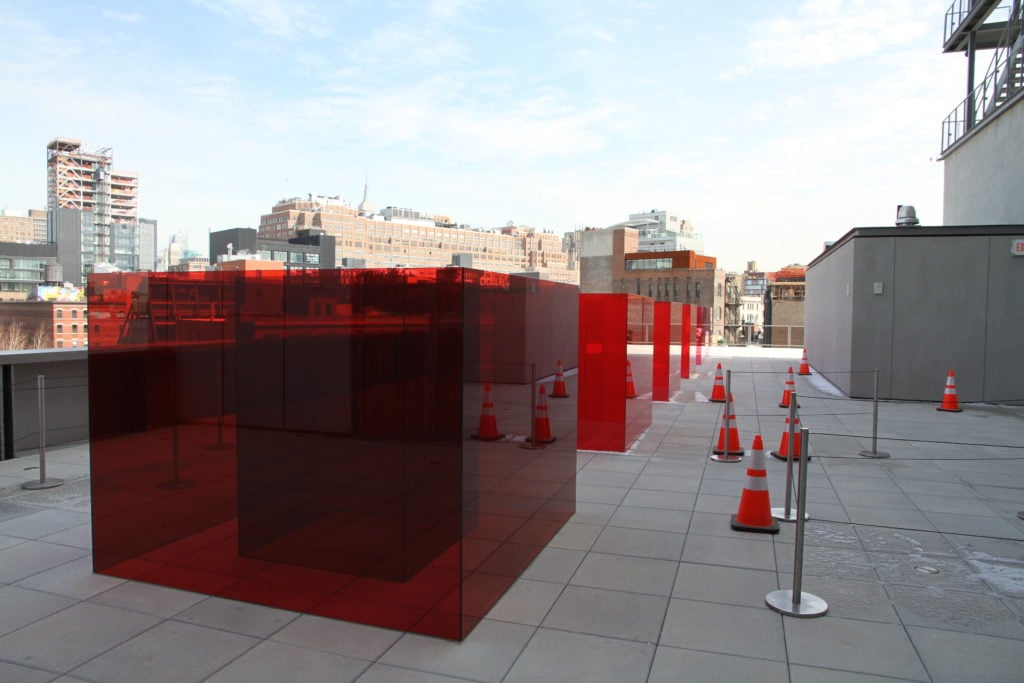
Larry Bell’s Pacific Red (2016)
on view at the Whitney Museum. Photo: Henri Neuendorf.
How big is your collection today?
I have a whole roomful of stuff, mostly artists who are not very
well known anymore. Because during the time I was building artnet,
I needed money all the time, so I sold everything that was
valuable.
Well, it sounds like one thing you have learned over the
years is that if you hold onto something long enough, it could be
worth something one day. Maybe the rest of your collection just
needs more time.
Who knows?
When you were building your gallery, how did you keep
your inventory and your own art collection separate?
I didn’t. I didn’t keep artworks because I was speculating on
their future market—I kept them because I couldn’t sell them. Now,
some of them have been rediscovered, like Larry Bell. His market
was pretty dead for a long time, 20 years or so, and it’s coming
back in a big way. So it can happen, but I’ve seen other artists
that have been forgotten completely. It’s not working the way it
used to anymore. Like I said, it’s popularity that counts now, not
quality.
The post The Story of artnet, Part 2: How Founder Hans
Neuendorf Helped Invent the Art Fair in a More ‘Innocent’ Time
appeared first on artnet News.
Read more https://news.artnet.com/the-big-interview/hans-neuendorf-story-of-artnet-interview-part-2-1664434
Further reading


Leave a comment