
The US–China Trade Agreement Has Been Hailed as a Boon for Business—But Buyers Will Still Have to Pay Steep Tariffs on Chinese Art
In Washington last
week, the US and China
finally agreed on the first phase of a trade deal that effectively
ends a 20-month standoff between the two countries.
But for US business owners
hoping the pact would ease inflated tariffs—including those on Chinese art and
antiques—the news came as a
letdown.
Whereas the new deal lays out
stipulations for increased trade, it does not eliminate or decrease
the 15 percent import tax that the Trump administration slapped
onto $120 billion worth of Chinese goods, including art objects,
last September.
For many, the lack of tax relief
was especially surprising given the announcement made by the Office
of the US Trade Representative (USTR) last December, after
President Trump reached an initial handshake agreement with China,
promising that the tariffs would be modified
in a “significant way.”
A fact sheet attached to the announcement said the
15 percent tax would likely be
sliced in half, to 7.5 percent.
“I was not surprised to hear
that Chinese art was not among the categories given some relief in
the recent US–China trade agreement, but of course I was
disappointed,” says James Lally of New York’s J.J. Lally & Co. Oriental
Art. “I now expect art
and antiques may not be addressed until higher-value categories of
trade all have been settled.”
Lally is among a group of trade
insiders who have been particularly vocal about their
opposition to the tax. In November,
immediately after the three-month window for exclusion
applications opened, Christie’s filed a request to be exempted from the
tax. Zetterquist Galleries, a 28-year-old enterprise
that specializes in Asian ceramics, followed suit later that month,
while Sotheby’s sent its own request in December. Lally’s gallery
has also filed.
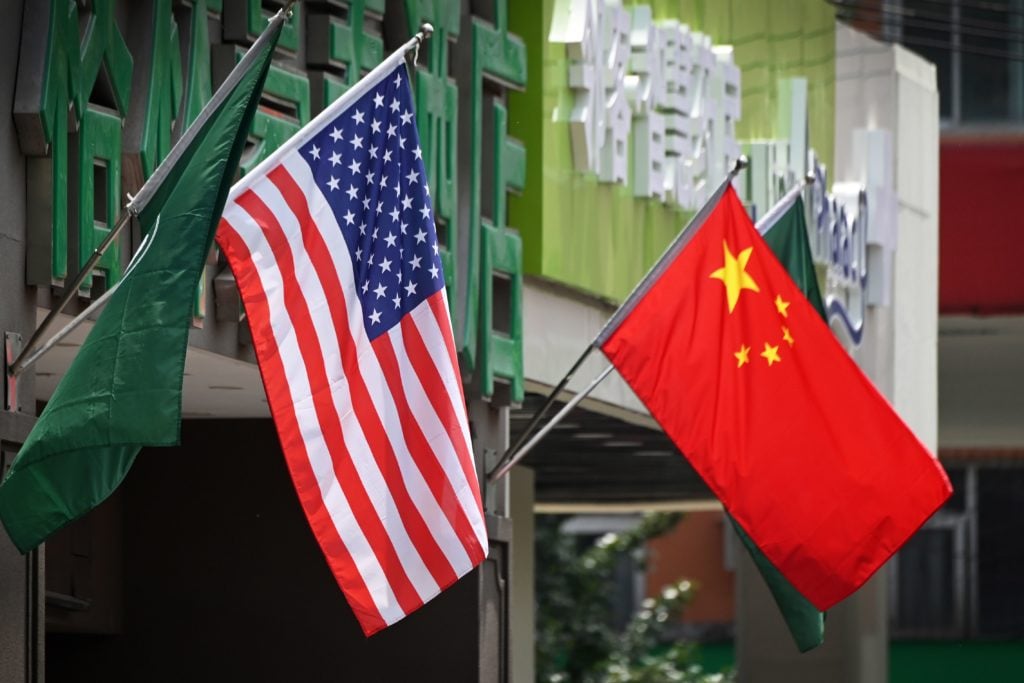
The US and Chinese flags displayed
outside a hotel in Beijing. Photo: Greg Baker/ AFP/Getty
Images.
At least six other galleries and
trade organizations, including New York dealer Michael C.
Hughes, Sante Fe
gallery TAI
Modern, and the
British Antique Dealers’
Association, have
submitted replies in support of Christie’s and Sotheby’s public
filings.
The window for applications
closes on January 31. As of now, none of the businesses that
requested exclusions have heard from the USTR on whether they’ve
been granted their requests.
“The USTR may respond at any
time it chooses to do so,” Lally says. “No one knows
when.”
The fear among dealers is that the tariffs will simply send
business out of the US and back to China.
“If the intention of the tariff
is to have a negative effect on the Chinese economy, it will
achieve the opposite outcome since the tariffs will only help China
to consolidate its control over the international trade in Chinese
antiques,” says Amy Weber, director of communications at TAI
Modern.
“I understand these tariffs are
intended to force China to the bargaining table on larger issues
related to the economy,” says Katherine Martin, director of
New York’s Scholten Japanese Art. “However, these tariffs are having the opposite
effect and are hurting the United States’s standing as a leader in
the international art market and [the tariffs will] drive business
elsewhere.”
The post The US–China Trade Agreement Has Been Hailed as a
Boon for Business—But Buyers Will Still Have to Pay Steep Tariffs
on Chinese Art appeared first on artnet News.
Read more https://news.artnet.com/art-world/art-market-us-china-trade-deal-1759878
Further reading


Leave a comment