
There’s Real Magic in Agnes Pelton Occult Paintings, But Not the Kind You Think
Consider two paintings.
One is Mother of
Silence (1933), by the early 20th century
spiritual-abstractionist painter Agnes Pelton. She is the star of a
show that has just arrived at the Whitney Museum, part
of a wave of recent interest
in experimental art by previously unsung or undersung female
artists working in esoteric or occult traditions, a vogue that is
currently rewriting how museums
approach the history of modern art.
Mother of
Silence centers on a cluster of numinous blobs in pale
lavender, pink, and turquoise pastels, set off against a red and
black background and wreathed by precisely organized whorls of
energy. It suggests the form of a seated Buddha.
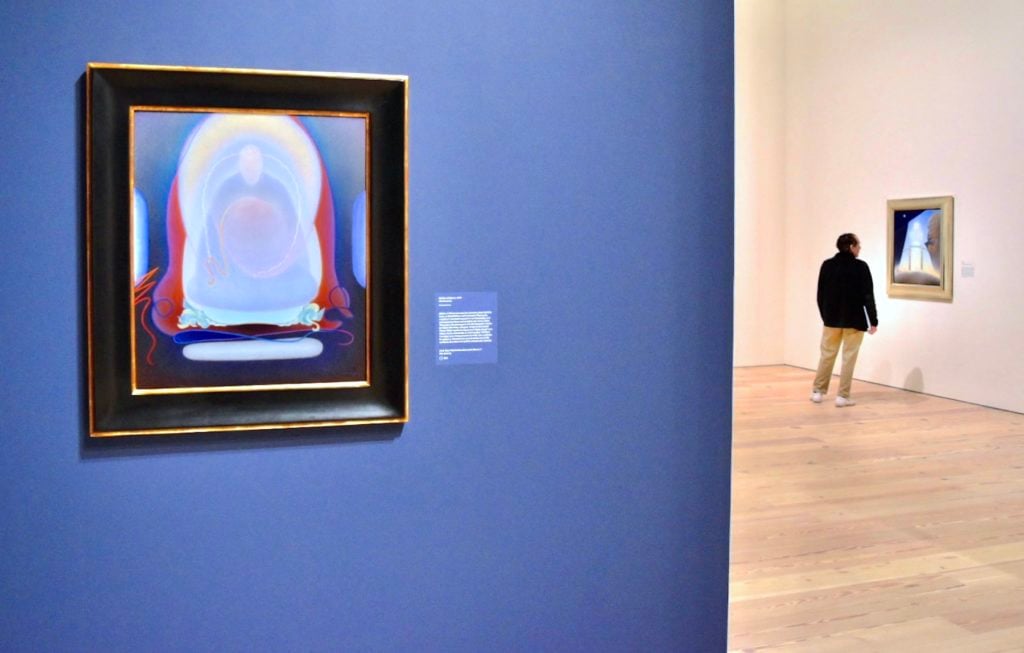
Installation view of Agnes Pelton,
Mother of Silence at the Whitney. Image: Ben Davis.
Now consider a painting not in the
show, Mother of the
World (1924), by the Russian painter, set designer, adventurer, and
mystic
Nikolai Roerich. In rich tones and flattened perspective, it
depicts the veiled figure of the ultimate female goddess in
Roerich’s occult system, seated on her mountain throne and framed
by divine halos.
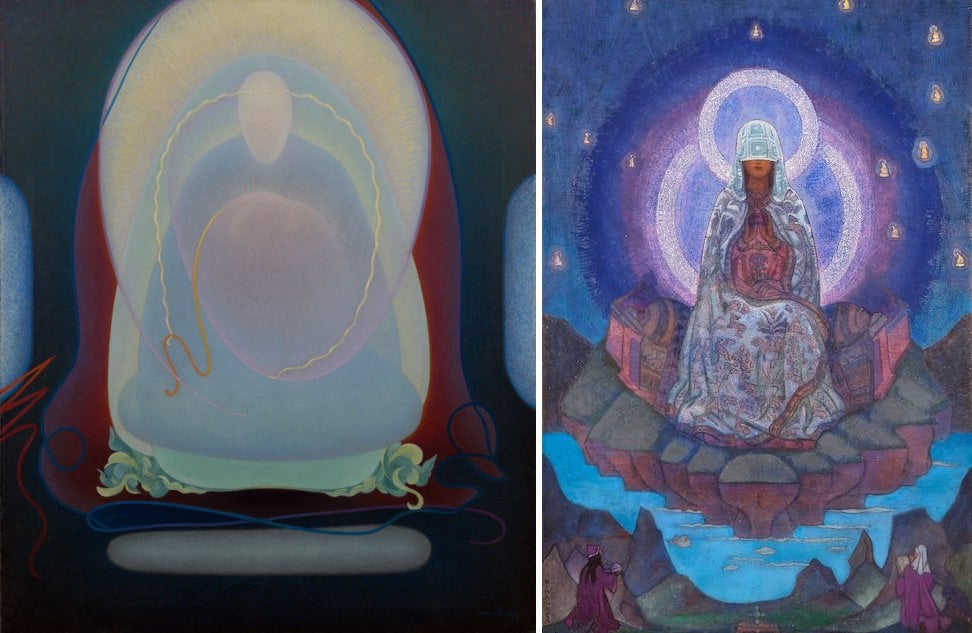
Left to right: Agnes Pelton, Mother
of Silence (1933) and Nicholas Roerich, Mother of the
World (1924).
Look at the two together and you get
a clear sense of the kind of archetypal image that Pelton is
adumbrating in her abstraction. I have no idea if Pelton is
referencing this exact image. However, both she and her art both
were deeply inspired by Agni Yoga, the doctrine that Nicolas
Roerich and his wife Helena dreamed up in the 1920s, claiming to be
channeling Eastern wisdom through spiritual séances.
Indeed, one of the rare figurative
works in the Whitney show—and a slightly unsettling beat in its
otherwise serenely otherworldly
atmosphere—is Intimation (1933). This is Pelton’s
portrait of Nicolas Roerich, rendered in gauzy, unearthly colors
and full guru style, his beady-eyed gaze transfixing the
viewer.
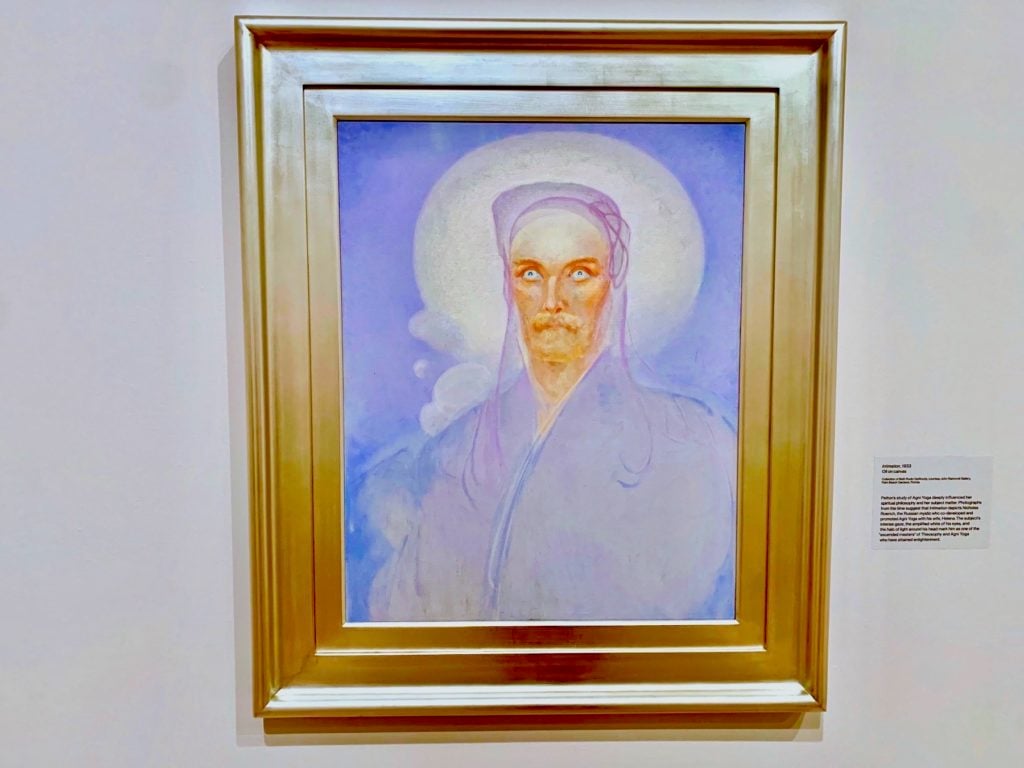
Agnes Pelton, Intimation
(1933). Image: Ben Davis.
“Agni Yoga” meant “Path to the
Divine Fire.” The Roerichs’ doctrine celebrated fire as the symbol
of the energy animating all fixed things and all forms of wisdom,
“the essence of the entire life, all-embracing, evading nought.”
The veiled goddess of goddesses in Nicolas Roerich’s painting was
conceived as his ultimate unifying symbol of the divine light,
whose energy, he preached, would be at last unveiled when the
coming “Age of Fire” dawned. Then, as the Handbook of the
Theosophical Current explains, “fiery energies will
move toward the sphere of the Earth to purify it from a surrounding
heavy atmosphere caused by the crimes committed by
humans.”
In any case, these two works merit two linked comments, one
formal, one symbolic.
The formal one is that Roarich’s painting clearly draws on
Russian orthodox icon depictions of the Virgin, given a fanciful
Buddhist-accent makeover. This conjugation makes sense, since Agni
Yoga’s ideas were syncretic, promising to reveal the common secret
wisdom at the root of all religions. Pictorially, however, it takes
us towards devotional cliché.
The modernist abstraction of Pelton’s Mother of
Silence, on the other hand, makes for a quietly more awesome
spin on the subject of a spiritual presence.
And at the same time, Pelton’s Mother better fits what
I take to be both works’ underlying idea: a goddess figure who
incarnates the protean energy at the root of all earthly things.
The miasmic, dreamy character of the Pelton painting is far more
evocative of that idea than the deliberately stiff, folk art style
of the Roerisch one.
The student surpasses the master here, or the acolyte outshines
the guru.
***
“Agnes Pelton: Desert Transcendentalist,” which began at the
Phoenix Art Museum, features 40-odd paintings by Pelton, of the
only 100 or so abstractions she made during her life. She made
figurative art too, tourist-friendly California landscapes (she
actually called them “Tourist Paintings”) that she sold to support
herself when money got tight during the Great Depression, but none
are here. It was her more modernist works that she considered her
calling.
“Always do ‘this’ work first, others only when these do not call
you,” Pelton advised herself in her diary of the abstract works.
She arrived at their forms via extensive meditation and trance,
creating exact sketches of the seemingly aleatory constellations of
forms and symbols that came to her in her notebooks before
rendering them to canvas.
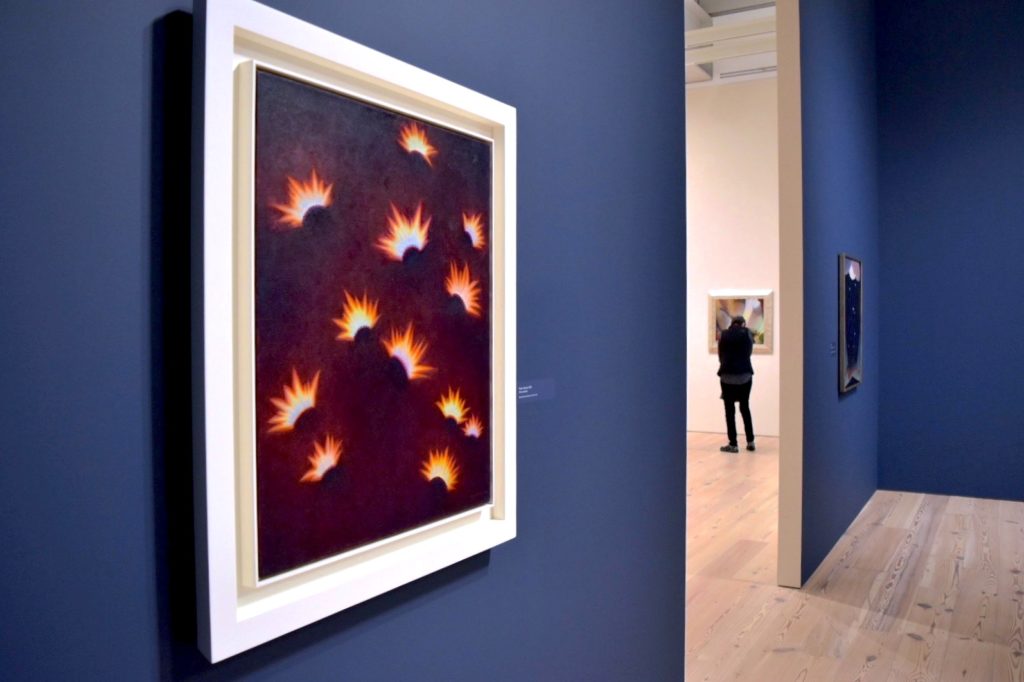
Agnes Pelton, Fires in Space
(1938). Image: Ben Davis.
Without knowing anything about Agnes Pelton’s story, you would
likely guess something about these paintings’ subject matter:
solitude (by dint of their evocations of empty landscapes); healing
(because of their gentle, nourishing color palette); and mysticism
(because of their many occult symbols: evening stars, floating
portals, roses, swans, lotus flowers, magic mountains, holy
deserts, “windows of illumination” opening in space, and flares of
the divine Roerichian fire breaking into reality).
Still, it’s worth knowing a bit about Pelton’s life story. Born
in 1881, she was raised in the shadow of 19th-century Brooklyn’s
most infamous sex scandal, the Beecher–Tilton Affair. Her
grandmother, Elizabeth Tilton, had been exposed as having an affair
with liberal preacher Henry Ward Beecher. Her grandfather, once a
devout Beecher acolyte, sued for “alienation of affection.”
Doubling his humiliation, he lost in court, and was estranged from
the church and from Brooklyn society.
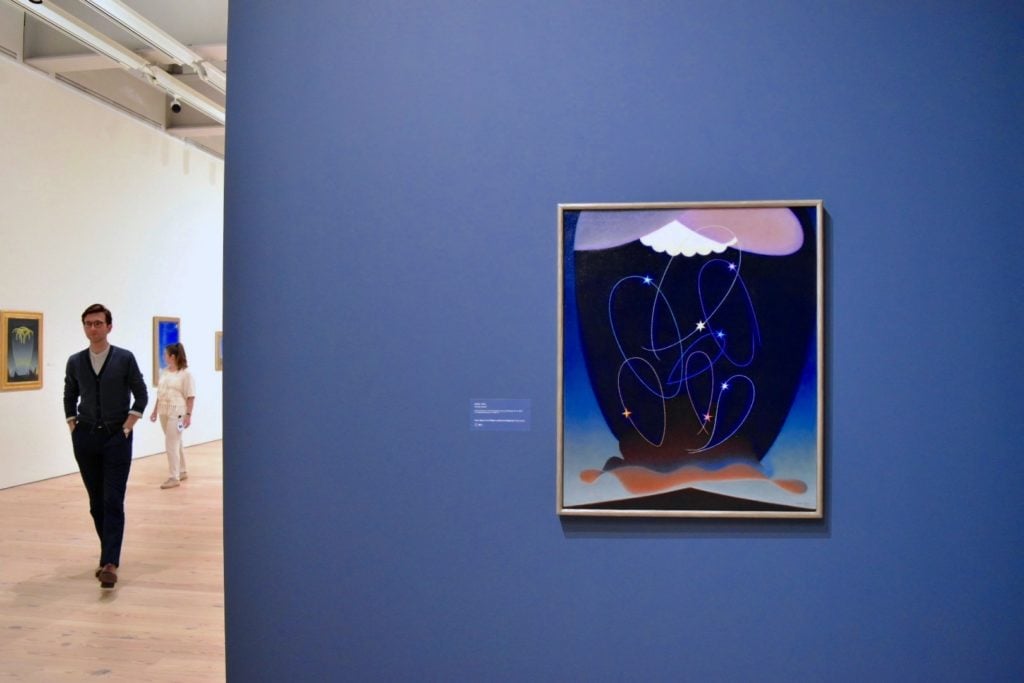
Agnes Pelton, Orbits (1934).
Image: Ben Davis.
Of her family’s heritance of infamy, Pelton would remember that
“it cramped our whole life and it also cramped mine…. [it]
overshadowed me.” Her mother (who had been the one to report the
infidelity) married a wealthy but troubled man from a Louisiana
sugar empire. He died of morphine overdose in 1891. Young Agnes
grew up “inclined to melancholy and tears,” surrounded by “deeply
religious and perhaps unnecessarily serious people.” She was
diagnosed with “neurotic fever” at 19, and may have had an eating
disorder.
Pelton would find comfort in two things. One was art, which she
studied at Pratt starting at 16, going on to paint portraits for
money, and Symbolist-inspired canvasses out of passion. She would
show at the 1913 Armory Show, the sensational survey that
introduced ideas of modern art to still-provincial USA (Marcel
Duchamp’s Cubistic Nude Descending a Staircase was the big
succès de scandale). There, Pelton’s work appeared alongside major
names from future art history textbooks like Charles Sheeler and
Marsden Hartley.
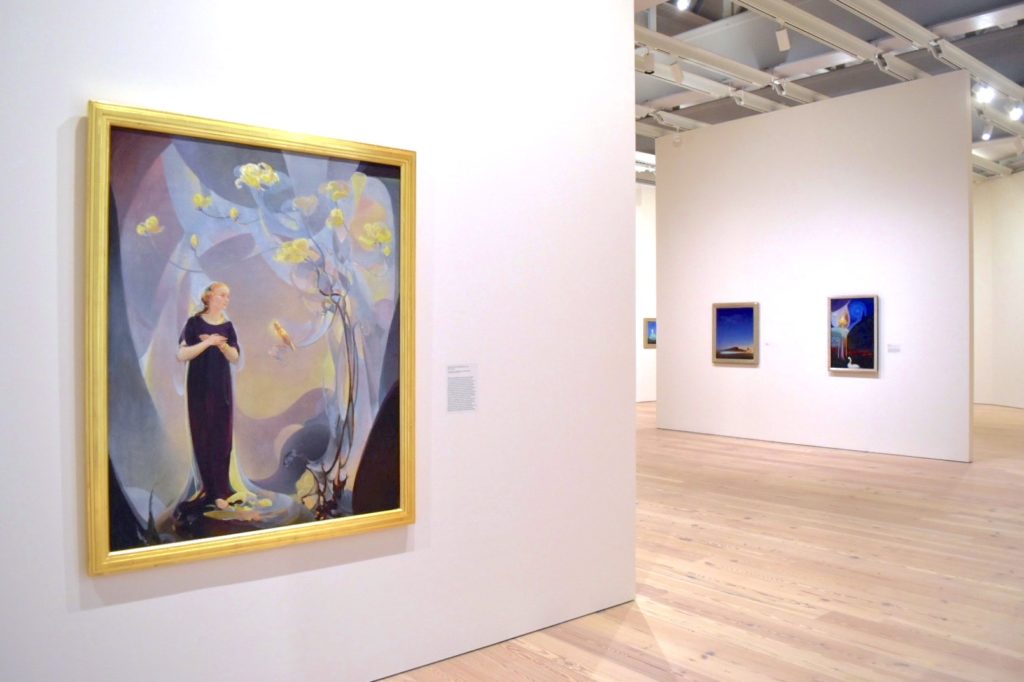
Agnes Pelton, Room Decoration in
Purple and Gray (1917). Image: Ben Davis.
The Whitney features just one introductory example that gives a
taste of Pelton’s early Symbolist mode of the 1910s, her
“Imaginative Paintings.” It’s a large canvas—her largest, actually
a painting for a mural—featuring a woman walking amid a secluded
woodland scene that has a swirling, animate character. It skirts
Symbolist kitsch (her own later judgment on these early works is
that they were “insincere” and “not real”).
Nevertheless, the idea of the solo female seeker in communion
with natural and cosmic forces was the foundation of all the more
experimental work Pelton did—though a theme she would elaborate in
less and less literal ways.
***
Pelton’s other comfort was alternative spirituality. In the
1920s, in her 40s, her mother died and she left New York to live in
a windmill house on Long Island. She also developed a yen for
Theosophy, the epiphanic slurry of pan-religious beliefs pioneered
by Russian émigré and occult entrepreneur Helena Blavatsky. It was
under the influence of Theosophical beliefs in accessing an
abstract “Divine Reality” at the root of all reality and thought
that Pelton began her experiments in abstraction, such as the
The Ray Supreme (1925) and Being (1926), which
suggest images of spiritual vibrations.
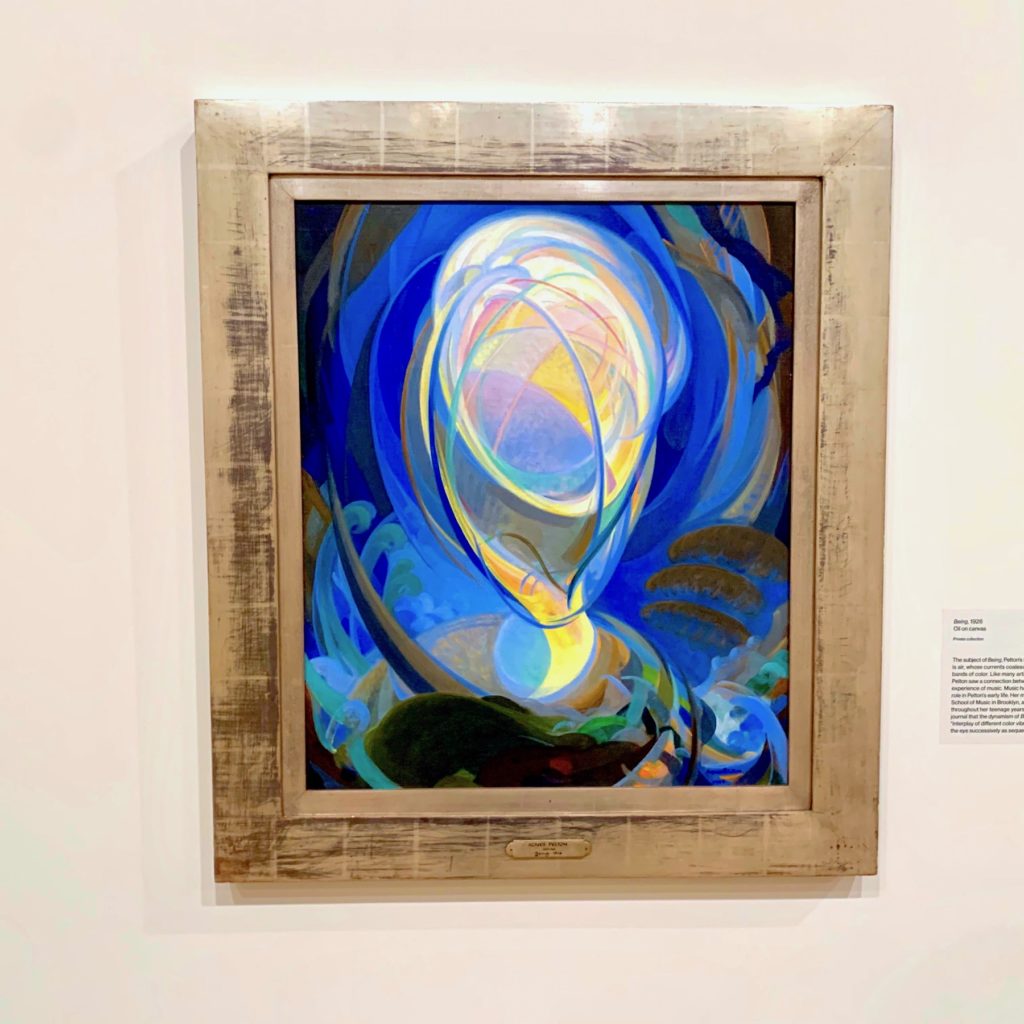
Agnes Pelton, Being (1926).
Image: Ben Davis.
Her best works, however, are from a little later. In 1930,
through an acquaintance with composer and “transpersonal
astrologer” Dane Rudhyar, Pelton would
discover the Roerichs’s Agni Yoga doctrine, a heretical elaboration
of Theosophy that, in addition to spinning pages of alluring hokum
out of the transcultural significance of fire, stressed self-help
and moral improvement through spiritual living.
The Roerichs’ tome, Leaves of Moyra’s
Garden, advised the reader: “In creation realize the
happiness of life, and unto the desert turn thine eye.” In 1932,
Pelton complied literally, moving West to Cathedral City,
California, near Desert Hot Springs, where she found both the
solitude in which she had always longed to work, as well as the
community of others with similar esoteric interests.
Her first painting after her arrival literally “turned its eye”
to the desert to find happiness: it depicts a floriform window of
divine light, piercing through a sandstorm, conjuring a hardy,
healing rainbow.
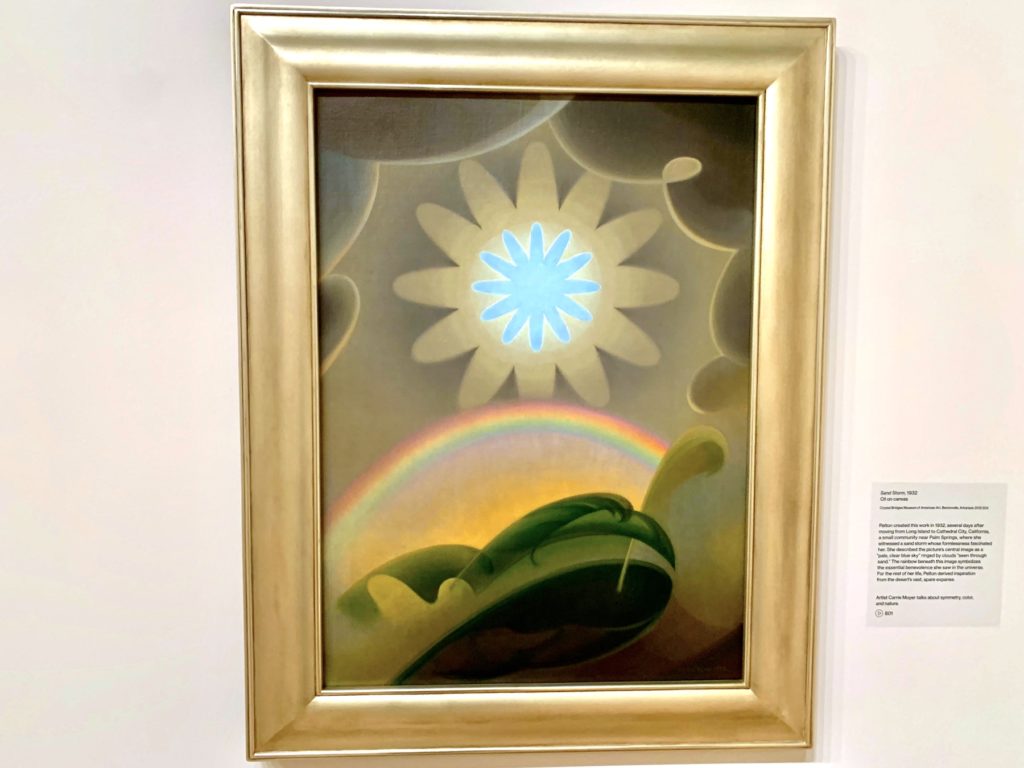
Agnes Pelton, Sand Storm
(1932). Image: Ben Davis.
How to look at these paintings, with their wonky, hieratic
quality? Part of their appeal is their exotic sense of marshaling
secret totems and magical signs, but a lot of their esoteric
symbolism remains remote. I also think the search for a master code
might miss the point of the imagery for Pelton herself.
Pelton’s family history had been scarred by the rigidity,
coldness, dogma, and moral judgementalism of New York’s Gilded Age
religious society. Aside from offering the spiritual warmth of a
literal fire cult, proto-New Age philosophies like Agni Yoga
appealed because they were notably eclectic—they encouraged
curiosity in the whole panoply of world religions, and you could
take from them what you wanted, in a highly personal way.
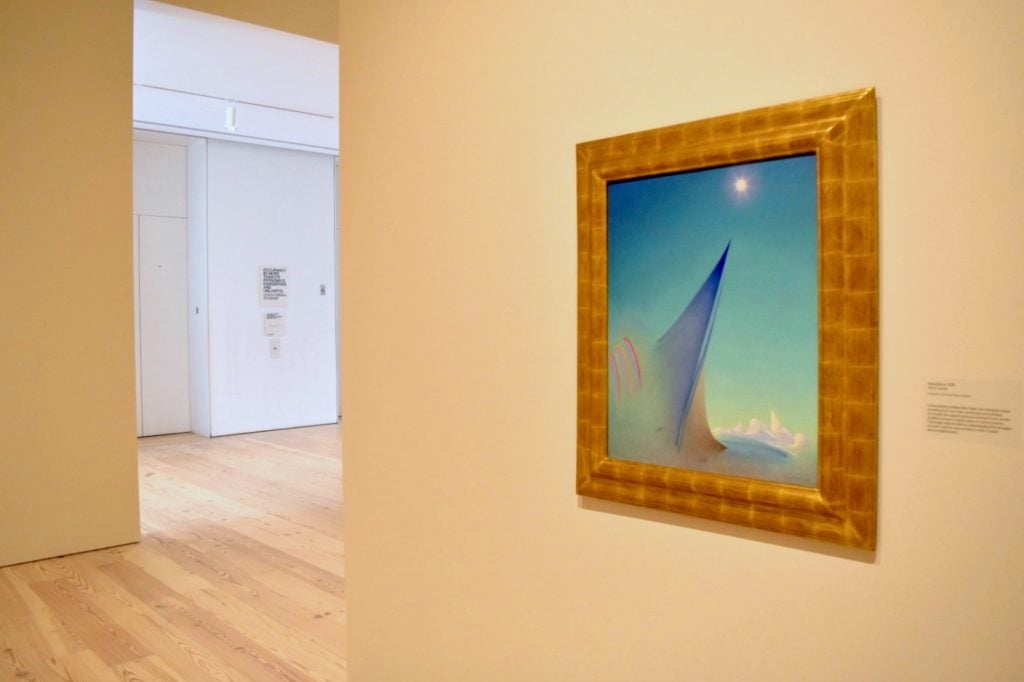
Agnes Pelton, Resurgence
(1938). Image: Ben Davis.
Pelton seems to have read deeply and widely and forged her own
synthesis to meet her own devotional needs. As much as Mother
of Silence evokes Roerich’s goddess of divine fire, for
instance, it also seems to have been for the artist an avatar of
her own mother’s spirit as well. In Pelton’s California studio, she
kept the canvas near her, to commune with its spirit for advice on
painting and to give her comfort in times of money woes.
In their day—the day of high modernism, after all—the appealing
aspect of these modern occult philosophies was the sense of
metaphysical order and higher truth, alongside the freedom from old
religious rigidities and the ability to make one’s own path. This
balance is coded into the formal vocabulary of Pelton’s canvasses.
Her art gives a comfortingly ordered, hieroglyphic form to symbols
of protean, unbounded spiritual potential: holy fire (Mount of
Flame, 1932), swelling oceans (Sea Change, 1931),
rippling atmosphere (Red and Blue, 1938).
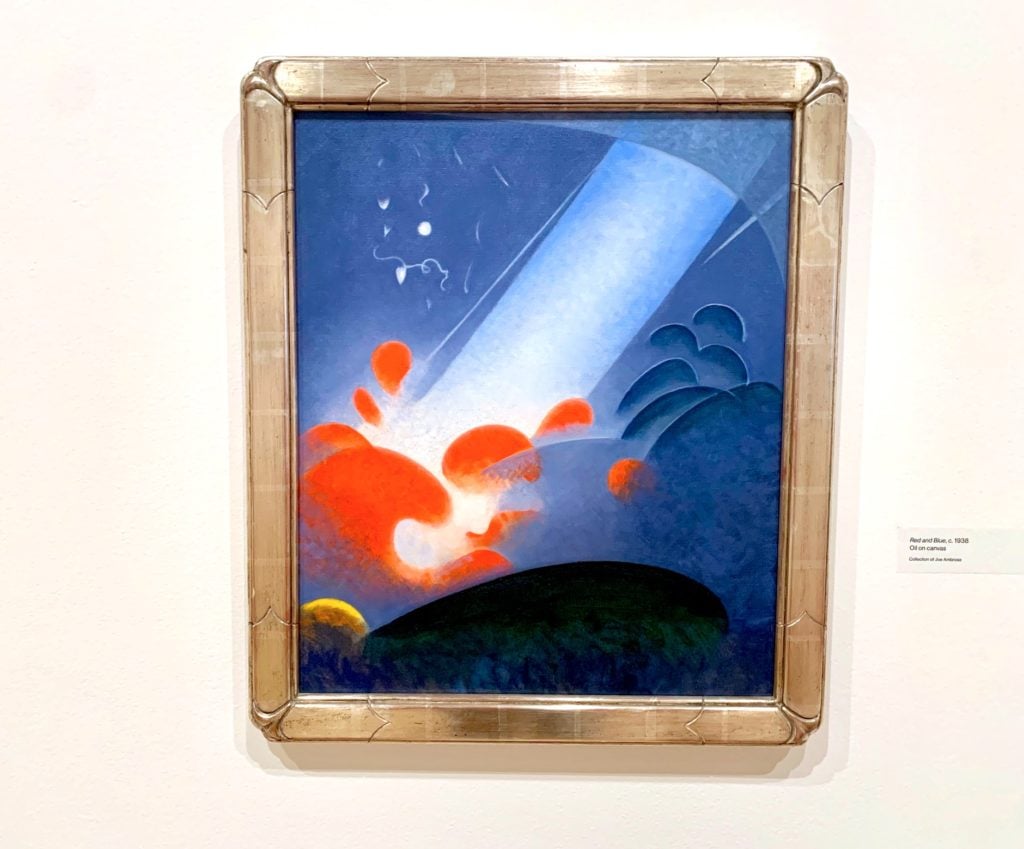
Agnes Pelton, Red and Blue (ca.
1938). Image: Ben Davis.
What is true within the canvasses is also true between them:
Pelton’s art embodies a protean spirit in that she never really
repeats an idea.
There is, clearly, a signature mix of abstract forms, allusions
to landscape, and far-out symbolism. But each composition is
distinctly a new idea—and you can’t help but imagine that the
singularity of each is part of what each symbolizes, and that this
is part of how Pelton’s art signifies for her that she was in touch
with the energy that always changes, that doesn’t degenerate into
doctrinal formulae, that carries her away from the world’s fixed
hardships.
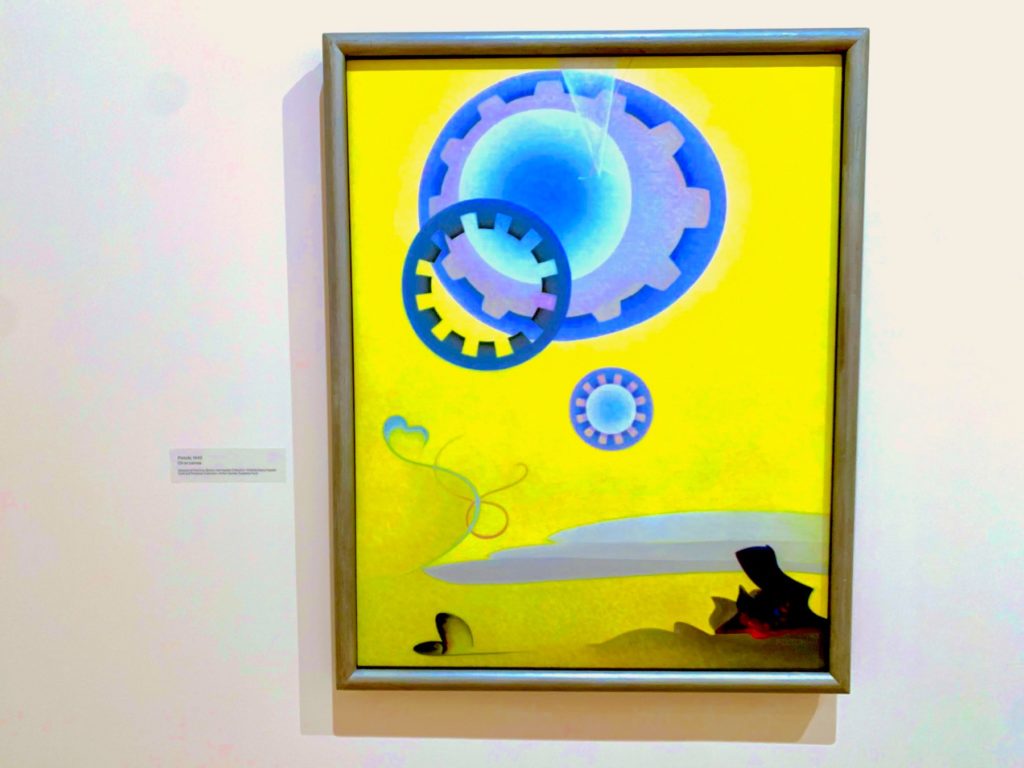
Agnes Pelton, Prelude (1943).
Image: Ben Davis.
Again, formal and symbolic pleasures align here. This restlessly
questing spiritual imperative is part of what makes Pelton’s art a
font of pleasant surprises. Just when you think you’ve got her
style figured out, there appears something like Prelude
(1943), with its saffron sky blossoming with floating gear shapes.
Where’d that come from?
***
Maybe all this is just to say that as much as Agnes Pelton’s art
answered a spiritual call and an inner necessity, she also was a
trained artist and brought an artist’s instinct for formal
freshness to her quiet desert studio.
Though she did not experience huge success in her lifetime,
Pelton showed her spiritual-abstract works at such non-arcane
institutions as the San Diego Museum of Art, San Francisco Museum
of Modern Art, the Crocker Art Museum, and the Santa Barbara Museum
of Art. She certainly seemed to have believed that she was bringing
into the world images with a higher mystical significance, but
unlike more mediumistically inspired artists, Pelton signed her
finished canvasses with her name, at the bottom corner, like
someone who expected to be recognized.
Still, a small reason exists to think that constant change was
the symbolic life force of Pelton’s art. Throughout the decades of
her oeuvre as seen at the Whitney, she never repeats herself—except
once.
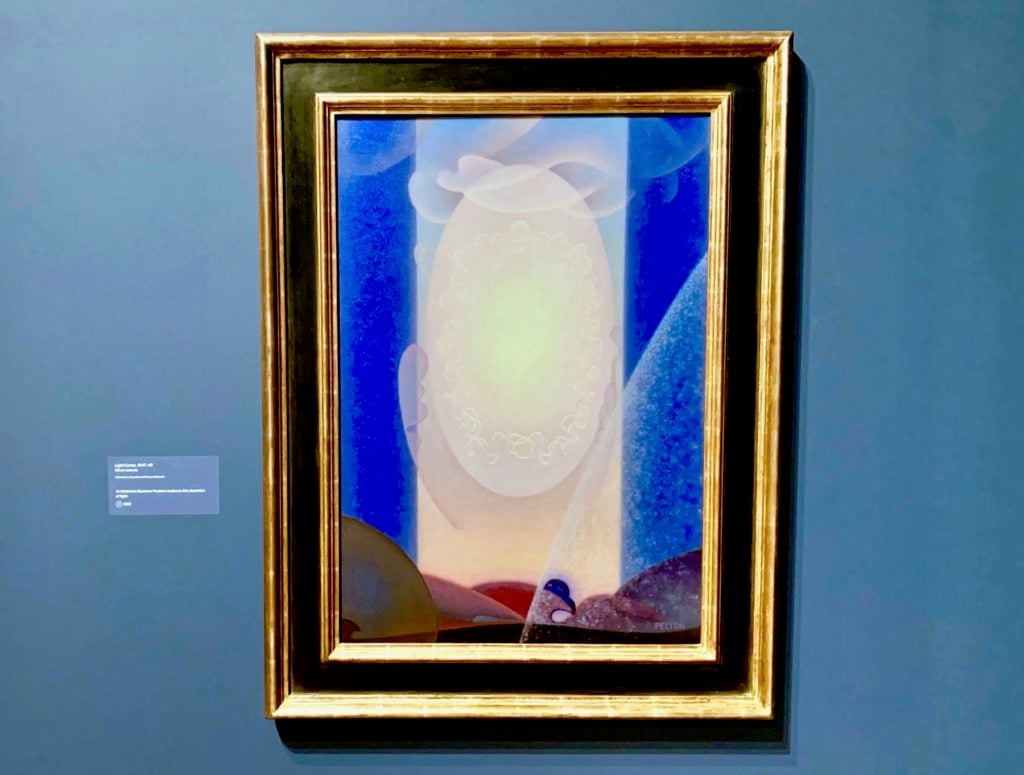
Agnes Pelton, Light Center
(1947-48). Image: Ben Davis.
In 1947-48, Pelton made a work called Light Center, a
hovering ovoid of energy suspended between an animate, rippling
earth and a gauzy, serenely agitated sky.
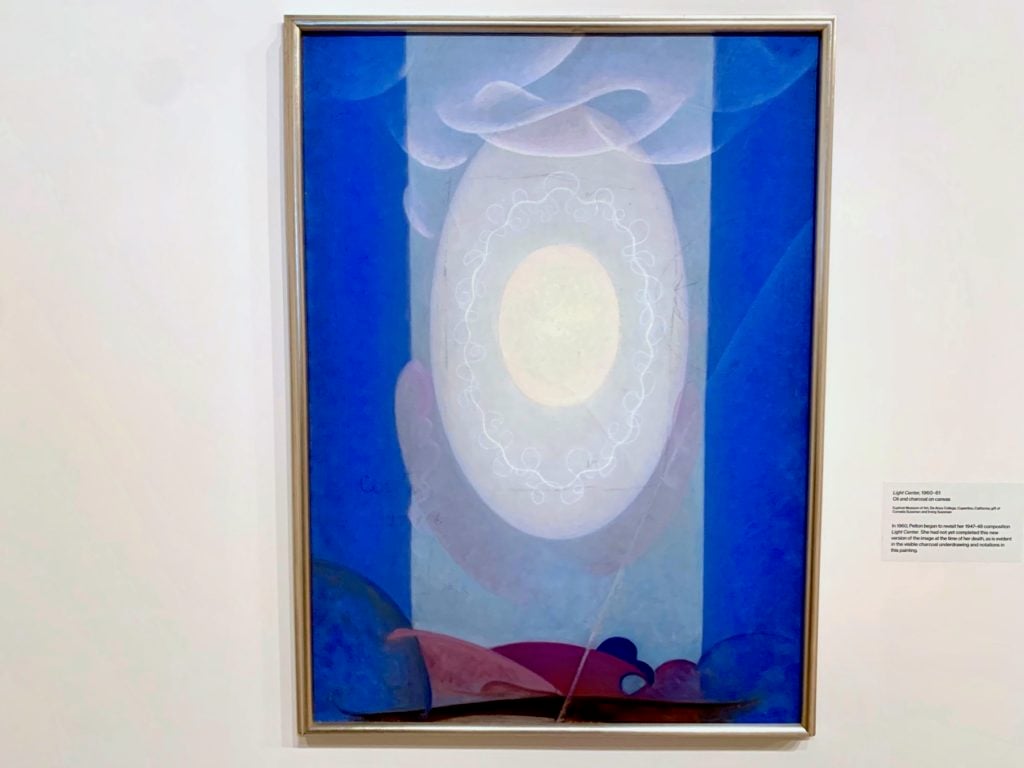
Agnes Pelton, Light Center
(1960-61). Image: Ben Davis.
In 1960-61, she repeated the same composition, clearly. There
are charcoal lines on the canvas still, where you see her trying to
plot how exactly to tweak the image to make it repeat. They remain
on the work because she died before she finished it.
Who knows why she turned, at that moment, to her own art for
inspiration instead of to the spirits. But it is a beautiful
thought that someone who had been looking for wisdom from the
beyond, at the moment when she merged with it, finally let herself
take inspiration from herself.
“Agnes Pelton: Desert Transcendentalist” is on view at the
Whitney Museum of American Art, through September 1, 2020.
The post There’s Real Magic in Agnes Pelton Occult
Paintings, But Not the Kind You Think appeared first on artnet
News.
Read more https://news.artnet.com/exhibitions/agnes-pelton-at-the-whitney-1802346
Further reading


Leave a comment