
This Artist Is Commandeering a Civil War Statue in New York to Celebrate the Resilience of Refugees
A monument to Admiral David Glasgow Farragut has been standing
wordlessly in New York City’s Madison Square Park since 1881, but
next month the Civil War veteran will have plenty to say. The
historic Augustus Saint-Gaudens sculpture will temporarily host
Monument by contemporary artist Krzysztof Wodiczko, an
installation that projects videos of resettled refugees onto the
larger than life-sized figure.
“With the use of projectors and projection mapping technology I
am turning the silent and motionless monument into the speaking and
performative monument to the refugees—the forgotten or
unacknowledged civil war heroes,” Wodiczko told Artnet News.
The 30-minute video loop will be screened onto the Farragut
monument every evening between January and May 2020. Wodickzo’s
work shows refugees from countries such as Syria, Somalia, and
Guatemala describing why they left home, describing their journeys
and the difficulties of building a new life. To create the
installation and connect with his subjects, Wodiczko received help
from Refugee Council USA and Integrated Refugee and Immigrant
Service.
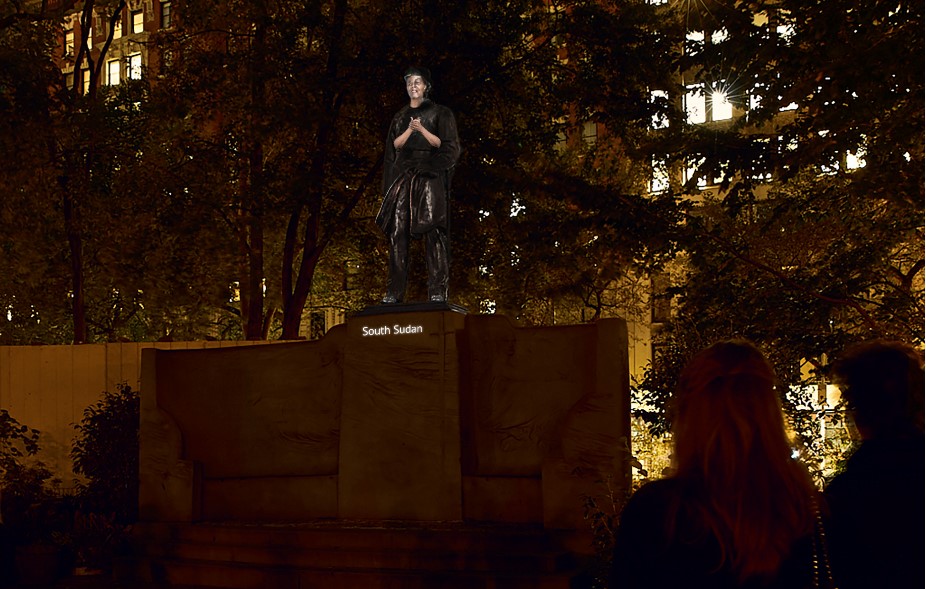
Rendering of Monument by
Krzysztof Wodiczko. Courtesy of the artist and Madison Square Park
Conservancy.
The Farragut statue was New York’s first Civil War monument, and
stands on a semi-circular platform designed by architect Stanford
White. Among other things, Farragut was famous for yelling “damn
the torpedoes” as his troops battled Confederate forces at Mobile
Bay, and releasing New Orleans from Confederate control.
Though Farragut stood on the right side of history, Wodiczko’s
installation challenges the notion of who is worthy of public
monuments. The very term monument, he explains, comes from words
“that mean a warning, and to be mindful.“ He thinks of the 70
million refugees around the world today as their own sort of
“functional monuments,” in human form.
Wodiczko, who is the head of the Interrogative Design Group at
Harvard University’s Graduate School of Design, has realized over
90 public projections and installations around the world that often
bring marginalized communities to the forefront. Some of his
previous projects have involved projecting images of Hiroshima
bombing survivors in Hiroshima Peace Memorial Park, and overlaying
Vietnam and Iraq war veterans onto an Abraham Lincoln monument in
New York’s Union Square.
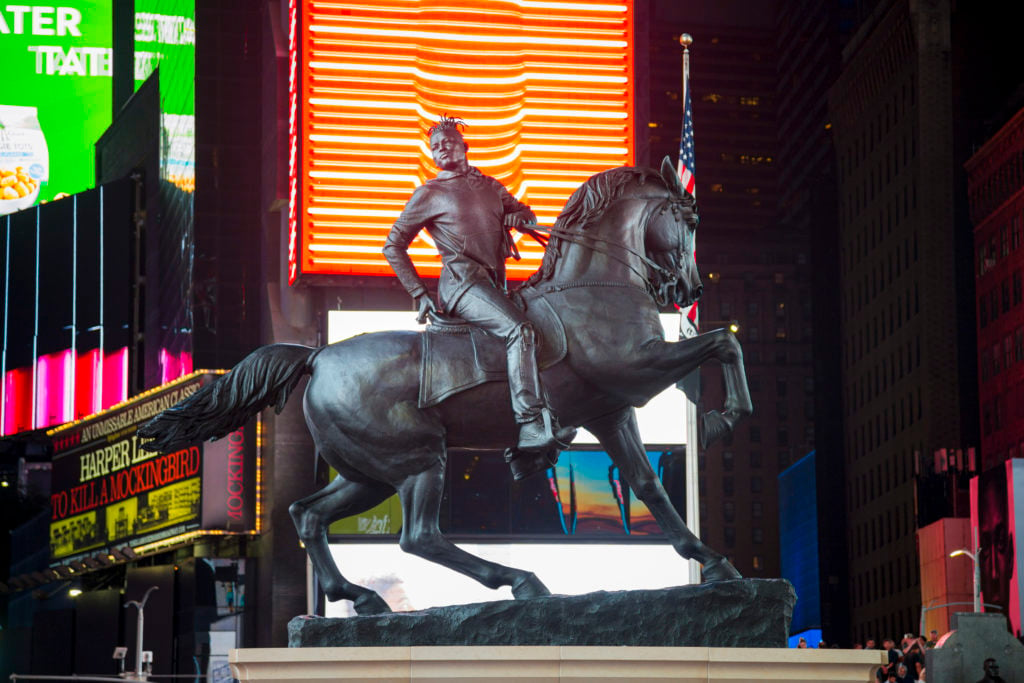
Kehinde Wiley, Rumors of War
(2019). © 2019 Kehinde Wiley. Courtesy of the Virginia Museum of
Fine Arts, Times Square Arts, and Sean Kelly. Photo: Ka-Man Tse for
Times Square Arts.
This project, Monument, joins a larger national conversation about how we should address Civil War
monuments today, specifically those memorializing Confederate
figureheads. In September, artist Kehinde Wiley unveiled Rumors of War—a
monumental equestrian statue of a young African American man that
was exhibited in Times Square before beking transferred to
Virginia, where it is now permanently installed within the vicinity
of Confederate monuments.
This month, the Texas Senate formed a special committee to
decide how it should handle multiple painted portraits of
Confederate figures (including Confederate president Jefferson
Davis, which hangs next to the presiding officer’s desk in the
state’s Senate Chamber). Meanwhile, a Republican representative in Tennessee has a
proposition for what to do about his state’s monument to
Confederate general and first Grand Wizard of the Ku Klux Klan,
Nathan Bedford: replace it with a statue of Tennessee-born musical
idol, Dolly Parton.
Wodiczko’s project demonstrates, though, that monuments to
figures whose history is not contentious can still be used as
platforms to voice contemporary concerns. “It is a time to publicly
acknowledge [the refugees] for their potential contribution to the
informed memory and understanding of civil wars,” he says. “As
living war monuments and memorials.”
The post This Artist Is Commandeering a Civil War Statue in
New York to Celebrate the Resilience of Refugees appeared first
on artnet News.
Read more https://news.artnet.com/art-world/civil-war-monument-refugees-1740360
Further reading


Leave a comment