
‘This Happened Very, Very Fast’: Faced With Closures, Galleries Are Being Forced to Build Online Viewing Rooms Overnight—Often From Scratch
For the past five years, Emmanuel Di Donna has staged
meticulously installed shows every six months at his eponymous
jewel box of a gallery on Madison Avenue. Last month, he was
carefully building out a show of work by Maria Helena Vieira da
Silva, a key figure in postwar European abstraction who is widely
considered to be Portugal’s most important contemporary artist. It
was set to be the most important survey of the her work in the
States in decades.
Instead, it never opened. In early March, New York’s inessential
businesses—including galleries—were shut down for the foreseeable
future. So instead, Di Donna worked around the clock to build out
in a matter of days something that for years he did not think he
needed: an online viewing room.
“Nothing compares with being confronted by the work, but this is
as close as it gets with the technology as it exists,” Di Donna
told Artnet News. “It has all the little things that make our shows
what they are—the coloring, the certain sobriety. I think this
viewing room is a very good reflection of how we do shows.”
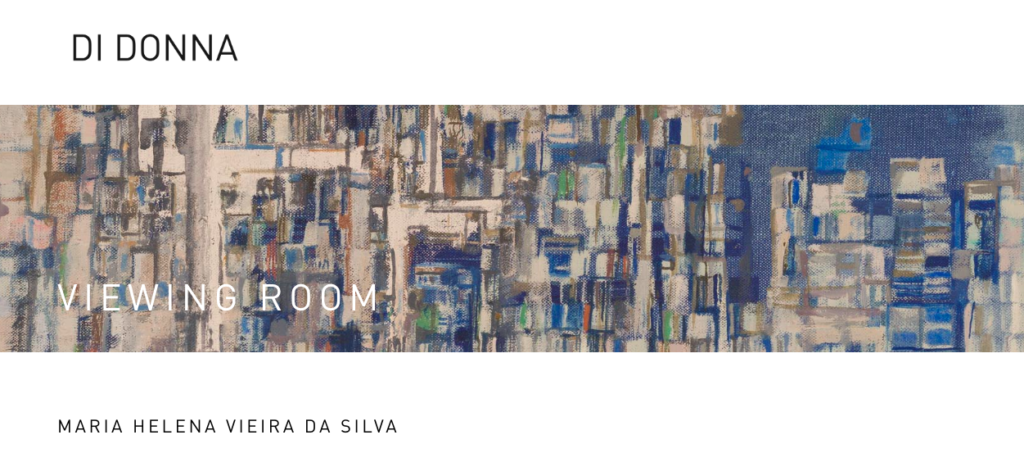
A screengrab of Di Donna’s online
viewing room. Photo courtesy Di Donna.
Such is the situation of art dealers around the world. Often
extroverts by nature, many gallerists got into the sales side of
this business precisely because of its deeply ingrained social
aspects—the jet-setting to art-market capitals, the in-person
reveals of a canvas an inch from a collector’s nose, and then the
handshake deal closed over backslapping cocktails.
That world no longer exists. We’re now dealing with the fact
that many market figures spent years building up an
infrastructure based on human contact, and avoided building out the
infrastructure needed for virtual engagement.
Now, online viewing rooms are all we’ve got—and if you don’t
have one, you need to build one, fast. Outfits lacking the
firepower of mega-galleries, having waffled on spending years of
energy and untold amounts of build-out fees, have now had to—and
I’m borrowing a term from the tech community—“bootstrap” their
digital portals. Fairs such as Art Basel and Frieze are providing
galleries with “booths” at online “fairs” to peddle their wares,
but such “events” happen just a few times a year. And so galleries
are now in the midst of building bespoke in-house spaces
themselves, from scratch.
“This Happened Very Fast”
Asked whether he had ever considered, pre-lockdown, building an
online viewing room, Di Donna replied, “not really.” But on March
10—nearly a week before New York shut down its bars and
restaurants, when galas were still being held, and on the day
President Trump told senators “we’re prepared, and we’re doing a
great job with it, and it will go away”—the gallerist had an
inkling that maybe his late-March show would not get the grand
Upper East Side opening it deserved. So he got to work.
“This happened very, very fast,” he said. “It’s been a
company-wide effort, my whole team has been working on it,
fine-tuning.”
The product is, like the gallery, stately, elegant, and
relatively demure. An email address is needed to enter. Prices are
not listed, though pieces that are spoken for get adorned with a
red dot. (At the time of publishing, there was one dot in place.)
What could not have been achieved in the real world is the section
devoted to Viera da Silva works in major institutions, with pieces
from the Guggenheim (shut down) and the Pompidou (on lockdown) and
the Tate Modern (ditto) on “view.”
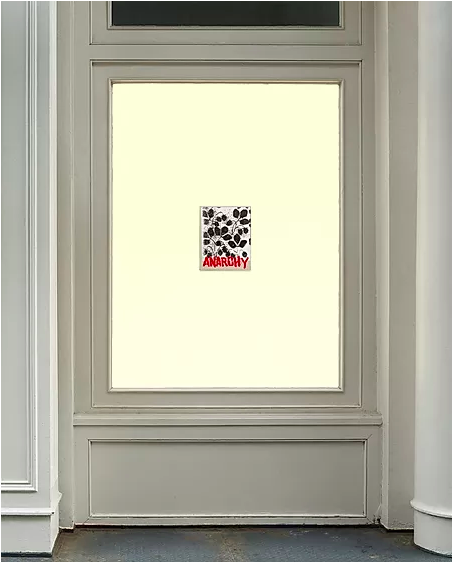
The online viewing room for Tennis
Elbow, made to look like the gallery’s sidewalk-facing window at
the gallery in Tribeca. Photo courtesy The Journal Gallery.
Like Di Donna, other dealers are striving to create online
portals that capture the distinct essence of their IRL brands. The
Journal Gallery has worked to develop a virtual home for Tennis
Elbow, a project that gives a show to one artist per week, anchored
by a single work in its Tribeca window that can be seen from the
street. Works are no longer actually out in the
window—sorry, downtown social-distancers. But they’re present in
the gallery’s new viewing room.
Gallery co-founder Michael Nevin said that there was already an
online aspect to the project before lockdown began: those who have
a membership to Tennis Elbow (it’s free, but members must be
approved by the gallery and agree not to flip any purchases for two
years) had been offered the works on email 48 hours ahead of the
public launch.
Now, there’s just a digital home base, too. What’s more,
Nevin will donate 10 percent of sales through the room to a trio of
charities: Food Bank for New York City, CityMeals on Wheels and No
Kid Hungry.
“The online sales, the online business, it’s
kind of a misrepresentation,” Nevin said. “The gallery’s still
rooted in what we’ve always done. if you go on these online viewing
rooms and it says click to inquire, it’s not that different from
offering works on email. You’re presenting things online but you’re
still selling in the old way.”
Similarly, Gavin Brown said the current crisis spurred him to
launch into a blistering few weeks of breakneck development on a
viewing room that will be ready to launch Friday. A percentage of
the profits will be donated to five organizations—the Studio Museum
Fund, Harlem United, NYC Health + Hospitals Donation Fund, UNICEF
Italia, and Comunita di Sant’Egidio—and Brown said it’s an
opportunity to switch up the programming a bit to match the new
online atmosphere.
“It’s a different ‘space’ to the gallery proper,” Brown said in
an email. “So it offers different possibilities.”
Skepticism Abounds
As recently as a month ago, the gallery model was still focused
on physical locations—and Bill Powers thought he’d found the
perfect one for Half Gallery when he signed a lease last year at a
former Korean friend chicken joint in the East Village. Powers
opened Tanya Merrill’s first New York solo show February 29, and by
March 13, it was closed. He had to quickly put together an online
viewing room, something he hadn’t considered doing before. He’s
still skeptical.
“We’ve had an online viewing room up since the last week in
March, but the online viewing room thing—unless there’s some other
facet—it’s gonna get played pretty quick,” Powers said. “Short
term, it’s a good fix, but after a month of that, people are gonna
get a little tired of it, unless there’s something more dynamic
about how the work’s presented.”
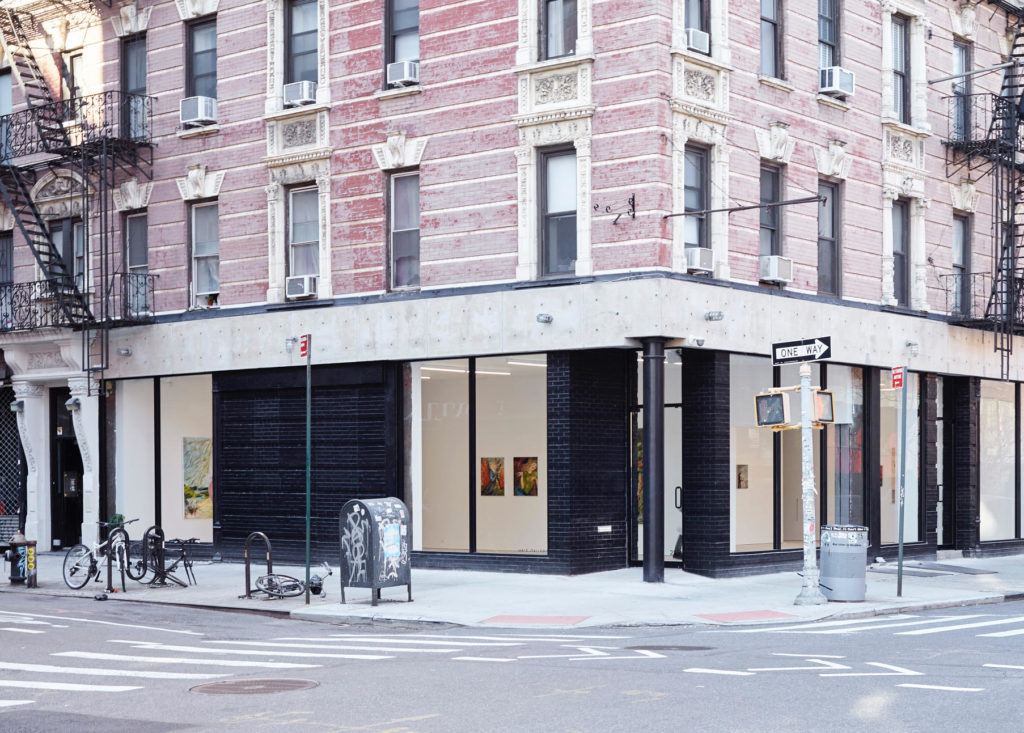
The Half Gallery space on E. 4th Street
and Avenue B, with Tanya Merrill’s show installed inside. Photo
courtesy Half Gallery.
His attempt at dynamism is a risky one—in addition to outfitting
the online viewing room, he’s going to install a brand new show
in the gallery, so passersby can get some fresh cultural
offerings through the floor-to-ceiling windows while walking six
feet apart. Standing there, they can access the online viewing room
on their phones, and immediately get an audio guide on what their
looking at, and a portal to buy.
“If you can see something in person, and click and hear a little
20-second content on the work, that’s approximating going into a
gallery and having the dealer walk you around the show,” he
said.
The first show will be called “Under Glass” (…get it?) and
feature works by Merrill, Richard Prince, as well as new roster
addition Anna Park, a young artist who counts KAWS as a collector.
He expects the show to open in a few weeks IRL (through glass) and
online.
(Powers hastened to add that he did not want to endanger anyone
while installing the show; he and his handler have both been
self-isolating.)
Driven by the Artists
The world’s biggest galleries had the resources to launch online
viewing rooms long before they were forced to close their physical
locations. Early adopters include David Zwirner, Pace, David
Kordansky, and Gagosian, which at the time of the crisis had more
brick-and-mortar locations than any gallery on earth. In March
2018, Gagosian made an online
viewing room for a work by Albert Oehlen, offered for a price
of $6 million, more than the artist’s auction record at the time.
The gallery gave collectors a full week to make an offer, hoping to
find a buyer in a matter of days. Instead, it sold within three
hours, to a collector who had never seen the work.
The mega-gallery online viewing rooms were originally designed
to work in tandem with actual sales made out of fair booths and
brick-and-mortar spaces, but the crisis has forced even the world’s
most successful galleries to adapt. This week, Gagosian is
launching Artist Spotlight, a series of one-week presentations of
the brightest stars on its storied roster, that will combine a
feast of content—written profiles, filmed video material, playlists
and movie recs from the artists—with a sales portal that will let
collectors buy one work per week, available for a period of 48
hours.
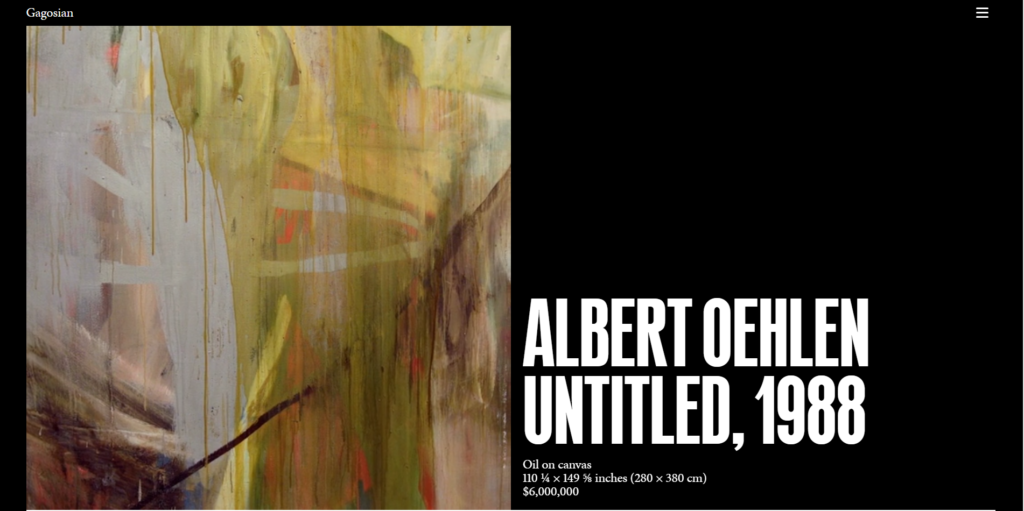
Screen capture of Gagosian’s third
online viewing room, devoted entirely to a single Albert Oehlen
painting.
Sam Orlofsky, the Gagosian director quarterbacking the
mega-gallery’s online efforts, said the idea came out of triage
meetings where executives brainstormed a plan for exhibitions that
could appease the dozen artists whose shows at outposts around the
world were in jeopardy. It was clear instantly that some
outside-the-box thinking would be required.
“The artists were extremely anxious,” Orlofsky said. “They saw
the writing on the wall and they were looking for some leadership
from us, saying, what are we gonna do about my show? The most
extreme thought alt is to simply move the shows online, but we
didn’t want to do that—that thought lasted about three
seconds.”
Instead, a completely new slate of programming emerged, where
the sales portal—with just one work each week, to keep supply of
in-demand artist sky-high—would be combined with the publishing arm
of the gallery, which has grown increasingly important in the
social distancing era.
The first Artist Spotlight is Sarah Sze, who was set to have a
show open at Gagosian’s Paris outfit the day after lockdowns were
enforced. And the regular online viewing rooms will still be
“opening” in May and June, pegged to what used to be the now-moved
dates of Frieze New York and Art Basel. Rather than focusing on
primary-market work, such rooms will offer secondary works, primary
market work from gallery artists who don’t have immediate shows
coming up, and other inventory.
Clearly, Gagosian is betting that collectors will be still be
buying via keyboards for the long haul. There is Artist Spotlight
content scheduled to run into July. If the other galleries want to
keep up, they’ll need their own rooms—and then some.
“We’re going to be open-minded and flexible about rolling out
more initiatives,” Orlofsky said. “I don’t think the online viewing
rooms and the Artist Spotlight represent the extent of what you’ll
see from us over the next few months.”
The post ‘This Happened Very, Very Fast’: Faced With
Closures, Galleries Are Being Forced to Build Online Viewing Rooms
Overnight—Often From Scratch appeared first on artnet
News.
Read more https://news.artnet.com/market/bootstrapping-online-viewing-rooms-1828128
Further reading


Leave a comment