
‘This Is a Revolution’: 18 Artists From Coast to Coast Share What They Saw and Felt at the George Floyd Protests
Protesters filled the streets in cities across the
United States this weekend to express fury over the recent deaths
of innocent black Americans—George Floyd, Breonna Taylor, and
Ahmaud Arbery—and the many
who came before them, killed senselessly at the hands of police
officers. Among the protesters were artists of all stripes, many of
whom view activism as an important part of their practice. Below,
18 artists shared what they experienced while protesting this
weekend.
Darryl Westly, Painter (New York)
There’s a realization that as a
black artist you’ve been dealing with this your whole life. Your
parents have dealt with it. Every name is etched onto this board
that we all carry within our hearts. I always feel as though when
you’re an artist of color, when you’re a black artist, you’re
hyper-aware of how you move, of how people move around you, of
oppression’s micro-transgressions.
When I heard about the death of
George Floyd, I immediately experienced a sinking feeling of just
realizing that this same scenario is playing out again, which was
coupled with exhaustion and tiredness. There’s a sense of
frustration around even having to try to explain the significance
of all this to the uninitiated. There is also frustration in the
expectation from people outside of the black community for how
black people should be responding to this event. It’s like, “This
is how you should react when you’re put on the ground and kicked.”
The intent of a person of
color can’t be gleaned from a simple movement of the hand or
gesture of the body.
I went to the protests for
myself, along with two of my white artist friends, Chris Rice and
Emil Martirossian. I needed to go to hear some of the voices that
aren’t the ones just running through the collective echo chamber of
the internet. I went to understand that the people attending these
marches are filled with a deep sense of empathy and they’re
attending to understand that their lives—all our lives—are
connected within these systems that have been created to stratify
us and stop us from being able to understand one another. The real
takeaway from all this is that there are police techniques in play
that only benefit one section of the public. But trying to preserve
a dead system isn’t enough just to maintain a false sense of
order. I went to hear
people walking and marching, to hear, “Black liberation! Black
women’s liberation! Black trans liberation!” And to hear, “Say his
name: George Floyd.”
Ann Lewis, Artist and Activist (Detroit)
My work focuses on the
intersection of womxn’s rights, mass incarceration, and police
brutality. I’ve been protesting this shit for years. It’s part of
my practice. I’d been wrestling severe emotional fatigue this week
from a deep dive into rape research for a project, but recognized I
had to dig deeper and show up for folks. We have deeper wells of
compassion and power than we realize. Every foot marching, every
voice chanting is important right now. We need the numbers. White
folks need to show up.
I saw the beauty and power of
the Detroit community while protesting. I saw people practicing
social distancing while also marching fiercely. Detroit is a
powerful city with a tremendous history of racial abuse and trauma.
Because of that history, the community is one of the strongest and
most supportive I’ve ever witnessed. People were racing to pick one
another up, defending storefronts, caring for one another. I also
saw instigators. I saw a white man with no mask on screaming at the
top of his lungs, carrying a massive knife, marching alone amongst
the crowds. Perhaps he was there to start shit, perhaps he was just
a lonely person needing to participate—I don’t know and can’t
judge, but we kept our eyes on him.
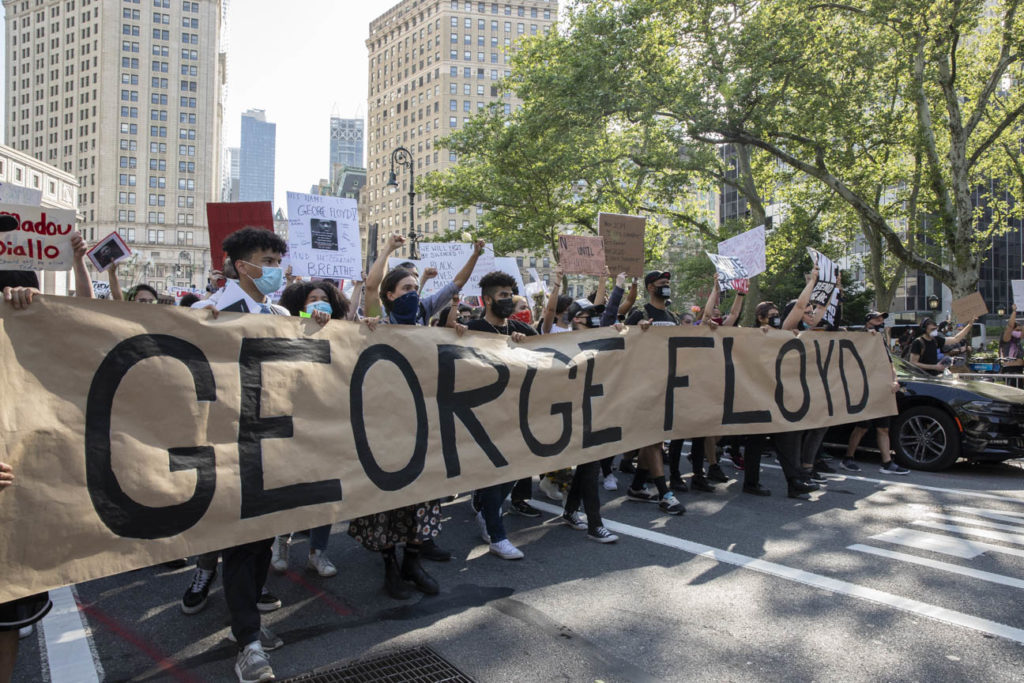
Protestors in Foley Square march with a
sign honoring George Floyd. Image courtesy Ventiko.
Candy Kerr, Artist, Embroiderer, and Musician
(Baltimore)
When I heard about what happened
to George Floyd, my soul sank and met the souls of my ancestors. I
went out the first night of protests in my city. I saw generations
of trauma and pain pouring out of black people. I saw two black
cops in the mix of 10 white cops, looking uncomfortable, and at
least one cop of unidentified descent who was twitching a bit as
insults were being hurled at him. The area smelled strongly of
weed. A few white and light-skinned people were attempting to
co-opt the space. I saw a pastor making demands of the police
commissioner, trying to keep the peace. A helicopter circled
overhead to read us our rights so that if they did make arrests all
their bases were covered.
Saturday was my birthday and I
chose to bathe in black joy. Sunday, I refueled. My soul holds joy
and sorrow at the same time. This is a revolution—it’s born of
oppression and made of chaos. I have no hope, but I have
patience.
Marcus Leslie Singleton, Painter (New York)
I decided to go to the protests
after thinking about what my parents, grandparents, and great
grandparents went through in this country. I remember when I first found out I was black.
That might sound crazy, but as a kid you’re just focused on doing
kid things. You’re not thinking about race. I was playing
basketball and Super Nintendo. I had a racist encounter at school
when I was around five or six and my parents explained to me that
sometimes people with darker skin get treated unfairly. When I
heard them say that, I got that airless feeling in my chest that
you get when you know something’s up. That’s how I felt at the
protest. Hope is too passive. As a country, we can no longer afford
the luxury of hope. Why are we still having to say black lives
matter in 2020?
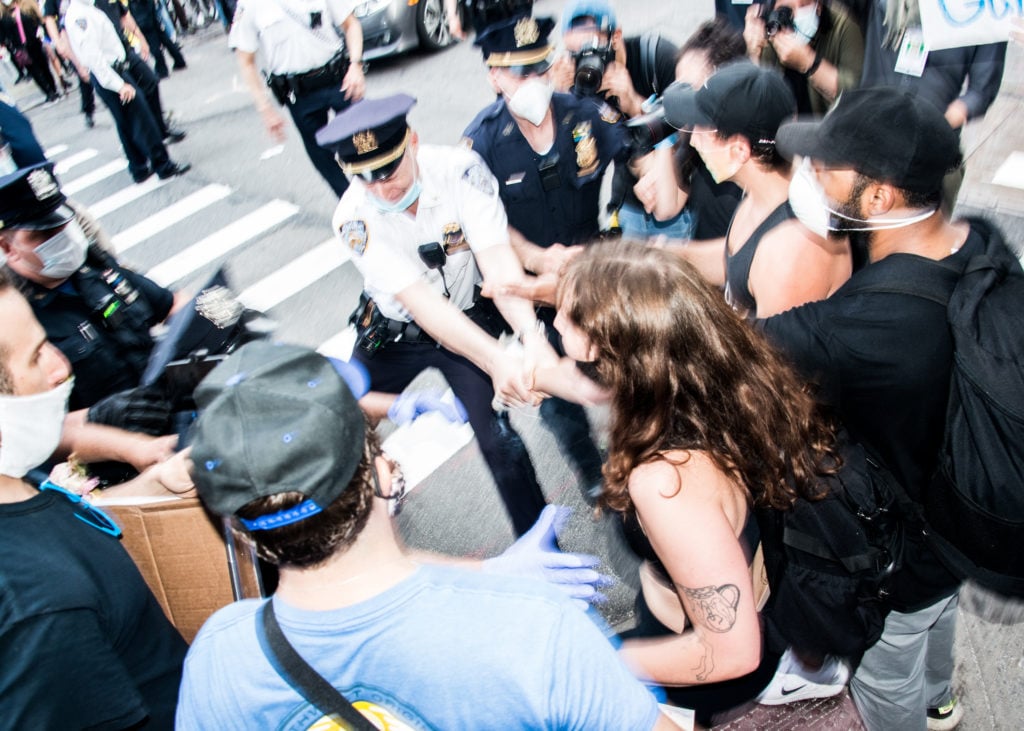
Police pull a woman off the sidewalk to
arrest her for being on the street. Image courtesy Ruvan
Wijesooriya.
Amy Khoshbin, Artist, Activist, and Educator (New
York)
I’ve been protesting a long time because showing up raises
awareness about these murders, shows solidarity, and creates a
sense of community power. It feels empowering to move as a
collective body. This is the first major protest since COVID-19 hit
and it lit the resistance fire in my heart to see so many people
showing up in the struggle towards change together, even though
we’ve been so isolated recently.
I saw brutality. Violence. Rage.
Joy. Catharsis. People power. The irony of protesting police
brutality is that the cops continue their unnecessary violence
towards unarmed protestors, throwing them to the ground, arresting
them, pepper spraying, driving cars into peacefully chanting
crowds. I’ve seen cop vans lit on fire in retaliation. I’ve seen
beautiful moments of dancing, chanting, taking the streets for
hours. I chanted the names of those who died recently at the hands
of the cops: George Floyd, Breonna Taylor, Tony McDade, Ahmaud
Arbery. I hope these actions put pressure on City Council in the
next few weeks, as they set their budget for the year, towards
defunding the $6 billion dollar NYPD budget, creating an NYPD
hiring freeze, getting cops out of schools, cutting NYPD’s
expansion into non-police activities, and so much
more.
Yashua Klos, Artist (New York)
I wanted to see and be seen with
others who are demanding a more just society. I also wanted a
constructive way to mourn the recent killings of innocent black
people by the police. I wanted release from my own fears. On
Saturday night, it felt energizing to exercise freedom of speech as
a community. Systemic racism realizes that it will be checked from
here on—we are not waiting any longer for the system to check
itself. Black and brown
folks are the most vulnerable to a healthcare system that
marginalizes us and state-paid law enforcers who murder us. The
system, as is, kills us both slowly and quickly. This is all our
problem. The desperate acts of rioting and protesting makes this
pain impossible to ignore.
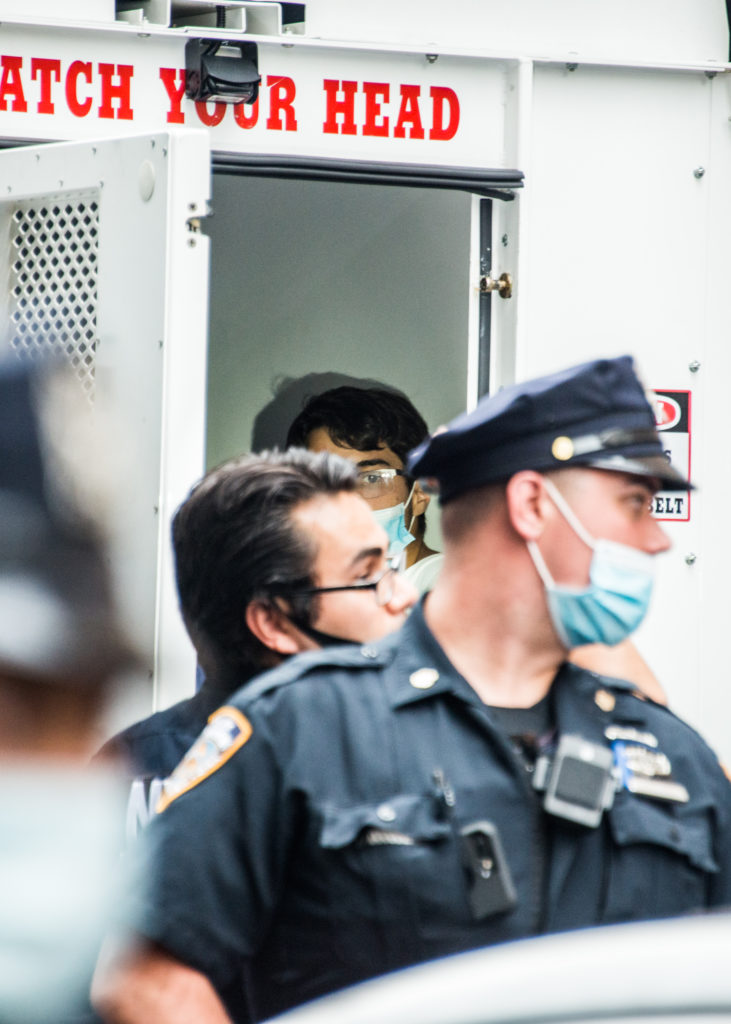
A teenager in custody. Image courtesy
Ruvan Wijesooriya and The Cut.
Onyedika Chuke, Artist and Professor at the Cooper Union
(New York)
A nearly four-minute video of a brutal police beating during a
peaceful protest was remotely deleted from my phone or corrupted
via my Google Cloud account. I was on the front lines of a peaceful
protest, marching up West 14th Street between 6th and 7th Avenues.
The group was composed of racially diverse members, with those
identifying as white occupying the front as a buffer between the
marchers and possible police interaction. As we marched, a white
man between the ages of 30 and 35 ran through the crowd and a fight
started. The protesters chased him onto the sidewalk. I stood back
to document what I saw, hoping to provide an accurate account of
what was happening. About eight NYPD officers swarmed the area,
zeroing in on the man. The protesters made way for what we assumed
would be an arrest, but instead it turned into a beating. They
threw him on the ground, punching and kicking him as he lay on the
sidewalk. Eventually, our arms were locked together in an attempt
to stop other officers from entering what seemed to be a tag-team
group MMA match rather than a lawful arrest. They eventually
zip-tied him and picked him up. His face was swollen from multiple
blows. Reds and pinks everywhere. Blood streaming down. We are all
speaking, but just not together or towards the same goals. I hope
we can change that.
Ebony Brown, Artist (New York)
I participated in the protest that took place at the Barclays
Center on Friday evening. It was necessary for my emotional and
mental wellness to let off some steam instead of suffering in
silence after repeatedly watching the traumatic, inhumane murder of
George Floyd. I wanted to come together with people in my community
to send the message that African Americans will no longer tolerate
police brutality. The chants were more aggressive than I
anticipated. I was surprised to be surrounded by so many white
people holding Black Lives Matter signs while yelling, “NYPD, suck
my dick!” It felt cathartic to yell and scream. Being from a family
with several police officers active and retired, it was
uncomfortable for me to chant, “Fuck the police!” but in that
moment, I realized my own discomfort didn’t matter because another
unarmed black man was strangled by a heartless policeman while
desperately uttering the words, “I can’t breathe.” Now I fully
understand how necessary it was for NWA to make that song in 1988.
The tension was high from the moment I arrived. I left when a
friend told me he saw the police preparing to use riot gear.
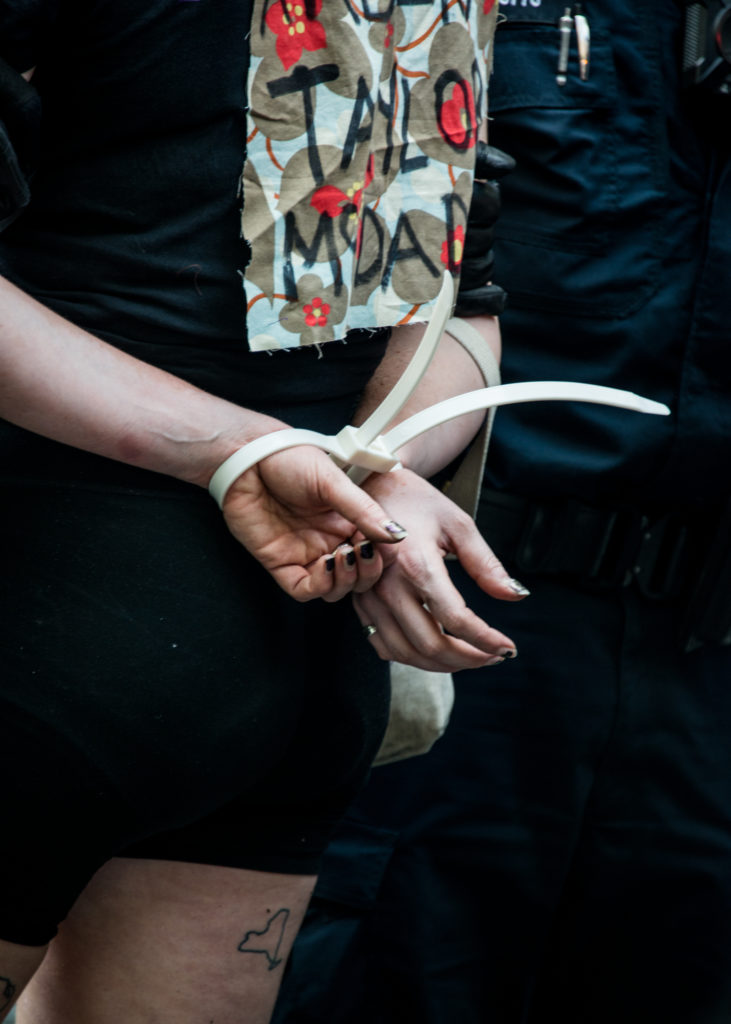
A young protestor is arrested. Image
courtesy Ruvan Wijesooriya and The Cut.
Ventiko, Conceptual Artist (New York)
Since March 21, I have been
riding my bicycle through New York City documenting New Yorkers in
quarantine for a photo series called From the Outside Looking
In. I understand
that my ability to cycle through the American coronavirus epicenter
was made easier because of the color of my skin. For me to stay
silent, to not acknowledge my white privilege and not show up,
especially now, is wrong. When I rode up to Friday’s protest at Foley
Square, I burst into tears. People of all races gathered, risking
their own health and potentially lives, to call for justice for the
murder of George Floyd, and other black people, at the hands of
white police. It was tragically beautiful. It was also tense and
everyone could feel it. Our country is ripping open and exposing
how broken it really is. Cameras—including mine—are covering every
moment of it. I want
true equality. I want black and brown people to be able to live
their lives without the constant fear of being murdered.
Fariha Róisín, Artist and Writer (New York)
People need to understand this
is not an isolated incident. Black folks, indigenous folks—have the
highest rate of murder at the hands of police. This happens
regularly. So, it’s not about a one-time resource, a
one-time protest you post about on Instagram. It’s about divesting
from capital, from the concept that one life is worth more than
another. If you want a good life, do you think that a good life is
worth more than the life of another person entirely? That’s what
capitalism does to you, it makes you think you
deserve nice things, no matter the cost to human
life.
There needs to be a concerted
effort to remember that this is our responsibility—if we are
non-indigenous/non-black folks—to do this work
consistently. If you are rich and come from wealth, begin to
talk to your families about divesting from their wealth because no
matter where that money is from, it’s probably been accrued from
exploitation. Not hard work. No one is rich from hard work—or else
we’d have laborers or the people that built this country dripping
in cash. This is systemic. We need to start seeing its
roots.
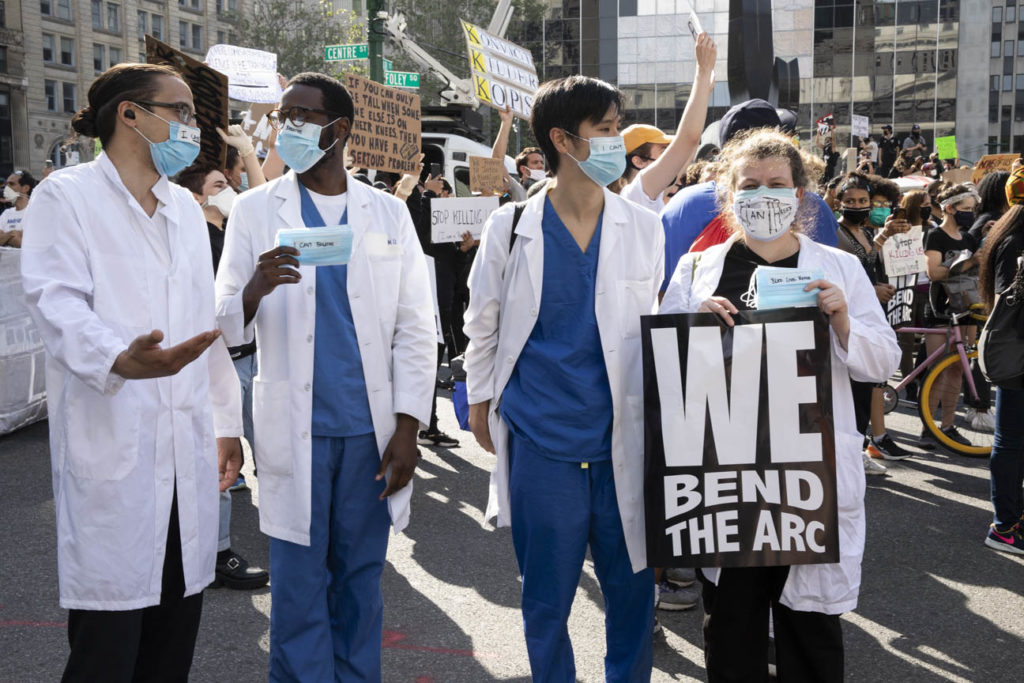
Medical workers gather in Foley Square.
Image courtesy Ventiko.
Zachary Tye Richardson, Performance Artist (New
York)
I have devoted my work to a
therapeutic process for the effects of anti-queer blackness. But
time and time again, black people are not afforded the chance to
begin the healing process without another life taken.
America’s taste for black
people’s blood is quenchless. The video of George Floyd’s murder
broke me and many around the world. I do not feel “hope” and I’m
infuriated by the semantics of the word. Joining these protests was the most
invigorating thing I’ve done in years. The march in Brooklyn on May
29, 2020 is something I will never forget. In a crowd of mostly
white allies, I felt a sense of ownership of their privilege. Being
biracial, I understand the privilege that I carry in the complexion
of my light skin—I am the digestible black person in American
society. But the consensus in this protest was that this is beyond
us. This is for our future and our kids’ kids. I, like many
artists, convinced myself that my advocacy through my practice was
enough. It is not.
I challenge everyone to get out and get your voices heard. Racism
is a vicious cycle that can only be stopped in solidarity. Silence
is the ultimate violence. Black suffering is loud and unwavering.
We have tried peace; this time, we shake the
table.
Marian Bailey, Artist (Philadelphia)
I decided not to attend the
protests. I was feeling too anxious about being in a large crowd
during a pandemic. I instead opted to walk around my very white
neighborhood with a Black Lives Matter sign, with a few people that
were wearing Black Lives Matter shirts. During my walk, I saw a lot
of uncomfortable people. A handful of people voiced their support
and one white man yelled from his truck that black lives, in fact,
do not matter. But I
felt empowered while walking through my neighborhood. It felt good
to confront people who continue to opt out and not care about the
injustice felt by so many people across the nation. Keep going,
keep feeling, keep speaking up. And for all of the people that
continue to be silent, we see you.
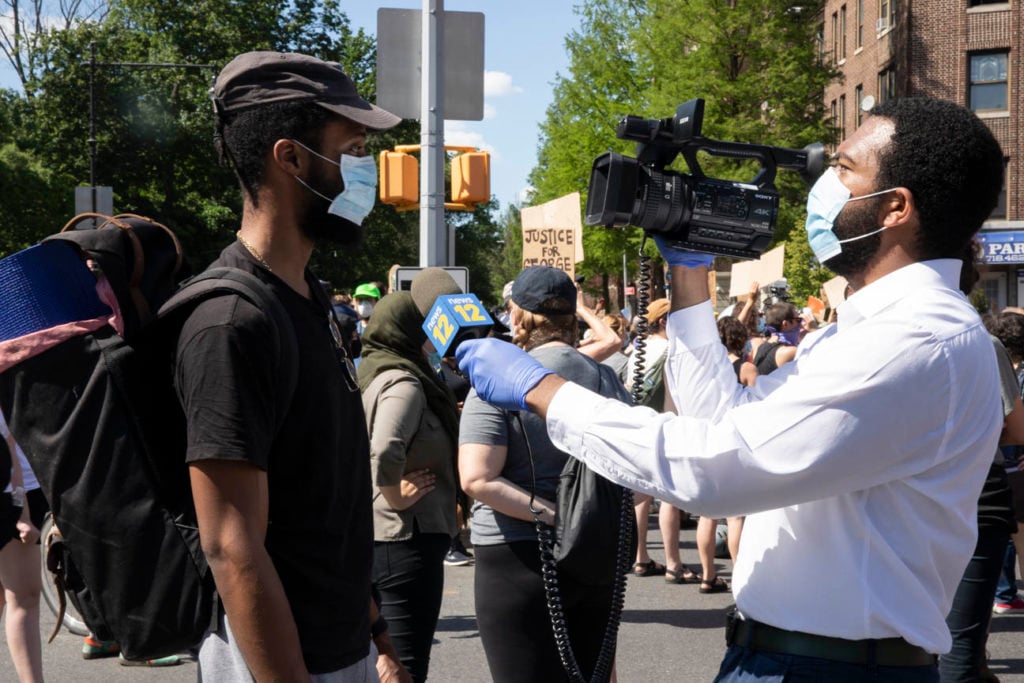
A protestor being interviewed in
Flatbush. Image courtesy Ventiko.
Tamar Zohara Ettun, Artist (New York)
I am originally from Jerusalem
and on Saturday, Iyad al Hallaq, an autistic Arab man, was shot
seven times in his chest by the border police when he was on his
way to work at a special-needs school in the old city in Jerusalem.
Iyad al Hallaq’s murder feels to me very related to the murders of
George Floyd, Ahmaud Arbery, and Breonna Taylor. I went to three
protests in Brooklyn this weekend: in Flatbush, Grand Army Plaza,
and Barclays Center. It was mostly young people, holding signs and
chanting, and keeping their distance. It’s quite amazing to see the
complex choreography of people gathering in a big group, expressing
rage and anger, while at the same time demonstrating a sense of
care not to touch anyone next to them, all while moving. It was
powerful to see this exercise in control which didn’t, in any way,
mute the power of raw emotions.
Kambui Olujimi, Painter (New York)
There’s a popular notion that
riots are violent spontaneous overflows of emotion, usually in
response to an incident. They are not. These actions are the result
of persistent and untenable conditions. They are not a swansong of
reason, but rather a transference of matter, like breath into
snow—what Dr. King calls “the voice of the
unheard.”
I’ve been focused on what I call
the silent-state
riot, the surreal and
absurd space of inequity that generates these proverbial shifts in
matter. I’m interested in these “outbursts” as telltale signs, not
just of the socio-economic conditions they belie, but of an
invisible psychological terrain that oppressed peoples must
negotiate daily. I investigate connections between the vernacular
of this psychological terrain, and the aspiration of the common
riot.
The Sublimation
Project is an
interdisciplinary project that looks to shift the dialogue around
riots. I am currently looking for support of the project. My recent
works on paper and writings are a spontaneous response to our
current American condition. These works are only a couple days old
and I’m still learning them but I do know that I wanted to make
something that would not allow us to forget this moment in the
years to come.
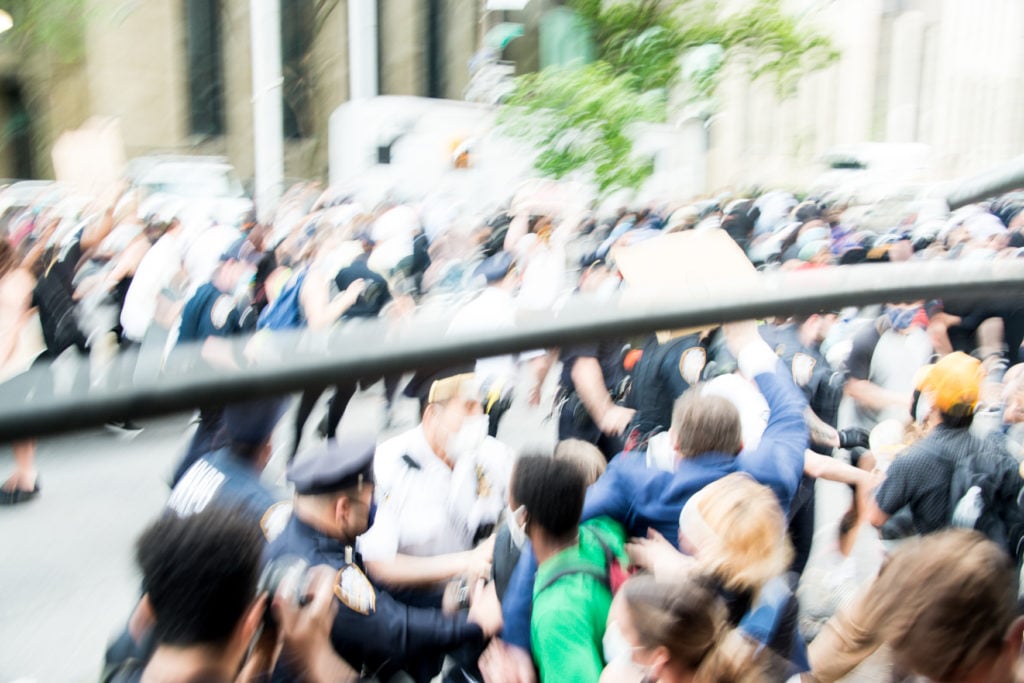
Policemen prevent protestors from
crossing Canal Street. Photo courtesy Ruvan Wijesooriya and The
Cut.
Kate Rath, Digital Artist (Philadelphia)
I want people to know that being
an anti-racism ally is a lifelong learning process and not a point
of enlightenment that white people can reach by crafting the
perfect heartfelt Facebook status. White people need to listen to
black people without trying to be the savior. I’m talking to all
white people, but I’m mostly talking to myself.
I attended the Solidarity
Against Police Terrorism Protest at the Philadelphia Art Museum and
the march to City Hall that followed. I saw Food Not Bombs passing out bread. I saw a
person with a huge bottle of GermX circling the crowd, offering it
to everyone. I saw people spraying sunscreen on strangers’
shoulders from a safe distance. I saw a crowd of people sitting
down peacefully in an intersection to stop two Philly police buses
from making their way to the next block, where other protesters
were surrounded by police and SWAT teams. I saw private property
with corporate tenants get vandalized, but I didn’t see aggression
towards human beings until the police began corralling groups of
people and shoving protesters.
I have the privilege of being a
white person in a country that was built to serve white people and
oppress anyone who is not. If I don’t listen to and support the
people being oppressed, then I am directly contributing to their
oppression.
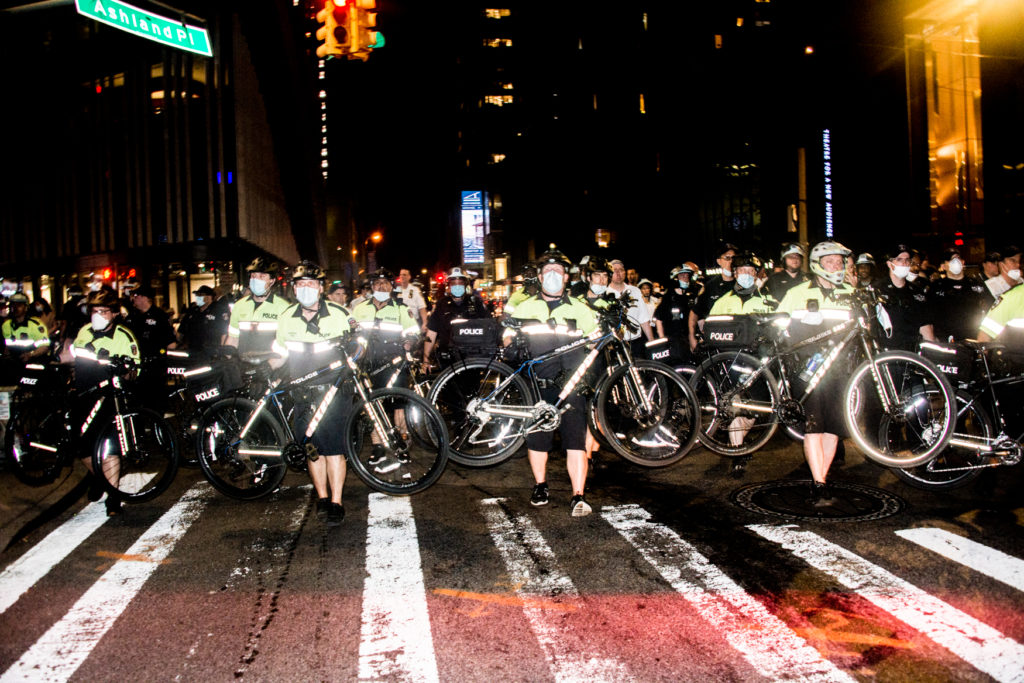
Policemen form a barricade with their
bikes. Image courtesy Ruvan Wijesooriya and The Cut.
Christen Clifford, Artist (New York)
I went to the Queens Black Lives
Matter / Fuck The Police protest on May 30th in Jackson Heights,
where I have lived for over 15 years. I saw hundreds of people
chanting “No justice, no peace!” “The people united / will never be
defeated!” I saw signs that said “Filipinos for BLM” and “Asians
Americans for Black Lives Matter.” They said, “Stop killing black
people.” They said, “Black trans lives matter” and “Black
liberation matters” and “Racism isn’t born, it’s taught” and
“Justice for Breonna Taylor”, and “Tony McDade.” I saw police with
fancy new equipment in their light blue helmets, with face shields,
in their vans and with taser guns. I saw friends, neighbors, and
artists. Leaders telling us to march, and people handing out
snacks, water, and masks. I felt angry, happy, sad, energized, old,
nervous about catching the virus, and hopeful.
Miriam M, Artist, Poet, and Educator (San
Francisco)
I am a brown, queer, indigenous
(Chichimeca Guamare) poet, artist, community educator, and worker
currently living as a guest on occupied Tuibun Ohlone land in the
East Bay, California. There are many roles to play within tangible
solidarity. I chose to donate to the Minnesota Freedom Fund that
pays bail for protestors arrested during demonstrations and shared
resources relating to other local bail funds. I also use digital
collage art as a vessel for solidarity and created a piece for our
beloved George. Through art, the images of our lost loved ones are
held in love and light, to uplift their transitioning spirits and
to support ours as we process this loss.
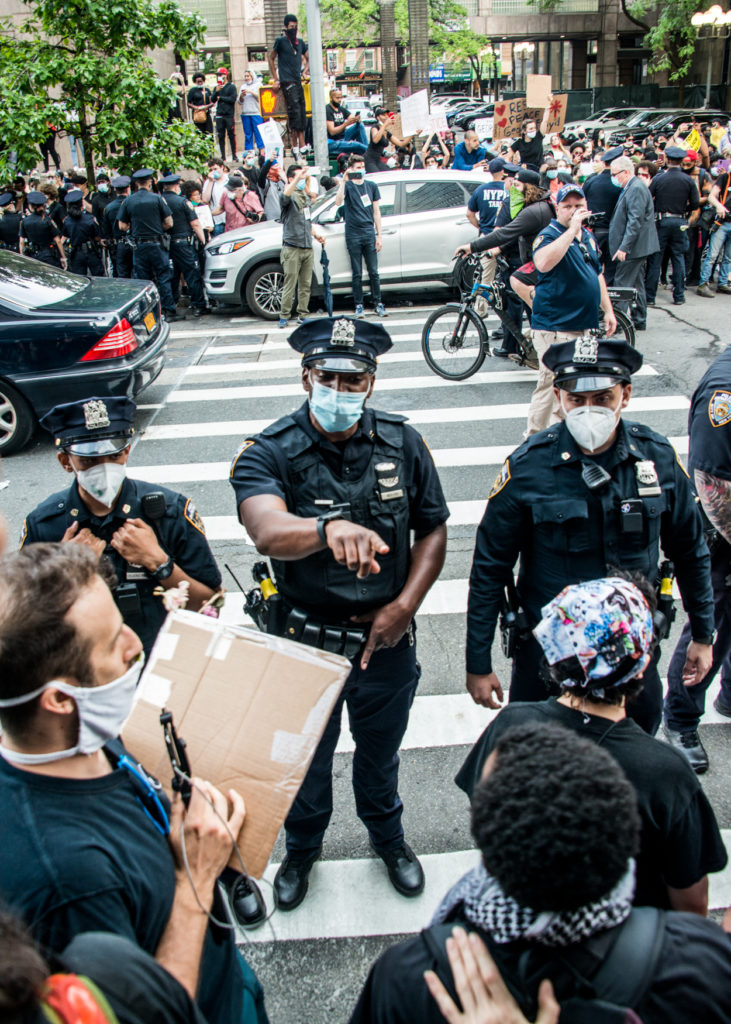
Policemen surrounding protestors. In the
background, an NYPD officer holds up a Sony face detection video
camera. Image courtesy Ruan Wijesooriya and The Cut.
Ruvan Wijesooriya, Photographer and New Media Artist (New
York)
I was on assignment for The Cut
on Friday. When I
walked north to Foley Square on Center at 3:45 p.m., it was empty,
so I kept walking. I immediately saw a man in his early 20s being
arrested. Then another guy a half-block up. Both were people of
color. The protest hadn’t started yet. I walked back to Foley at
3:55, and it was packed. I hadn’t been around more than three
people in nearly three months, and managed to get over the
COVID-19-crowd scare fast. Everyone was wearing a mask and we were
outside.
The main protest was cathartic.
Nobody was looking for a fight—just to express themselves and their
disgust for police brutality aimed at black people. When we got to
Canal Street, the police blocked the crowd from crossing and backed
up a prisoner van. We’d landed right outside “The Tombs” or House
of Detention, where they take you when you get arrested.
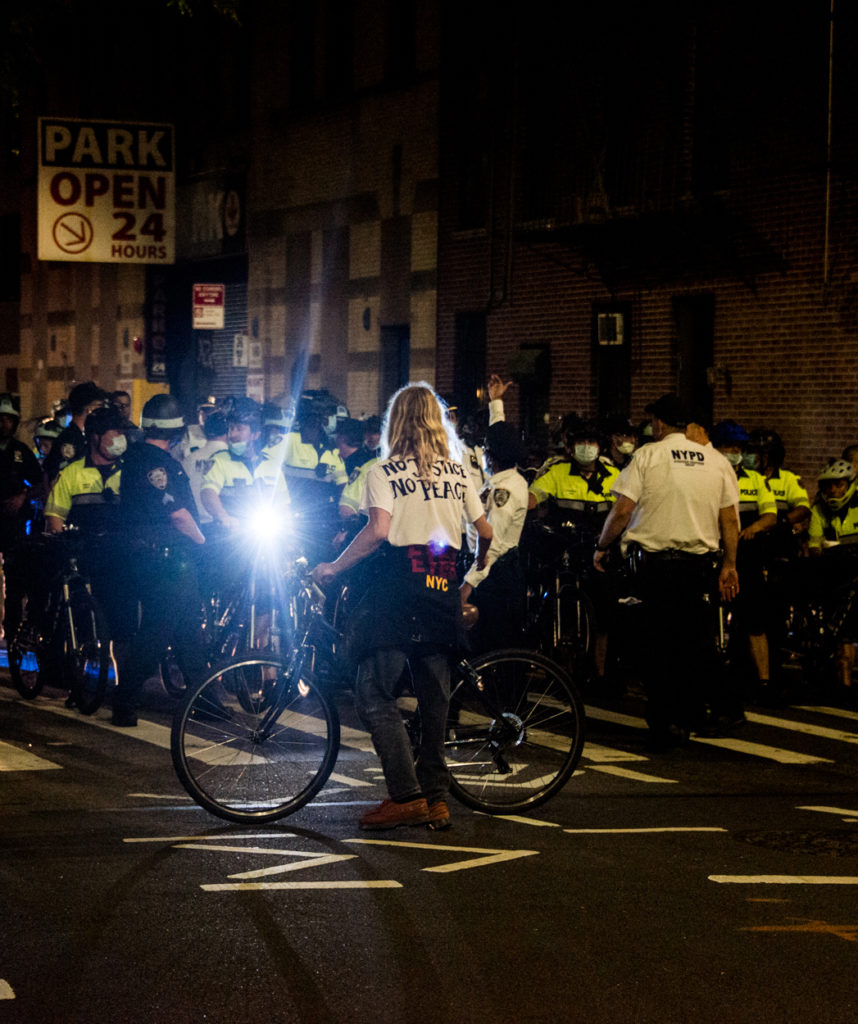
A protestor stands before 60 or 70
policement. Image courtesy Ruan Wijesooriya and The Cut.
All of a sudden there were
seven, maybe eight different cops around us. A few younger people
refused to get off the street and they were immediately arrested.
It wasn’t going to be the kind of protest I was hoping for.
There was one undercover NYPD
“press” team cruising around the crowd and there were a few in
uniform using the Sony tourist video camera with group photo facial
recognition.
Close to Walker Street, they
sprayed mace, and many ran away. It rained, the crowd thinned out
more, and it felt like the police were going to surround everyone
and take them into The Tombs. At some point, an MTA driver walked
off of a bus transporting police and protestors. Protesters
cheered. I left for Brooklyn just as it was getting
dark.
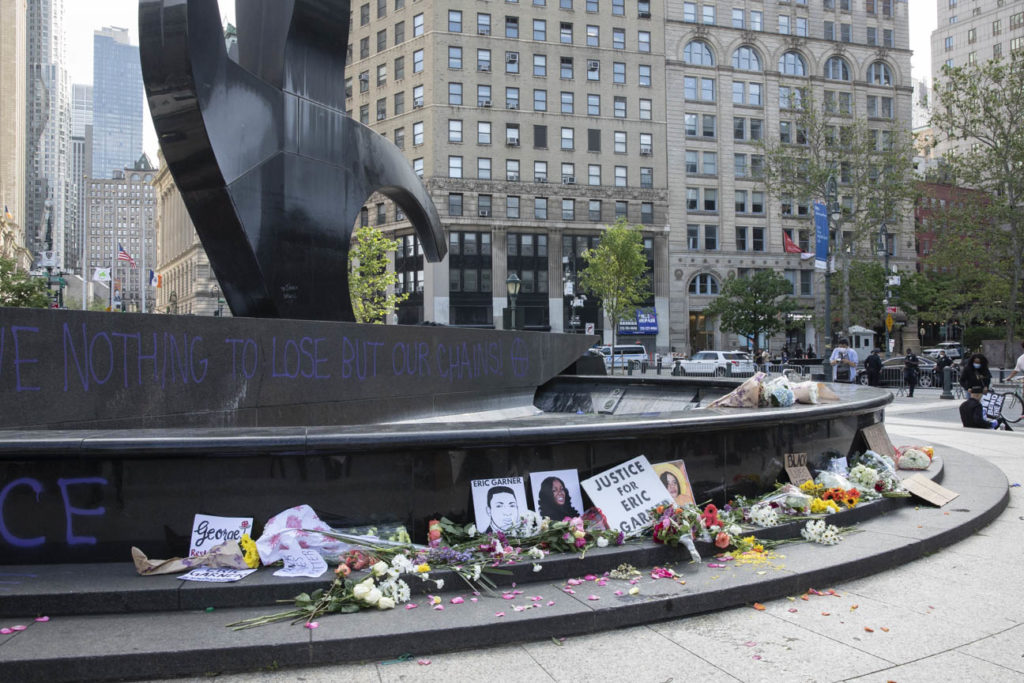
Tributes to black Americans who were
killed fill Foley Square. Photo courtesy Ventiko.
Toward the end, the Tour de
France of the NYPD showed up. A hundred dudes on bikes. I felt like
I was in a Revolutionary War reenactment where muskets and bayonets
had been replaced by billy clubs and bicycles. I saw one of them
shoving a teenage girl with his billy club before trying to land it
on someone else. The feeling that so many other people with camera
phones are filming police brutality, but lacking the agency to do
anything about it, sunk in. There are way more violent policemen
than protestors, most of whom were—like myself—walking in the only
direction they could take to get home. I kept walking, wondering what the fuck
just happened, knowing that the police wanted, more than anything,
to win.
The post ‘This Is a Revolution’: 18 Artists From Coast to
Coast Share What They Saw and Felt at the George Floyd Protests
appeared first on artnet News.
Read more https://news.artnet.com/art-world/artists-protests-george-floyd-testimonials-1876254
Further reading


Leave a comment