
This Is the Earliest Known Photograph of Slaves in the US—and It Challenges Our Understanding of History
The Nelson-Atkins Museum in
Kansas City, Missouri says they have acquired what is thought to be
the earliest known photograph depicting slaves. Importantly, the
image also challenges some popular notions about who generally
owned slaves in the antebellum South.
The quarter-plate daguerreotype depicts what appears to be a
slave owner and several enslaved men, women, and children standing
outside of a small plantation building in Greene County, Georgia.
Three of the enslaved men appear to be carrying large baskets of
cotton above their heads.
The photograph was purchased in November from Cowan’s
Auctions by the Hall Family Foundation (the philanthropic arm of
the owners of Hallmark Greeting Cards and the Hallmark Channel) and
gifted to the museum. The estimate for the image was between
$100,000 – $150,000, but bidding for the
rare photograph was furious, bringing the price up to
$324,500.
The Cowan’s Auctions lot listing says that the photograph
was discovered as part of the Austin, Texas estate of Charles
Gentry Jr. (1958 – 2012), who had moved
to Texas from Polk County, Georgia.
“Numerous Gentrys have resided in the areas around Polk,
Hancock, and Greene Counties, and we suspect the daguerreotype was
passed from Charles Gentry Sr. to his son,” the website states.
“How Charles Sr. came to own the image is unknown, though
presumably, it passed by descent through a member of his
patrilineal line.”
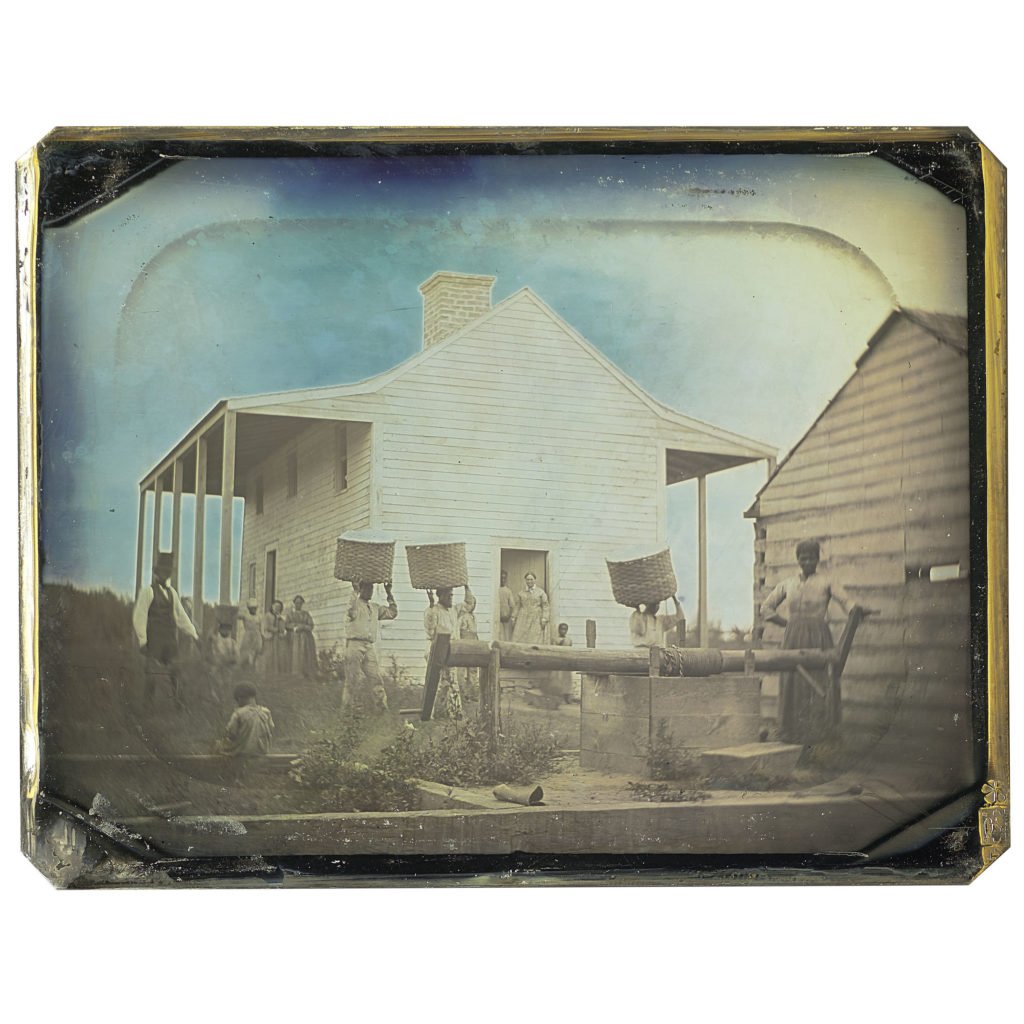
The daguerreotype before restoration.
Unknown maker, American. Slaves on cotton plantation, ca. 1850.
Daguerreotype, quarter plate. Gift of the Hall Family
Foundation.
With the name and possible locations as a clue, historians
from the Georgia Historical Society, the Georgia
Historic Preservation Division, and the Georgia Trust for Historic
Preservation, among other organizations, were able to further
narrow down the subject of the photograph.
The historians went through the Federal Slave Schedules from
1850 to 1860, a federal census of slaves that also collected the
names of slave owners. The slave owner pictured in the
daguerreotype is likely Samuel T. Gentry. The census listed only a
few Gentrys in Georgia, and Samuel Gentry was the only Gentry known
to own at least 10 slaves. There appear to be at least that many
slaves in the photograph.
The historians point out that the photograph is most important
in that it shows that even middle-class Georgians owned slaves.
“The Gentry daguerreotype documents slavery in a far more humble
setting than the large coastal plantations depicted in post-Civil
War images taken by Samuel Cooley and other photographers who
accompanied the Union Army,” the Cowan’s Auctions website states.
“In these Sea Island plantations, hundreds of slaves were owned by
a small class of planter elites, providing their families with
access to luxuries only dreamed of by the vast majority of
Georgians. While this is the vision most Americans have of the
antebellum south, the Gentry daguerreotype depicts a different
reality.”
Keith F. Davis, senior curator of
photography at the Nelson-Atkins said in a statement from the
museum, “This piece—a record of the historical crime of slavery—is
remarkable both for the power of its content and for its technical
and aesthetic sophistication,” said Davis. “This is an
unforgettable rendition of an era, and a way of life, that must
never be forgotten or forgiven. At the same time, it markedly
expands our understanding of the history of American photography.
We have long believed that daguerreotypes such as this ‘should’
have been made in the 1850s; now we know that at least one actually
was.”
Plans to display the image,
perhaps in a broader context, are already in the works. The museum
also intends to make the photograph available for loans.
The post This Is the Earliest Known Photograph of Slaves in
the US—and It Challenges Our Understanding of History appeared
first on artnet News.
Read more https://news.artnet.com/art-world/nelson-atkins-earliest-slavery-daguerreotype-1724079
Further reading


Leave a comment