
Those Puzzling Cone-Shaped Caps Depicted Atop the Heads of Ancient Egyptians in Art Were Real Hats, Researchers Find
We dare you to spot an ancient Egyptian who isn’t sporting some
kind of headgear. From fishermen to pharaohs, ancient Egyptians
were forever wearing wigs, crowns, and headbands associated with
specific roles and rituals, and archaeologists now know many of
these accessories by name. The blue Khepresh crown, for example,
was worn by pharaohs going into battle and the Nemes headdress—that
striped linen headcloth with two flaps hanging down over the
shoulders—was reserved for royalty.
One headpiece depicted in sculptures and paintings has puzzled
Egyptologists, though, and that is a small, cone-shaped cap, most
often white, at other times bedazzled. The cones appear atop the
heads of ancient Egyptians in visual representations spanning a
stretch of nearly 1500 years from the early New Kingdom to the
Ptolemaic period. They’re usually worn by banquet guests, people
being rewarded by a king, or folks doing everyday things in the
afterlife. Alternatively, the caps may be associated with
childbirth and fertility.

Book of the Dead of Hunefer (19th
Dynasty), papyrus. Image via Wikimedia Commons
“The nature and role of the cones have long been debated,”
writes a team of archaeologists in a new study published this month
in Antiquity journal. “In the absence of any convincing
examples of head cones from archaeological contexts, scholars have
questioned whether the cones were ever produced as
three-dimensional objects, or were instead entirely symbolic of
anointing or beautification rituals or of more abstract ideas.”
But now, after a recent discovery in the ancient city of
Akhetaten (also known as Amarna), archaeologists know that these
cones were very real. Cemetery excavations conducted since 2005 as
part of the Amarna Project (on behalf of the McDonald Institute for
Archaeological Research at the University of Cambridge) have
extracted 700 graves—and two beeswax cones.
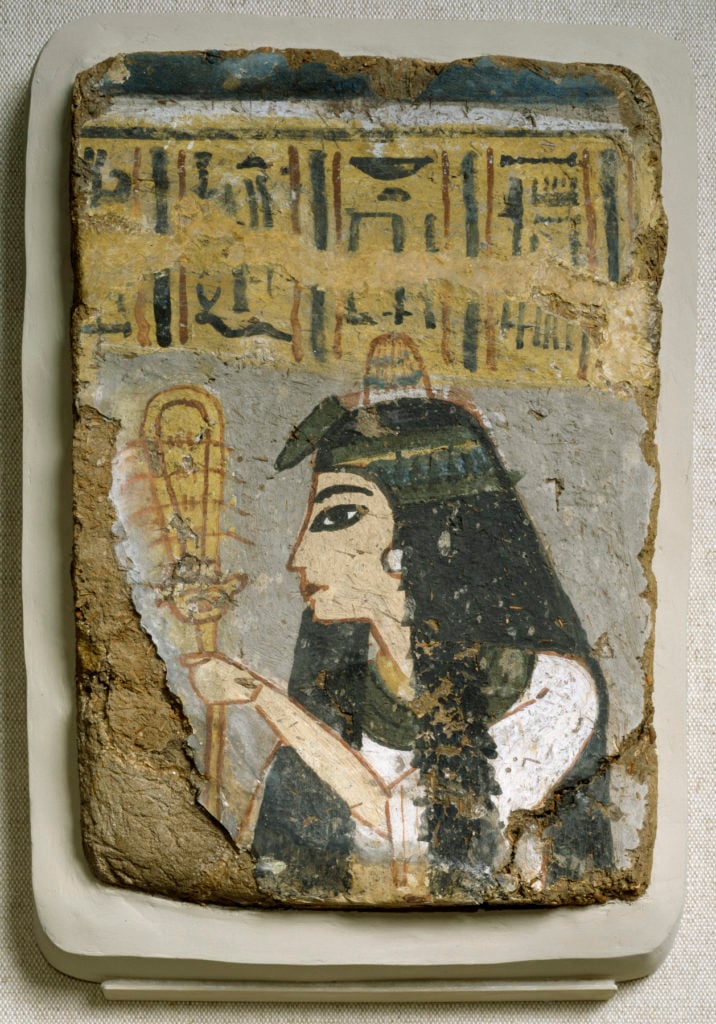
Wall Painting: Woman Holding a
Sistrum (ca. 1250-1200 BC), The Walters Art Museum
One of these cones was found on top of the skull of a
29-year-old woman, with her hair still coiled inside. The other was
found with the grave-robbed remains of a teenager, gender unknown.
The burials of these two cone-wearers were simple in style, not
reflecting upper-class origins.
The mysterious cones were not symbolic illusions, then, but
actual hats. Research is ongoing, but the discovery will help
Egyptologists learn the meaning and function of these domes, which
until now were believed to have existed only in paintings and
sculptures.
The post Those Puzzling Cone-Shaped Caps Depicted Atop the
Heads of Ancient Egyptians in Art Were Real Hats, Researchers
Find appeared first on artnet News.
Read more https://news.artnet.com/art-world/cone-head-ancient-egypt-1730412
Further reading


Leave a comment