
Van Gogh Had Many Friends, and Even a Girlfriend. A New Show Seeks to Debunk the Myth of the ‘Lonely, Tormented Artist’
In the summer of 1879, Vincent
van Gogh was living in the Borinage, a poor coal mining region of
Belgium, working as a priest. He sat down to write a letter of
gratitude to his brother, Theo, who had recently come for a
visit.
“Like everyone else,” he wrote.
“I have need of relationships of friendship
or affection or trusting companionship, and am not like a
street pump or lamp-post, whether of stone or iron, so that I can’t
do without them without perceiving an emptiness and feeling their
lack, like any other generally civilized and highly respectable
man.”
Through such feelings of
connection to others, van Gogh wrote, “one is aware that one has a
reason for being, that one might not be entirely worthless and
superfluous but perhaps good for one thing or another.”
Helewise Berger, curator of the
exhibition “Van Gogh’s Inner
Circle: Friends, Family, Models” at the
Noordbrabants Museum in Den Bosch, which opens tomorrow and runs
until January 12, 2020, said that it was time for a museum to “do
justice to the broad group of people around van Gogh.” The show
sets out to explore how his network of family and friends supported
him—emotionally, fiscally, and socially.
Speaking at a press conference on
Thursday, Berger said the museum is trying to refresh the
longstanding image of the Dutch artist: “We aim to put an end to
the image of van Gogh as a lonely, tormented artist, who was never
appreciated in his own days.”
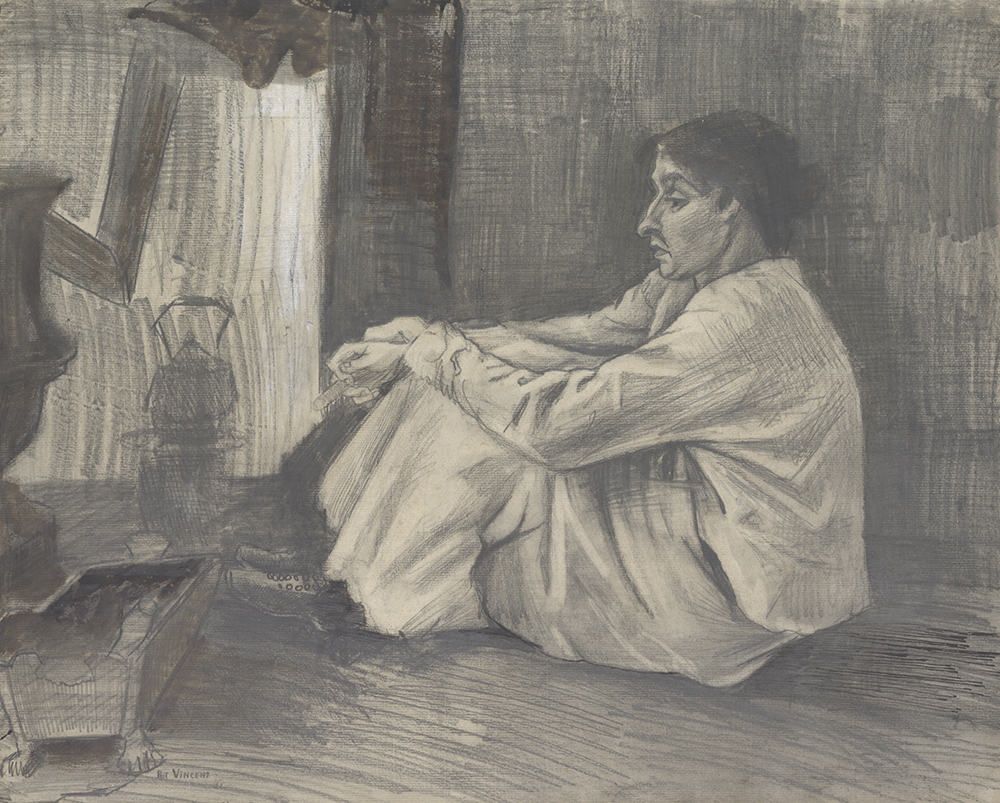
Woman (‘Sien’) seated near the
stove by Vincent van Gogh, (1882). Kröller-Müller Museum,
Otterlo.
Van Gogh, the Myth
Through nearly 100 objects,
including 16 original van Gogh paintings and 17 of his works on
paper, as well as personal letters and paintings by his friends,
the show presents an intimate view of his friendships with fellow
artists such as Émile Bernard, Paul Signac, and Anthon van Rappard,
who was his boss at Goupil & Cie art gallery’s branch in The
Hague. The perspectives of his pupils, who described him as strict
but playful, are also included, along with the voices of several
important women in his life.
“The image of the artist as
doomed, and a lone wolf who went unappreciated through life is
simply not true,” said Sjraar van Heugten, the exhibition’s guest
curator, and a leading authority on van Gogh. Although scholars have long known that van Gogh
was very well connected in artistic circles and that he had close
ties to his family, the outcast image has persisted in the public,
said van Huegten. Popular films, from Vincente Minnelli’s 1956 “Lust for
Life” to Julian Schnabel’s 2018 “At
Eternity’s Gate,” have sustained this myth.
The curator said the idea of this
exhibition was catalyzed by Steven Naifeh and Gregory White Smith’s
biography, Van Gogh: The Life from 1994. That
work became the
definitive guide to the artist for the ensuing decades, despite the
fact that van Heugten
felt it cast the artist as “a complete maniac.”
“He was a difficult man,” Van
Heugten concedes. “He was not very huggable; he was not a teddy
bear. But he was also someone who was very much appreciated by
people in his life, and that was very important to him.”
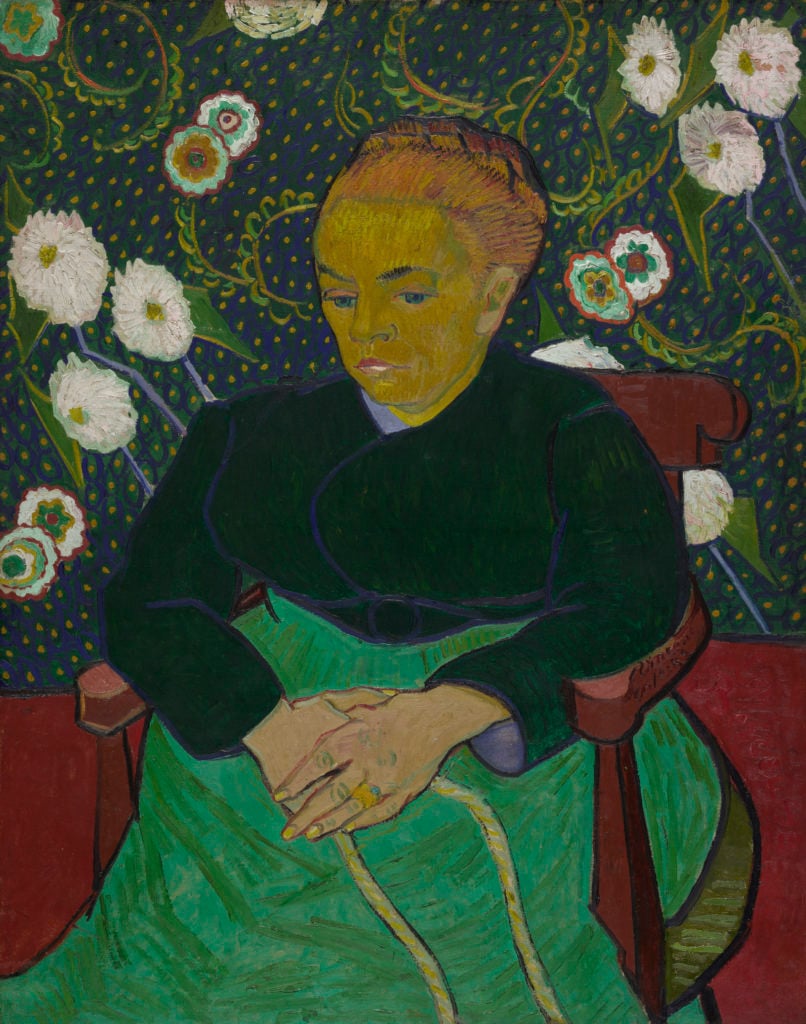
Madame Roulin Rocking the Cradle (La
berceuse) by Vincent van Gogh, (1889). The Art Institute of
Chicago, Helen Birch Bartlett Memorial Collection.
The Inner Circle
Van Gogh was the son of a vicar.
His family was religious and socially prominent. “They had to be
role models in the village where they lived, so [they were]
strict, yes, but warm and empathetic as well,” said van Heugten.
“In the Netherlands, we would call it a ‘warm nest.’”
At the museum, a full wall is
devoted to very personal drawings van Gogh made of Sien Hoornik, a woman
he met in The Hague in 1882. He had described her to his brother,
Theo, in a letter as having been “abandoned by the man whose child
she was carrying.”
“I took that woman as a model and
worked with her the whole winter,” he wrote. “I couldn’t give her a
model’s full daily wage, but all the same, I paid her rent and have
until now been able, thank God, to preserve her and
her child from hunger and cold by sharing my own
bread with her. When I met this woman, she caught my eye because
she looked ill. I made her take baths and as much fortifying
remedies as I could afford, [and] she’s become much
healthier.”
Sien became van Gogh’s
girlfriend. She posed naked and visibly pregnant for his
lithograph, Sorrow. After she gave birth to her daughter,
the artist moved in with her, and they lived together in The Hague
for a year.
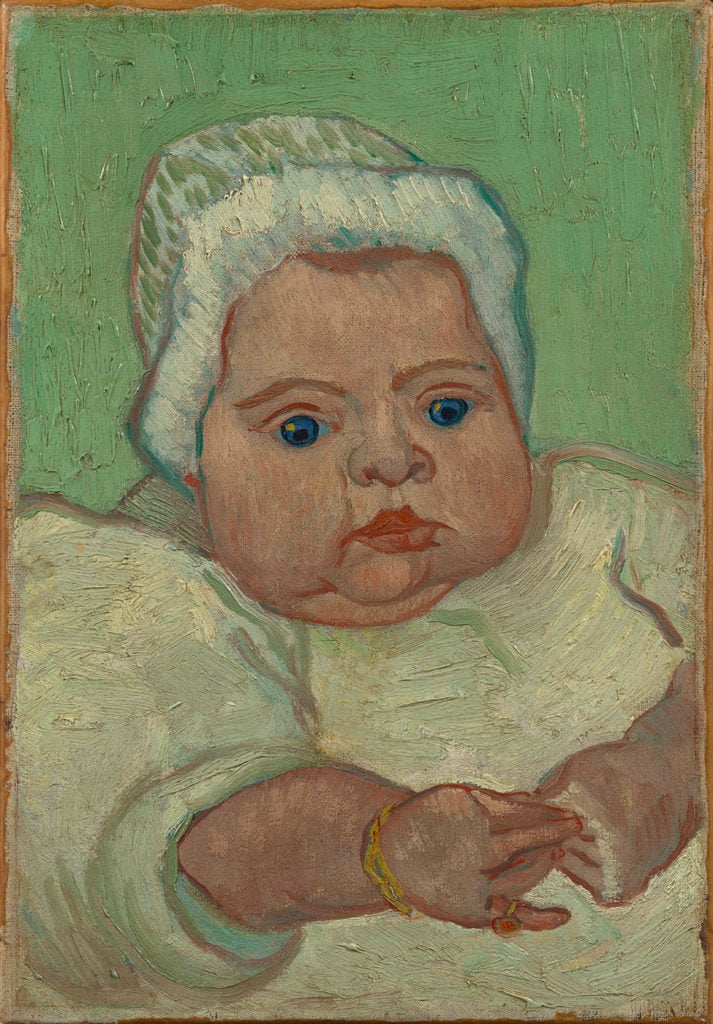
Portrait of Marcelle Roulin by
Vincent van Gogh, (1888). Van Gogh Museum, Amsterdam (Vincent van
Gogh Foundation)
“He was so happy when he lived
with Sien and he had a little baby who was crawling through the
studio,” said van Heugten. “Domestic life—he loved it. It was the
only time he did have a family, and it was only for a year, but he
was happy.”
Van Gogh’s fraught friendship
with the artist Paul Gauguin figures
only briefly into the exhibit, which instead gives more attention
to his relationship with the Roulin family in Arles, with whom he
developed a close bond. He made 25 paintings and drawings of
members of the family, including the youngest baby, Marcelle, just
after he was born. “Van Gogh loved children and especially babies,”
said van Heugten. Another painting depicts Madame Augustine
Roulin with her hands holding a rope to rock Marcelle’s cradle
beyond the frame.
Getting a better grip on these
relationships, said van Heugten, can help us understand that the
narrative of the solitary genius artist is just “a romantic
notion.” Great artists almost always come out of a rich social
context.
“If he had been the solitary
artist that people liked to imagine, he never would have developed
into the person he was,” said van Heugten. “His whole development
depends on that.”
“Van Gogh’s Inner Circle. Friends, Family, Models” opens on
September 21, 2019 at the Noordbrabants Museum in Den Bosch,
Netherlands. It will be on view until January 12, 2020.
The post Van Gogh Had Many Friends, and Even a Girlfriend. A
New Show Seeks to Debunk the Myth of the ‘Lonely, Tormented
Artist’ appeared first on artnet News.
Read more https://news.artnet.com/exhibitions/van-gogh-den-bosch-1656760
Further reading


Leave a comment