
‘We Have Our Own Individual Voices’: Saudi Artists Debate Their Place in the Kingdom as the West Becomes Wary of Its Commitment to Progress
Against the endless, arid landscape of the harsh Jeddah desert,
a man in a white thobe, the traditional Saudi male dress,
approaches a camera. Walking swiftly and with utmost determination,
he carries a paintbrush dripping with crude oil.
An eerily violent mood fills the air as he takes his paintbrush
and begins to paint in wide strokes along a giant glass surface. A
few calligraphic marks emerge until the man, Saudi artist Nugamshi,
smashes the glass and his painting.
The resulting video, Sarab (2016), which was included in
“Naphtha,” a summer exhibition curated by artist Moath Alofi at the
Khuzam Palace in Jeddah and organized by the Saudi ministry of
culture, is a provocative representation of the changes taking
place in the country, and a potent symbol of its attempted break
with the past as it enters new terrain under 33-year-old crown
prince Mohammed bin Salman, known as MbS, who has promised
modernizing reforms.
The exhibition, which presented artworks that explored the
social and economic consequences of the kingdom’s oil economy, is
also reflective of Saudi Arabia’s grand plans to wean itself off of
the energy market by developing a new “creative economy.”
But inevitably, the work also recalls the country’s shattered
relations with the West since the murder, last October, of
dissident journalist Jamal Khashoggi at the Saudi embassy in
Istanbul. Although MbS has denied any wrongdoing, authorities
around the world, including the CIA, have squarely blamed him for
ordering the assassination.
Now, as the country looks to reconcile its various challenges
and opportunities, artists are debating their place in the
unfolding conversation.
![Ahmed Mater,<i> From the Real to the Symbolic City,</i> (2011–13) [detail]. Courtesy of the Smithsonian Freer Sackler.](https://news.artnet.com/app/news-upload/2019/09/banner-S2014.5-1024x439.jpg)
Ahmed Mater, From the Real to the
Symbolic City, (2011–13) [detail]. Courtesy of the Smithsonian
Freer Sackler.
A Culture of Reform?
Early in his reign, MbS was praised around the world for reforms
that loosened restrictions in the ultra-conservative Gulf country.
The ban on women drivers was lifted and the economy was slowly
becoming diversified. But since Khashoggi’s death, a series of
boycotts and protests—including the cancellation last October by
Columbia University in New York of a talk by visiting Saudi artist
Ahmed Mater—have left the Saudi art scene in a difficult spot.
An anonymous American curator working for a US organization in
the Middle East said that while she was interested in the country’s
art scene, she felt looking into it would be frowned upon by her
institution.
“It’s not the right time,” she tells artnet News.
But those inside the country urge interested parties to
distinguish between Saudi artists and the Saudi state.
“It is important now to separate the people and the artists from
the government and the powers that be,” says Stephen Stapleton, the
inaugural co-director, with Mater, of the Misk Art Institute, a
Saudi state-run cultural initiative. “We are living a very
emotional moment. We must never forget what happened to Jamal and
what he stood for, as we can’t forget America’s decision to go to
war with Iraq.”
Stapleton, who is also the founder of Edge of Arabia,
CULTURUNNERS, and the Crossway Foundation, says a boycott of the
scene by the West won’t bring about any positive change. “[In Saudi
Arabia] you have a very important young art scene that has grown
out of a conversation with the international community,” he says.
“[We] might be seen as abandoning it if we don’t keep that dialogue
open.”
One example of that nascent freedom is a work directly inspired
by the gruesome murder of Khassogi: Saudi artist Abdulnasser
Gharem’s The Safe, which was shown in June at Art Basel. In the
work, Gharem created a memorial for the journalist as a way to
stress that dissident voices still exist in the country.
“I wanted to show ‘the other,’ or the West, that this work could
come out of Saudi Arabia,” he told artnet News, adding: “we have
our own individual voices.”
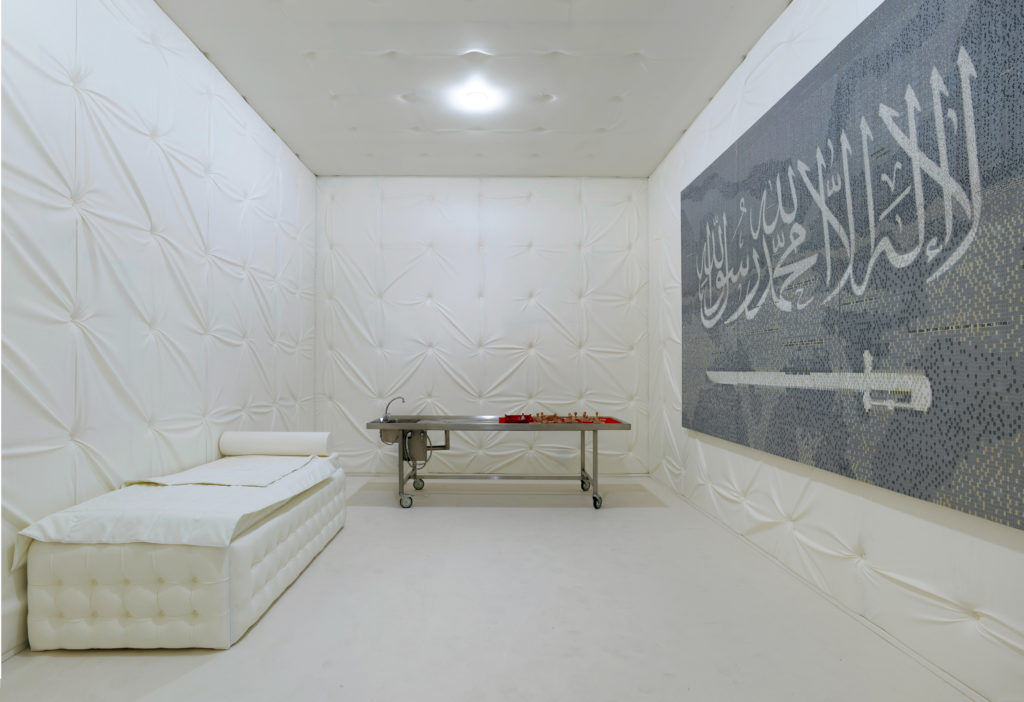
Installation view of Abdulnasser
Gharem’s The Safe (2019), courtesy of Art Basel.
Tastes of Freedom
While the outside world continues to grapple with how to deal
with Saudi Arabia, those inside the country say that reforms have
inaugurated real change.
“Just under two years ago, music was not allowed to be played at
restaurants and families would have curtains to hide from
neighboring families,” says Saudi-American photographer Tasneen
AlSultan, who is a member of the Rawiya Women’s Middle Eastern
Photography Collective, and who has documented gender and social
issues in the kingdom for the New York Times and National
Geographic.
“Women weren’t allowed to travel or renew their passports
without the approval of their legal male guardians. Now we find
live musical bands flown in from across the world to entertain
families at restaurants, malls, and parks.”
“My images have changed [as a result],” she says. “I was able to
photograph the first music concert in Jeddah with Cheb Khaled and
Nelly [and] the first woman officially to drive last year. Our
struggles will be vastly different from those of my daughter’s
generation.”
Cinemas, along with mixed-sex music festivities and clubs, are
now open, a result of MbS’s plan to open new economies beyond the
oil industry. The country also plans to increase the number of
festivals and events from 300 to 500. And according to a recent
report by the state tourism center, spending on tourism could
rocket up to 174 billion Saudi rials ($46 million) by 2020 from
104 billion (USD27m) Saudi rials in 2015.
Meanwhile, the Misk Art Institute established a permanent
national pavilion for Saudi Arabia at the Venice Biennale this
year, and the organization’s plans include the opening of a major
museum in Riyadh in 2020 and the start of the Riyadh Biennial.
“Forty years ago we were told certain things were haram
[bad] and now we are told they are not haram,” says Abdullah
Hadi Asri, who runs the Shmokh Resort in Abha in Southeastern Saudi
Arabia. “I feel like I’ve lost 40 years of my life but it is
different for the younger generation.”
“The goal is to massively support the cultural sector, helping
make art and culture part of people’s everyday lives, enriching
life for Saudis, boosting the economy, and creating opportunities
for cultural exchange,” said Abdulkarim Alhumaid, a spokesperson
for the ministry of culture.
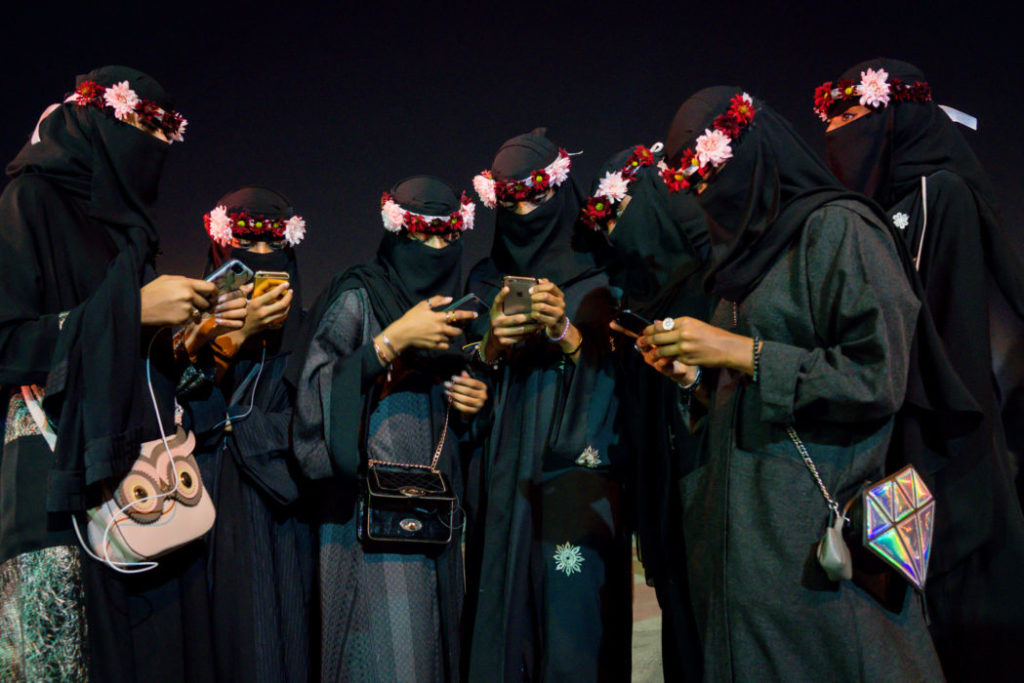
Tasneem Alsultan, A group of
relatives busy on their social media phone applications, at
Al-Jenadriyah, a cultural festival in Riyadh. (2018). © Tasneem
Alsultan.
An Uncertain Future
Even during the country’s most repressive years, and long before
the existence of state-sponsored projects, Saudi Arabia had an art
scene run by self-taught artists and wealthy private patrons.
The cultural powerhouse Art Jameel, founded in 2003 by the
wealthy Jameel family, is responsible for numerous initiatives,
including the Jameel Art Center in Dubai and the Hayy Creative Hub,
due to open in Jeddah in spring 2020.
The Al Mansouria Foundation has an even longer history, having
been founded in 1990 by Princess Jawaher Bint Majed Bin Abdulaziz
al-Saud. There are also the Pharan Studio, an artist-led space, and
the Hafez Gallery in Jeddah. Edge of Arabia, another initiative,
was founded in 2003 by Stapleton with artists Abdulnasser Gharem
and Ahmed Mater.
Yet while many have compared Saudi Arabia’s sprint into the
future to similar changes that took place in Qatar and the United
Arab Emirates, where state actors wielded culture as a tool of soft
power, some Saudis are cautious about the perceived parallels.
“When things move fast and you are in the middle of them, you
cannot comprehend the speed,” says Mohammed Hafiz, an art collector
and co-founder of Athr Gallery, a contemporary art space
established in Jeddah in 2009.
“What is happening in Saudi Arabia now did not happen in Doha,
Dubai, or even Abu Dhabi. We have a population north of 30 million
people. What [is happening] in Saudi Arabia [is happening] for
[our] people [first],” he says, arguing that similar developments
in other Gulf nations were primarily geared to outside
audiences.
Yet while winds of change can be felt, there is doubt and fear
as to how long they will last.
“The ‘grass root’ has shifted from under us” said Riyadh-based
artist Muhannad Shono. “The art scene is attempting to replant its
feet, but we can’t just get complacent or take these new changes
for granted.”
“It’s all about nation and image-branding—it’s not genuine,”
said one British journalist who spoke on the condition of
anonymity. And some in the country seem to not see much difference
anyway.
“Yes, there are women driving and there are musicians playing,
but as for the artists and their practices, the practice remains
the same,” says Hafiz, the collector and gallery owner. “There is
now a larger space for artistic expression and a big number of new
opportunities. [But] I believe that the so-called restrictions have
forced artists to think outside the box. When you are an artist
here, you find your voice in between these restrictions.”
The post ‘We Have Our Own Individual Voices’: Saudi Artists
Debate Their Place in the Kingdom as the West Becomes Wary of Its
Commitment to Progress appeared first on artnet
News.
Read more https://news.artnet.com/art-world/saudi-arabia-artists-1646848
Further reading


Leave a comment