
‘We Should Not Forget We Are in the Magic Business’: A Roundtable Discussion on How the Lockdown Era Could Change the Art Market Forever
This article was first published
in German in the June issue of Art, das Kunstmagazin.
With the world still largely on lockdown, art dealers, like the
rest of us, are working from home—and imagining what their industry
will look like on the other side. On April 20, Claudia Bodin,
the US editor of Art, das Kunstmagazin, convened a
virtual roundtable among three forward-thinking art-market
figures—König Galerie founder Johann Koenig (in Berlin),
Independent Art Fair co-founder Elizabeth Dee, and Pace Gallery CEO
Marc Glimcher (both in New York)—to discuss their vision for the
art world after the lockdown era ends. At the time of the
conversation, New York was in the thick of its shelter-in-place
order, while Berlin was preparing to reopen. Koenig had just
launched an online booking system for in-person gallery visits,
which were quickly booking up, and Glimcher had recently recovered
from his own battle with coronavirus.
Below, the three experts discuss why the art world as we know it
is unsustainable—and what systems they hope will take its
place.
How are you feeling these days after
your experience with coronavirus, Marc?
Marc Glimcher: Good, I am
totally back to normal.
Thank you for the honest article you
wrote about catching the coronavirus, your recovery, and your
thoughts about unsustainable practices in the art world, from the
the travel, to the over-promotion of artists, to the ballooning
overheads. Such honesty is usually not the first thing that comes
to mind when one thinks about the art business.
Marc Glimcher: Unfortunately not.
Are we really going to see changes after we come out of
this?
Marc Glimcher: I do not
have unrealistic expectations, but let’s put it this way: If there
was ever a good chance for change, it is probably now.
Johann, how are you doing in Berlin? You managed to stay in
touch with the world with your “10AM
Series” of live Instagram conversations with
artists in their studios over Instagram Live.
Johann König: I think my
wife wants me slowly out of the house, but I’m getting used to this
and I start liking it.
Marc Glimcher: I
have never been in one place for so long. I got back from a trip on
the 3rd of March, got sick the day after, and have not moved much
since. First of all, I have to confirm what Johann said: It feels
great. It also makes you go through all kinds of thoughts like, am
I not living my life correctly? Do I really need this? It certainly
feels like some of the travel was inefficient. Like, what are art
fairs again?
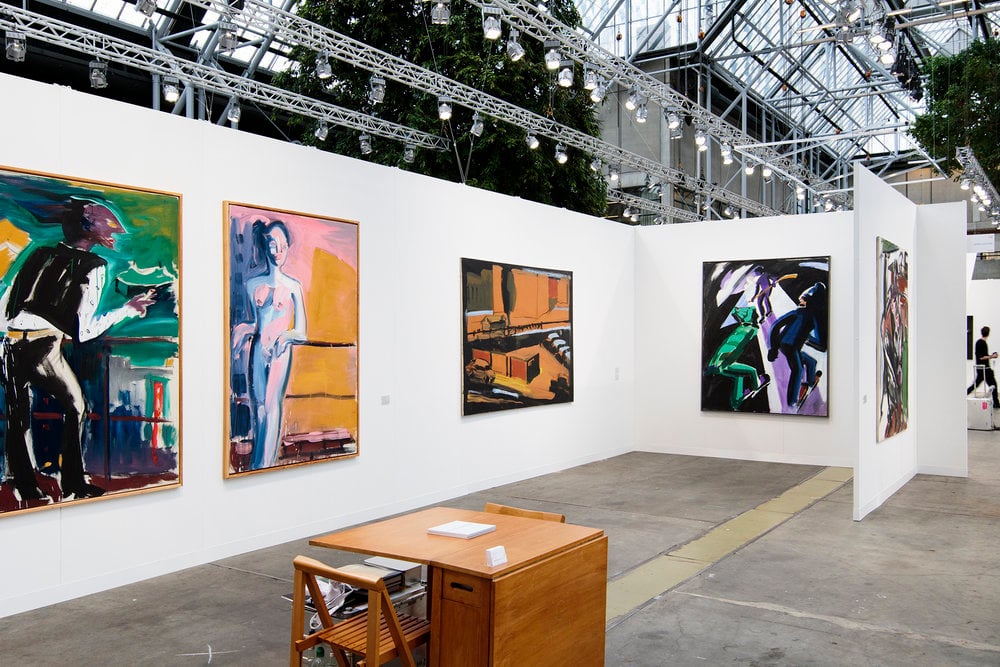
Booth of König Galerie at Code. Photo I
DO ART Agency, Courtesy of the artists and König Galerie.
But 45 percent of business is done at fairs, according to the
most recent Art Basel and UBS Global Art Market
report.
Elizabeth Dee: I do not
think all fairs are equal and I do not think all fairs are going to
do well post-COVID. The big convention centers, hosting
thousands of people, or locations without a native collecting
community, places that you have to travel to, are going to suffer.
But I think bespoke experiences where you have quality over
quantity provide an opportunity for a more open, less densely
crowded environment.
Johann Koenig: The main
reason for fairs is to get things done quickly. We need them as a
platform to reach our goals in a super-efficient way. From a
collector’s perspective, at a good fair like Art Basel in
Switzerland, someone who doesn’t know yet what he is doing and what
inspires him gets an overview of the better end of the market, from
postwar Modern art to
the youngest contemporary art.
Isn’t it primarily a question of whether galleries must
participate in 10 or more fairs a year?
Johann Koenig: Of course,
we can question the necessity of Art Basel or any other fair. It is
not just people buying art. There are committee meetings, board
meetings. Why do we need to fly everything to Hong Kong and
pay insane prices for a whole week in a hotel, even though we only
want to stay for two nights? I did not do Art Basel Miami last
year; I did not even apply for Hong Kong. I know what my gallery is
worth. I know what I can do for my artists. I do not need the fair
stamp. My advice to young art dealers is: Do what is right for
you. You have to say no at some point.
Elizabeth Dee: It is that
forthright honesty that is unique now. When I started, we always
had to find a way to pay the country club bill even if we were not
rich. If we wanted to compete, that was just the deal. We now
see galleries who have been participating at Art Basel and other
fairs for years and years and are leaving because what might
be right for some might not benefit them long-term. There’s a
comfort level with that we didn’t see before, and I think it’s
healthy because fairs had too much power. Galleries should
have ownership over the fairs that they participate in and be
partners with the fairs. As a gallery, I would not do a fair if I
could not call the head of PR and have a dialogue about what I’m
bringing or if I could not call the director and ask him or her,
what are you planning this year? I think expectations are
changing.
Marc Glimcher: Economics
is the ultimate ecological regulatory system. So as long as we can
all afford to do them, obviously we are going to. From time to time
I say: OK, this is it! And we did reduce from 23 fairs to 16 last
year. But the interesting thing we’re going to see is that
everybody came into this crisis burning everything they could. Very
few people have some kind of cushion.
Elizabeth Dee: Especially
in America.
Johann Koenig: The US is
so extreme, people immediately got laid off. You cannot compare it
to the amazing social net in Germany everybody falls into and is
protected by. In the US, the world is over—and a couple of months
later, it is the best world possible.
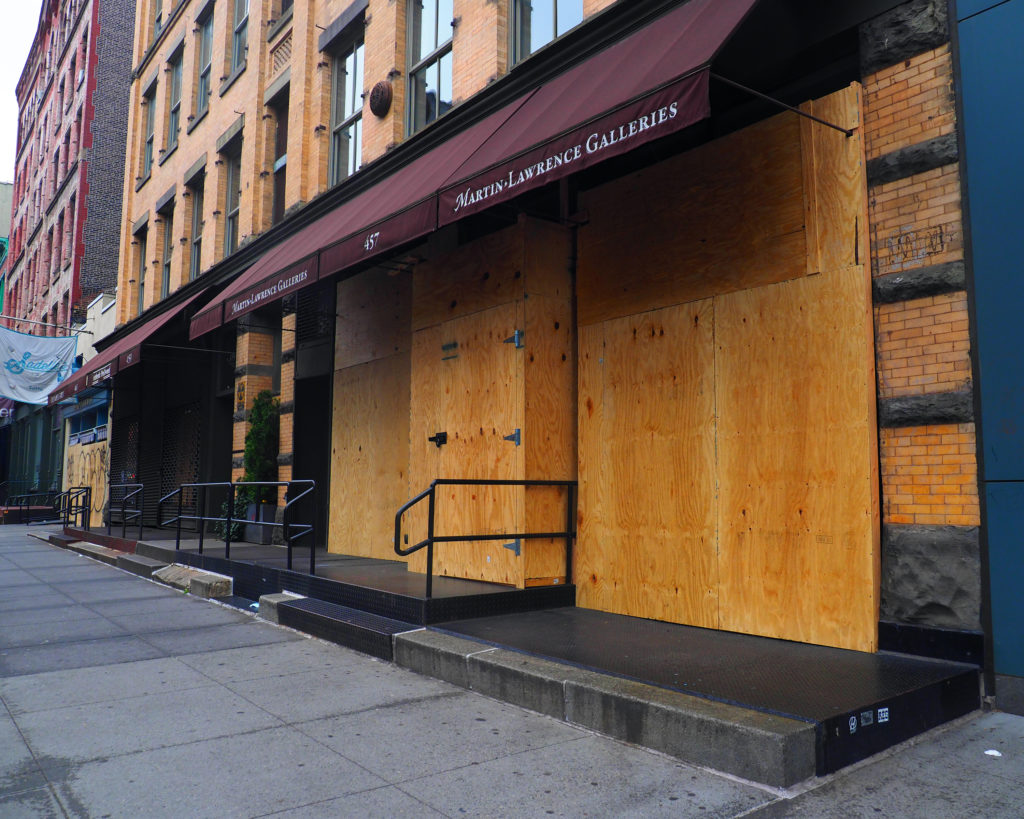
Martin Lawrence Gallery in Soho is
boarded up during the coronavirus pandemic on April 17, 2020 in New
York City. (Photo by Debra L Rothenberg/Getty Images)
A lot of the galleries cannot afford not to sell anything for
two months.
Marc Glimcher: Many
galleries are going to close. Everyone traded in—either they gave
up a safety cushion or their honest, deeply held beliefs. Instead,
they got on the treadmill, hit 10 incline and speed, and started
running as fast as they could. But people do not love us because we
could run so fast. I just did our dealers’ meeting online with
about 30 people from all over the world who work for the gallery.
They all said they wanted to go back to basics instead of expanding
further. If everybody feels that fatigue, let’s do something about
it. Let’s show a little courage. How are we going to do five
art fairs in three months as it might be planned for fall
now?
Elizabeth Dee: That is a
problem.
Marc Glimcher: We all
have shows piled up and what happens on September 1st? We just
switch the whole thing on and every piece of art is for sale at the
same time?
Elizabeth Dee: And what
is the price of shipping going to be? Fairs need to
collaborate. How is this sustainable from an ecological, economic
standpoint? What about the fatigue, the market fatigue? You don’t
turn on the stock market after it has been closed and have it run
for seven days straight. We have to have an open conversation about
this.
Marc Glimcher: If the
galleries are desperate—and we have seen desperation ruling the day
for so long—and we all go for it with these five fairs in the fall,
we will all lose money. We already lost a lot of money, I don’t
know if you have noticed? It is like having a heart attack and the
first thing you do is eat a cheeseburger.
Elizabeth Dee: We’ve got
to get real. I talked to collectors yesterday and they told me that
they are not going to any of the European fairs this year. They
will wait for New York fairs to reopen. Otherwise, they’ll go to
the galleries.
Marc Glimcher: Art Basel
Miami is going to be a hit, it is long enough away. [Florida] has a
Republican governor who started opening bars and beaches already.
The next coronavirus spike is not going to dominate any news cycle.
We are going to have an election that is going to dominate the
news. I bet people are going to Florida…
Elizabeth, you have been using this crisis to work on ideas about how
to build a different, and maybe stronger, art
market.
Elizabeth Dee: I think
downturns expose a lot, especially the flaws and what is not
working. Whatever you want to call this moment, it is one of these
unique times when you are forced to assess whether the business
models [you are using] are the right ones. Success and growth mean
a lot of different things to a lot of different
galleries.
Marc Glimcher: Look, the
core issue—and this is the first time that this has happened in the
art world—is that the invention or the discoveries of the artists
are not center stage any longer. Instead, galleries and gallery
strategies, the idea [hat] we are an asset class is moving center
stage. The thing that gives art value is the art experience, as we
all know. But as soon as that stops being the central topic, we
become a derivative of ourselves, a stock option on art. That does
not mean it has evaporated the core thing that we do. But we should
not forget that we are in the magic business.
Elizabeth Dee: Yes, we
are.
Marc Glimcher: If you
want to be in the asset management business, then go there! If the
work of a 40-year-old painter from this year is worth more than a
Franz Kline painting, then this is only the asset management
business. That very expensive painting by a young
artist could be a magical thing, but we are draining the blood
out of it. Look at how many people are joining in the game. It is a
lot fewer than in 2015 or the years before that. If you keep
getting such a bad result, the collectors will stop saying, I
picked the wrong artist, and they will start saying, I picked the
wrong hobby.
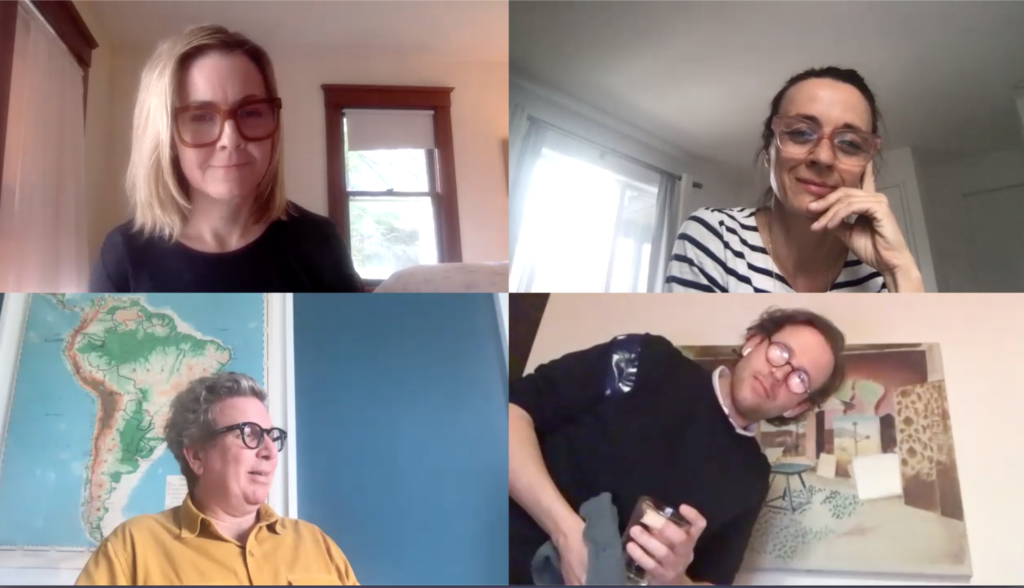
Clockwise from top left: Elizabeth Dee,
Claudia Bodin, Johann Koenig, and Marc Glimcher in conversation.
Screen shot courtesy of Claudia Bodin.
So far, the art market has always came back.
Marc Glimcher: It won’t
come back if you drain the blood out of it. I’m sorry, but you can
destroy societal systems if you continuously soak the meaning out
of them. In the art world, we think that we are invulnerable. That
is how they felt in the classical music world. For 500 years,
classical music was a massively significant system and part of
a huge industry. It disappeared overnight. Technology changed;
there were 50 years of artists breaking the rules as all modern
artists did it. There was jazz, rock, and popular music, the radio,
records. Don’t be so cocky about the imperviousness of our art
system. You cannot keep abusing our system and keep assuming that
there won’t be any consequences.
Johann Koenig: What do
you mean, the hyper-inflated prices?
Marc Glimcher: I mean,
you take a really talented artist and feed him into the art-world
machine. How many times do you have to see that story unfolding the
same way? Our job as dealers is to protect the collector and the
artist. We are on opposite sides of the transaction. This is very
old fashioned. So, you need kind of old-fashioned rules for our
system. But are we still protecting the artist and are we still
protecting the client?
Elizabeth Dee: In that
case, who is the abuser and who is the abused? Is the abuser the
gallerist or a combination of the gallerist and the collector as a
default? Our gallery system has been moving further and further
away from these values. The question is how do we keep supporting
revolutionary artists?
Marc Glimcher: The
artists are guilty, too, by the way.
Johann Koenig: Success
has different meanings for different artists and different
galleries. For me, it is amplifying the artist’s careers and
helping them realize projects, getting them shows, and being
present in collections that contextualize work. It is about
realizing dreams. But then the whole cycle with a growing
market—all the superlatives, the spectacles—got out of control. The
entertainment elements at some of the dinners were as expensive as
the art-fair presentation. This whole competition got out of
hand.
Nobody is willing to slow down, spend less, or do fewer art
fairs?
Elizabeth Dee: I don’t
think reputational capital is enough to qualify success; I don’t
think a great dinner is enough anymore. All these things are
in the process of being identified as no longer essential.
There are fairs that offer real context for the program and the
artists—and there are fairs that don’t. There are exhibitions that
push the ball forward—and there are exhibitions that don’t. There
are collections that make an impact on an artist’s development;
others just don’t. I think it’s that pace, Johann, you were talking
about that was getting out of hand. That food chain that was
hyper-accelerated to a point where it was hard to identify the
context and the quality versus the quantity.
Johann Koenig: Also, do
not forget the natural competition between artists as we saw it
between Matisse and Picasso. I keep hearing from my artists: Why
does she cost so much? Why does he get the pavilion? It always has
been a mélange between realizing dreams and competing over
them.
Marc Glimcher: This will
be an opportunity for the pendulum to swing back. It was maybe
starting to swing back anyways. The ability of galleries to work
together is starting to be a very attractive idea. The competitive
level we have been operating on is so self-destructive. I
would compare it to the potluck ceremony in a village when the
wealthiest man would bring all of his belongings to the town square
and burn them all just to prove that he is the richest man in town.
At some point, that ceremony becomes somehow unattractive. How many
artists are you going to add to your program? Where are you heading
with that, what is the plan? We represent a crazy number of
artists—93—already. Is the plan to represent 500 at some
point?
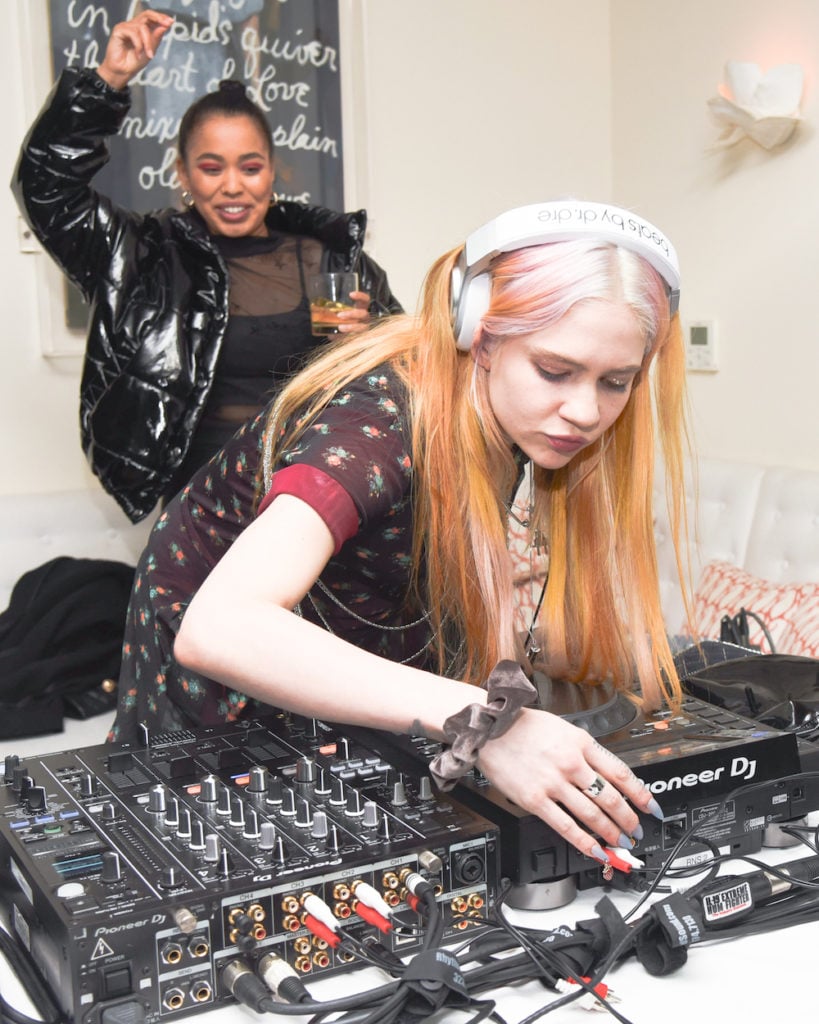
Grimes performing at a party hosted by
Pace and Kayne Griffin Corcoran for James Turrell’s Roden
Crater artwork. ©BFA
Photos: Linnea Stephan and Eunji Kim/BFA.com
Let’s talk about collaboration. Pace, in contrast to other
big galleries, has been open to different models of
co-representations of artists.
Marc Glimcher: You
have to go back to defining what your goal is. I still
consider Pace a New York gallery, an American gallery. Even though
we have galleries in lots of countries. It is important to honestly
want to co-represent artists and not just tolerate it and eliminate
it as you grow. When we remove the local nature of the art world,
it is going to lose all of its magic.
Johann Koenig: I
always recommend my artists show with a North American gallery in
America. I think a gallery lives from the personality of the art
dealer—and it can be many personalities or directors. But in
German-speaking countries, I can achieve for my artists what I bet
nobody else without these roots can. It is such a personal
business, in a positive and negative way. We, for example, need
partners like Pace, knowing the New York and the US structures and
how the system works. It really always has to be the best of all
worlds, ideally the triangle of a mega-gallery, plus an
innovative gallery, plus maybe the young gallery. But, of course,
there might be conflicts with the mega-gallery signing these
artists and their team just wanting to make them happy.
Elizabeth Dee: You have
to be willing to walk away sometimes.
Johann Koenig: Let’s take
the example of the artist Jordan
Wolfson. I ultimately lost him over criticizing him. But this
is my role, to be a sparring partner. We had this big dispute
because he asked me to write on the website of my gallery that he
is the most important artist of his generation. I refused as I did
not think of it as a good idea. He left and joined David
Zwirner.
Marc Glimcher: The
tyranny of the artist. We are their loyal subjects for sure. But we have
constructed a system where every artist that joins the gallery is a
bullet in that art dealer’s gun and everyone that leaves is one
bullet taken out. But artists move around now, that is just
the way it is. One thing that helps is to calm down about
it. If an artist leaves, it’s not the end of the
world.
But for some smaller galleries, it is the end of the world,
because this artist might be their main source of income.
Marc Glimcher: There
still should be room for the word no. I am embarrassed about some
of the artists I considered competing over, one in particular…
Johann Koenig: Who was
the artist?
Marc Glimcher: I did not
even tell my father or my wife about this. The galleries should
bleed for the artists; my father was very much part of forming this
ethos. But you have to believe in yourself enough to
sometimes be able to say no—not just to the artist, but to an
extra art fair or opening another gallery or doing this or that.
Now that you are just paddling as fast as you can, this is maybe a
moment to paddle a little slower and to try to get back to the
thing you love. Because the reason you were successful in the first
place was that people could recognize the depth of authenticity
that you brought. The art world is shrinking around us because we
are all after the same thing. Pretty soon, all we are going to be
after is, how are we possibly going to pay the insane
bills?
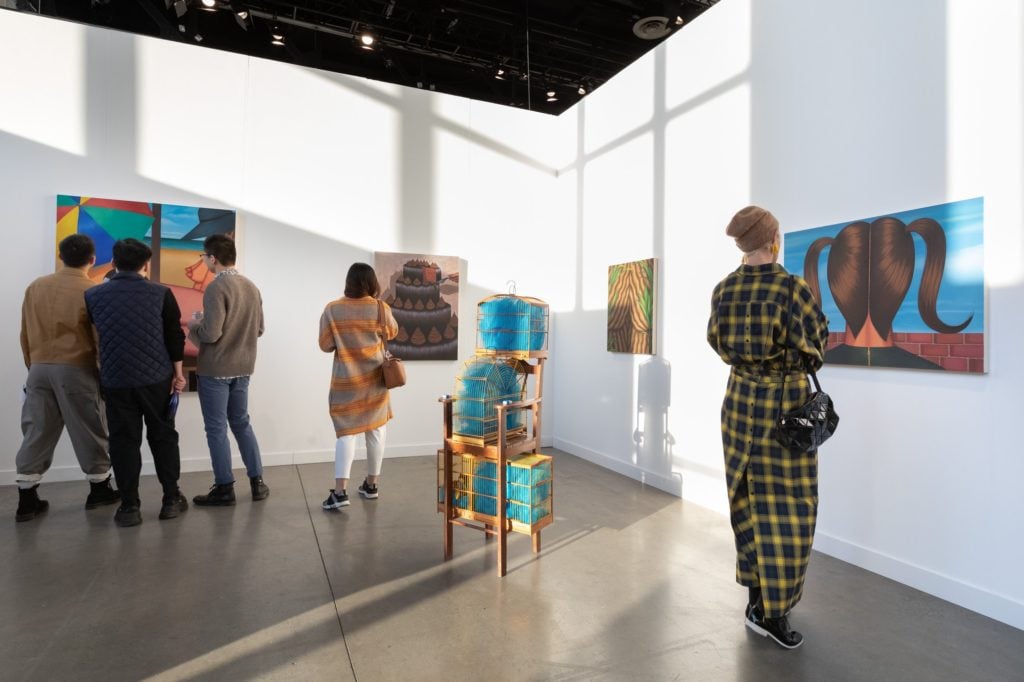
Installation view of the Independent Art
Fair. Photo courtesy of Independent Art Fair NYC.
It sounds like you see a spirit of change, Elizabeth?
Elizabeth Dee: Before
this, there was this assumption that bigger galleries are better
off, and everybody else is a victim of the system. So the idea of
survival was joining up with peers who identified with what you
identify with, whether it was your city or your generation. I never
really bought that the bigger galleries were winning the war and
were free from the same challenges. I think it is much more complex
than that. The second people get honest about their own unique
circumstances, interesting things are going to happen for each
gallery associating differently across these cities, generations,
and footprints. I’m not saying that every gallery is feeling like
they want to share every aspect of their issues, but I definitely
think that the more this conversation grows within the community,
the more change is actually potentially possible. I think we will
see an art world in the future that is more intergenerational and…
breaks through perceived class differences. The potential for Marc,
who represents one of the top mega-galleries, and a gallery that is
just starting is actually more possible in this future scenario. I
would like to support that. To start, we can actually have
dealer-to-dealer, gallery-to-gallery conversations.
Johann Koenig: How was it
when you started?
Elizabeth Dee: I think
there was a sense of, you have to fake it till you make it and you
have to defend your territory ruthlessly. There was definitely a
generational bond, but it was not like that you had mentors giving
you advice. People are coming together more now, which is much
healthier.
Johann Koenig: In Berlin,
we have five different initiatives, among them Gallery Weekend and
Office Impart, for a really not so important art market, at least
internationally. How come they all think they can do it themselves?
I tried to bring them together, but it seemed to me that there’s no
interest. I think there’s so much we can learn from each other. We
are always exchanging ideas. For our new booking system for gallery
visits, for example, I got advice from the gallery Various Small
Fires in Los Angeles.
Elizabeth, you have been working on an idea for a new
initiative to get collectors on board and help out galleries and
museums at the same time.
Elizabeth Dee: The
pipeline is fragmented between the for-profit community, the
galleries, and the nonprofit community, the museums. What I’m
trying to do is engage an idea around the collector’s resources for
something that functions at both ends. The concept is that
collectors would give money as a non-profit donation to crowd-fund
acquisitions for museums and fast-track those acquisitions for
artists. The main focus for museums in the US for the next two to
three years will be getting their operational budget sustained and
making sure that patrons support the mission to recover and keep
operating capital. To keep their doors open will be the main
concern. Collectors may not want to buy a $100,000 painting by an
artist they are just getting to know because it just does not feel
like an environment for discovery right now, but I think they would
easily commit $5,000 or $10,000 toward that work, especially if it
is going directly to the institution. And that would also help
support the galleries.
Are collectors at all interested in buying at the
moment?
Johann Koenig: I must say
we’re doing surprisingly well. We were planning a show with
Loie Hollowell for
Gallery Weekend and we have sold out her show already. The
same goes for Sarah Morris; we have an exhibition locked down in
New York City which was meant to go to Tokyo. What had a
strong market before COVID still has a strong market now, and
eventually [it] will even be stronger. Because it is really about
the asset class quality of the art. We are not in this because we
are asset managers, like Marc said earlier, but I could also not
ask my clients to spend €250,000 and not talk about the potential
loss and growth.
How are artists responding to this crisis and issues like
social inequality that have come even further to the surface as a
result?
Johann Koenig: With too
many possibilities things are not necessarily better. I see some
artists starting to work on a smaller scale and being very
innovative.
Marc Glimcher: We still
have an open question about the democratization of art. It will be
a boom for the artists who will continue to make paintings and
sculptures for exactly the reasons Johann said. Tough times always
make for great art. But those artists who are continuing to
explore the questions of how do I have a practice and decommodify
it at the same time, this is more fuel for that.
The post ‘We Should Not Forget We Are in the Magic
Business’: A Roundtable Discussion on How the Lockdown Era Could
Change the Art Market Forever appeared first on artnet
News.
Read more https://news.artnet.com/market/art-dealer-roundtable-kunstmagazin-1874280
Further reading


Leave a comment