
We Went to an Art Auction on a Cruise Ship. It Was… Unusual
I was lounging poolside, cocktail in hand, when I heard the
announcement. The grand finale art auction was about to start.
It was a weekend cruise from Miami to the Bahamas aboard Royal
Caribbean’s recently
refurbished Navigator of the Seas. Attending the
ship’s auction wasn’t part of my plan, but it was beginning to
rain, and the rest of my party was still at port. What else was I
going to do with the rest of the afternoon? As I entered the event,
hosted by cruise-ship auctioneer Park West Gallery, I bypassed the
registration table, heading straight for the auction floor, where a
waiter was handing out glasses of sparkling white wine.
From the start, it was clear that this was no regular art
auction. After a brief spiel encouraging folks to buy art as a
legacy to leave to their children, the auctioneer, Robert
Borotescu, got down to business.
“I don’t know if you’ve seen Oprah,” he said. “We have some
surprises under the chairs.”
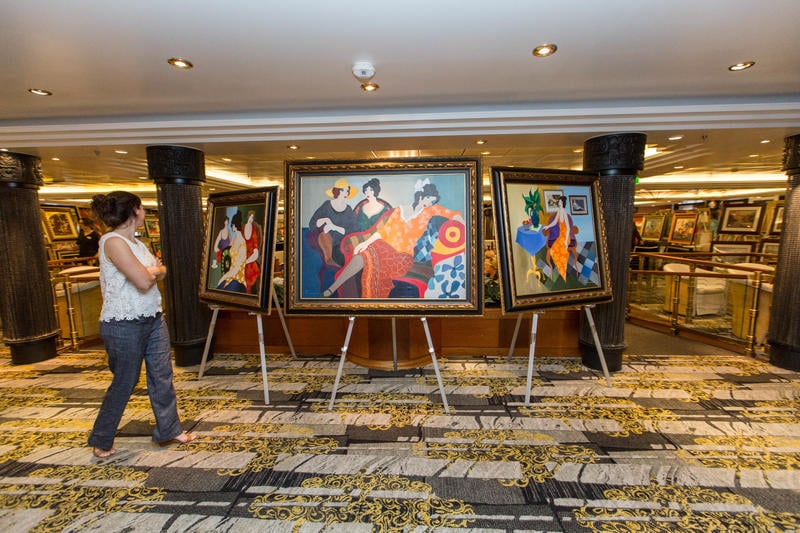
A Park West art auction in the Star
Lounge on Royal Caribbean’s Navigator of the Seas.
Courtesy Cruise Critic.
Cue a frenzy as the few guests in the room rushed to upturn
every seat cushion. There were no car keys to be found, but there
were $100 certificates for discounts on winning bids.
Borotescu, a dark-haired Romanian man in his mid-to-late 30s,
endeared himself toward the crowd by offering additional raffle
tickets for $100 credits throughout the auction. After every lot,
he would encourage attendees to wave their auction paddles (or bid
cards, in the parlance of Park West), promising the discount to
whoever was first in the air. Inevitably, he’d credit two, three,
or even four bidders every time, making everyone feel like a
winner.
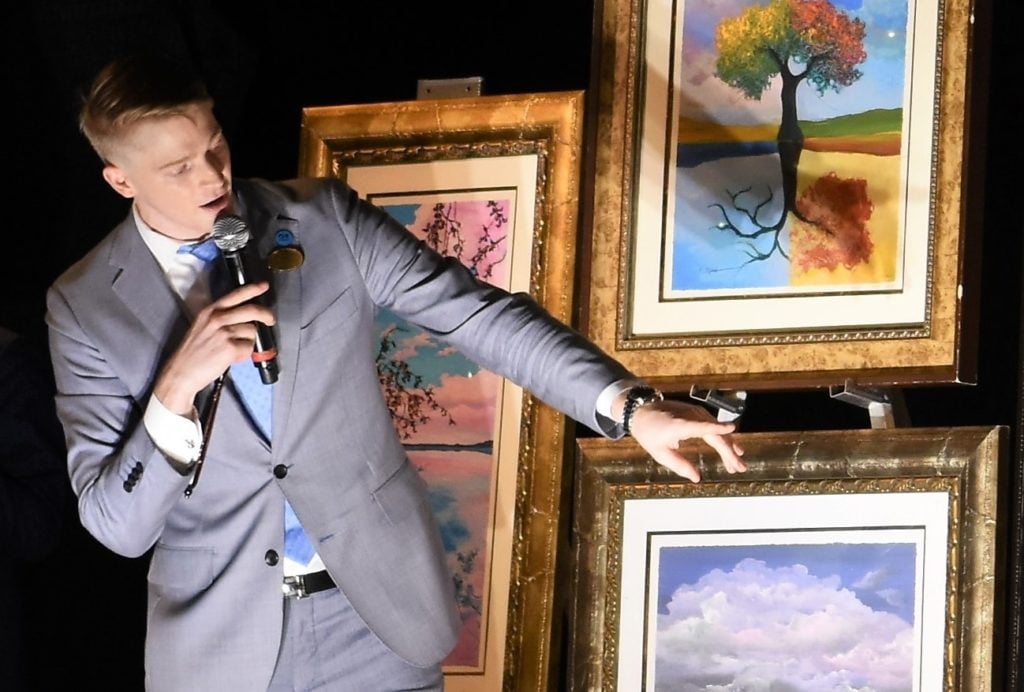
Park West art auctioneer Alex White.
Photo by Park West.
With his pleasantly urbane accent, Borotescu set his
audience at ease, acknowledging that they probably never had the
time to visit art museums and galleries. But they were here now,
and it was his job to make sure that they went home with something
they absolutely loved.
Founded in 1969 by Albert Scaglione, Park West boasts some
impressive-sounding sales numbers. Borotescu told us that the
company operates on 100 cruise ships, and claimed that the art
aboard the Navigator of the Seas alone was worth
$3 million. Representing some 200 artists, the company holds 1,200
auctions every month.
“You tell me another gallery that sells so much art in a
month,” Borotescu boasted to his audience, noting that the
company even has its own art museum just outside Detroit.
But where traditional auction houses operate on the secondary
market, selling works consigned by private collectors, Park West
specializes in what it calls “graphic works”: Mass-produced
reproductions of original paintings, signed by the artist and
released in limited editions. Some are giclée prints—a
fancy term for high-quality inkjet prints. Other pieces might look
like paintings, but these more expensive offerings are often merely
hand-embellished, with brushstrokes layered over a printed image to
give it a more “authentic” feel.
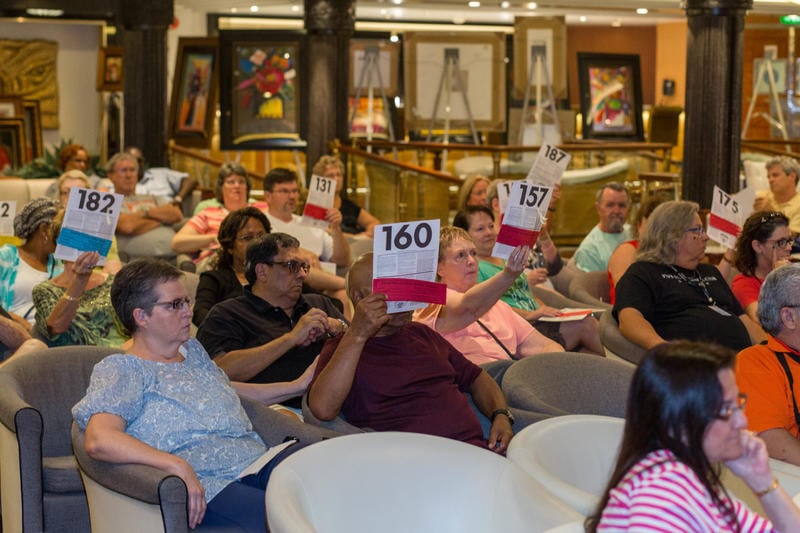
A Park West art auction in the Star
Lounge on Royal Caribbean’s Navigator of the Seas.
Courtesy Cruise Critic.
“They look like a unique one-of-a-kind, they feel like a unique
one-of-a-kind—just [at] the fraction of the price,” Borotescu
explained before kicking off the sale. Later, he said: “If we
look at the Oxford Dictionary of Art, every single
artwork that can be traced back to the artist, or was created under
the artist’s supervision, is considered to be an original work of
art,” he said, noting that the Park West collection does not
include posters, because “they have no value.”
Of course, practically all these works are anything but unique,
and most of the time, you won’t even take home the exact work
you’re bidding on. Park West will ship you a functionally identical
copy from its warehouse, rather than going through the trouble of
turning over the on-board stock, according to Bloomberg
Business. The publication also reported in 2016 that since
2008, Park West had been subject to nearly a dozen lawsuits
alleging abusive sales practices.
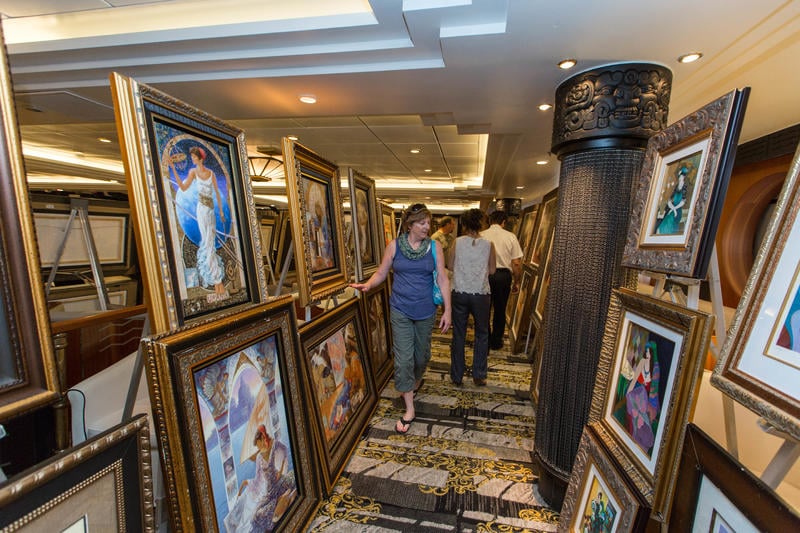
A Park West art auction in the Star
Lounge on Royal Caribbean’s Navigator of the Seas.
Courtesy Cruise Critic.
Before the opening lot, Borotescu instructed the staff to open
the side aisles where the art was on view to allow collectors to
peruse the works on offer and to place stickers next to the works
they were particularly interested in. They could also talk to his
associate, Gabby, who he referred to as “the love of my life”
(on board love
affairs between Park West
employees are
celebrated on the company website)
about securing a lower, pre-auction reserve price for any pieces
they were dead set on taking home, or to discuss package pricing
for groups of works.
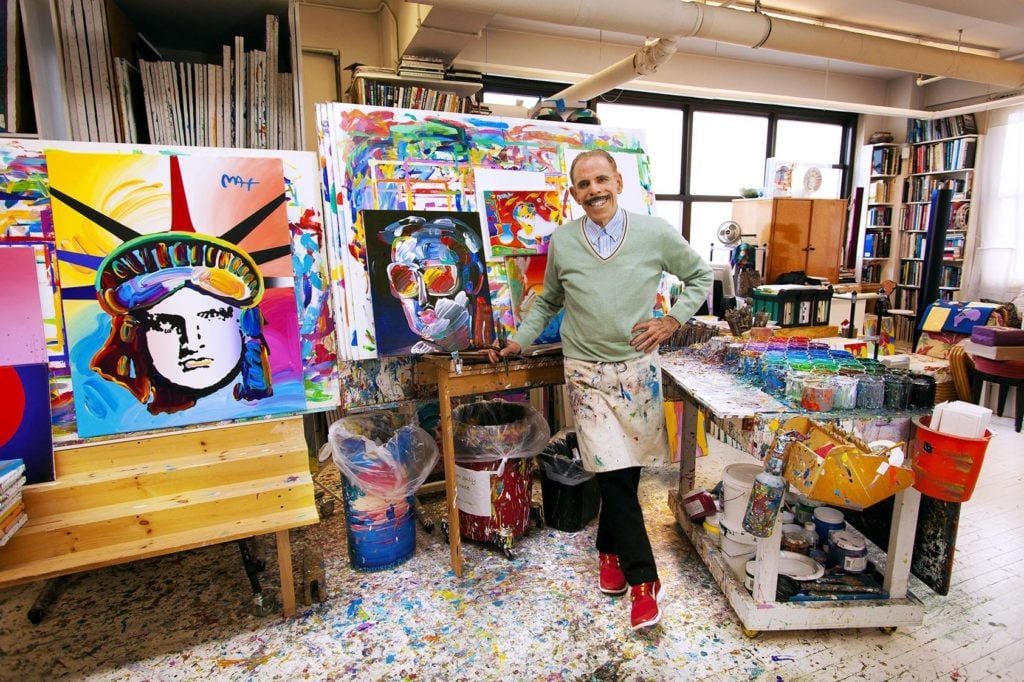
The bidding kicked off with a piece by Peter Max, a well-known Pop artist who met
Scaglione, Park West’s founder, back in the late 1960s, and has
been represented by him ever since.
That arrangement has become strained in recent years, as Max has
suffered from dementia and stopped painting, allegedly signing
pieces churned out by assistants. According to the New York
Times, the artist’s daughter has sued the gallery for
underpaying for his works, and Park West has returned the favor
with a breach of contract suit.
“This is one of the gems we have on the Navigator of
the Seas,” Borotescu told the crowd, claiming that the
“printed painting on canvas” was valued at $23,500, but that he
could start the bidding at $20,000. Less than 30 seconds later, the
work was sold for $20,700.
Max has decades of experience exhibiting at international
museums, and the highest auction record for a work of his is
$53,125, according to the artnet Price Database. But that’s an
outlier; among nearly 2,000 records, only two other works by the
artist sold by a serious auction house went for more
than $20,000.
Peter Max. Photo courtesy of the
artist.
Other artists on offer had decidedly less impressive CVs.
Borotescu proudly proclaimed that Park West is the only gallery to
represent David “Lebo” Le Batard, noting that the artist is known
for his paintings of cats and owls. This
didn’t seem like much of a selling point, but that didn’t stop the
auctioneer from presenting a group of his works. Later, Slava
Ilyayev was praised for working exclusively with a palette knife.
And then there was someone named Gene Moore. “He has a lot of
creativity,” Borotescu insisted. “We have to agree that he has
a lot of creativity.”
The relative obscurity of most of the artists—all of them seemed
to be men—might be part of the reason that the auction relied
heavily on gimmicks, presumably designed to encourage the audience
to get in on the action and make a bid.
Every attendee was encouraged to enter a free raffle to take
home a massive, unframed Thomas Kinkade. And if you signed up for
the Park West “collector’s card,” used exclusively to make
purchases with the company, you were promised a free work by some
Croatian artist named Marko Marković.
One lot was a pair of works presented backward, sold without any
idea of what they looked like. “They are going to be two of the
most gorgeous works of art that anyone has ever seen,” Borotescu
promised the audience. “Once you turn it around, if it’s something
you don’t like, you don’t have to keep it.”
The prints turned out to be by an artist named David Najar, one of the most prominent
artists of the night, with numerous lots featuring his generic,
highly saturated compositions of trees and skies. The unseen works
hammed down for $1,490, and Borotescu generously tossed in a third
work by the artist (an edition of it sold as part of an earlier
lot) to round out the set.
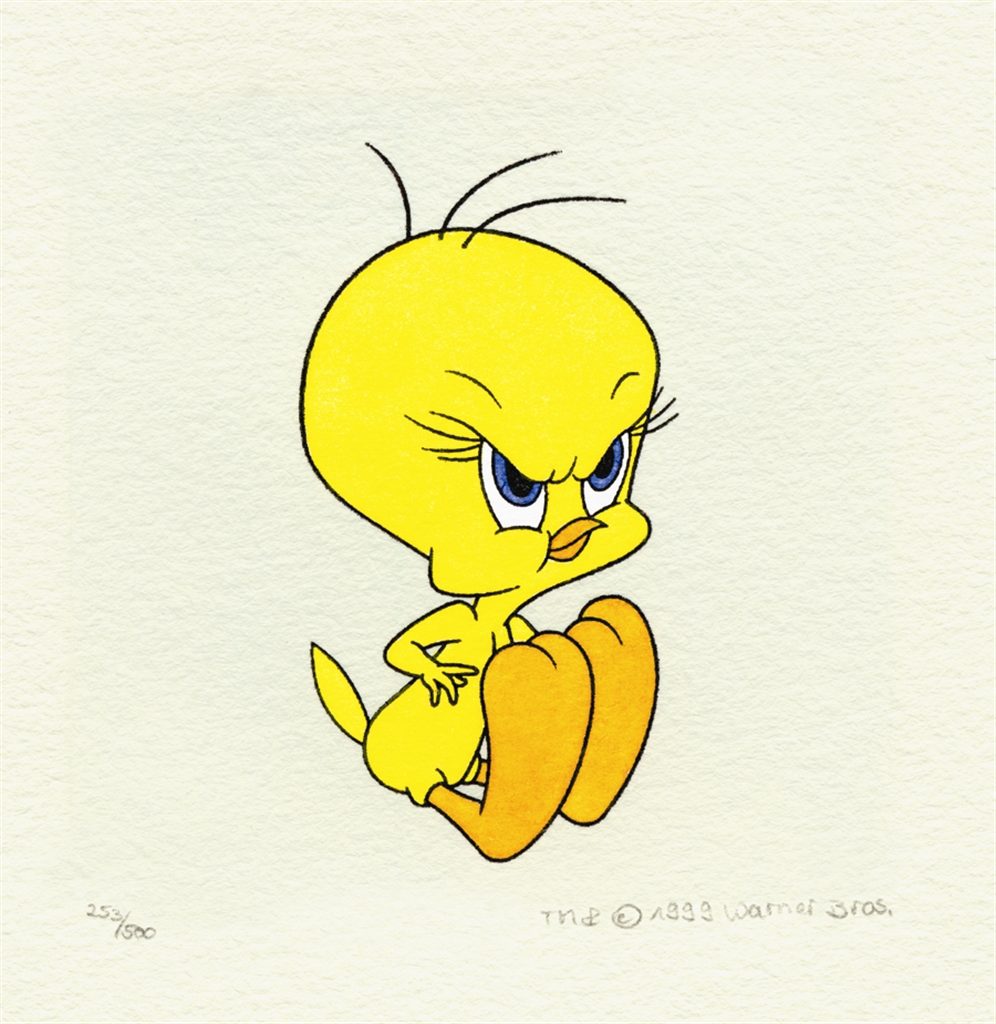
Then there was Tweety.
Borotescu never named the artist responsible for designing the tiny
print, relying on the Looney Toons character’s name
recognition and the picture’s very loose connection to an Old
Master painter to secure the sale.
“Rembrandt was doing etchings 500 years ago,” the auctioneer
intoned. “Tweety was done using the same technique.”
Warner Bros. Studios, Tweety
(1999). Courtesy of Park West Gallery.
Supposedly, the artwork, which was just a couple inches high and
therefore impossible to see from across the room, was valued at
$549.
“Let’s have some fun,” Borotescu suggested, asking everyone in
the room to hold up their bid card. He opened the bidding at just
$20. Two thirds of the crowd dropped out when he raised the price
to $40, and suddenly the auctioneer dropped the hammer, selling the
cartoon bird to a handful of guests.
Amused by the over-the-top spectacle of this dumbed-down version
of Christie’s or Sotheby’s, I felt compelled to make a video
as Borotescu sold one of the lots. Scanning the room in search
of bid cards, the auctioneer quickly spotted me, and didn’t skip a
beat as he intoned, “no recording, no pictures please.”
Within minutes, a security guard had been dispatched, warning me
that the guests purchasing works of art had a right to their
privacy and that I was not allowed to make recordings. There was no
point in arguing. In 2009, the Independent reported that one
passenger was removed from a cruise for warning guests to beware of
Park West. So I knocked back another glass of champagne and took my
leave.
The post We Went to an Art Auction on a Cruise Ship. It Was…
Unusual appeared first on artnet News.
Read more https://news.artnet.com/market/cruise-ship-auction-1626928
Further reading


Leave a comment