
What Gives an Art Fair Staying Power? Turin’s Artissima Remains a Haven for Old-School Collectors After a Quarter-Century
There’s a huge soccer match in
Turin on Saturday, the Italian city where art, like soccer, is a
deeply serious business. “Half my team are Torino but we have to
cheer Juventus at the fair,” says Ilaria Bonacossa, the director of
Artissima. Juve is sponsoring the fair’s child-friendly junior
section for the second time. The manager of Juve’s women’s team
turned out yesterday, October 31, as the fair kicked off its 2019
edition. So, the bias is understandable.
Now in its 26th edition,
Artissima stands out in a crowded field of European art fairs held
every fall because it is committed to serious art for serious
collectors. It isn’t looking to expand internationally, nor is it
particularly interested in converting art novices into first-time
buyers. Artissima is comfortable existing for the already
converted. As one French collector who preferred to remain unnamed
put it: “It’s not branded—it’s different.”
And indeed, throughout the
aisles, brand names give way to lesser-known galleries from Tehran,
Beirut, and Tel Aviv. Sculpture doesn’t get more serious than Yael
Bartana’s haunting new “fossilised” automatic weapons,
R.I.P. AK47
and R.I.P. UZI, on the booth of Sommer Contemporary Art of
Tel Aviv and Zurich, which were instant talking
points.
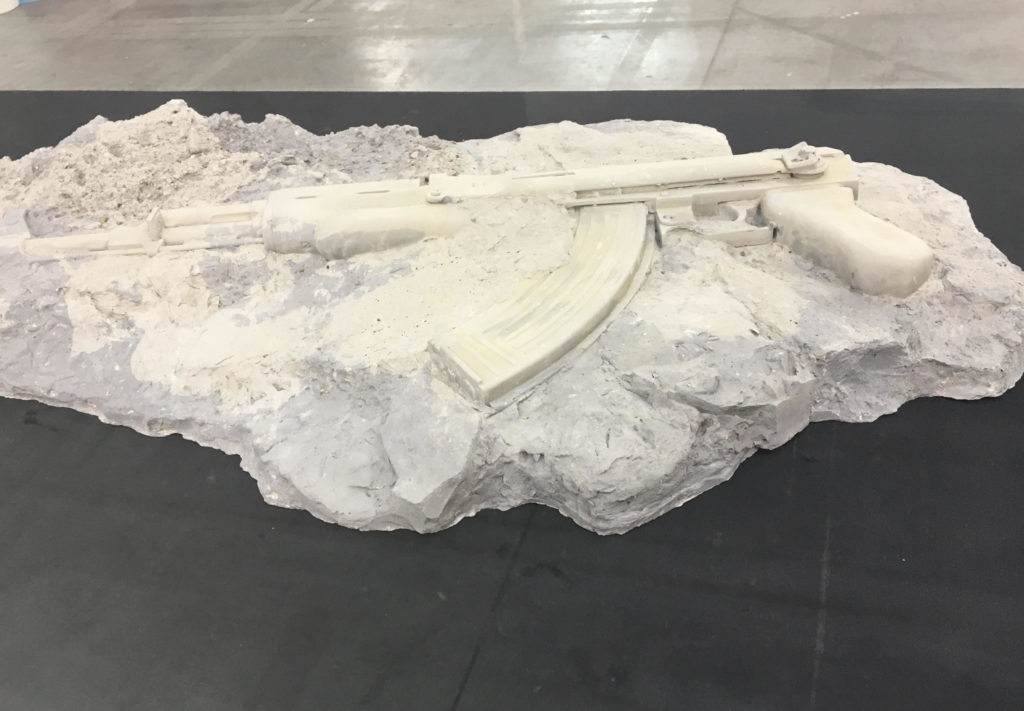
Yael Bartana R.I.P. AK47 (2019)
at Sommer Contemporary Art. Photo by J. Pes.
Not a “Shopping Mall” Fair
“There is a tradition of Italian
collectors being quite brave,” says Bonacossa, the former curator
of Turin-based super-collector Patrizia Sandretto Re Rebaudengo’s
foundation, who now juggles Artissima with directing the Fondazione
La Raia near Genoa. “International collectors come because they
find strong new things, not the same power 100.”
That view was also endorsed by
the Belgian collector and art-fair aficionado Alain Servais, who
tweeted that Artissima is a healthy contrast to other fairs that
can feel like “shopping malls” full of branded products. His early
purchases included an interactive sculpture comprised of a set of
rolling pins made of various animal skins by the Brazilian
collective OPAVIVARÁ at A Gentil Carioca gallery of Rio de
Janeiro.
Museum leaders were also in
ample supply. Fifty curators and museum directors had signed on to
attend, a remarkable number given the size of the fair. Among those
that made purchases was the Castello di Rivoli museum, which bought
the VR installation Real
Violence (2017) by the
American artist Jordan Wolfson for an undisclosed sum from Sadie
Coles. The work is, virtually speaking, the hardest-hitting at
Artissima: Don the goggles and earphones and you will witness a man
beating a defenseless victim in what seems like an unprovoked
street attack. The more than two-minute-long bloodbath is
accompanied by a Hebrew prayer and brutal sound effects. (Full
disclosure: the first whack of the baseball bat was enough for
me.)
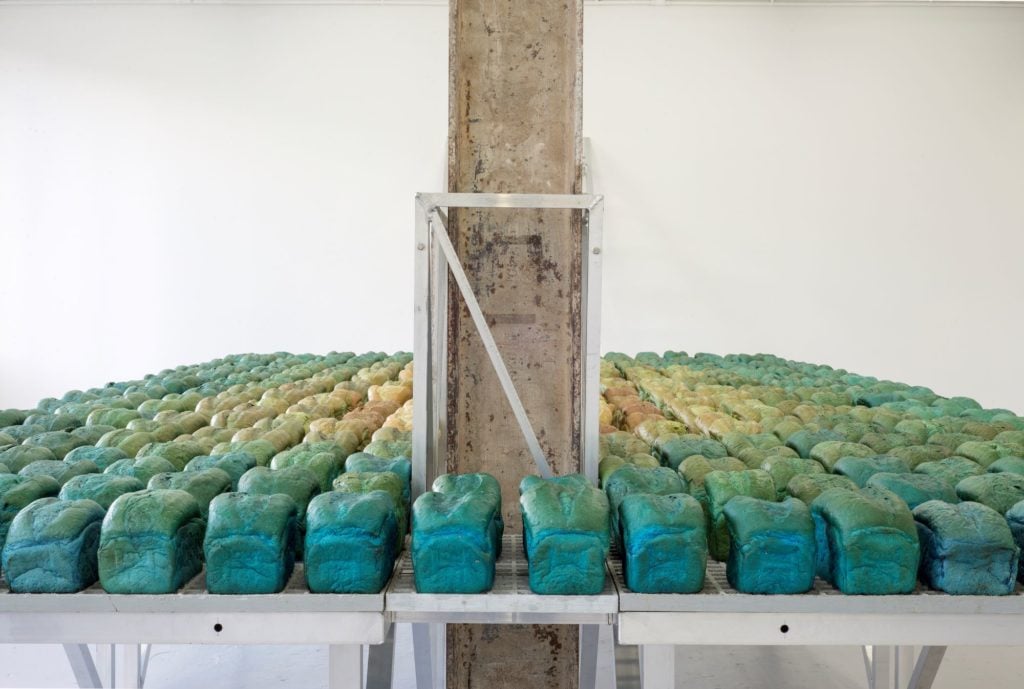
Augustus Serapinas Blue
Pen (2018-19). Courtesy of Emalin and David Dale
Gallery.
A Place for Risks
Part of the benefit of Artissima
is that participation “is not expensive for galleries,” Bonacossa
says. “So [they] can take risks with a young artist.” Proof of the
pudding is the way the London-based gallery Emalin and Apalazzo of
Brescia quickly sold a show-stopping installation of bread loaves
by Augustas Serapinas, the youngest participant in the main
exhibition of the 2019 Venice Biennale. Called
Blue Pen (2018), the ingeniously engineered sculpture
was first shown at the 2018 Glasgow International. The Italian
designer Luca Bombassei bought it for €35,000 ($39,000) and plans
to show it at his forthcoming exhibition space in
Perugia.
Meanwhile, another
well-trafficked portion of the fair was its much-imitated section
“Back to the Future,” which features works made from the 1960s to
2000 with a focus on overlooked artists. Standout projects this
year include the American-born, Britain-based Liliane Lijn’s video
and bronze sculptures at Rodeo of London and Athens; veteran
Japanese artist Kimiyo Mishima’s collages from the late 1960s at
Sokyo Gallery Kyoto; an ephemeral sculpture made of pillars of salt
by the radical architecture collective Superstudio presented by
Pinksummer of Genoa; and animated work by the late American artist
Robert Breer at gb agency of Paris.
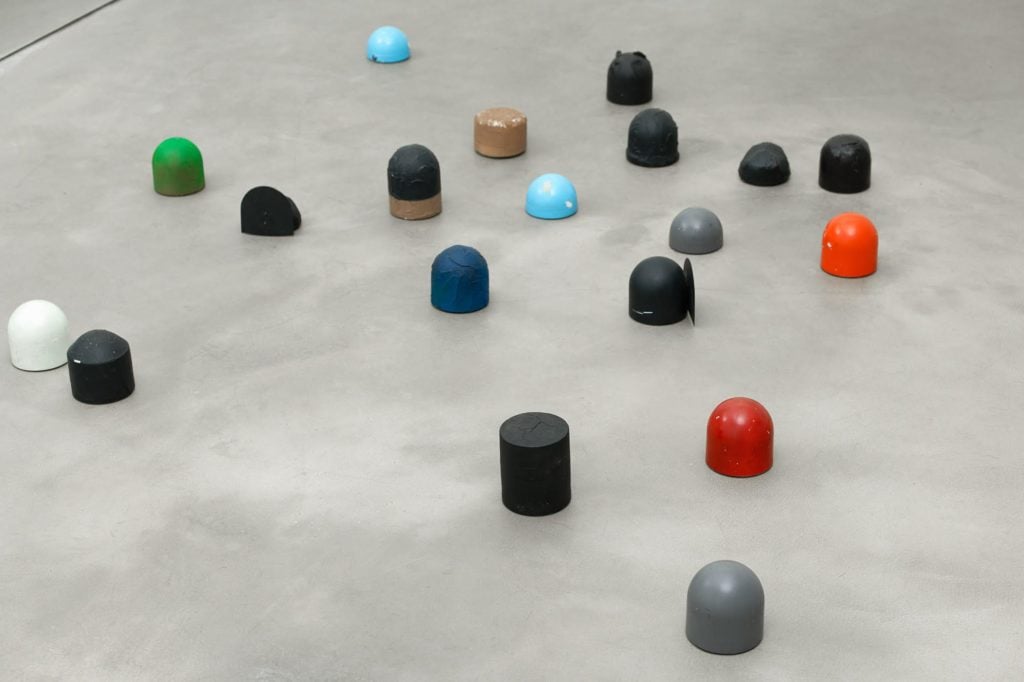
Robert Breer Variation(1970).
Photo: by Aurélien Mole, Courtesy gb agency, Paris.
Early sales of historic pieces
from the section included 21 of Breer’s colorful mechanical
“creepers.” Made in 1970, the mesmerizing miniature kinetic pieces
were snapped up by an Italian foundation within hours of the fair’s
opening. The artist’s works in the presentation—which artist Ryan
Gander called “a genius stand”—included experimental film,
drawings, and animation sketches priced from €10,000 to €100,000
($11,000 to $111,000). The gallery’s Marisol Rodríguez says she
keeps coming back to Artissima because there are “serious
collectors here, who are very educated about different artists, and
different epochs.”
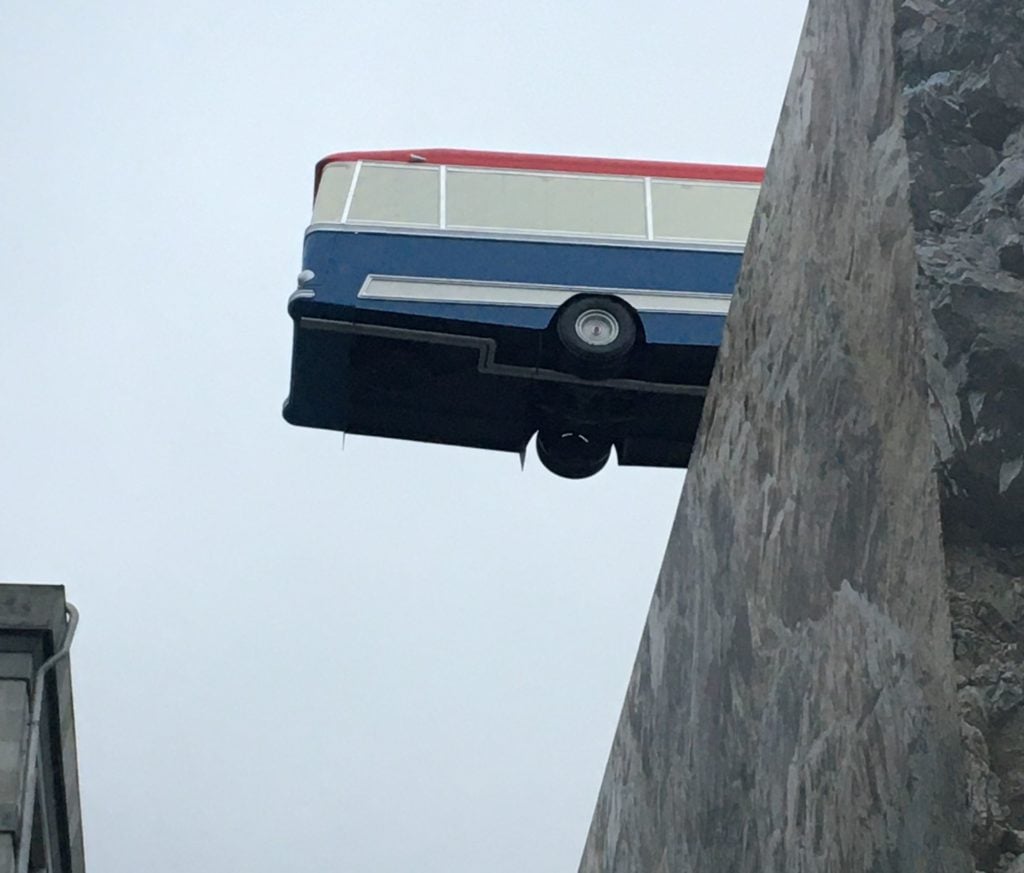
Richard WilsonHang On A Minute Lads…
I’ve Got an Idea, installed in Turin, 2019, for Artissima.
Photo by J.Pes.
There is much to see outside the
confines of the fair, too. Two of Artissima’s off-site projects
stand out: the exhibition “Abstract Sex” held at Jana, a famed
Turin fashion boutique, which includes tantalizing works by Simon
Fujiwara and Barbara Hammer, and British sculptor Richard Wilson’s
spectacular sculpture of a full-sized bus teetering on the edge of
a tall building. Inspired by the famous cliff-hanging ending of the
1969 heist movie, The
Italian Job, which was
filmed in Turin, the precarious sculpture was unveiled the day
Britain was due to leave the European Union (but didn’t). Politics,
like art and soccer, is an unpredictable and precarious
business.
The post What Gives an Art Fair Staying Power? Turin’s
Artissima Remains a Haven for Old-School Collectors After a
Quarter-Century appeared first on artnet News.
Read more https://news.artnet.com/market/artissima-art-fair-turin-2019-1695063
Further reading


Leave a comment