
’When I See These Paintings, I See Myself’: Celebrated Artist Jordan Casteel on How She Brings Her Own Femininity to Her Paintings of Men
Jordan Casteel has followed a trajectory few artist can relate
to.
This week, she opened an impressive institutional show at the
New Museum in New York titled “Within Reach,” and her paintings are selling
for six figures at Christie’s. A giant
portrait of hers now looms over New York’s High
Line Park, and she’s quickly become a poster child for new figurative
painting.
But Casteel, with her signature pixie cut and cat
eyeglasses, has always
been a step out of sync with the rhythms of the art
world.
At 23, she got into Yale’s
renowned art school after Googling
“best MFA
programs.”
The year she graduated, she opened
“Visible Man,” a buzzy debut of intimate portraits of naked men at
Sargent’s Daughters.
“I’ve always been interested in
trying to capture the people behind the scenes,” Casteel tells
Artnet News.
On the occasion of her New Museum show, we visited the artist’s
studio in the Bronx, where the walls are hung
with candid photos of subway
riders and others source materials for future paintings.
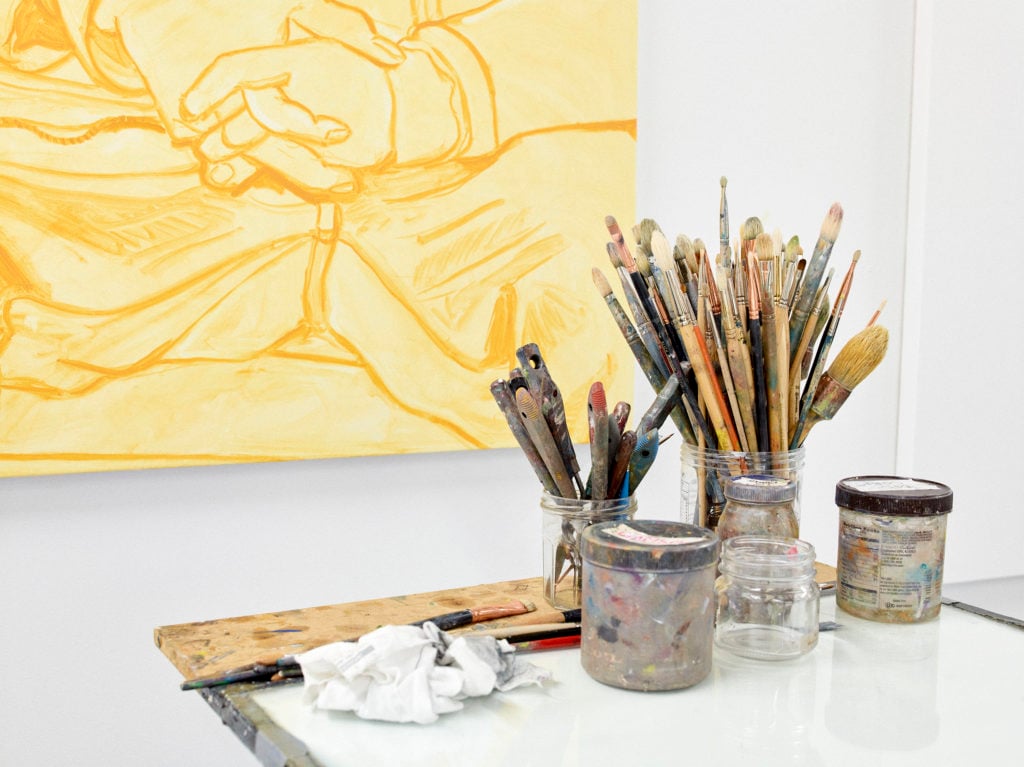
Details from Jordan Casteel’s studio,
2020. Photo: David Schulze.
I want to start by going back to your time at Yale. I heard
that when you first went there, you showed up with a couple of
prestretched canvases from Michaels art supply and an easel from
Hobby Lobby. That’s a far cry from where you are now.
It’s true. [Laughs] When I got
to Yale, that was the first time I had a traditional “studio.” I
had been painting out of a second bedroom up until that point while
I was teaching special education. I was using it as a space of
relief, as a space of relaxation after stressful teaching days.
When I applied to graduate school, I knew it was going to be an
opportunity where I could indulge in a studio practice. And having
a space where I could close the door and be by myself is what Yale
offered. It was quite magical.
I literally knew nothing about
anything. I had three paintbrushes from Michaels. I was buying Dick
Blick or whatever brand of paints that were the cheapest. I didn’t
know about color theory or mixing or about brushes. In my first
year of graduate school, I was just trying to pick up technical
bits and pieces from my classmates wherever I could, because I
realized quickly that I wouldn’t be taking a painting class in the
way that I thought. Like, in my head I was going to art school,
which meant that somebody would teach me how to paint.
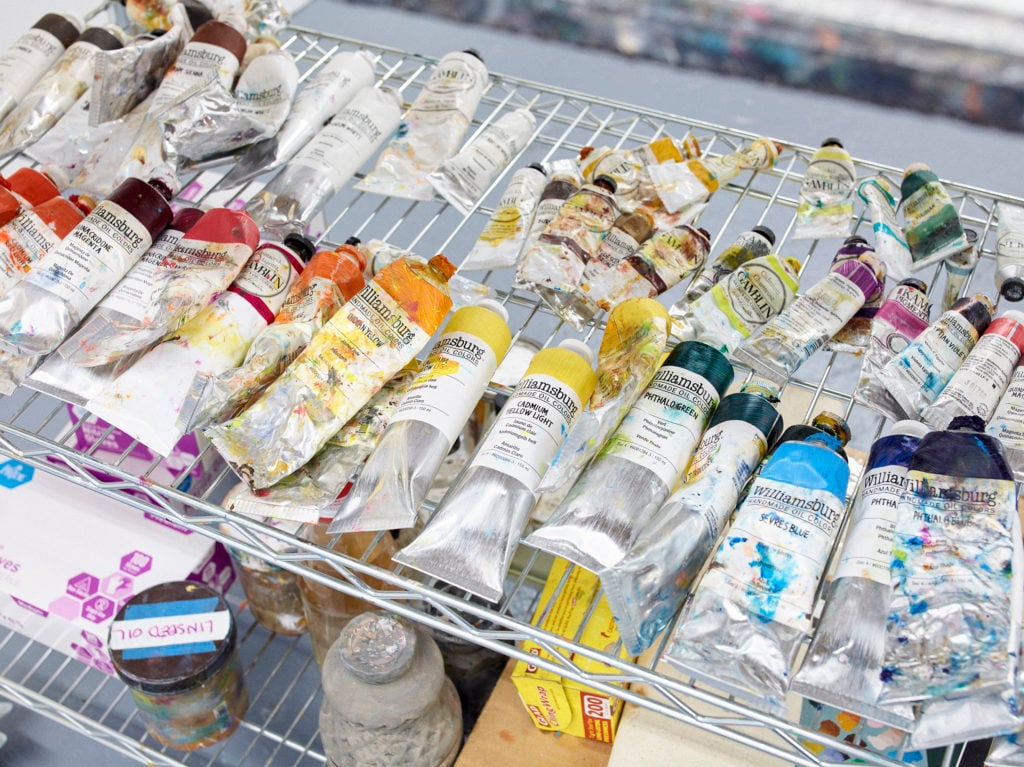
Details from Jordan Casteel’s studio,
2020. Photo: David Schulze.
You would walk into a room with a naked model and a bowl of
fruit in the middle of it.
Exactly! It would be old school.
I’d be at my easel that I brought with me, living my painterly
dreams. On the first day of registration, I was sitting next to the
faculty member who was advising me and I said, “So I’m really
interested in signing up for a painting class. Where do I do that?”
And he was like, “Uh, we assume that if you’re here, you’ve already
done that.” I was like, “Oh,
yeah. I mean, of course. Been there, done that.”
[Laughs]
I realized quickly that I needed
to be a learner first and foremost, to ask a lot of questions and
be shameless if there were gaps in my knowledge base. I genuinely
believe that it was this deeply embedded curiosity that ultimately
became the sustaining force during my graduate degree. It was a
difficult time.
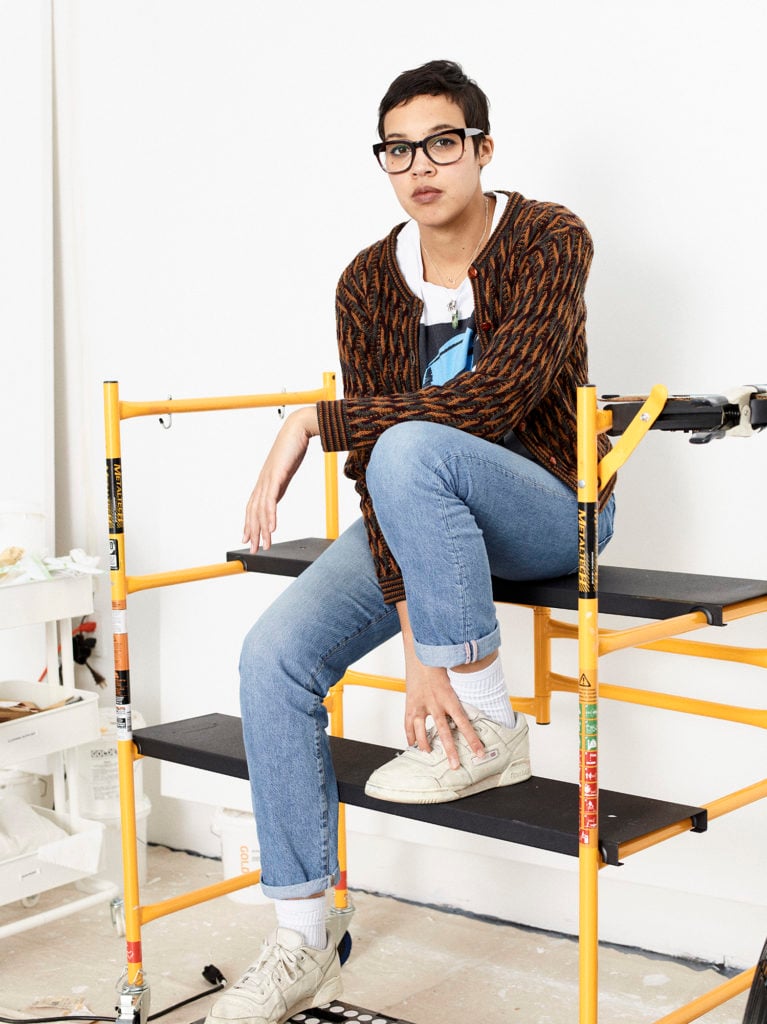
Jordan Casteel, 2020. Photo: David
Schulze.
Did you always have that sense of curiosity that growing
up?
Growing up, I was very awkward
and kept to myself. At the same time, I guess I was sort of cool. I
played sports and was often the captain because I made other people
feel good. I’m a people person to a degree, so I took on a lot of
leadership roles in high school. I was the president of the black
student association, and I designed T-shirts. In field hockey, I
would make all the ribbons. But all of that is to say I ended up my
junior year in a drawing class on accident. There was a gap in my
schedule and I didn’t actually sign up for it.
It was like The Breakfast
Club. It was all the weirdos that ended up in this art class
and didn’t want to be there and I would just hang out with the
football players in the corner. But I actually kind of enjoyed it.
I started this sketchbook, and I would do tattoo drawings for
people. I had this hustle, this little business where somebody
would give me their family picture, and I would draw it and give it
to them for $20 bucks or whatever. Someone along the way was like,
“Oh, you’re kind of good.” I had no idea. So I just kept it up, but
I had no real connection to art in Denver. What we understand as
the art world, that meant nothing to me.
I took art classes in college,
but my major wasn’t studio art until my junior year, when I studied
abroad in Italy and took my first painting class. It was kind of
like, “Here’s a palette knife. Make some colors and throw it on
there. Drink cappuccinos and have the wind blowing in your hair.
Paint portraits or whatever you want.” And I did. I painted
portraits of a lot of the grounds-keeping staff, which isn’t far
from my practice as it stands right now. I was very interested in
trying to capture the people behind the scenes. Those were the
relationships that I found to be the most intimate and important to
me.
When I got back, I changed my
major to studio art. My parents were not particularly happy about
it. I finished undergrad and ended up teaching, which I’ve always
loved. I was painting my students when I applied to
Yale.
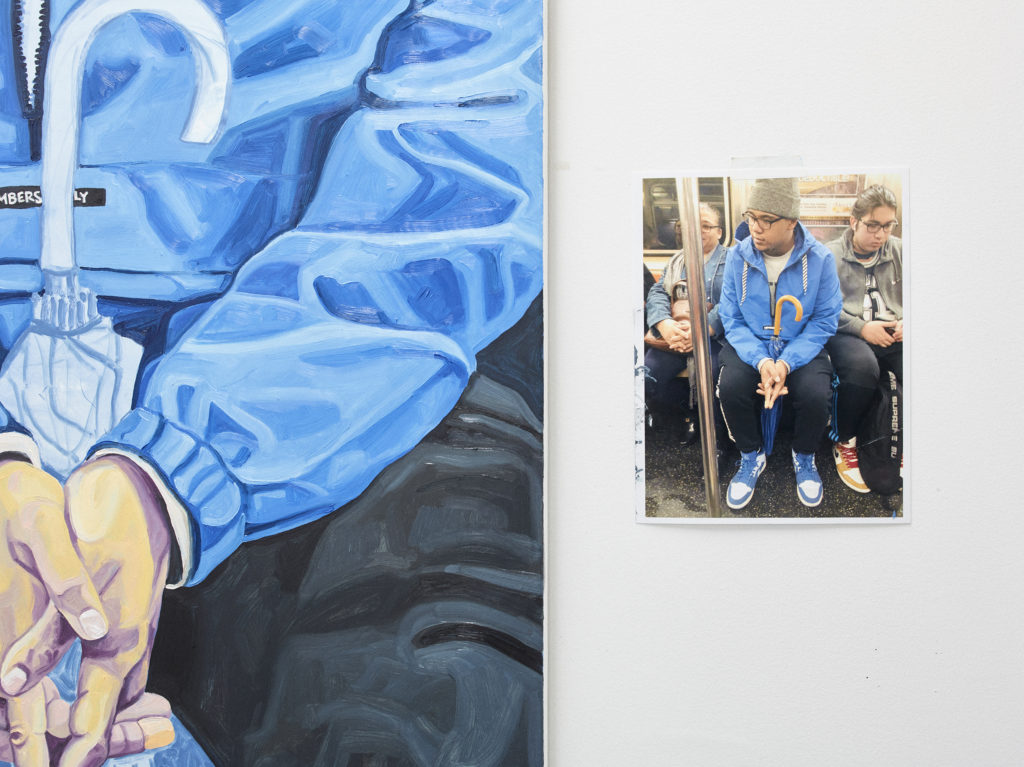
Details from Jordan Casteel’s studio,
2020. Photo: David Schulze.
Do you feel like that lack of traditional background shapes
the way you make work today?
I definitely do. I think that my
practice has benefited from the naiveté that I went to Yale with.
Unlike my peers, who were trying to unlearn all the traditional
methods they had been taught, I came in as myself. I was all over
the place, but all I needed to do was focus in and tighten up my
skills. I think that’s allowed a freshness in the work and an
uninhibited way of making.
There is a lot of entitlement in
art school and in the art world, where people feel they’re
deserving and owed something at every beck and turn. I didn’t have
that because I knew I was an anomaly. I was just waiting for
somebody to tap me on the shoulder and say, “Actually we made a
mistake. We don’t know why you’re here. Get going.” I felt that
every opportunity I was getting was possibly the last, so I made
the most of each one. I have an ego, because I think every artist
has an ego—you have to have an ego if you think you can sit alone
all day and spend your time exercising your own ideas on a
canvas—but I try not to take anything for
granted.
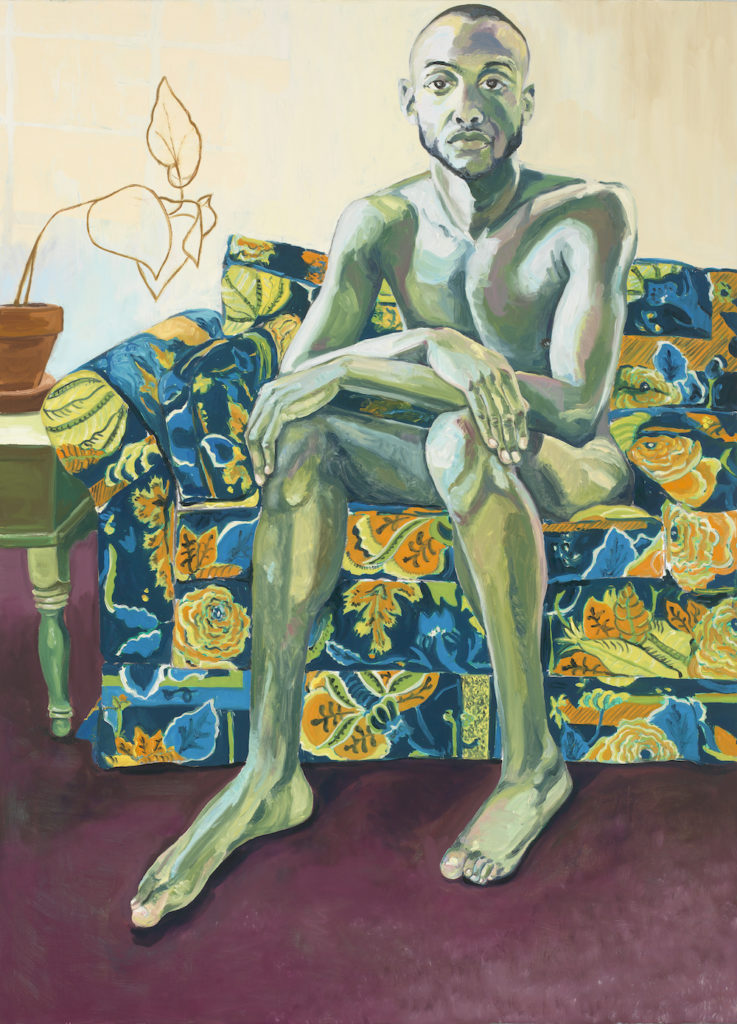
Jordan Casteel, Jireh (2013).
Courtesy of the artist and Casey Kaplan, New York.
Then you moved to New York after graduation?
Yeah, everybody was graduating
and going to New York or LA. I figured I should follow suit. If I
had committed to that much, then I should try a little bit further.
I came to New York because of my family connections—my mom’s sister
still lives on the Upper West Side. I was being very strategic in
the sense that if I end up broke and without a house, I would at
least have a place to stay and a family member who would feed me.
So it was like a backup plan. I’m really keen on backup
plans.
It was a struggle when I first
got here, trying to figure out what a studio would look like, but I
found a 200-square-foot space in Bushwick for $400 a month. I got
that place right after I found out I was going to have my first
show at Sargent’s Daughters, where I showed the “Visible Man” series. At that point I was like, “I’m going to
try to do this thing. I’m going to be an artist.”
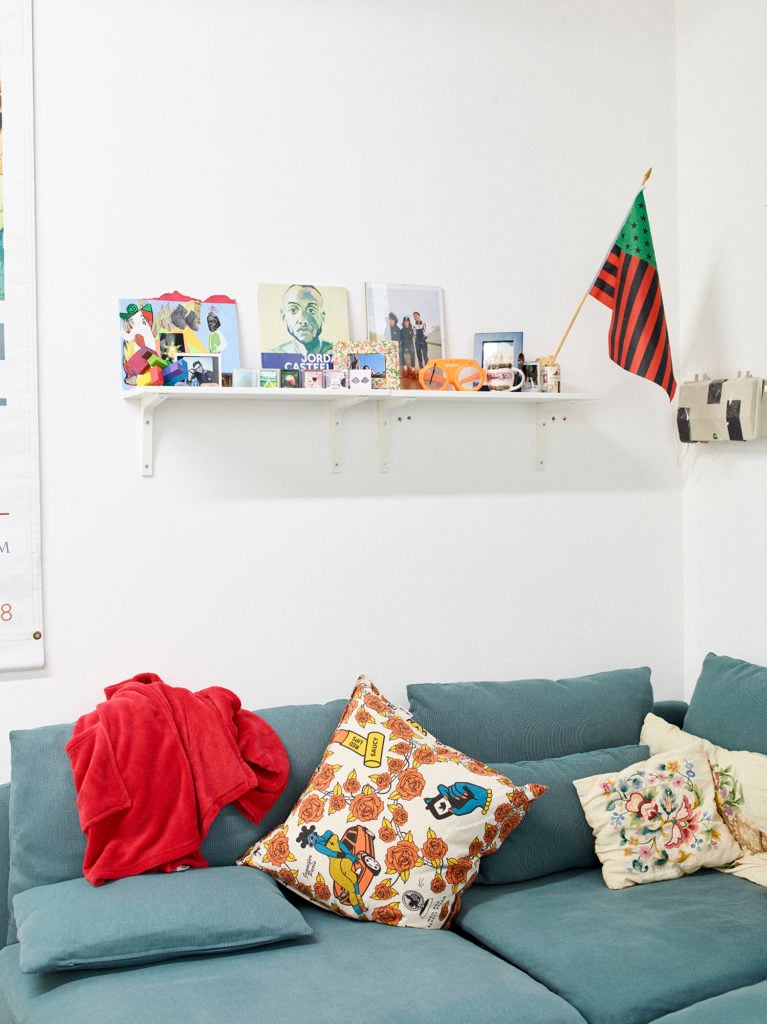
Details from Jordan Casteel’s studio,
2020. Photo: David Schulze.
With that series, and the one that followed it the next year
at Sargent’s Daughters, Brothers, much was
made of the fact that you were only painting men. It’s strange,
looking back on it. Why do you think that was such a hang-up for
some people?
I love that you felt that,
because I felt that way too. I’ve found throughout my young
practice that people find ways of accessing the work through things
they understand. They’ll find language or concepts that feel
tangible and sink their teeth into them, then never let go. For
some, it’s what my gender is or what the genders of my sitters
are.
The idea of me as an African
American woman painting African American men or bodies in
general—people want to use that as the anchor on which the work
rests. It’s as if they were like, “Okay, it’s black. It’s men.
They’re naked. We’re done. We’ve understood it.” Those weren’t the
center points for me in developing and thinking about that work.
They are truths, they are facts of being that I can’t ignore, and
of course I considered them when I was making the work. But it was
not the source for which the greatest amount of significance came
from for me. For me, it was about something more.
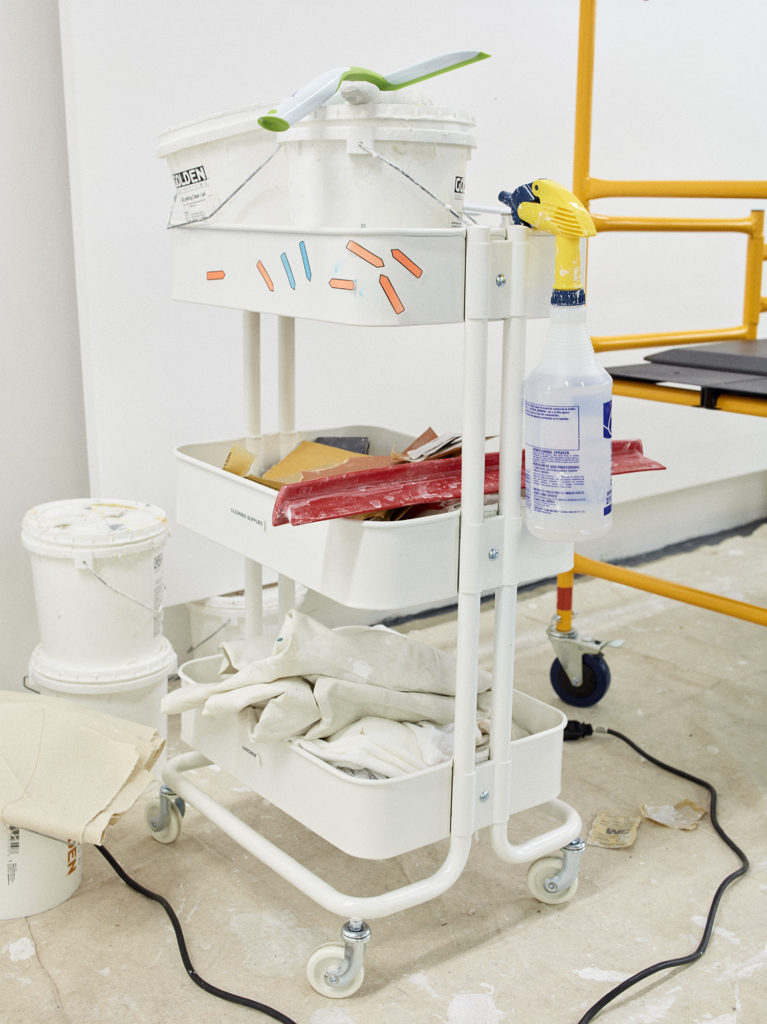
Details from Jordan Casteel’s studio,
2020. Photo: David Schulze.
It’s also not a critique you would hear lobbed at a male
artist painting women.
Of course not. That hasn’t been
the case throughout history, especially when it comes to white men
throughout history.
I remember doing a talk at the
Studio Museum with Kerry James Marshall, EJ Hill, and Kevin
Beasley. I was just trying to keep my life together, because, you
know, I was on stage with Kerry James Marshall, living my dream of
all dreams. And at the end, during the Q&A, a woman raised her
hand and asked me why I was only painting men. “I think that you
should be painting women,” she said. “It doesn’t make sense to me
why you’re denying women the opportunity to be seen. All voices
need to matter, too.”
She said that to me while I was
on this panel, the only woman sitting up there. And I was like,
what you’re doing right now is reducing me as a woman making these
paintings and reducing my presence within them. You’re ignoring the
fact that I have labored over this work myself and that it has been
translated through my being as somebody who identifies as a woman,
through a very specific feminine lens. When I see these paintings,
I see myself, which means that the woman or the feminine is present
in every painting that I’ve ever made, whoever is represented
within them.
We have to think bigger. If
you’re actually taking the time to see me in the way that I’m
trying to see these subjects and the things that I’m looking at,
then I think that you would discover that there’s a lot more
complexity involved. So yeah, the narrative of “Jordan Casteel
paints black men” tired on me really quickly because it just didn’t
feel right. It didn’t feel true.
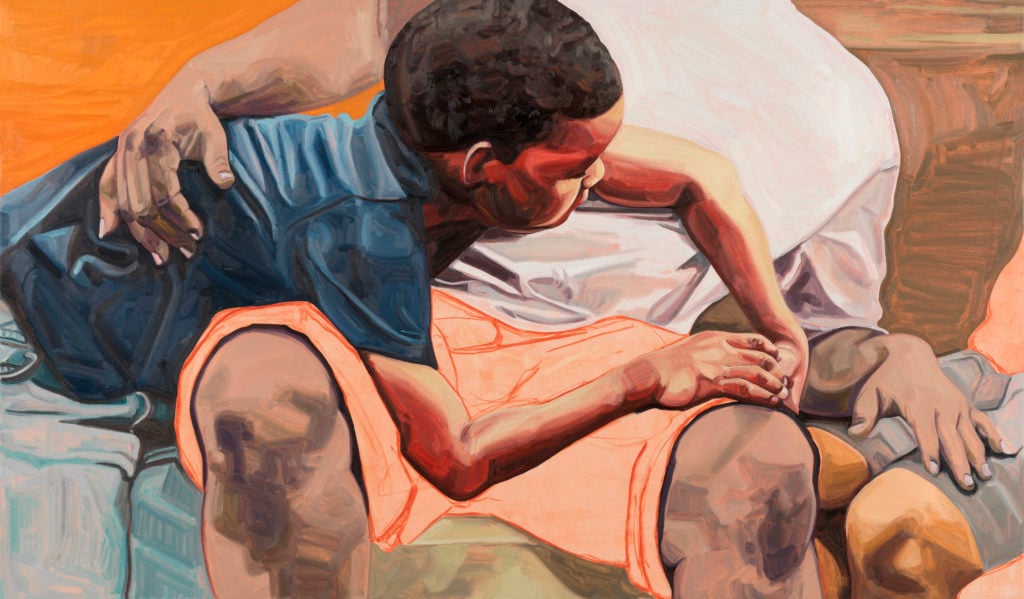
Jordan Casteel, Within Reach
(2019). Courtesy of the artist and Casey Kaplan, New York.
Recently you’ve been painting your students at Rutgers, where
you teach. It hearkens back to the portraits you were making when
you applied to Yale. What is it about certain communities that
interests you?
For me, it’s about coming out of
oneself. Because the ego is so deeply embedded in an individual
studio practice, it’s important for me to leave my own space of
making and live in the space of others. Their learning and
curiosity inspires my desire to continue to learn and be curious as
well. At Rutgers, I start the semester by saying I probably know
less than they do, which is true in many ways. Most of my students
are coming into my class with more training than I had when I
started at Yale. And I still don’t know a lot of things, but I do
think that I can offer a lot of support in terms of mentorship,
guidance, and filling in the gaps of their knowledge about the art
world or what it looks and feels like to manage one’s time with
intention in ways that I think are important.
I genuinely believe in the
notion of there being a difference between symbols, which artists
tend to traffic in, and substance. It’s one thing to say that I
care a lot about people, and it’s another thing to really be
involved in people’s lives meaningfully. So I try to exercise that
where I can and however I can, and education has been the form in
which it has worked most seamlessly in my life and I have felt most
of service to others.
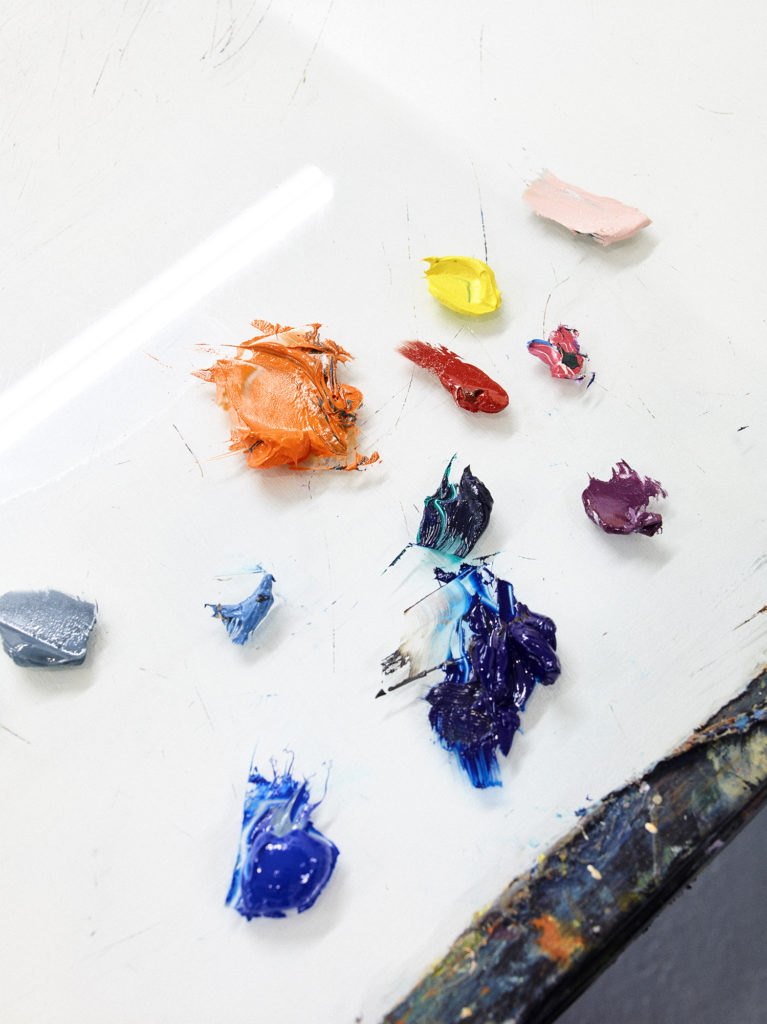
Details from Jordan Casteel’s studio,
2020. Photo: David Schulze.
Do you think it’s possible for a full-time artist to straddle
both those categories, substance and symbol?
Of course, because I think there
are many ways to exercise one’s substantive work. And what that
looks like and feels like is different to everyone. For me, it
requires the physical labor of stepping outside of my space and
into the space of someone else. The work does a lot, but my
physical body needs to be doing more. That’s just my own personal
solution.
I love the pictures and videos on your Instagram of your
painting subjects seeing their portraits in person for the first
time. What do those moments mean to you?
Talking about this makes me
almost speechless. It’s where I become the most emotional and
uncertain of my words. When somebody sees their painting the first
time—those are the moments that remind me the most, out of
everything in my practice, why it is that I do what I do. It
reminds me of the importance of the work and how it’s bigger than
me sitting alone in a studio making paintings, or paying my rent,
or whatever kind of concerns I have in my life. Those things become
really irrelevant in the moments in which people are seeing
themselves portrayed on such a monumental scale in such historical
and significant spaces.
For example, James, whom I’ve
painted a couple of times, the first time he saw his painting, he
ran out and got his wife. Later, she was asking around where the
artist was, and somebody pointed me out. Then she ran up to me and
threw her arms around me and said thank you. She said, “Thank you
for seeing the man that I love the way that I have always known, as
beautiful as I have always seen him to be, as I have always known
him and as wonderful as he is, and then sharing that with the
world. I’ve always wanted him to be seen as I see him, and you’ve
done that.”
I think that that is bigger than
anything else I’ve done in my life—putting people, who have maybe
spent their lives feeling invisible in certain ways, front and
center and honored in the way that they ultimately deserve to be
honored.
“Jordan
Casteel: Within Reach” is on view now through May 24 at the New
Museum in New York.
The post ’When I See These Paintings, I See Myself’:
Celebrated Artist Jordan Casteel on How She Brings Her Own
Femininity to Her Paintings of Men appeared first on artnet
News.
Read more https://news.artnet.com/art-world/jordan-casteel-interview-1781658
Further reading


Leave a comment