
Why an Artist and a Scientist Teamed Up to Bring the Sounds of the Undersea World Into the Heart of Miami’s Art Fair Week
If you’ve visited Collins Park during Art Basel Miami Beach this
week, you’ve undoubtedly seen banners for The Art of Listening:
Under Water, a spatial sound installation by Norwegian artist
Jana Winderen and her collaborator Tony
Myatt that turns the park’s rotunda into a sonic gateway to the
seldom-heard marine ecosystem.
Commissioned by Swiss timepiece titan Audemars Piguet, the work
is a sort of sequel—or perhaps the next evolution—of a piece
Winderen created for this June’s edition of Art Basel in the
mega-fair’s namesake city. But whereas the earlier piece focused on
the sounds of Switzerland’s Jura Mountains, the new piece makes the
sea’s natural wonders and man-made stresses surprisingly visceral
for locals and visitors alike.
With the climate crisis percolating beneath nearly every aspect of the
week’s festivities, Winderen and Myatt sat down with Artnet News to
discuss how to make an invisible crisis visible, the importance of
reconnecting with our lost past, and how Jacques Cousteau lied to
us all. (The conversation has been condensed and edited for
clarity.)
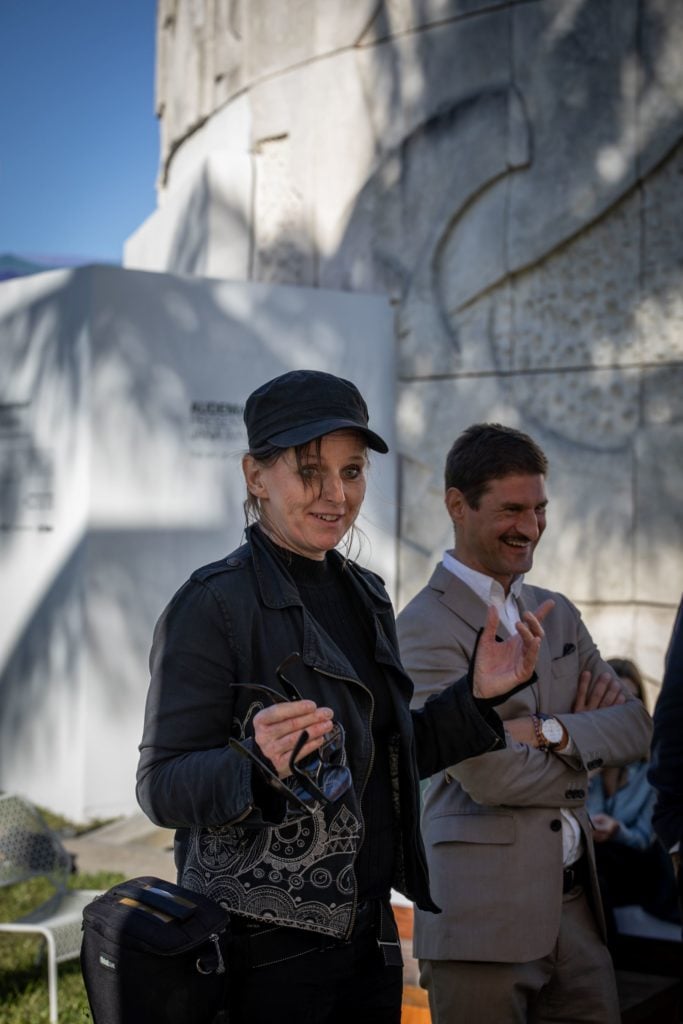
Artist Jana Winderen and Denis Pernet,
Audemars Piguet Associate Curator, at the opening of “The Art of
Listening: Under Water” by Jana Winderen at Art Basel Miami Beach,
2019. Courtesy of the artist and Audemars Piguet.
What was the origin of this project?
JW: This is a commission by Audemars Piguet, and I was invited
to come up in the Jura Mountains to visit near the factory. I was
particularly interested in a 300-year-old forest up there, with
trees that are looked after very much for their excellent
resonating capacity. Their wood is used for violins and cellos.
I had also worked with a project in Thailand where you could
listen to the underwater environment using an oar [pressed] to the
head. And through that project, I became very aware of how
different types of wood would transmit sound from water to air. So
when I came up [to the Jura Mountains], I also had in mind the
local fish in the lake. It was under attack by a lot of
human-created sound. It looks very beautiful, but there’s a totally
different story when you put a microphone out.
I made this piece for Art Basel in Basel, and while we were
working on it, Audemars Piguet suggested that we [do] a project in
the rotunda [at Collins Park in Miami]. And then I suggested that
we would like to do something site-specific having to do with Miami
Beach and the ocean right outside. I like things to be based in the
local and the recognizable, so that people can have a relationship
to the sounds and to the site. You may be dealing with a global
issue, but [having] the local sounds give people a feeling that
it’s actually present here.
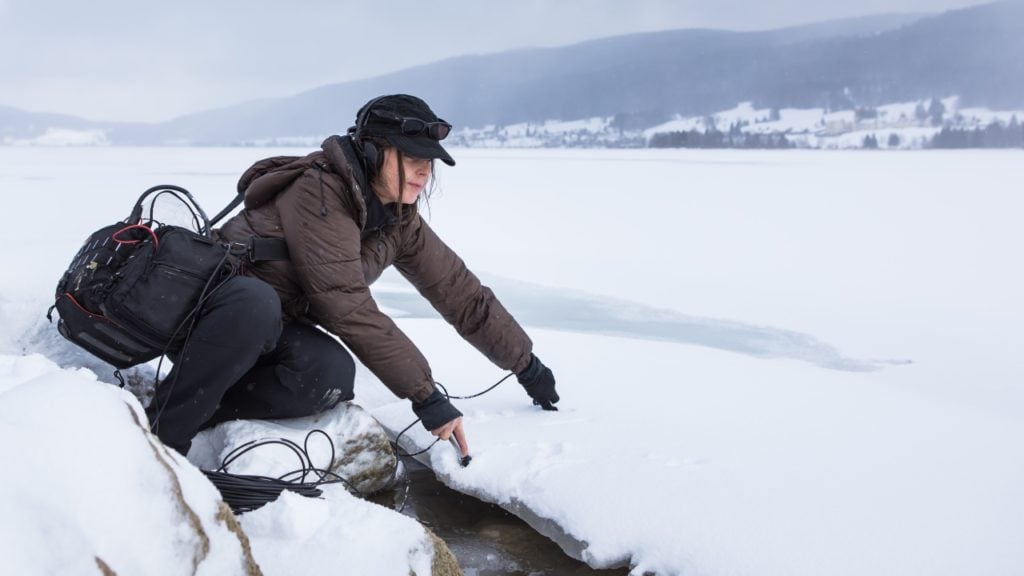
Jana Winderen recordings sounds in the
Vallée de Joux. Courtesy the artist and Audemars Piguet.
How did you go about creating the piece?
JW: Tony and I together went out to record locally. I was
expecting to get a lot of human sounds from the harbor here, close
to land. And I had already prepared a lot of the sound and the
story, which would be about coming from the north, where the ice is
melting, to here, the south, where you get the flooding. So the
storyline of the work was already made, but I knew [it would be
affected by] the temperature outside, the situation you come from,
the sound environment you leave, and the closeness to the sea.
In my experience, people tend to not think about sound
in the same types of way that they think about images. Tony, as an
academic, can you speak to the aspects of sound that the average
person might not appreciate until you shape it in a particular
way?
TM: Well, I think there are two parts to that. One is that
listening is something we’re training ourselves not to do a lot of
the time. We try not to hear background noise: cars, sirens, the
music that’s being played in bars and cafes, and so on. We’re
trying to tune into our own conversations whilst making it very
difficult for ourselves to do that by creating all of the
background noise that can obfuscate the sounds we make.
Jana obviously has a great interest in underwater recording, and
part of my role here is to work with her from the recording stage
through to the production stage to create these environments that
are believable and understandable. And listening underwater, which
is the subject here, is something that people can’t do. We don’t
have the physical mechanism to do it, we don’t have the size of
head to do it, and we don’t have any way to perceive the spatial
world underwater. And the oceans are the most sound-rich
environments on the planet.
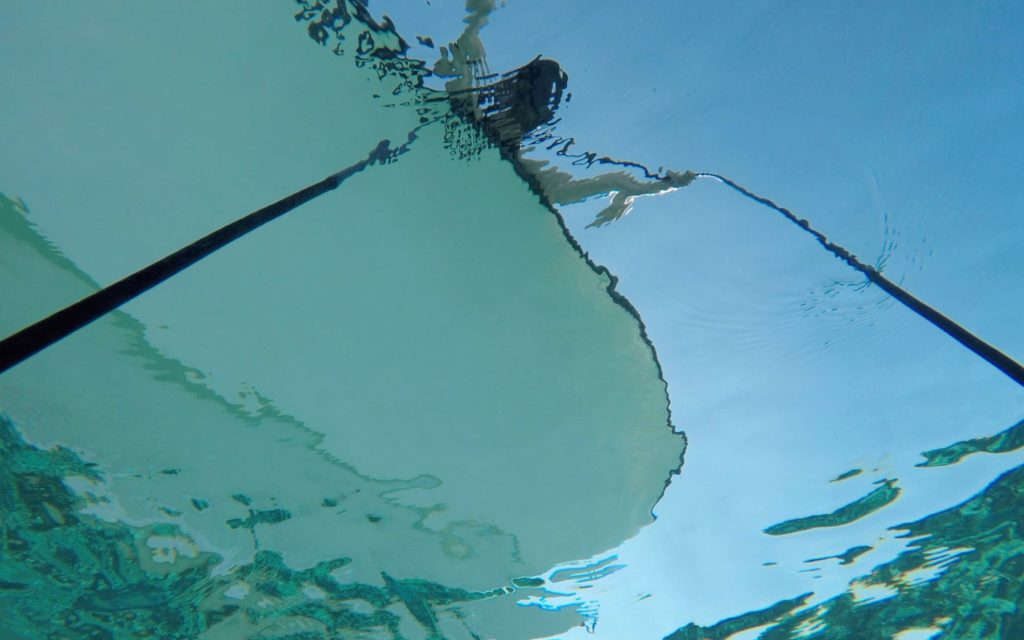
Photo of recording by Jana Winderen.
Courtesy the artist and Audemars Piguet.
Really? Why am I so surprised to hear that?
TM: The surface of the water doesn’t allow sound to permeate
out. And so for most of us, it’s invisible. And I think in part,
this work is potent in revealing to people the complexities of
sound for communication between species, between individuals,
between mammals, for finding mates, for navigation, for all of the
things that actually, the whole of the marine environment rely
on.
One of the other artists I work with, Chris Watson, often
comments on the opening lines from Jacques Cousteau documentaries,
where most people were introduced to the undersea world. Costeau
opened every program by saying, “I’m now entering the silent
undersea world.” And that was a complete myth. It was not [silent].
He just couldn’t hear it!
What is unknown, and is often ill-considered, is the amount of
sound that we put into the oceans unintentionally from jet skis,
from propellers, from motors, from super tankers, and so on. If you
have an idle moment, put vesselfinder.com into
your browser. It gives the GPS location of all the marine traffic
in the world. The sea is absolutely peppered with vessels. Some
animals can adapt to that, but most animals can’t. And simple
things, like propeller design and changing the mounting of engines
in boats could, if we thought about it, and if we legislated for
it, mitigate that.
This idea of trying to make sound more perceptible
strikes me as being similar to the larger problem of climate
change, which is on some level an abstract issue that people tend
to not want to think about in their day to day lives. How did you
start originally working in sound that had a focus on
ecology?
JW: When I was a child growing up by a lake in Norway, and also
every summer by the sea, I was very concerned with how we are
treating the planet. In the early ‘70s, this lake was about to die
from algae overgrowth, and it’s where we got our drinking water. It
was a very, very scary thing to grow up thinking that that lake
would die.
I also wrote this essay in school about this fish that was
traveling around the world trying to find a mate and, meeting other
fish that couldn’t find their way back into the river because of
pollution—salmon for example, and an eel who was complaining about
human beings’ oil spills, and more. I was laughing when I [found]
this essay. I’d forgotten about it.
Do you still have it?
JW: Yes, it’s called “Henry the Herring.” I wrote it when I was
12 or 13. So ecology has always been a concern of mine. I later
studied to become a marine biologist—[including] chemistry,
biochemistry, fish ecology—because I wanted to do research on the
ocean and particularly on the mammals underwater. So how we are
treating the planet has been a core in my life.
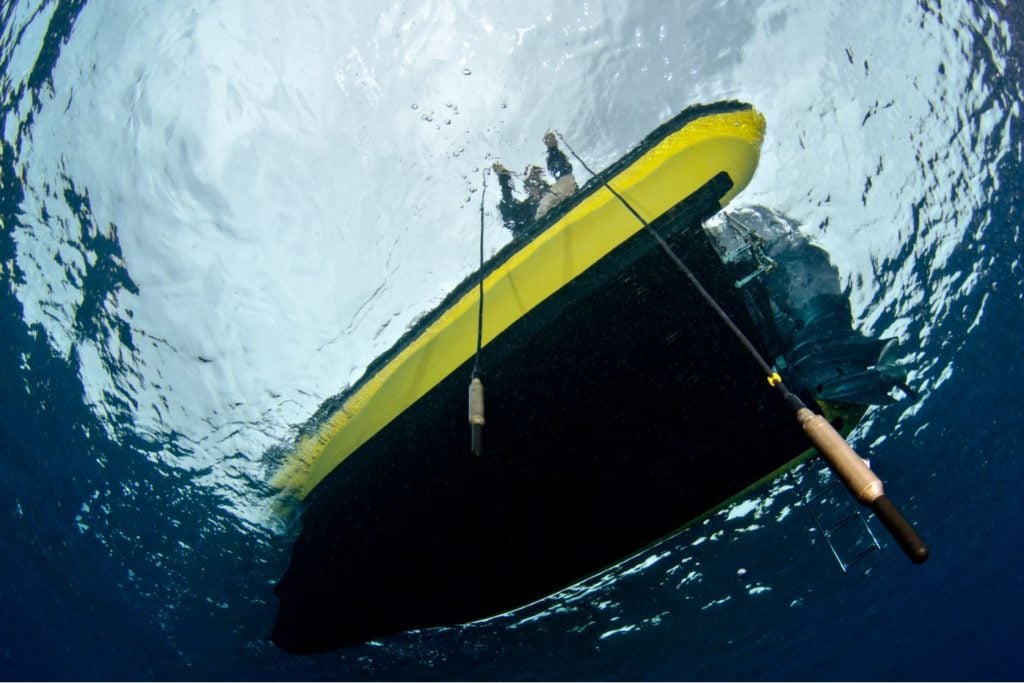
Jana Winderen recordings sounds in the
Tropics. Courtesy the artist and Audemars Piguet.
It’s an understatement to say that going from marine
biology into sound-based artwork is a hard pivot. How exactly did
that happen?
JW: I started working with sound in about 1992. I had changed my
studies, and at that point, I was drawing a lot and making physical
sculptures. But conceptually, it didn’t make sense to me anymore to
make objects and pile up things that would later go into a
landfill. So I wanted to work with an immaterial material that
didn’t take up any kind of space but is still a very physical
medium.
My first [sound piece] was walking around recording the sound of
the Thames. I displayed, or played back, the sound for the other
students down in this dark room underneath [Goldsmiths] college,
and people got scared. So I really started to think about how to
present the sound.
I then worked for quite some years with interactive sound, where
the audience could, for example, distort the sound by the way they
moved. And it was through that process that I became aware of
[equipment] like the piezoelectric contact microphone, and the
hydrophone [a microphone designed to capture underwater sound]. But
I like to use the equipment where you’re not actually supposed to
use it.
Around 2000, I used a hydrophone to start recording inside of an
ant’s nest with Chris Watson. You hear all the [ants] calling
around. And I also put the hydrophone inside of a tree, so you
could listen to the insects down in the ground, the worms moving
around, and in the sun and in ice. It’s good to challenge the tools
you have.
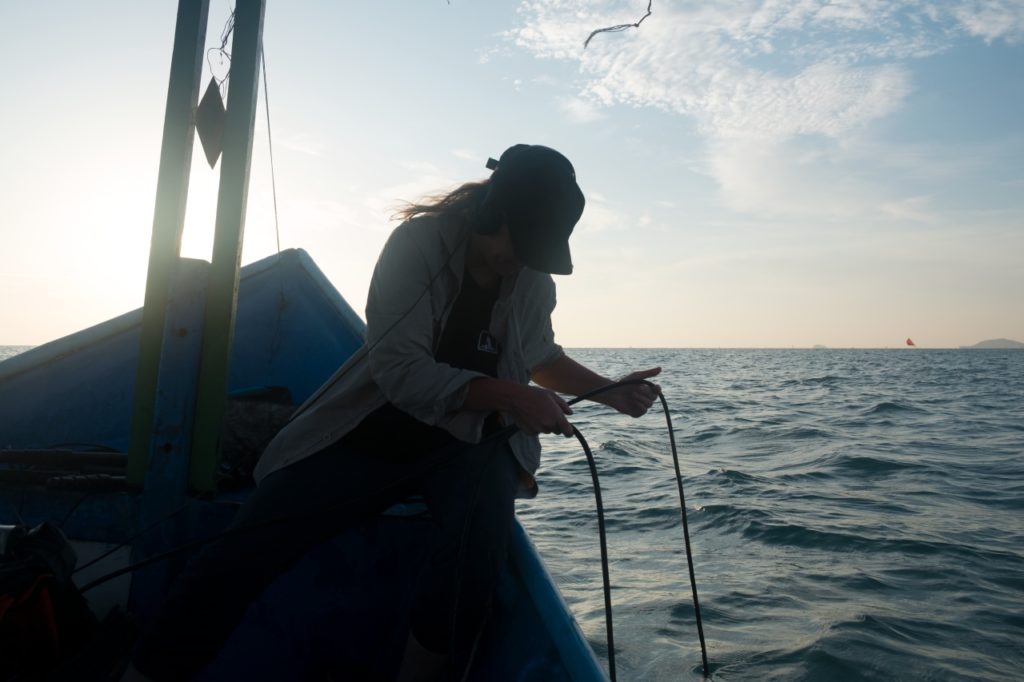
Jana Winderen recording in the Tropics.
Courtesy of the artist and Audemars Piguet.
How, if at all, does that idea relate to the project you
mentioned in Thailand, involving fishermen pressing oars to their
heads?
JW: I met a fisherman in Thailand who told me that his granddad
showed him how to listen to the sounds of crackling shrimp,
barnacles, and reef areas there, with an oar to the head. He was
connecting without a hydrophone. Next time you go for a swim, put
your head in the water, concentrate, and listen. You can hear it,
but our ears have adjusted to listening for sound traveling in air
and not in water.
I think we’ve had some kind of forgetting period in the history
after industrialization. We’ve forgotten even what our grandparents
have told us. We need to reconnect to that knowledge, I
believe.
Tony, can you speak to why you think it’s important to
hear, or experience, this piece as it’s installed rather than just
listening to, say, a recording on headphones?
TM: From an academic and spatial audio perspective, the
installation is one of the few ways that people can really engage
with full three-dimensional sound reproduction. There are sounds in
this exhibition where waves are captured with ambisonic microphones
that really do generate a complex wave front in front of you, and
surround you with foam and splashing water. There aren’t just 10
sounds or 20 sounds there. To create this effect of a wave front
crashing on the shore at your feet, there are thousands and
thousands of pebbles moving and wavelets and little tiny drops, and
that’s captured by a recording technique that can capture that
spatial dimension.
And so it takes you to a very different sort of sonic place than
one we’re quite often used to. You can’t go to the cinema to
experience this. Dolby Atmos won’t do this for you, and nor will
most cinema systems. You can’t hear it in the theater. You can’t
see it on the TV. This is the only place you can experience
this.
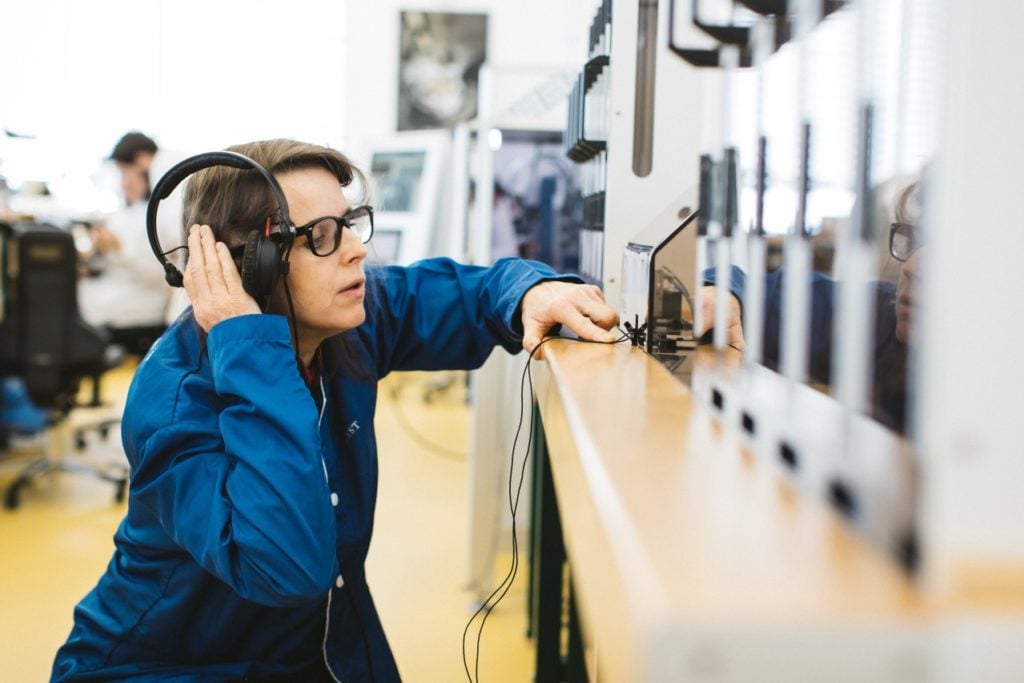
Jana Winderen recordings sounds in the
Vallée de Joux. Courtesy the artist and Audemars Piguet.
I’m wondering, if there’s one thing that you hope people
who come here and experience the installation would take away from
it, what would it be?
JW: I am hoping they feel a heightened sensitivity to the
creatures that are living underwater, and to the sound that we are
putting underwater, and to how much that is actually influencing
their environments.
I would also mention here that we are keeping the construction
to a minimum. All the bits that we have put into the rotunda will
be reused. The speakers are rented, the beanbags will be given
away.
So you’re minimizing your footprint in the installation
in a similar kind of way to what made you want to minimize your
footprint with the work by moving into sound
initially.
JW: You have to start with yourself and do what you can in this
situation. It’s critical. We all need to do what we can.
The post Why an Artist and a Scientist Teamed Up to Bring
the Sounds of the Undersea World Into the Heart of Miami’s Art Fair
Week appeared first on artnet News.
Read more https://news.artnet.com/exhibitions/jana-winderen-tony-myatt-the-art-of-listening-1723458
Further reading


Leave a comment