
Winter Is Coming? The Riddles on an Ancient Viking Monument May Have Predicted Climate Change, Research Says
The meaning of enigmatic
inscriptions on a 9th-century Viking runestone in Rök, Sweden,
have long baffled scholars. But a new study suggests—eerily—that
the five-ton granite slab’s riddles actually reflect anxieties and
predictions about a catastrophic cold-weather climate crisis.
The Rök runestone is the longest
extant known runic inscription, consisting of 28 lines of text and
700 runes (ancient Germanic characters). Given the monument’s age,
the texts are remarkably legible and intact, with just one damaged
line. The eight-foot slab, erected in a prosperous agricultural
society in south central Sweden, delves into Norse mythology
and lore. For years, scholars have been divided over the text’s
narrative or ritual intentions; it was previously believed to have
alluded to the emperor Theodoric the Great.
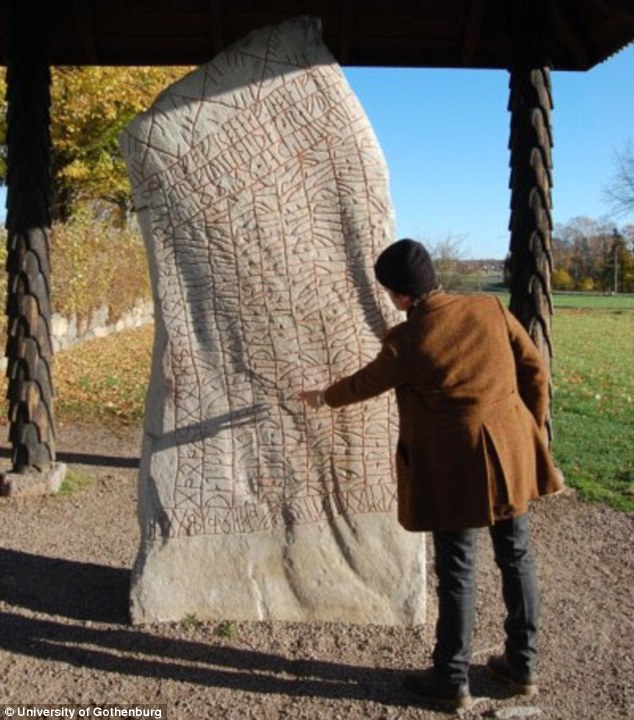
The runestone is now located beside a
church church in Rök near Lake Vättern in, Östergötland, Sweden.
Courtesy of the University of Gothenburg.
The new study, assembled by
scholars Per Holmberg, Bo Gräslund, Olof Sundqvist, and Henrik
Williams, posits an alternative reading. The researchers suggest
the inscriptions reflect fears over the possibilities of a cold
weather pattern similar to one the region experienced from 536 to
550, which was set off by a series of volcanic eruptions. Marked by
lower-than-average temperatures during the dismal era, the region
experienced widespread crop failures, starvation, and mass
extinction that decreased the population of the Scandinavian
Peninsula by more than half. The intergenerational knowledge of
this period would have
been passed down through oral and folkloric
tradition.
The scholars credit the new
findings to their integrative approach, which incorporated
philology, archaeology, and the history of religion, allowing them
to share new context for the period of
time.
“Without these collaborations
between textual analysis, archaeology, history of religions and
runology, it would have been impossible to solve the riddles of the
Rök runestone,” Per Holmberg, a professor at the University of
Gothenburg, said in a statement.
The new study suggests that the text consists of nine questions:
five centering on the sun and four contemplating the god Odin. The
evocative lyrics, in this interpretation, touch on battles between
light and dark, cold and warmth, life and death, and share
structural parallels to early Scandinavian poetry, particularly the
Eddic poem Vafþrúðnismál.
What exactly inspired such
doom-and-gloom soothsaying? Scholars say the region experienced an
onslaught of ominous celestial and environmental
portents. “A powerful solar storm colored the sky in dramatic
shades of red, crop yields suffered from an extremely cold summer,
and later a solar eclipse occurred just after sunrise,”
said Graslund, an archaeology professor at Uppsala University.
“Even one of these events would have been enough to raise fears of
another ‘Fimbulwinter,’” the Nordic mythological term meaning
“Great Winter.”
The post Winter Is Coming? The Riddles on an Ancient Viking
Monument May Have Predicted Climate Change, Research Says
appeared first on artnet News.
Read more https://news.artnet.com/art-world/rok-runestone-viking-cold-climate-crisis-1749405
Further reading


Leave a comment