
With Its New Show of Sam Gilliam’s Painting, Dia Wants to Explode Our Assumptions About Minimalism
One could argue that a historian’s most important job is not
writing history, but re-writing it—pouring back over primary
documents to determine who was left out or misrepresented in
earlier drafts and correcting the record. By that measure, the
historians over at the Dia Art Foundation, who specialize in the
art of the 1960s and ’70s, have been extremely busy.
In recent years, the museum has put on shows by artists
including Dorothea Rockburne, Michelle Stuart, Anne Truitt, and
Charlotte Posenenske; made acquisitions of significant work by Mary
Corse and Nancy Holt; and also diversified its spotlights on male
artists to include French neon artist François Morellet and the
Korean painter Lee Ufan. Now, it is adding another
previously overlooked artist to its ranks: Washington Color Field
painter Sam Gilliam. The 85-year-old artist has been working for
six decades, but has recently been enjoying a career renaissance
after a long stretch of institutional neglect.
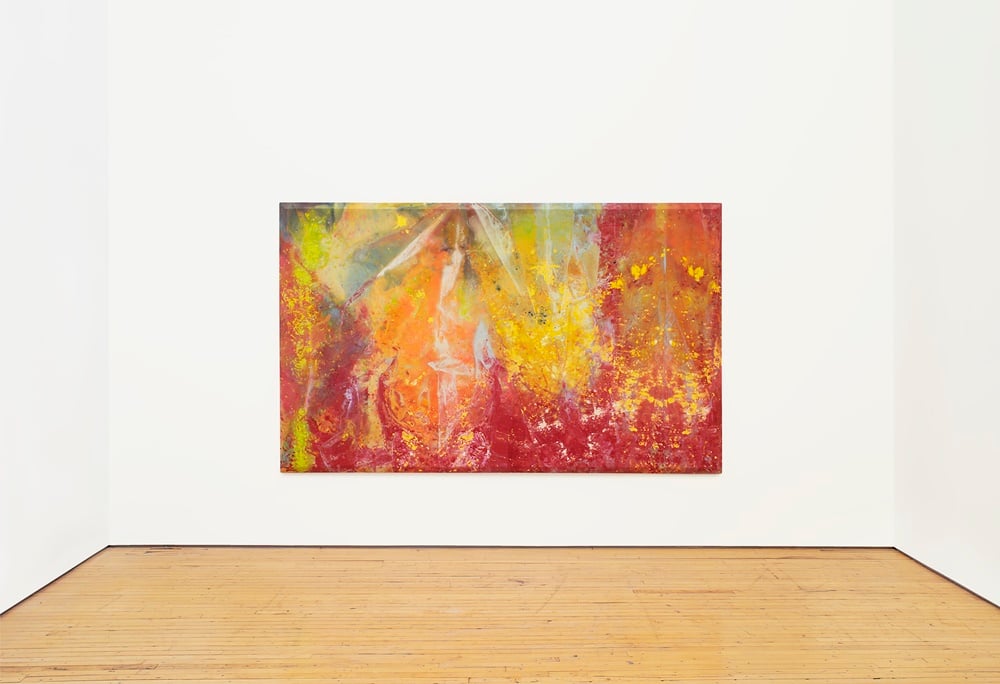
Sam Gilliam, Spread (1973).
Dia:Beacon, Beacon, New York. © Sam Gilliam. Photo: Bill Jacobson
Studio, New York, courtesy Dia Art Foundation, New York
On August 10, Dia will unveil an exhibition of Gilliam’s early
work from the 1960s and ’70s in Beacon, New York. The presentation
includes two “drape” paintings, suspended in concert with one
another from the ceiling, and a painting from his “beveled edge”
series in which the work’s edges extend off the wall and toward the
viewer. The works will be installed within the museum’s permanent
collection, putting Gilliam in the context of his minimalist
and post-minimalist contemporaries such as Robert Ryman and Mary Corse. The goal
is not only to enhance our understanding of who was making
minimalist art, but also to challenge the widely held belief that
painting took a back seat to sculpture during this era.
“I’ve known Sam’s work since I was a child and the opportunity
to curate a show with his work was top of my list,” says Courtney
J. Martin, Dia’s former deputy director and chief curator, who
oversaw the project before becoming director of the Yale Center for
British Art in New Haven this spring. “I probably called Sam the
week that I knew I was going to Dia full-time because I knew I
wanted to work with him.”
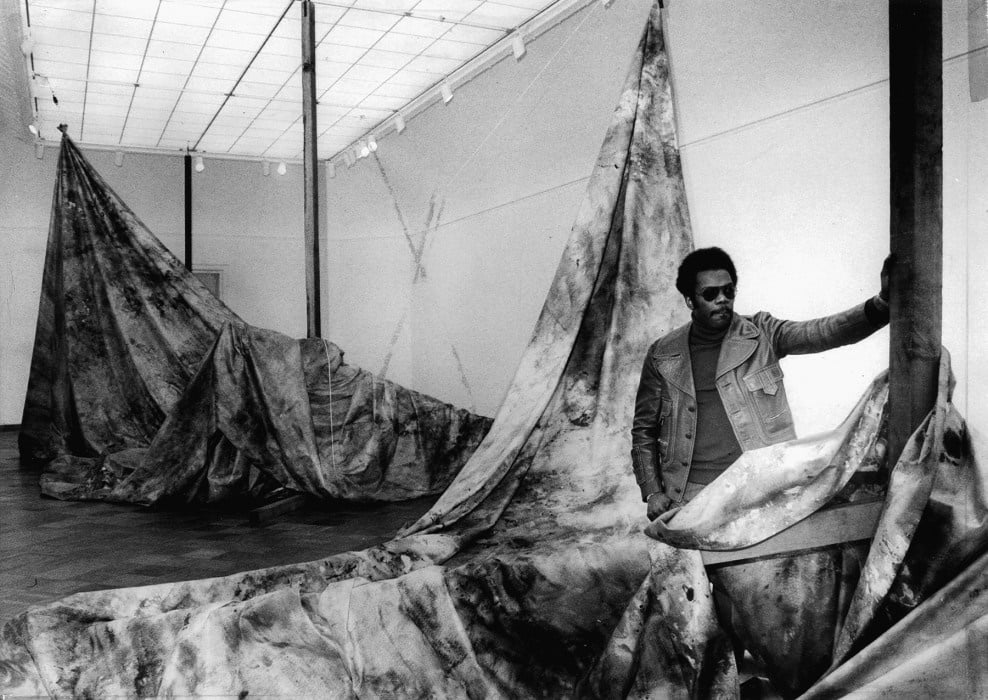
Sam Gilliam, Autumn Surf (1973).
Installation view San Francisco Museum of Modern Art, 1973. © Sam
Gilliam. Photo: Art Frisch, courtesy San Francisco
Chronicle/Polaris
Gilliam first garnered attention in the mid-1960s for his
beveled-edge and drape paintings, which sought to push the
boundaries of what a painting could be. He was the first African
American artist to represent the United States at the Venice
Biennale in 1972.
He is one of a number of painters active in the ’60s and
’70s who were celebrated when they emerged, but receded from view
in the ensuing decades due to a mix of factors, including his race
and the fact that he worked in Washington, DC, outside of a major
art-market hub.
In recent years, however, the art world has appeared to wake up
and take notice of Gilliam’s importance. In 2013, he began showing
with Los Angeles-based gallery David Kordansky. In 2017, Gilliam
returned to the Venice Biennale with a vibrant, unstretched
canvas Yves
Klein Blue (2017), which welcomed visitors to
Giardini’s main pavilion. In 2018, he was the subject of a major
retrospective at the Kunstmuseum Basel. Last
month, he joined mega-gallery
Pace.
Still, his early work in particular remains underexposed in the
United States. Martin recalls that, as a young art
enthusiast, “I was very taken by works that I’d never actually
seen, these early installations where he had these large scale
drapes that would take up basically a full room.” The works were
site-specific and existed only as installations, meaning that they
were rarely shown after their debuts. As a curator at Dia, “I was
interested in whether he would want to revisit this idea, come to a
place, and figure out its contours and work from there,” she says.
Gilliam readily agreed.
The beveled-edge and drape paintings “represent a radical
approach to the medium,” says Dia’s director Jessica Morgan.
“Architectural in scale, these works chart a crucial moment in
Gilliam’s early practice as he explored the possibilities of
manipulating canvas in three-dimensional space.”
The works will remain on view at Dia long term to encourage
repeated viewings. “My hope was that people walk into the
smaller gallery—where the bevel painting is at a 45 degree angle
coming off the wall—and feel a compression,” says Martin. “Then you
walk into the bigger gallery and feel really loose and free once
they see the drape installation.”
The goal is to provide deeper context for Gilliam’s work—and to
offer viewers a richer understanding of the art coming out of the
’60s writ large. “I hope that people come to see these works
and ask the bigger questions about what happens with Minimalism at
a certain point. Dia does a good job, particularly with the works
by Donald Judd that are on view. The thing you begin asking
yourself is, where was panting at that moment where there is so
much conversation around sculpture? Painters were doing super
interesting things too.”
The post With Its New Show of Sam Gilliam’s Painting, Dia
Wants to Explode Our Assumptions About Minimalism appeared
first on artnet News.
Read more https://news.artnet.com/exhibitions/sam-gilliam-show-dia-1620244
Further reading


Leave a comment