
Yoshitomo Nara Drunkenly Doodled on the Walls of This New York Dive Bar. Ten Years Later, the Mural May Now Be Worth Millions
A decade ago, the artist Yoshitomo Nara finished installing a
gallery show and got a few drinks at the East Village bar Niagara,
a punk scene mainstay on Avenue A that stands out even in a
neighborhood full of similar dives. After a while, flush with
inspiration, Nara began to draw directly on the walls, conjuring up
a bevy of his signature figures: angsty boys and girls, lonely and
besotted with rock ‘n roll, banging out tunes on drums and guitars.
When he was done, he signed and dated the work, and left.
And then, while waiting for the subway home, he scribbled some
graffiti and promptly got arrested by some cops standing nearby. He
was taken to the nearest precinct, spent the night in the clink,
and made it out just in time to make it to his opening at Marianne
Boesky Gallery.
“It’s an incredible story,” said Tim Blum, who has represented
Nara since the 1990s. “Nara’s not normally the guy who’s out
getting arrested, so that’s a classic New York story of a certain
time.” Both he and his partner, Jeff Poe, were in town for
that opening in 2009, though now Blum can’t remember if he bailed
Nara out or just gave someone the cash.
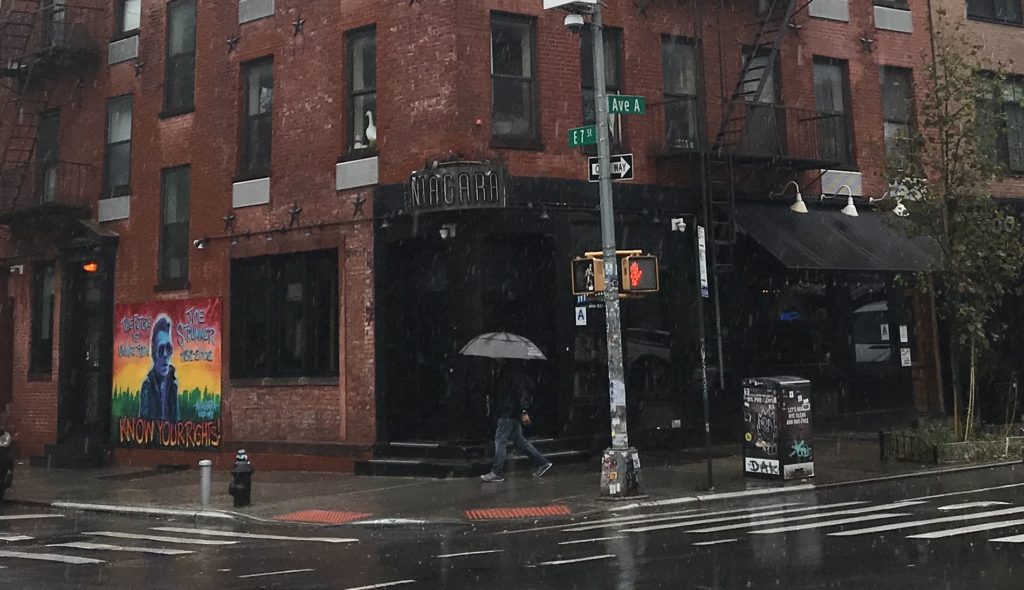
The bar, on the corner of Avenue A and
E. 7th Street. Photo: Nate Freeman.
While the police scrubbed the artist’s scribblings from the
walls of the subway, back at the bar the owners did the opposite
and installed a plastic screen to protect the works that they had
been gifted. A smart choice. This Sunday, Nara’s Knife Behind
Back (2000), a large painting of the same frowning little girl
present on the walls, sold for nearly $25 million in at Sotheby’s
in Hong Kong. Among living artists, only Jeff Koons, David Hockney,
Gerhard Richter, and Jasper Johns, have sold works for more higher
figures.
The Nara market has entered an echelon where prices for even his
drawings and prints are about to go into hyperdrive—and that little
dive bar called Niagara very well may have millions of dollars of
Nara on its walls, advisers told me. Blum says the work is
certainly a Nara, and the artist signed and dated the wall next to
the work. An art adviser who is very involved in Nara’s secondary
market said that the works, when taken together, could be worth as
much as $5 million.
Another said the prices might not be quite so high. Still, the
prospect was tantalizing enough that he quipped, “Maybe we should
just buy the bar.”
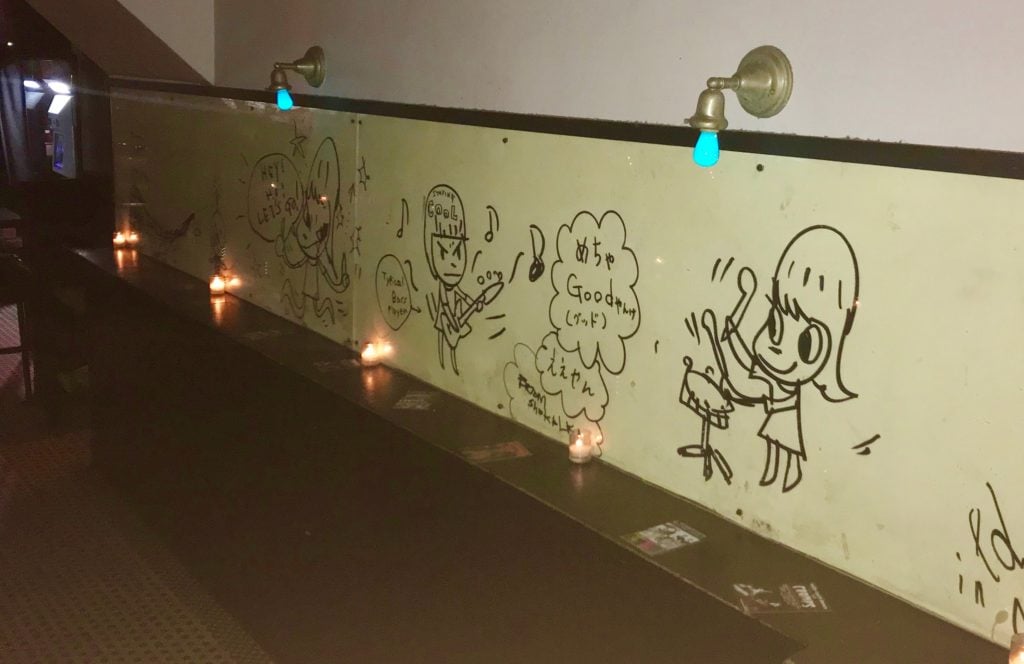
A detail of the mural. Photo: Nate
Freeman.
Reviewing how the non-painting Naras have fared in recent years,
a multi-million total figure does in fact seem possible. In 2018, a
9-inch-by-9-inch Nara marker-on-paper work, which also depicts his
famous cartoon figures, sold for $72,386 over a $27,600
estimate—and that’s for a work smaller than a standard piece of
printer paper. At Niagara, the mural is three feet high and eight
feet long, with at least five instantly recognizable Nara figures
running across its length. There are also three standalone works
against the back of the bar, near the bathrooms, and they each
feature a large figure as well.
On the mural there’s a punk girl drumming and shouting the Joey
Ramone iconic “Hey ho, let’s go!” chant, next to a bass player with
a hat that says “staying cool” and a girl with a short haircut
banging on a snare. Then, in the three works along the bathrooms,
there’s a lead singer yelling “Hey NYC are you happy?” into a
microphone, one signature Nara kid pointing to the ladies room, and
another kid pointing to the boys.
The work is pure, iconic Nara. Not only does it contain all of
his most famous motifs—the little rebel girls, punk rock, text
bubbles—but the fact that it’s on a public structure connects him
to his heroes Keith Haring and Jean-Michel Basquiat, who used to
make works on buildings in the same neighborhood.
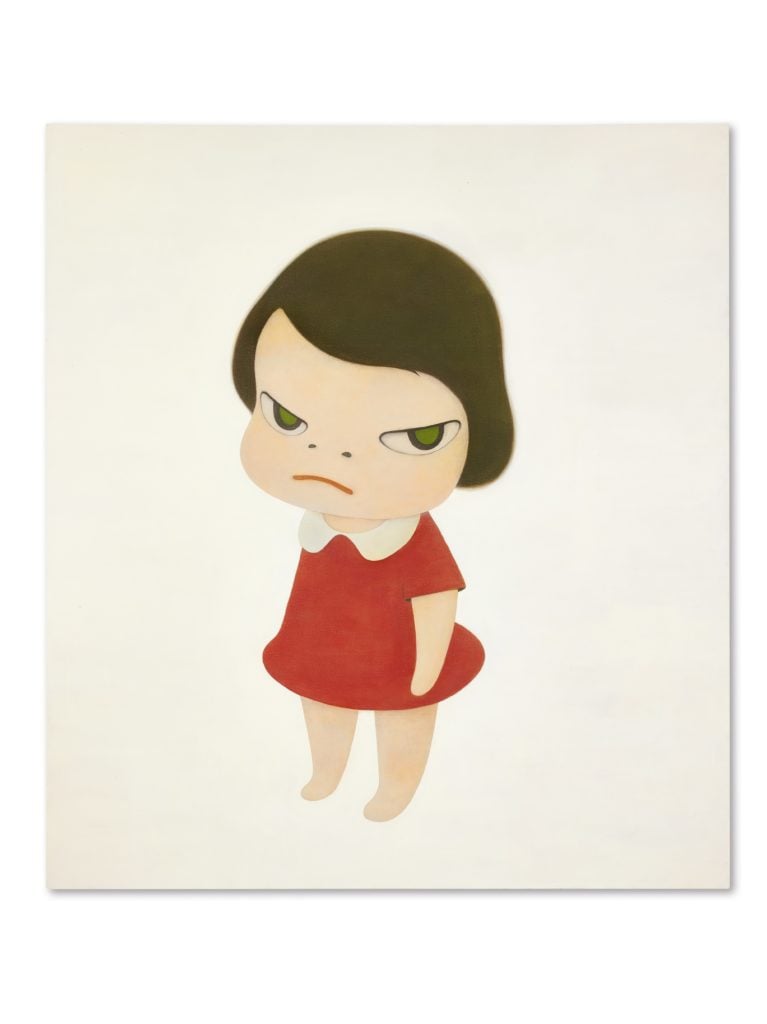
Yoshitomo Nara Knife Behind
Back (2000), which sold for $24.9 million this weekend in Hong
Kong. Photo courtesy Sotheby’s.
Any price would also reflect Nara’s newly cemented market
position after the $24.9 million auction result, as well as the
fact that he is about to be the subject of a large-scale
retrospective at LACMA (rumored to be moving to the Yuz Museum).
When asked about the work at Niagara, Blum declined to speculate
what the prices on the secondary market would be, and noted that
the work wasn’t technically in any Nara catalogues that have come
out. Despite those lacks, the longtime dealer insisted that it was
a legitimate work of art, if one executed in a very unusual way,
and should be treated as such.
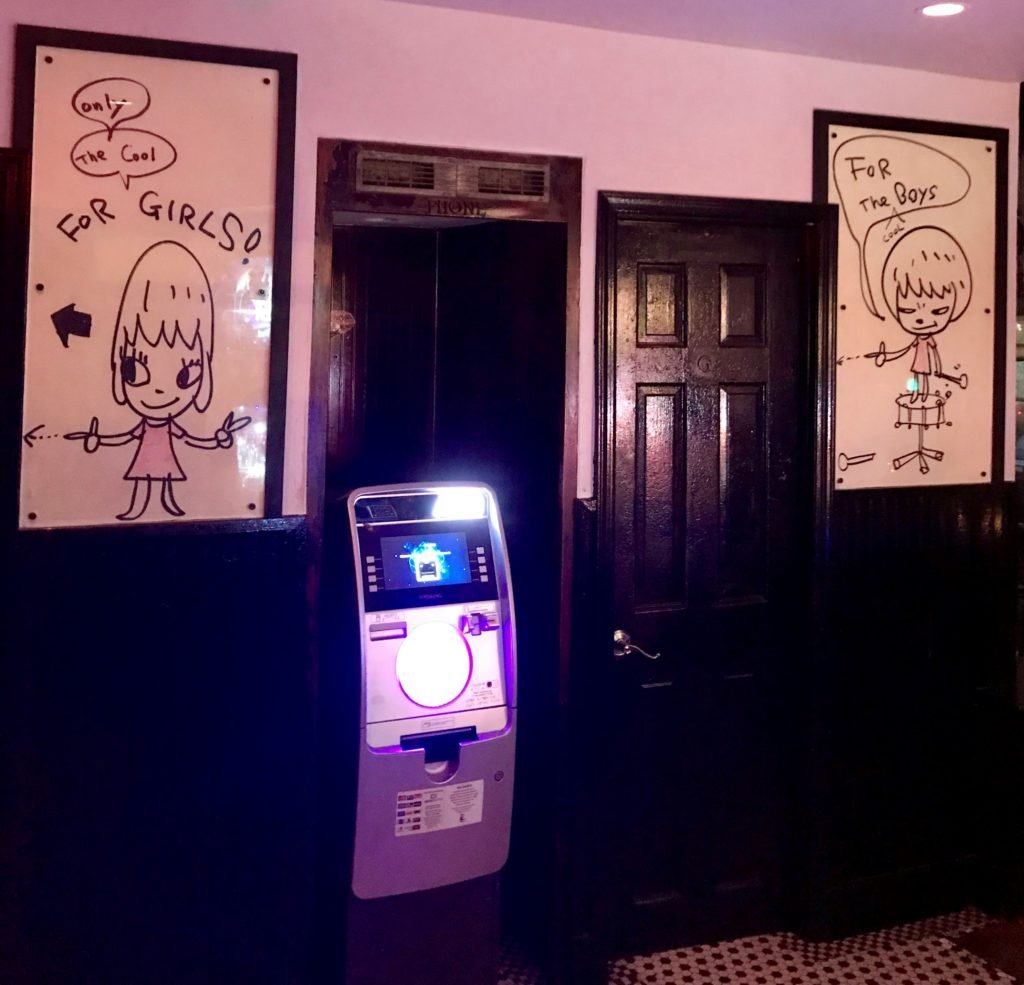
Two Nara works by the bathrooms. Photo:
Nate Freeman.
“For me personally, it’s a work of art by Nara. If it’s made by
Nara, it’s a Nara,” Blum said. “Objectively, we all know the story.
It happened, it’s real, it’s legitimate.”
When asked if—hypothetically—whether it could be sold, Blum
said, “I don’t see that there would be anything to get in the way
of that.”
Blum noted that it could be offered a la a Banksy (“not that I’m
comparing Nara to Banksy”), wherein the owners of a building remove
the now-valuable bricks and offer them to the highest bidder. In
January, a steelworker in South Wales sold one such small Banksy
for a “six figure sum.” A different sort of precedent comes from
within the bar and restaurant world: In 2009, the owner of Berlin’s
fabulous art boite Paris Bar sold a Martin
Kippenberger painting that the artist had made as a tribute to the
space and that had hung on its walls for $3 million at Christie’s,
to settle a debt.
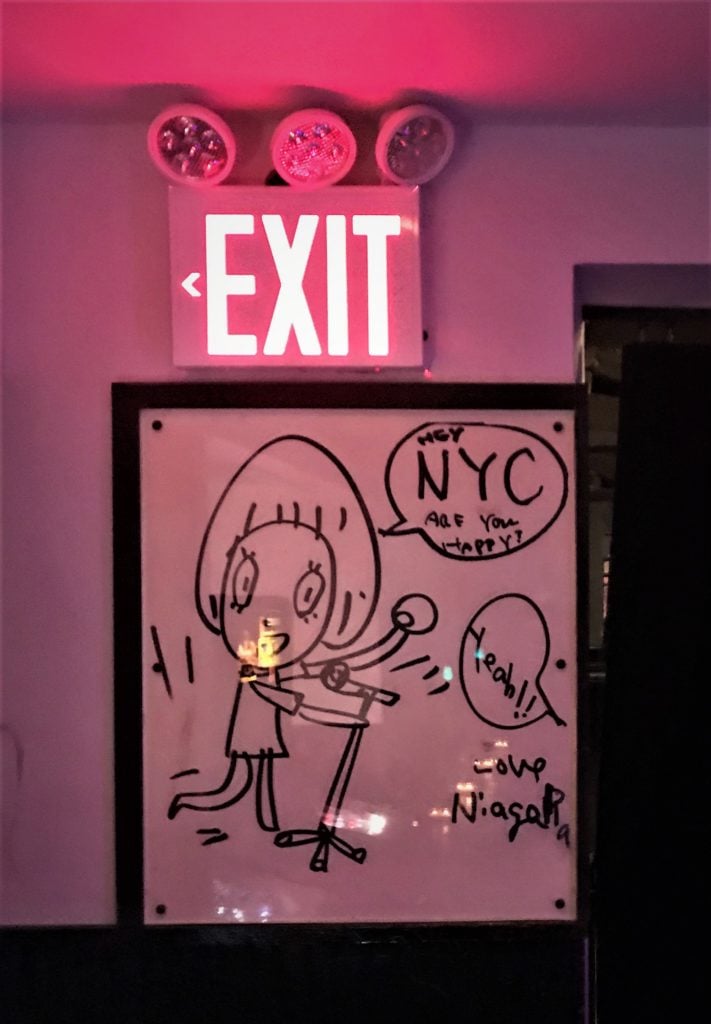
A work in the back of the bar. Photo:
Nate Freeman.
Blum did make it clear that the artist wouldn’t exactly be
thrilled to see the beloved dive bar sell the work, though.
“He is loath to get involved in authenticating things for the
sake of monetization,” Blum said. “It was an ephemeral gesture that
was something in the spirit of a good time, and so when people try
to authenticate with a goal to monetize, he blanches. He certainly
was there and he certainly created it, but he’s hesitant to embrace
it if it’s for money.”
(Calls to the owner of Niagara’s parent company, Tozzer Ltd.,
went unanswered, and no one responded to an email sent to the
address listed on the bar’s website.)
Personally, I’d be devastated to see the bar sell the work to
the highest bidder. I live around the corner, and pass by often to
hang with Nara’s cute-angry punk kids. When I stopped for a beer
one recent Sunday evening, a few hours after the record had been
set in Hong Kong, the popcorn machine bubbled with snapping kernels
and Paul McCartney and the Clash were blaring. Niagara meets what I
consider to be the test of a good bar: roughly half the seats
taken, at any given time.
None of the customers were paying particular notice to the
artworks on the back wall that night. When I told the bartender
that the artist who made them had sold a work for $25 million this
weekend, she said, “Is that so!” and went back to pouring a drink.
When she returned, she added that she loves the work, and that
regulars have embraced the drawings as part of Niagara lore, but
that no one ever really thinks about them in terms of value.
Nara himself shares that kind of nonchalance, Blum said. Even
though his prices have skyrocketed in recent years, he’s stayed
down to earth and remains the same person he was when Blum and his
partner first met him, when his works were selling for just a few
hundred dollars.
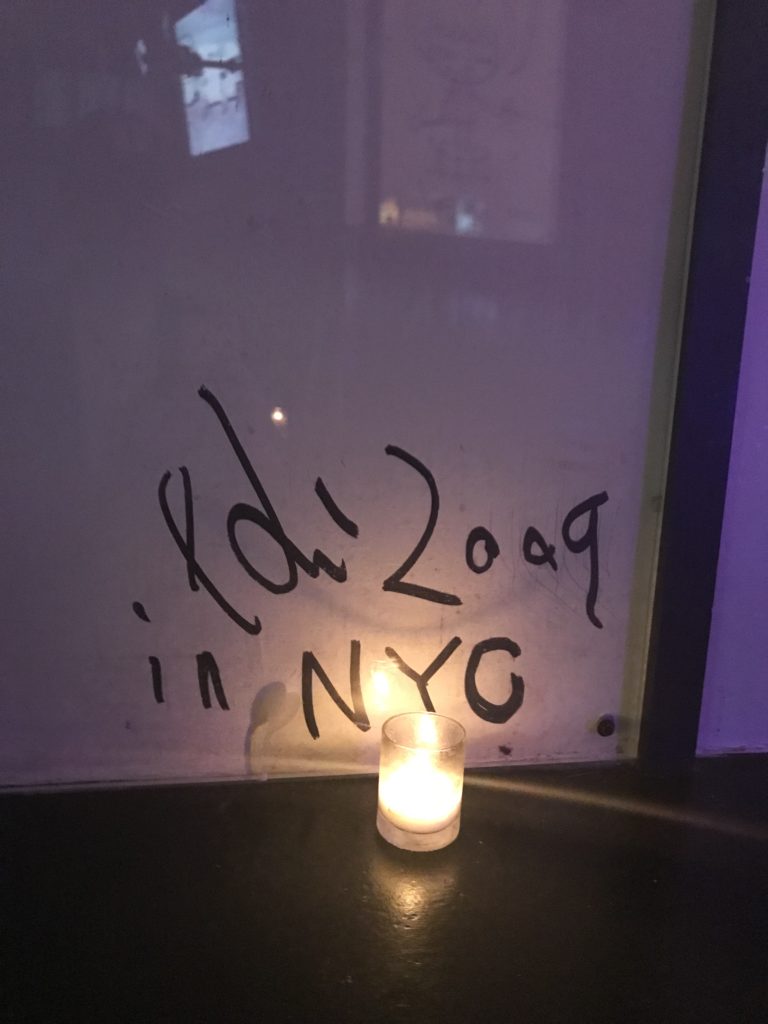
Nara’s signature. Photo: Nate
Freeman.
Blum & Poe first sold the now-record-breaking
eight-figure Knife Behind Back out of the gallery’s
old Santa Monica space, way back in 2001. “I remember the picture
so well… I remember the painting hanging on the wall, man, in the
white room,” Blum said. “It wasn’t really a no-brainer, easy
thing to sell, though we did sell it. It was 20 grand.”
(Given the recent $24.5 million record, that means that the
price of the work has increased more than 85,000 percent since it
first sold on the primary market.)
Despite being one of the five most expensive artists alive, Nara
still has the same taste in dive bars. When he had a solo show with
his New York gallery, Pace, in 2017, he insisted on having the
“dinner” at Niagara. I was there. It went late.
“Nara’s a fucking great artist and he’s a great guy and he’s
grounded and he never sold out,” Blum said. “He follows his own
damn rhythm and doesn’t give a fuck. He doesn’t let this shit
rattle him.”
The post Yoshitomo Nara Drunkenly Doodled on the Walls of
This New York Dive Bar. Ten Years Later, the Mural May Now Be Worth
Millions appeared first on artnet News.
Read more https://news.artnet.com/art-world/yoshitomo-nara-niagara-mural-1673719
Further reading


Leave a comment