
‘You Just Have to Enjoy It’: Swiss Art Star Nicolas Party on His Evolution From Outlaw Street Artist to Art-Market Darling
As we look out onto the horizon of 2020, there are several major
shifts underway in the art world. After a period of focus on correcting errors in the
art-historical canon, the pendulum is swinging back in the
direction of young artists who
can inject new ideas and innovative approaches into the mix. If you
ask anyone in the know who of this next generation you should be
looking at, one of the names you’re sure to hear is Nicolas Party,
a genial, 39-year-old Swiss artist who has won widespread attention
not for his high-tech artistry, but rather for the opposite.
Party specializes in a relatively traditional form: portraits,
landscapes, and still-lifes that he executes in vividly colored
pastels, a painting technique developed during the Renaissance.
What results is a pictorial world so over-abundantly rich that
you can all but taste it. Party pushes this effect into overdrive
by bathing the walls of his galleries in gorgeous color, often
adding surrealistic elements like floating jellyfish or flapping
cartoon birds on top.
The artist currently has a ravishing show on view at New York’s
Flag Art Foundation, where he is displaying his own work alongside that of historical
artists he admires, like Marsden Hartley and Mary Cassatt.
Party is also preparing for his debut exhibition with Hauser &
Wirth—the Swiss gallery that signed him to its
roster last June as one of its youngest artists ever—in Los Angeles this February.
So where does Party’s beguiling art come from, and what does it
feel like to be a rising art star in 2020? The artist sat down with
Andrew Goldstein at Artnet News’s headquarters to discuss.
Click here to listen to an audio version of
this interview on our Art Angle podcast.
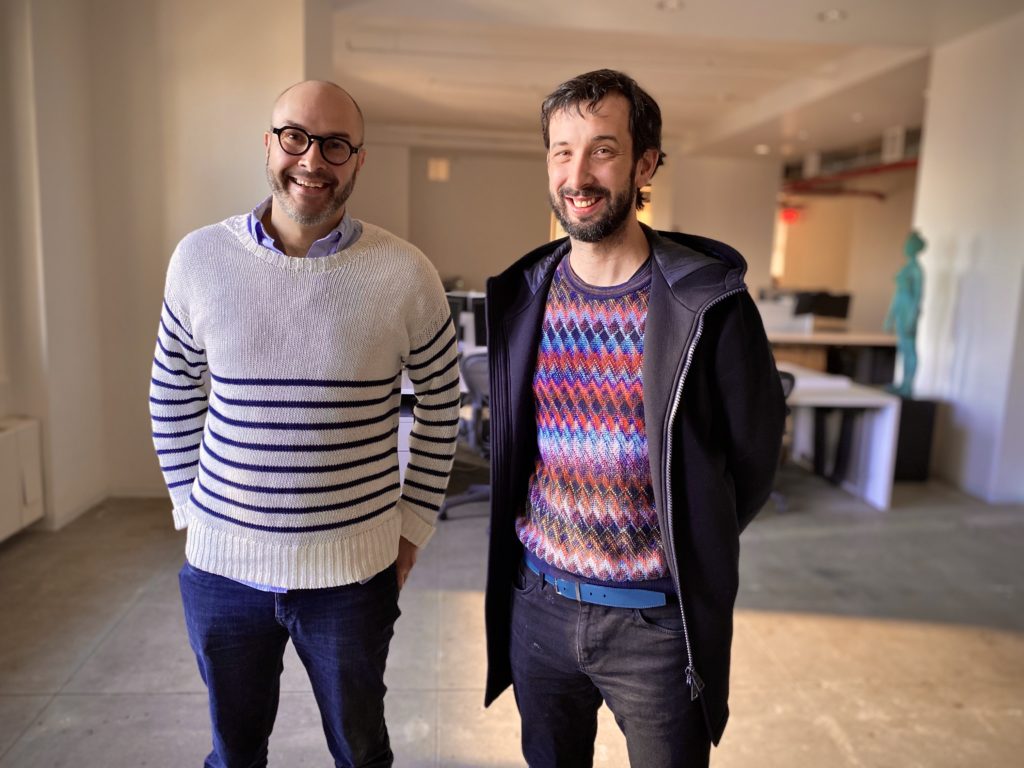
Artnet News editor in chief Andrew
Goldstein with artist Nicolas Party. Photo: Tim Schneider.
So you grew up in Lausanne, Switzerland, which is a
beautiful city overlooking the Alps. How did you first become drawn
to making art?
When you’re a small child, six or seven years old, you have a
certain amount of playtime and creative time allowed. [From then
onward,] I never stopped doing it.
In your shows, you have a penchant for drawing on the
walls. Is that something you did as a kid as well?
Yes! As a kid, they give you a small piece of paper that is the
surface that’s allowed—but yeah, I’m sure I did some drawing on the
walls where I wasn’t supposed to.
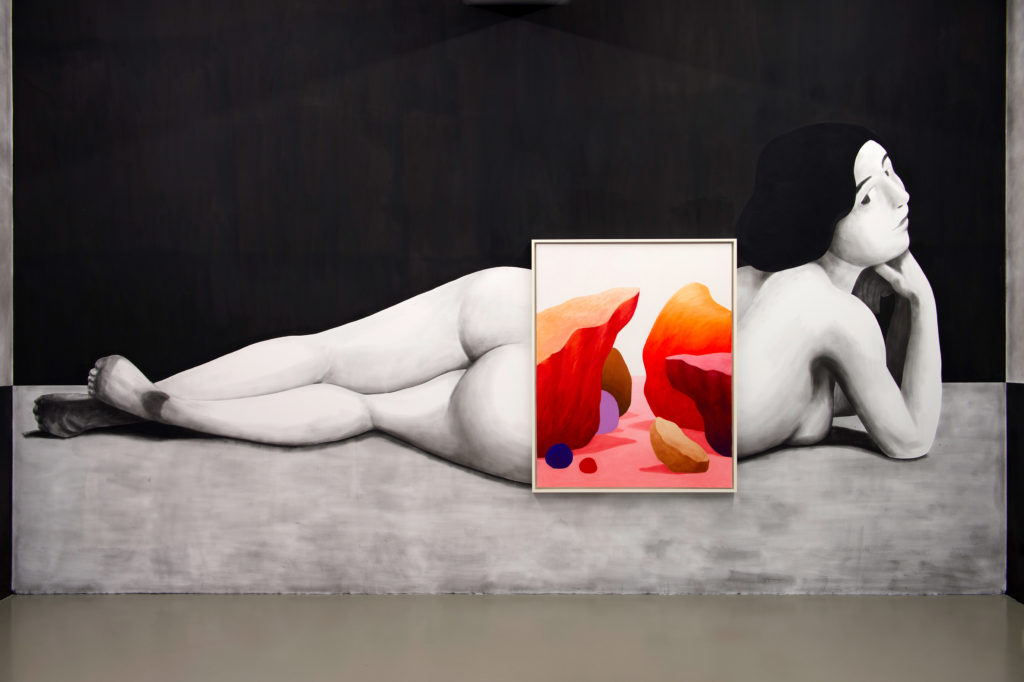
Installation view, “Pastel et nu,”
Centre Culturel Suisse, Paris, France, 2015. ©Nicolas Party.
Courtesy the artist, Hauser & Wirth, and Centre Culturel Suisse,
Paris. Photo by Marc Domage.
And in fact, for a long time, you were a street artist,
which is another form of drawing on the walls. What was that like,
doing graffiti in Switzerland in the ’90s?
It was probably from when I was about 12 to 21, when I had a
very tight-knit group of friends; we were going out at night
together, getting chased by the police, hiding things, dressing up
to blend in at night, breaking into some places. These things
create a very strong bond, just as it would if you were into
skateboards or were in a rock band.
At that particular moment in the ’90s, it was extremely exciting
to be involved in graffiti. It was probably the second or third
wave in Europe. Growing up in a small town, we only had one printed
magazine about graffiti, and it was a revolutionary thing for us to
discover, and basically we just kept trying to mimic that.
In street art, it is really important to develop a
signature style, because that’s the only way that somebody walking
down the street is able to recognize who did what. Did you have a
visual catchphrase as an artist?
It’s strangely a very conservative kind of environment. I
remember when I was doing block letters without perspective, and
that was not seen as real graffiti. The signature was really the
[artist’s chosen] name, and it’s usually four letters because
that’s the right amount of space to fill in a short amount of time.
Basically, you choose letters to form a word—of course, it has to
be a name that’s not yours. It’s very similar to advertising
logos.
My particular thing was to be a bit more skilled in terms of
figuration, because I was drawing a lot, and not just doing the
letters. Most people didn’t do characters, the kind of goofy heads
and stuff that I was working with, these sort of monster creatures.
It was a very fun and creative thing for me, and you just feel so
alive.
I’ve got to ask, what was your tag?
My tags were “SEAM” and “REAL”—that’s what I tagged a lot of
trains with. I can say that now because I got caught. You never
want to keep the tag for too long, because that’s just stupid.
Well thank you for telling us that now! The police will
be waiting for you.
It took me about 10 years to pay back all of the fines.
Wow, okay. So how did you transition from the cool,
dangerous world of street art to the stuffy realm of “fine
art”?
While I was doing the graffiti, I was actually still doing a lot
of fairly traditional landscape painting. That environment is quite
picturesque, but it got complicated with the police for a time.
It’s fun, but spending nights in jail, you know, it gets old. It
took years for me to believe that I could find the same thrill,
that kind of joy of belonging to a group of friends again. Art
school is such a great opportunity, but I was still missing that
thrill, the adrenaline. Doing murals right now, it’s similar in
that it’s a very physical environment and there is a time
constraint—I was really chasing that sort of performance
aspect.
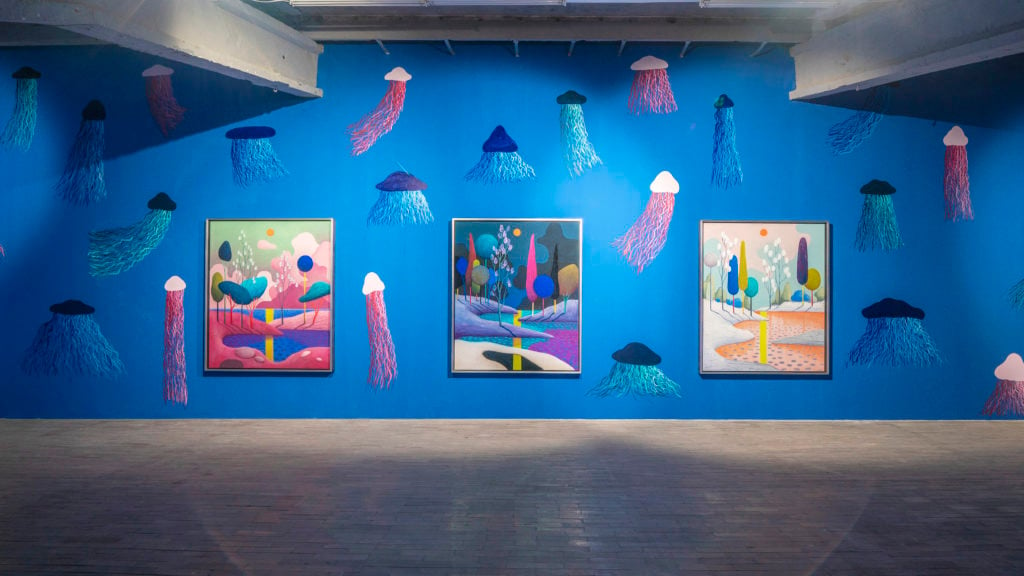
Installation view, “Arches,” M Woods,
Beijing, China, 2018. ©Nicolas Party. Courtesy the artist, Hauser &
Wirth, and M Woods, Beijing.
How did you go from working with spray paint to this
really genteel medium of pastels, which very few other artists have
made their signature technique since the 1800s?
That was fairly recent. For a long time, I was working with oil
painting, but it was just very slow—I was struggling with the idea
that a work could take a year and a half to complete. It was just
too long. I got interested in pastels because I saw a little
portrait by Picasso at a show in Basel, a work that was from a
series influenced by Greek sculptures. I think he used pastels
because it was a sort of loose rendering, and the shading was so
smooth.
And I just immediately connected to that work and thought pastel
would be a great medium to do the shading in my portraits. I went
straight to the museum store and bought a little postcard of the
work, and the next day, I got a little box of pastels and paper,
and I spent that summer copying the portraits, more or less. It
goes so quickly; it’s such an immediate medium.
Instead of taking this in an abstract direction, you
decided to make landscapes, still-lifes, and portraits—these really
traditional, bourgeois, domestic, recognizable historical art
forms. How were you drawn to this approach?
I was always taught in school that you need to have context for
everything you create. I tried to think of elaborate themes: you
know, “I’m doing this because it means that and it’s related to
this text.” But I wasn’t connecting with any of it. I got more and
more frustrated with my teachers, feeling how the Impressionists
must have felt when they said, “We don’t want to do history
paintings anymore.” As a reaction, they did still-lifes and
landscapes, the most minor or underappreciated genres.
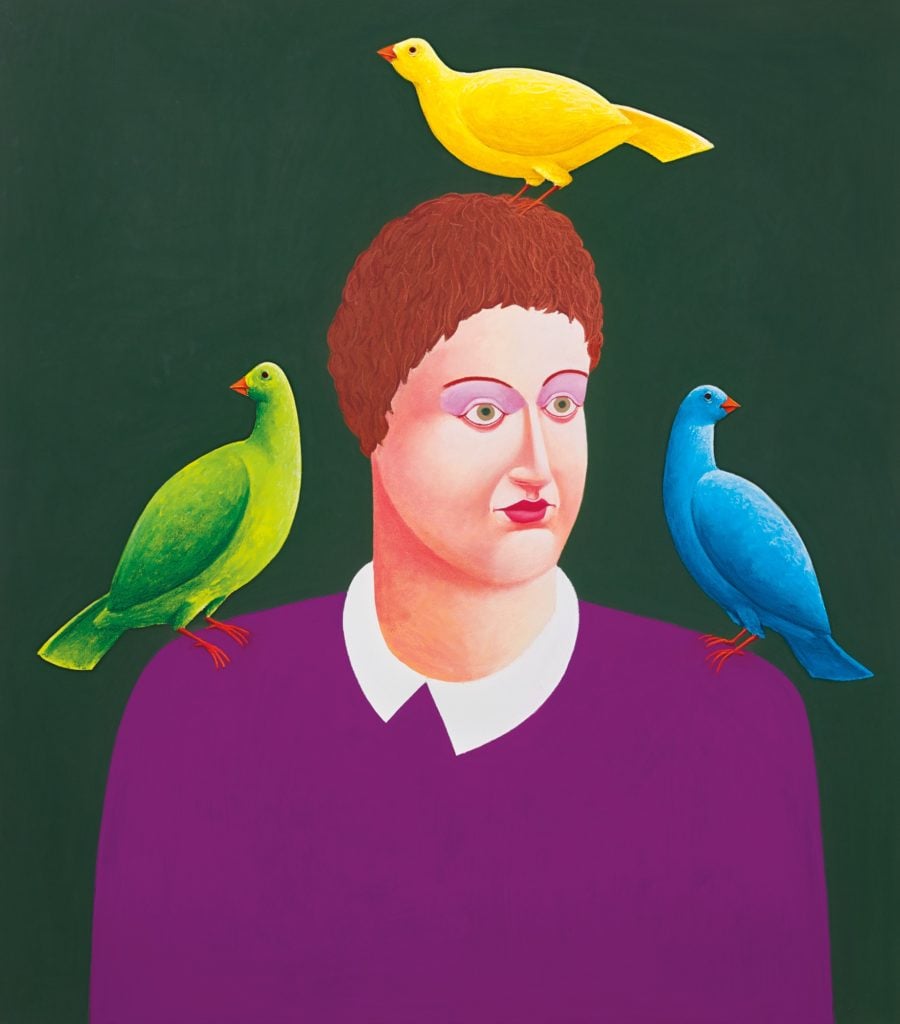
Nicolas Party, Portrait (2015).
Courtesy of Sotheby’s.
You are using traditional tropes, but your approach is
very uncanny, and that’s something that people really respond to.
Your portraits seem to be a bit of a cross between ancient Etruscan
art—with these huge mysterious almond eyes—and illustrator Edward
Gorey. Are these real people that you’re painting, or are they
archetypes?
Traditionally, if I do a portrait of you, I will name the
painting after you. So if you’re painting someone and you remove
the “someone,” you’re just seeing that first layer, the first few
millimeters of something—as if I were putting makeup on the face
and not including all of what’s inside. Like the famous story with
Christ in his last few hours, when he gets fabric put on his
face.
The shroud of Turin.
Exactly. At art school, I had a lot of freedom to work with
animations—I was loving creating the volume and the surface of
things. When social media came along, I was using a lot of
Photoshop, and I really love this idea of working on the surface of
things to make them more appealing. More and more, we’re living in
the time of the filter—with Instagram, you always have a filter to
make you look pretty or older or younger. The portraits are like
those filters.
Your work is responsive to Instagram because you place
your paintings in settings against a backdrop of architectural
interventions like curved archways and painted walls, so everything
pops out. How do you think about your work in regard to
Instagram?
Painters back in the day used a mirror to physically see from
another angle. And I think the camera is even better than a mirror.
When I’m doing an install, I take a lot of pictures so I can go
home and look again and make changes.
When painters were creating works to hang in a church, they were
thinking about the candlelight and working based on the physical
conditions of where the painting would live. When people ask if I
think about Instagram, of course I do. Everything is influenced by
the screen; we’re all post-Internet artists now.
You were born in 1980, which by some accounting
techniques makes you a millennial, and now you’re speaking like a
true millennial. Last summer, you became one of
the youngest artists to join Hauser & Wirth, the gigantic
mega-gallery that straddles the world with 11 locations
internationally. Your cohort of artists is pretty rock-solid: Amy
Sherald, who painted Michelle Obama’s portrait, Rashid Johnson, who
just had his directorial debut with Native Son last year,
and Avery Singer, who is this incredibly hot phenomenon right now.
This is your new crew.
It’s really great. I kept all the galleries that I work with, so
now I have six different galleries, and I do really spend more or
less the same amount of time with each of them. But when you jump
to a mega-gallery, it’s totally different.
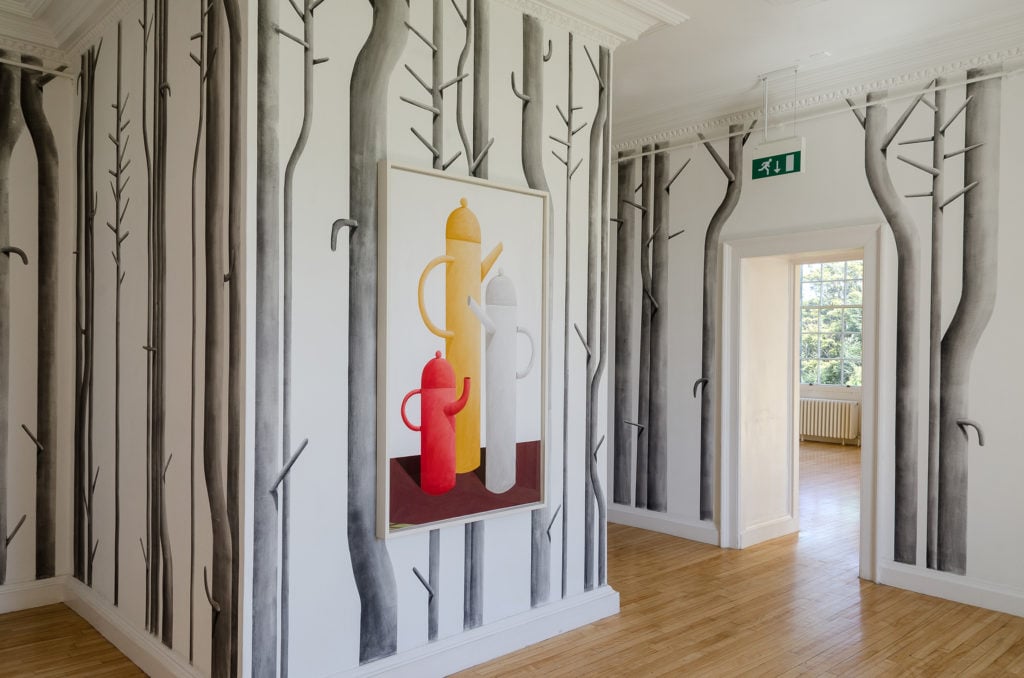
Nicolas Party, Boys and Pastel
installation view at Inverleith House Courtesy of the artist and
The Modern Institute/Toby Webster Ltd, Glasgow. Photography:
Michael Wolchover.
With Hauser, it’s more like working with a museum because it is
so large and has so many departments—communications, marketing,
finance, install, sales. When I did my show at the Hirshhorn
[Museum and Sculpture Garden in Washington, DC], there’s obviously
a lot bureaucracy. You can’t just go in and say, “Oh, put this
ladder here, and I’m going to paint this there.” The ladder has to
be brought by a technical team and everyone has to agree on the
changes in another meeting on another day. So for the big
galleries, it feels similar, whereas in the smaller galleries, it’s
much more direct. I’m very, very fortunate to have both
structures.
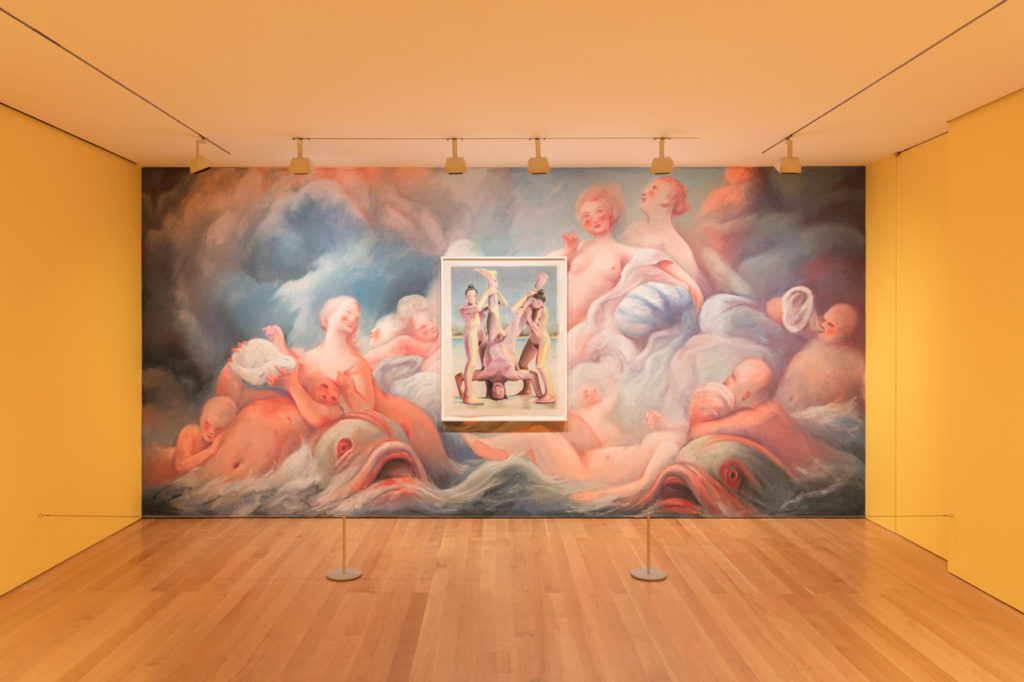
Installation view, “Nicolas Party:
Pastel” at the FLAG Art Foundation. Photo: Steven Probert.
I imagine it as the difference between working for an
independent movie studio and one of the big studios like MGM or
Disney, where they can make your dreams come true with unlimited
budgets. Another side effect—and this is always sensitive to talk
about with an artist—is that since you joined Hauser & Wirth,
the demand for your work
has exploded. Prices for your work have quadrupled, and you
broke the $1 million mark at auction in Hong Kong just a couple of
weeks ago. How do you manage to compartmentalize that noise from
the work?
Moving to New York was a big part of it. I don’t think [the
art-market attention] could’ve happened if I had not established my
studio here. The markets are here, and the money discussion is
based here—certainly more than when I was in Glasgow. As soon as I
moved here, I tried to embrace it. This is a capitalist city,
almost like a caricature. My work that sold at the charity auction One Drop at
Phillips made a very high price, but it was a strategic
thing that was happening—certain galleries building it up. You have
to get comfortable with the strategy that is in place. Some artists
get really tense when you talk about it—you don’t want to say that
you’re making so much more money than everybody around you.
For me, what’s happening right now is exciting, I’m lucky to
have shows that I’m proud of and I work very hard for those shows,
and the money helps me make those shows the best they can possibly
be. I can have a great studio now, and as you know, rent in New
York is insane. So I’m selling these paintings for very high
prices, I can have an amazing studio and a few people to help me,
but I am extremely lucky to have that. For 10 years I didn’t, and,
to be honest, it’s much better now, no doubt about it.
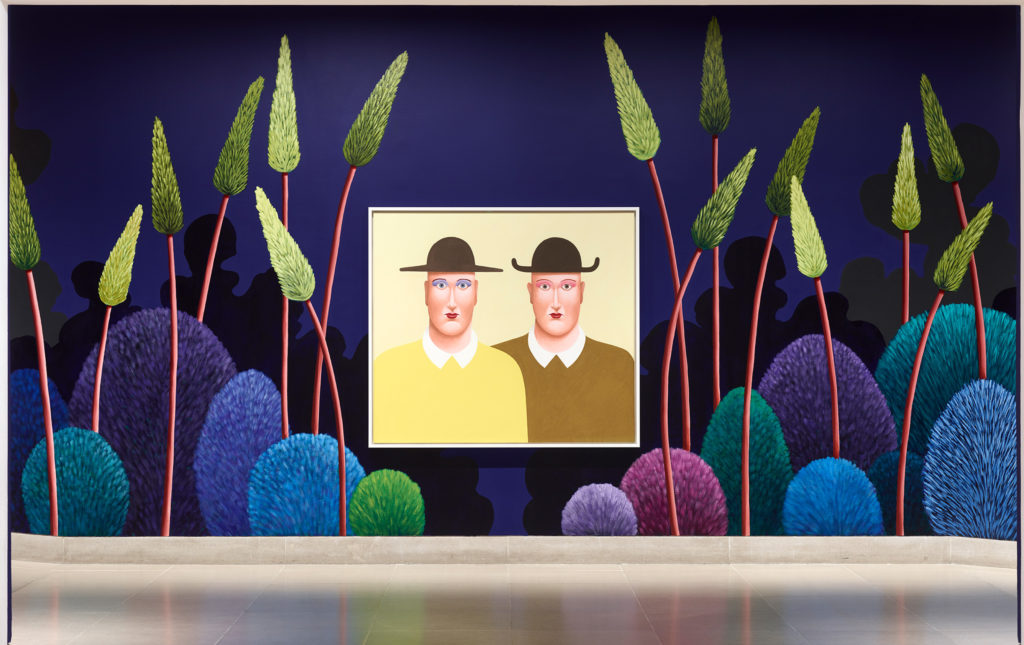
Nicolas Party, Pathway
installation view, Dallas Museum of Art, 2016. Courtesy of the
artist and The Modern Institute/Toby Webster Ltd, Glasgow. Photo:
Chad Redmon
It’s much scarier to take risks when you have nothing, I feel
more creative now. I have more space to try things, though I also
have more to lose. But, you know, if I need to sell two paintings
to [break] even, it’s okay—that’s when you can experiment. People
always say, “Oh, it’s not going to last,” but when you’re in love,
you never say, “Oh, in two years this will crash, she’s going to
cheat on you or you’re going to have fights.” That’s how I feel:
You just have to enjoy it now.
So you’ve got a lot of big shows coming up, but you also
have one project in the works that is different from the rest: a
recent commission by the nonprofit organization RX Art to paint a
207-foot hallway in a Los Angeles children’s hospital, where 16,000
kids walk every year on their way to surgery. How do you approach
something like that?
It may not be a hip gallery in Chelsea, but [it was meaningful]
to get that commission. It’s visually quite scary, because of what
it represents, for children and their parents and caretakers to
have to walk down it—even if you can change it in a tiny way, and
help even a few people, that’s a big thing.
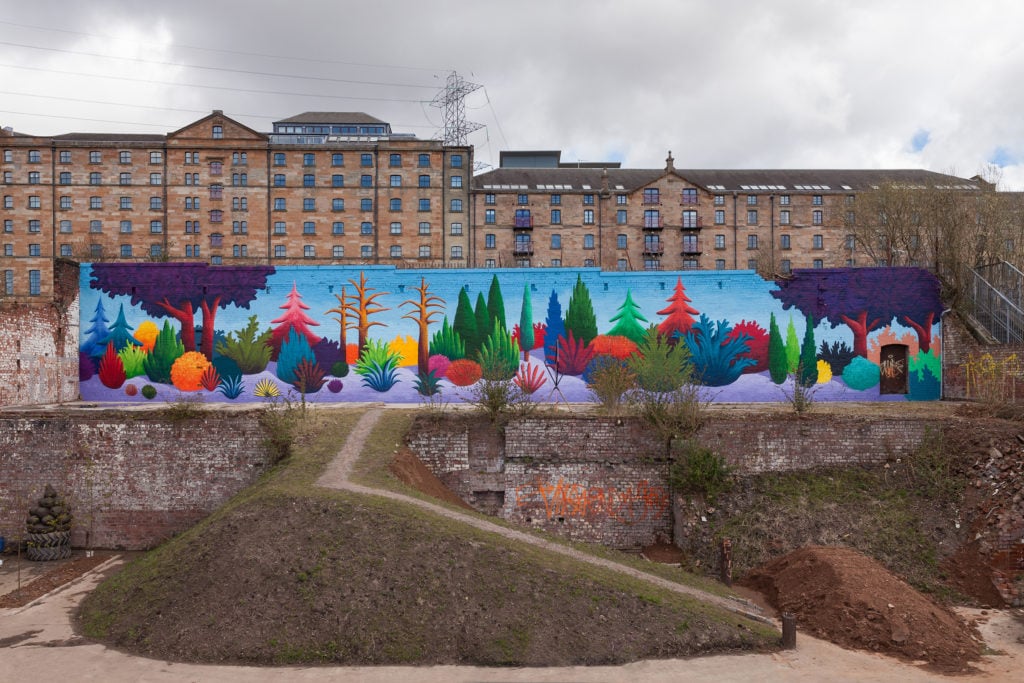
Nicolas Party Landscape (2013).
Courtesy of the artist.
I love art, and I believe 100 percent in its power, because it
affects me on a daily basis. I think in culture, music is by far
the most direct thing that can help people tackle emotions. But
visual art can affirm an idea, and certain elements can really help
change your mindset. You have to be modest and humble, because you
know that even if you do something [great] for this hallway,
everything is not going to be okay. We all know that if you’re a
kid and you have to go to surgery, it’s not the place that you’re
supposed to be. But the idea is to create an environment that could
help even a tiny bit in those dark moments.
To end on a lighter note, your name is Nicolas Party,
and that’s a name that people love to play with. What is the best
pun on your name that you’ve heard, and what is the most annoying
one that you keep on hearing?
I don’t think it’s that easy to make a very good one. But
anyway, it’s a fun name and a party is a good thing.
The post ‘You Just Have to Enjoy It’: Swiss Art Star Nicolas
Party on His Evolution From Outlaw Street Artist to Art-Market
Darling appeared first on artnet News.
Read more https://news.artnet.com/the-big-interview/the-art-angle-nicolas-party-interview-1752999
Further reading


Leave a comment