
4 Striking Trends at NADA Miami That Show Us Where the Art World—and Market—Are Headed Next
A few hours into the VIP preview of NADA in Miami on Thursday,
Emanuel Aguilar of Chicago’s Patron Gallery was almost out of
breath. “I haven’t had a morning like this since 2011,” he said. “I
haven’t been able to finish conversations.” The 17th edition of the
fair, which offers work by emerging artists from 135 exhibitors
from around the world, opened to a crush of visitors and brisk
sales. By 3 p.m., around 80 percent of the art on Patron’s stand
had sold, according to the gallery.
While small and midsize art businesses have struggled to stay afloat in recent years, many of
NADA’s dealers have benefitted from the fact that collectors seem
to be on a tighter budget these days. “People don’t want to spend
half a million dollars right now—they want to spend $20,000,” said
Lexi Bishop of the West Hollywood-based Nino Mier Gallery.
NADA also continues to be a fair where collectors can discover
artists who may go on to show at larger venues in years to come. In
other words, if it’s trend-spotting you want, NADA is the place to
be. To that end, we pulled together a selection of themes that
emerged from the aisles this year, which may offer some insight
into where the market at large is headed.
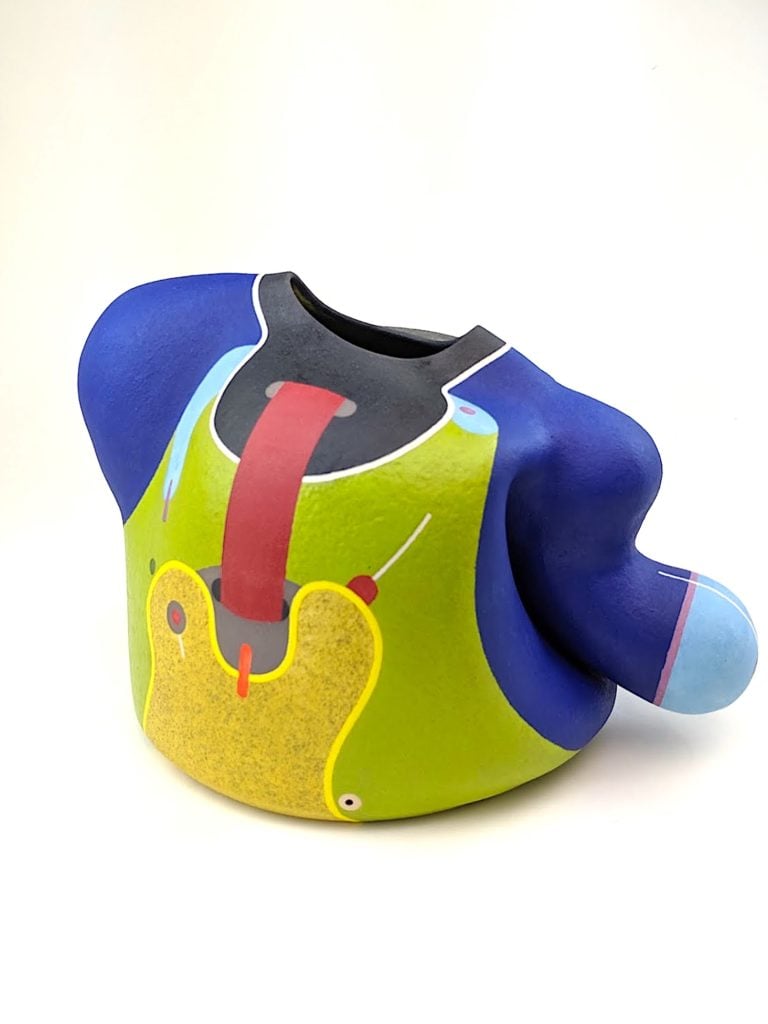
A ceramic work by Jose Sierra. Photo
courtesy of Louis Lefebvre.
Ceramics on Fire
Certain genres were MIA at NADA: there was almost no
photography, for example, and very little new-media art. But you
could barely turn a corner without bumping into a ceramic
sculpture. The medium has attracted artists of all ages—and
collectors, too. Within the first few hours of the fair, Galerie
Lefebvre & Fils from Paris sold out of its solo display of amoebic
ceramic vases by the Venezuelan artist Jose Sierra, priced from
$2,500 to $6,500. (The series is inspired by a Gabriel García
Márquez text about bananas, which appear to be the fruit of the
week.)
Ceramics are appealing to collectors in part because “there
aren’t so many artists with a really high price point,” says Louis
Lefebvre.
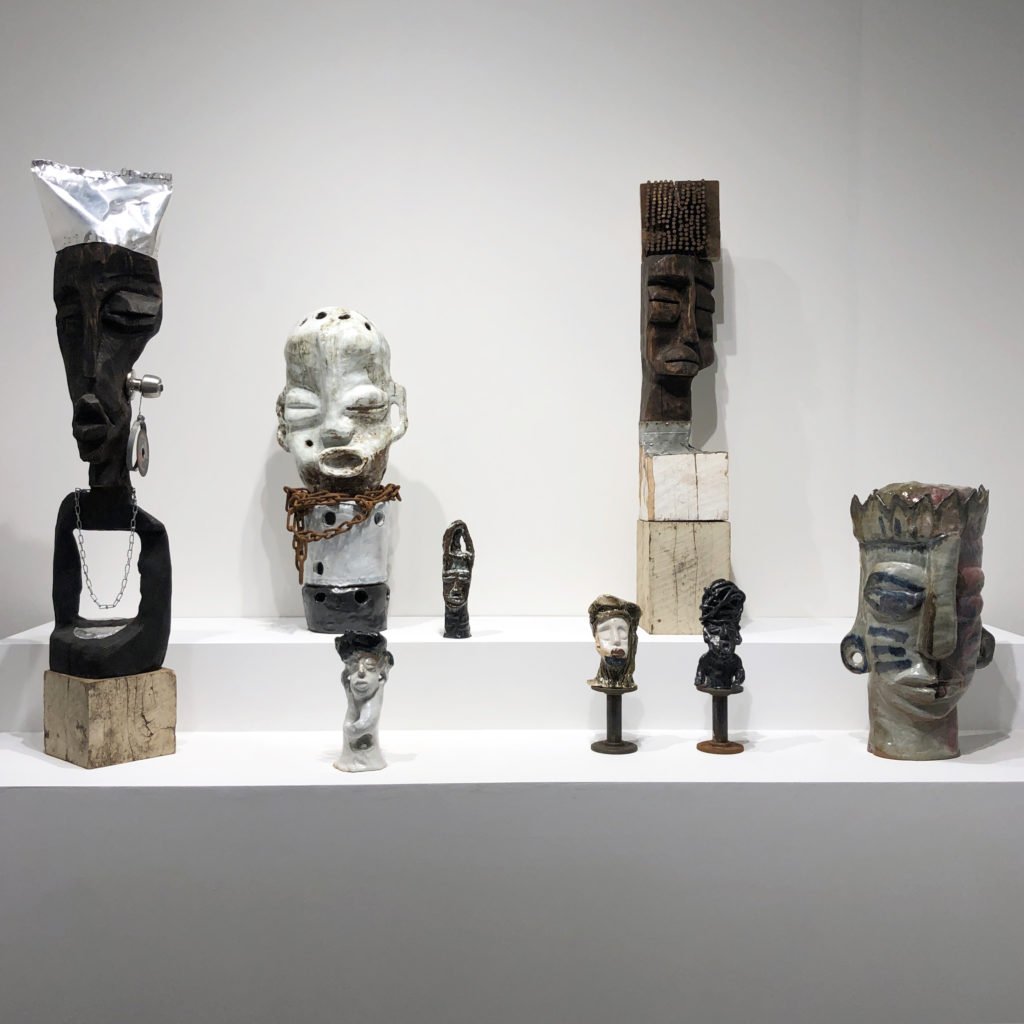
Gordon Robichaux’s solo presentation of
Leilah Babirye’s work. Photo courtesy of the gallery.
While Sierra is a dedicated ceramicist, other artists are new to
the genre. At 64, Dutch artist Marliz Frencken has only recently
embraced the form, having dedicated much of her career to painting.
Her ceramics, on view at Althuis Hofland Fine Arts from
Amsterdam, are interpretations of the female form—from tall and
sinewy, to stout and squat. At least one of the sculptures, priced
between €2,400 and €2,800, sold during the VIP preview.
The New York gallery Gordon Robichaux also swiftly sold out its
solo booth dedicated to the Ugandan artist Leilah Babirye,
including her ceramic, wood, and found-object sculptures (priced
from $3,400 to $10,000). Babirye successfully sought asylum in the
United States several years ago after being outed as a lesbian in
her home country, which put her and her family in danger. Her
ceramic sculptures of guardian figures “are trans and queer
subjects that represent chosen family in the LGBTQ community,” said
gallery co-owner Jacob Robichaux.
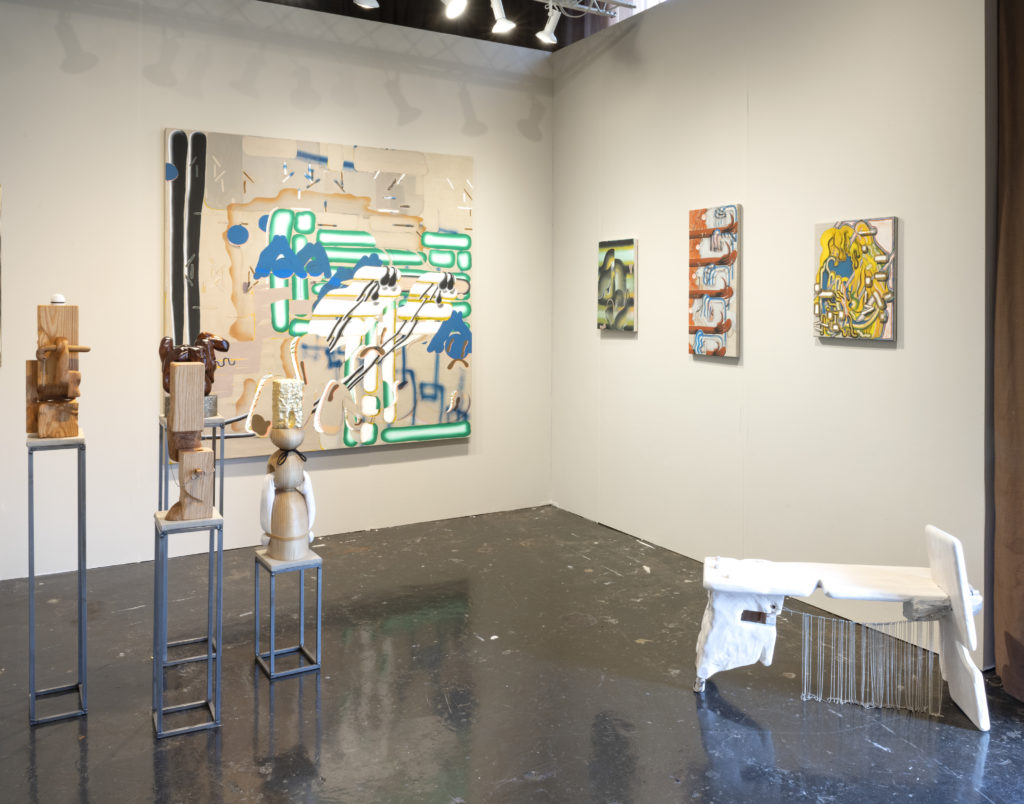
Bridget Mullen’s solo booth at Helena
Anrather at NADA 2019. Photo courtesy of Helena Anrather.
Abstract Is Back?
Figurative painting by young artists has dominated the market
for several years now. But its death grip may be weakening. While
it felt as if almost every booth at NADA last year was stacked with
paintings of people or colorful interiors, this year offered a bit
more variation. “It’s become so trendy,” Bishop, of Nino
Mier Gallery, said. “Even if you had some painting of a poodle, you
could find someone to buy it.” But, like any trend, “people
eventually start turning away from it. And there is something
timeless about abstraction.”
She sold two works by Ethan Cook, whose large compositions are
made from hand-woven canvas and painted aluminum, for $32,000 and
$28,500. Other prominent abstract works at the fair include layered
canvases by Vivian Suter, whose saturated works sold for prices
ranging from $25,000 to $35,000 at the Guatemala City-based
Proyectos Ultravioleta’s booth.
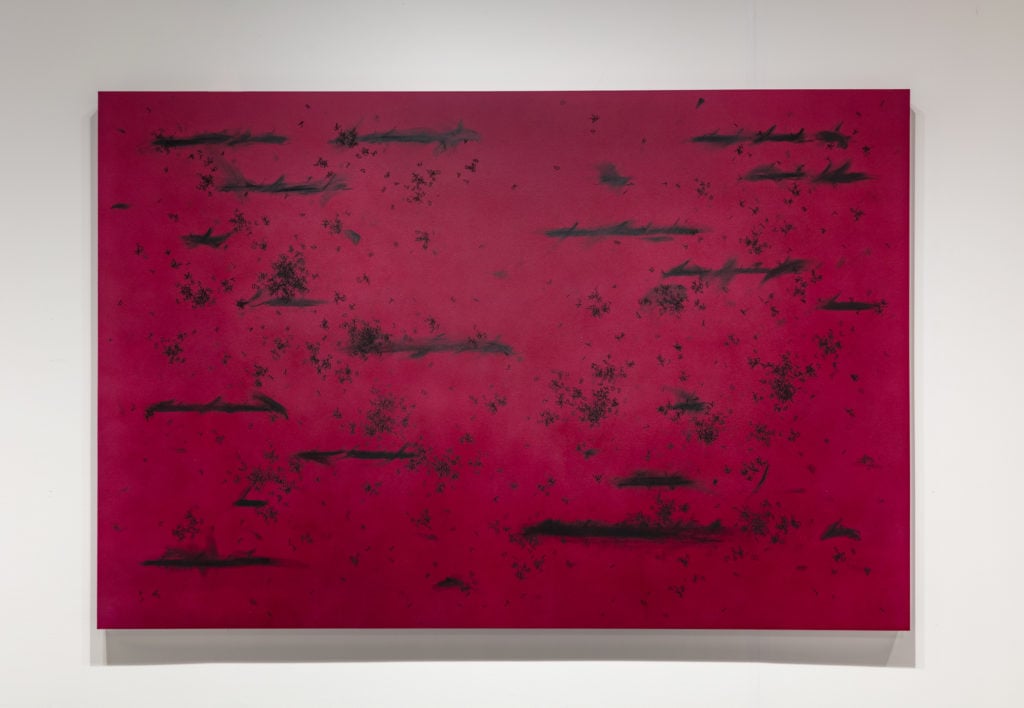
Bethany Collins, Stand beside her
(God Bless America) (2019). Photo courtesy of Patron
Gallery.
But many works on view still retained some link to the real
world, resisting full-on abstraction. Helena Anrather Gallery
from New York sold around half its solo booth by painter Bridget
Mullen, whose wry canvases appear entirely abstract until you
notice an eye drooping over a cylindrical shape, or a hand
extending across the surface, for prices ranging from $4,000 to
$14,000. “That space between figuration and abstraction feels
fresh—it’s like a game to look at the painting and see how it
changes,” Anrather said.
Patron Gallery, meanwhile, sold a composition by Bethany Collins
that presents piles of letters taken from American hymns for
$35,000. “We are reconsidering the boundaries between figuration
and abstraction,” said Logan Lockner, the editor of the
Atlanta-based publication Burnaway, which is presenting
work by five painters from Georgia at the fair.
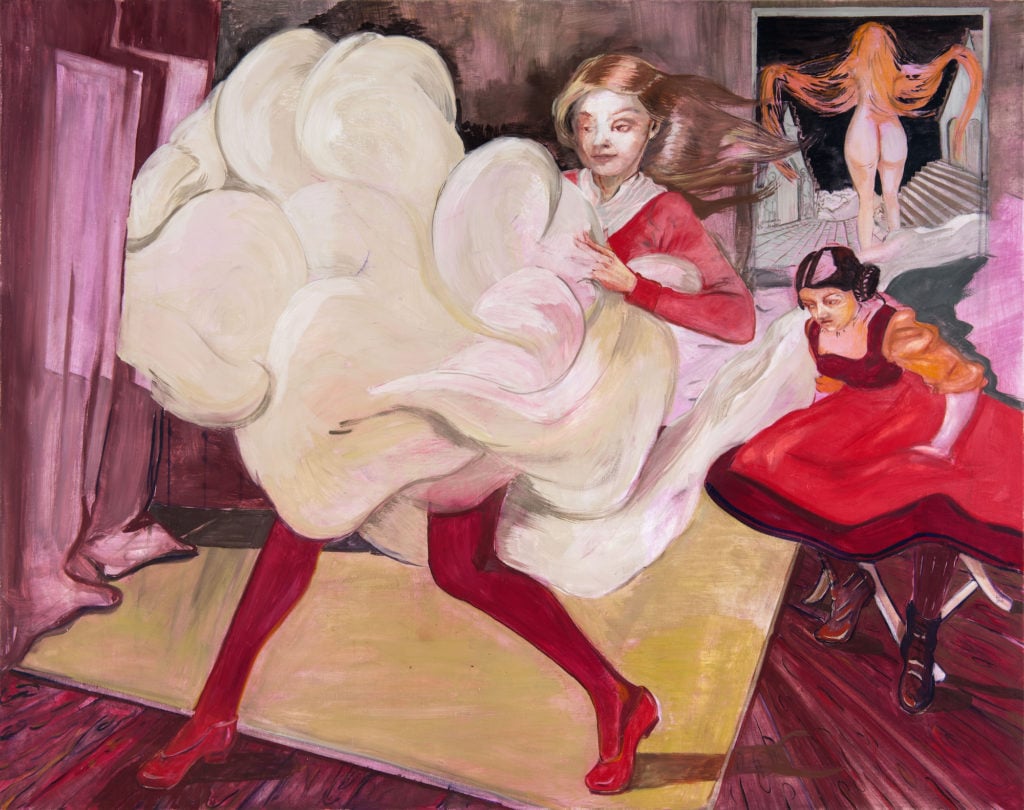
Rosa Loy, Welle (2011). Courtesy
Lyles & King, New York.
Surreal Times Call for Surrealist
Artworks
If you’re looking for something that lands in the sweet spot
between an authentic Dalí and your college roommate’s poster of
Swans Reflecting Elephants, NADA has you covered—or it
did, if you acted fast. Several dealers featured artists putting a
contemporary spin on classic Surrealist themes, with robust results
for all involved.
Brooklyn gallery Fisher Parrish presented a solo stand by
ascendant 26-year-old talent Alexander Harrison, whose trippy
trompe l’oeil paintings of sometimes racially charged
iconography, such as a colossal watermelon with an open wound on
its side, sold out at prices ranging from $1,600 to $9,500 each.
(Harrison, who was born in Greenville, South Carolina, is African
American.) Cofounder Zoe Fisher confirmed that buyers also made a
clean sweep of Harrison’s concurrent exhibition at the gallery’s
permanent space, with over a week still to go in its run.
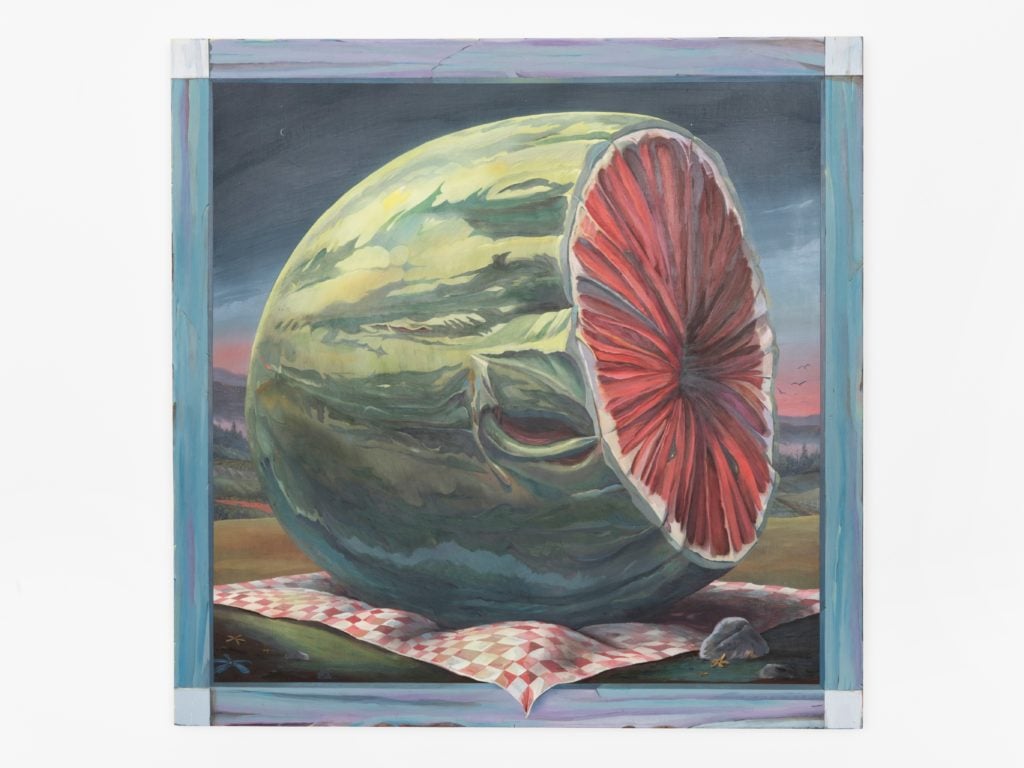
Alexander Harrison, The Beast
(2019). Courtesy of New Art Dealers Alliance.
Lyles & King gallery from New York also sold two canvases at
$37,000 each by Rosa Loy. Her uncanny paintings exclusively depict
female characters in Surrealist-inspired scenarios. Loy, who has
been painting for over 40 years (and who emerged from the so-called
New Leipzig School alongside her husband, Neo Rauch), was the
subject of a solo exhibition at Kohn Gallery in 2018. She will
debut a one-person exhibition at Lyles & King this spring.
Nearby, Rachel Uffner from New York sold a trio of works by Anya
Kielar, who houses three-dimensional objects inside
theater-window-like boxes, then stretches handpainted textiles over
the forms. Think of them as playful, craft-informed mashups of Rene
Magritte and Joseph Cornell. They sold for $15,000 apiece by
mid-afternoon Thursday. So while Kielar may not be making exquisite
corpse drawings with Loy and Harrison, their joint success suggests
that an updated Surrealist aesthetic is very much alive in our
increasingly surreal era of fake news, internet hoaxes, and nearly
magical technology.
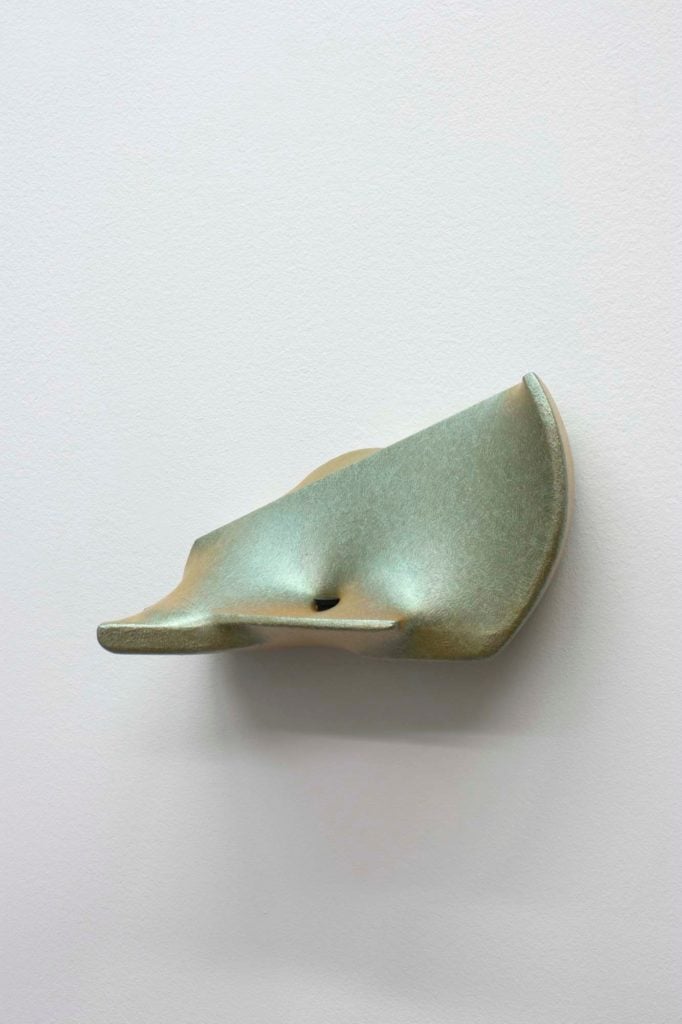
Zach Meisner,
Untitled (2019). Courtesy of New Art Dealers
Alliance.
Pragmatism Is the Name of the Game
Regardless of the various styles and themes on trend at NADA
Miami this year, in one way or another, most dealers surveyed at
the fair on opening day nodded toward a market activated in part by
newly realistic expectations. The fair featured an ample
supply of intriguing works available south of $10,000, a marked
difference from some recent years, even for an event defined by its
focus on rising talent.
Chicago gallery Mickey dedicated much of its booth to a series
of perceptually and materially bewitching sculptures by Texas-based
artist Zach Meisner, a former studio assistant to Larry Bell who
has devised a way to stretch an ultra-thin layer of acrylic paint
and medium over armatures of poplar, MDF, and other materials.
Priced from $1,000 to $6,000 each, the works had not yet sold out
by mid-afternoon Thursday, but founder Mickey Pomfrey said he was
“happy with the progress” they’d made with buyers, perhaps in part
due to a refreshingly direct attitude toward valuation.
“Some people will add 20 percent for a fair,” Pomfrey shrugged.
“I just try to price at what the actual demand is in the
gallery.”
Brussels-based gallery Super Dakota made some of the bigger
scores on preview day by selling three Julia Wachtel canvases
before noon, including one for $60,000. But founder Damîen
Bertelle-Rogier also emphasized that it was important for the
gallery to balance Wachtel’s works with accessibly priced
“discoveries,” such as Jeanne Briand’s wall-mounted aluminum masks
and multidisciplinary artist Chris Dorland’s single-channel video
work, each for $3,000.
In fact, the prevailing attitude may have been captured best by
Matt Ducklo, who returned to his native Memphis, Tennessee, after a
decade in New York to open his basement gallery, Tops, in 2012. “A
lot of people are leaving New York and looking for something more
sustainable,” he said. “I’m from a place where $2,000 is still a
lot of money.”
That number didn’t come up by coincidence. For the gallery’s
NADA debut, Ducklo exhibited a solo booth of domestically sized
paintings by Kevin Ford, each one made with a combination of
spray-gun-applied paint and traditional brushwork, priced from
$2,000 to $6,000. Four were sold by mid-afternoon Thursday, with
buyers still circling others.
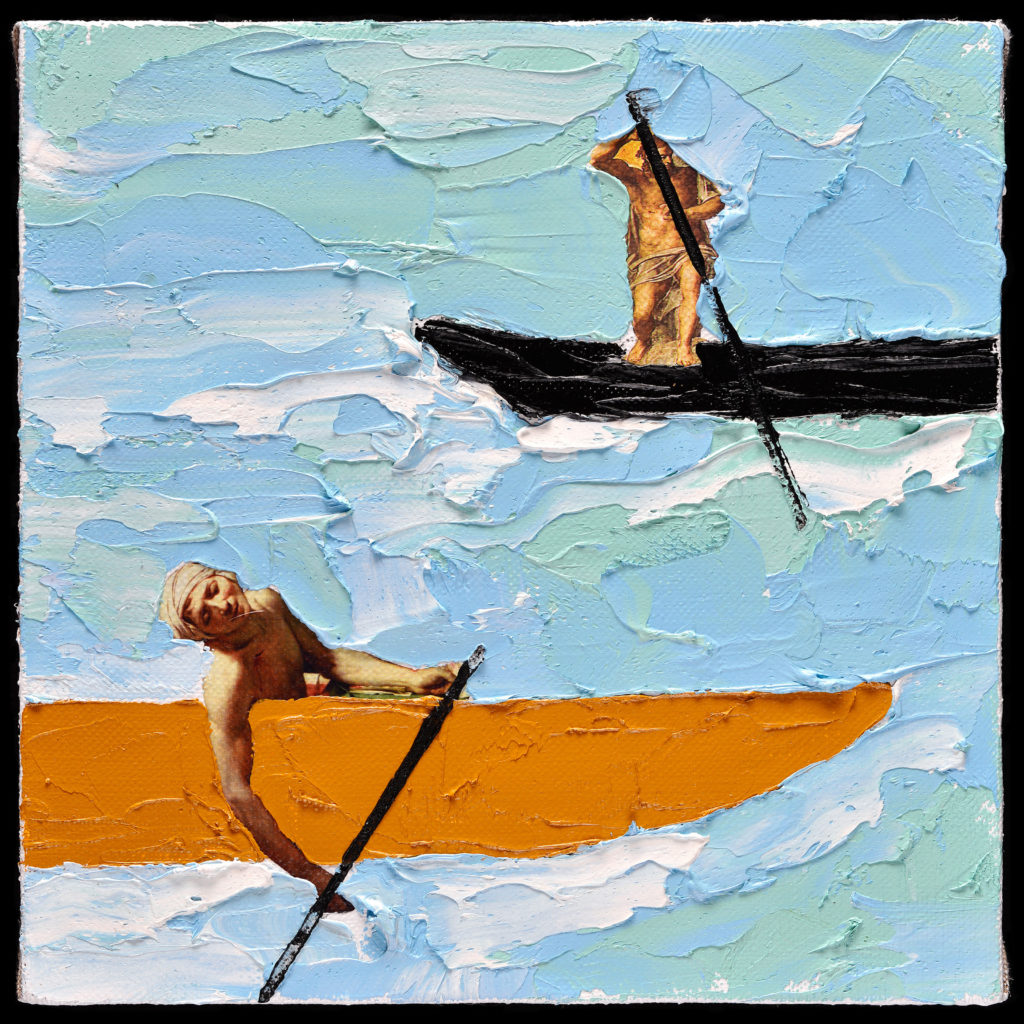
Przemek Matecki, Small
Painting (2016–19). Image courtesy of Raster Gallery,
Warsaw.
In light of all that, Warsaw-based gallery Raster arguably
pinpointed the zeitgeist in its booth. Along with higher-priced
works by the likes of renowned collective Slavs and Tatars (a
mirror work by the group was on sale for $16,500 plus VAT), the
gallery hung its outside wall with about two dozen small collage
paintings by Przemek Matecki. Each one (the gallery brought about
50 of them in total) cleverly sends up a work by a canonical male
great on a compact canvas measuring no larger than 7.8 by 7.8
inches. All were identically priced at $1,000 (plus VAT) and 10
sold on the first day.
After praising Matecki’s wit and technique, cofounder Łukasz
Gorczyca addressed the works’ combination of size, weight, and draw
by saying, “This kind of work works perfectly for an art fair.” Or
at least for this fair, this year.
The post 4 Striking Trends at NADA Miami That Show Us Where
the Art World—and Market—Are Headed Next appeared first on
artnet News.
Read more https://news.artnet.com/market/nada-miami-2019-trends-1724091
Further reading


Leave a comment