
The Nazis Purged German Museums of Thousands of ‘Degenerate’ Works. Now an Expressionist Painting Sold by Hildebrand Gurlitt Has Gone Home
A German museum has recovered a watercolor the Nazis purged from
its collection more than 70 years ago. The so-called “degenerate”
painting by the leading German Expressionist Christian
Rohlfs was one of the hundreds of confiscated works that
passed through the hands of the notorious museum director turned
art dealer and Nazi collaborator Hilderbrand Gurlitt.
Rohlfs’s Study for a Tree
Trunk resurfaced when it was consigned for sale at the German
auction house Ketterer Kunst. The Kunstmuseum Moritzburg Halle
(Saale) in central Germany has been able to purchase the watercolor
at a “fair market price” after a deal was brokered with its
owner, according to the auction house’s press
statement.
Staff at Ketterer Kunst
discovered a vital clue to the provenance of the painting in the
form of an old museum
label on the back of the watercolor. After checking the work against the database of
the Research Center for
Degenerate Art, experts were able to confirm their suspicions that
the watercolor was one of the 147 works confiscated from the Halle
museum by the Nazi’s in 1937 during what was called the “Degenerate
Art Action.”
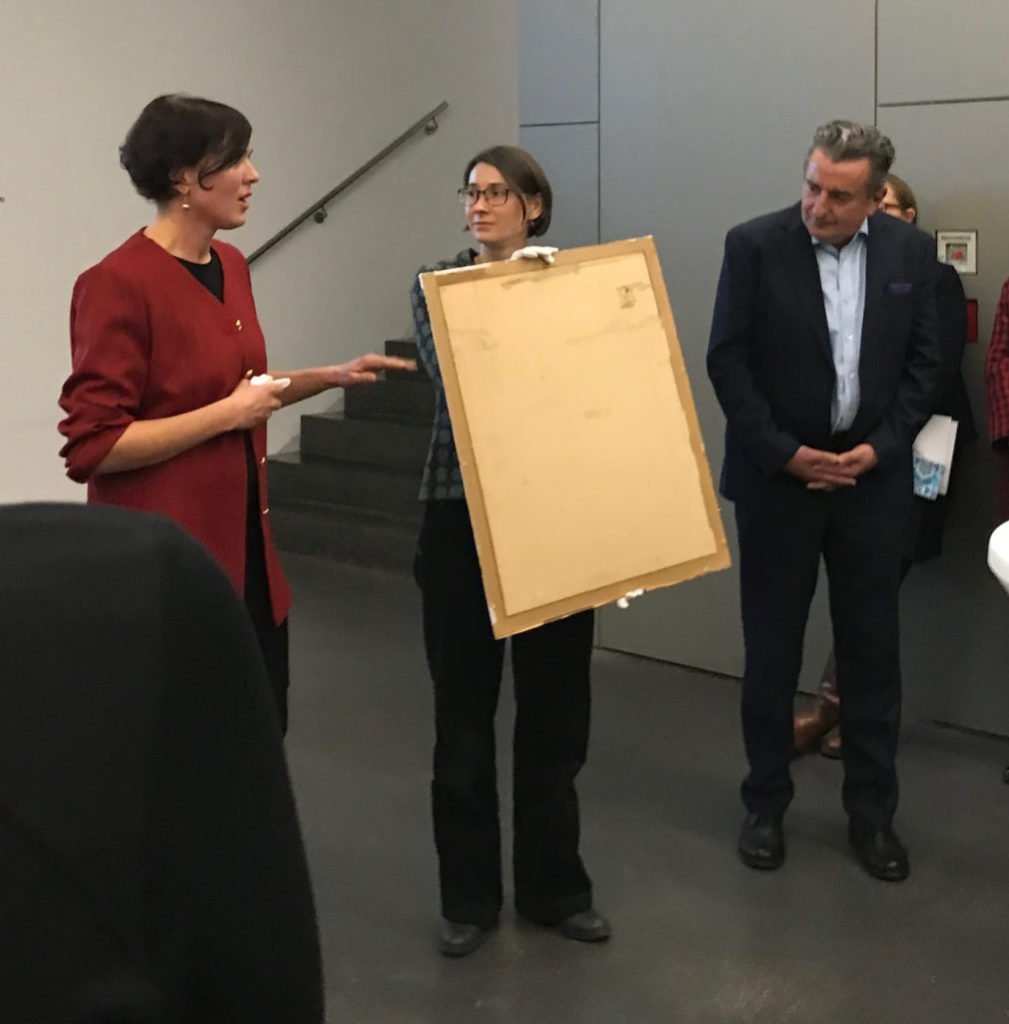
The original stamp proving the Rohlfs
work’s provenance was found on the back of the watercolor. Here, it
is shown during the reception celebrating its return to Kunstmuseum
Moritzburg Halle (Saale). Image courtesy of Kulturstiftung
Sachsen-Anhalt.
The Nazis banned Rohlfs from
painting and he lost his post at Berlin’s Prussian Academy of Arts
in 1938. The artists died shortly thereafter. Hitler defined
“degenerate” art as works that “insult German feeling, or destroy
or confuse natural form or simply reveal an absence of adequate
manual and artistic skill.” Many works of Modern art were
condemned. It included paintings by the Expressionist artist Emile
Nolde even though he was a Nazi supporter.
Rohlfs’s watercolor had long
been recorded as “lost” by the museum. Research revealed the last
written documentation of the work after it was purged. It is dated
1940 when Gurlitt acquired it from the Nazi authorities in exchange
for foreign currency. Its subsequent history is unclear.
Gurlitt’s personal collection
was later revealed to contain a number of valuable works of art
either stolen from Jewish collectors or acquired
through the forced sales of their assets. But a number of the 1,500
works found in 2013 in the possession of his son, Cornelius
Gurlitt, were confiscated by the Nazis from Germany museums.
They are now being
researched by the Kunstmuseum Bern, which was bequeathed the
collection by Cornelius Gurlitt.
The Kunstmuseum Moritzburg has
expressed its appreciation for the painting’s safe return thanks to
Ketterer Kunst without having to bid for it at auction. The auction
house paid for the work’s transport and insurance. The museum also
announced that the work will shortly go on display to the
public.
Robert Ketterer, the owner of
Ketterer Kunst, said in a statement that the return of Rohlfs’s
painting “shows that it takes just a little bit of good will on all
sides to find fair solutions for works with a Nazi past appearing
on the market.”
Ketterer added that the return
of works to German museums or to the heirs of Jewish collectors “is
not only about the art itself, but also about a chapter of German
history that may never fall into oblivion.” He stressed that the
art trade “has to make its contribution to this
endeavor.”
The post The Nazis Purged German Museums of Thousands of
‘Degenerate’ Works. Now an Expressionist Painting Sold by
Hildebrand Gurlitt Has Gone Home appeared first on artnet
News.
Read more https://news.artnet.com/art-world/christian-rohlfs-gurlitt-1723479
Further reading


Leave a comment