
Puerto Rico’s Museums Face Devastating Losses After a Spate of Earthquakes Struck the Island
Puerto Rico has experienced a series of increasingly strong
earthquakes in recent days, culminating in a 6.4 earthquake on
Tuesday that triggered a widespread blackout, leveled buildings,
and killed at least one person.
In the wake of the destruction, art institutions, too, are
shuttering around the island and assessing the damage. The
Museo de Arte de Ponce, which is located near the epicenter of the
quake, posted on Instagram that it would be “closed until further
notice.” It did not respond to inquiries about the extent of damage
to the museum or its collection.
The Museo de Arte, which is located in another heavily affected
historic district, San Germán, is currently closed because “there
is no power in the whole area,” a representative told Artnet News
in a Facebook message. “There was damage to some of the
collections, especially the ones on the second level, which fell
and broke. The structure of the facility suffered some cracks but
most of it is in good condition.”
On the other side of the island, a two-hour drive away, the
Museo de Arte de
Puerto Rico in San Juan announced on Twitter that it would be open
for its regular hours today and waiving the entry fee.
"background:#FFF; border:0; border-radius:3px; box-shadow:0 0 1px 0 rgba(0,0,0,0.5),0 1px 10px 0 rgba(0,0,0,0.15); margin: 1px; max-width:500px; min-width:326px; padding:0; width:99.375%; width:-webkit-calc(100% - 2px); width:calc(100% - 2px);">
View this post on Instagram
The disaster strikes a community still recovering from the
wounds inflicted by 2017’s
Hurricane Maria. “Blue tarp roofs can still be seen everywhere
from the mountains and countryside to communities in the
metropolitan areas,” wrote Gretchen Ruiz Ramos, a museum specialist
who has been aiding cultural recovery efforts following Maria, in
the current issue of Public Art Review. Ahead of
the earthquakes, the article warned that the island’s electric
infrastructure “remains dangerously fragile.”
In the wake of the earthquakes, Puerto Rican Governor Wanda
Vázquez Garced has declared a state of emergency and mobilized the
National Guard. President Donald Trump signed an emergency
declaration authorizing aid from the Federal Emergency Management
Agency.
Recovery efforts following Maria were widely criticized as
inadequate, and the effects of the storm were devastating.
“Structural damage to historic buildings has affected thousands of
collections,” wrote Ramos. “The main hazard in the aftermath of
María was loss of electricity. Six months of constant blackouts,
the most widespread in American history, saw mold growth caused by
high humidity levels and lack of climate control.”
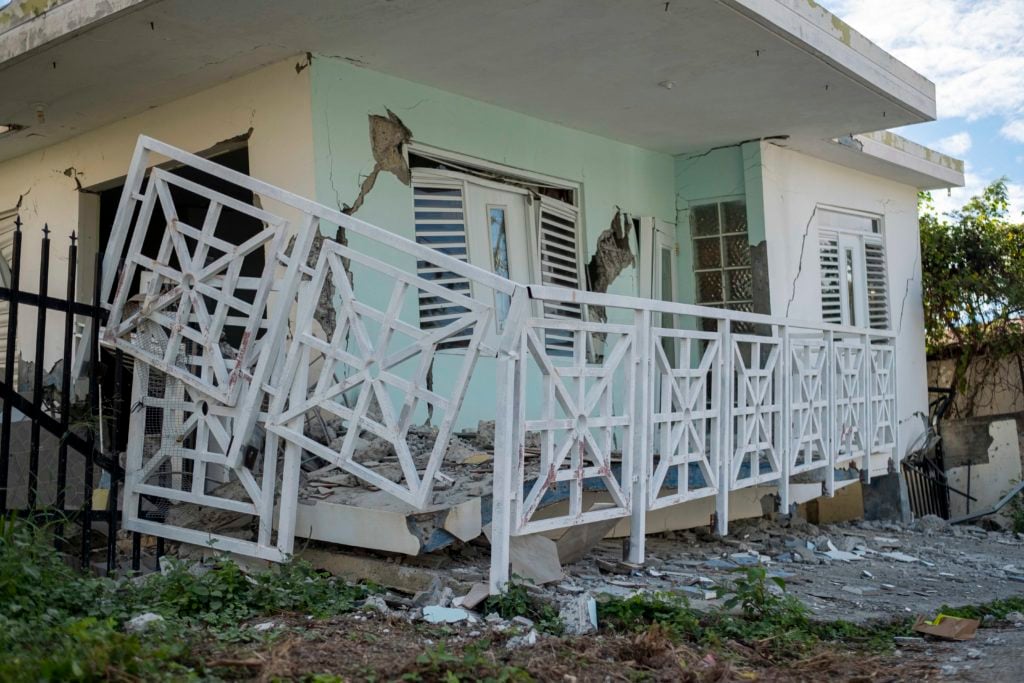
Houses collapsed by a 5.8 earthquake are
seen in Guanica, Puerto Rico on January 6, 2020. Photo by Ricardo
Arduengo/AFP/Getty Images.
Although Puerto Rico sits on the border of the North American
and Caribbean tectonic plates, the recent spate of seismic
activity—there have been an estimated 950
quakes, both large and imperceptible, in just the last eight
days—comes as a shock. It is the strongest earthquake to hit the
island since 1918, and there had not been significant tremors on
the island since 1999.
Among the tourist sites affected by the earthquakes are the
scenic Punto Ventana, a natural coastal rock formation in
Guayanilla named for its window-like appearance. It collapsed
during the quake. Also destroyed were the two belltowers of the
historic Church of the Immaculate Conception, built
in Guayanilla in 1841.
The church’s Father Melvin Díaz Aponte told the New York
Times: “We will rebuild.”
The post Puerto Rico’s Museums Face Devastating Losses After
a Spate of Earthquakes Struck the Island appeared first on
artnet News.
Read more https://news.artnet.com/art-world/puerto-rico-earthquakes-close-museums-1748175
Further reading


Leave a comment