
A Remarkable Exhibition in London Reveals How the Renaissance Painter Titian Once Captured the Troubled Psyche of a Colonial King
Some readers of this article will call it a fish tale, and I
guess I would too. The fish in question is a black sea
bass—Centropristis striata—and this is the tale of how
that New World creature came to show up in The Rape of
Europa, an ancient Greek myth painted in the early 1560s, in
Venice, by Titian.
That painting is in a revelatory one-room show called “Titian:
Love Desire Death,” organized by Matthias Wivel for the National
Gallery in London, where it is scheduled to run through June 14
before moving on to other venues. (The National Gallery shut down
soon after I saw the exhibition; luckily, all the paintings in it
are easy to find online.)
Europa is keeping company in London with the six other
pictures, known as poesie or “fables,” that Titian painted
on commission for Philip II, prince and then king of Spain—and also
ruler of Ireland and England (briefly, as consort to Mary Tudor),
of the Dutch and the Flemish and eventually of Portugal and a host
of colonized peoples in the Americas, in Africa and even in Asia.
(The Philippines were named for him.) I’ve studied all of Philip’s
poesie before, here and there, but seeing them as an
ensemble in one room, reset into matching frames, completely
changed what I felt and thought about them.
Though I have to confess that my fish-out-of-water was not the
first thing I noticed.
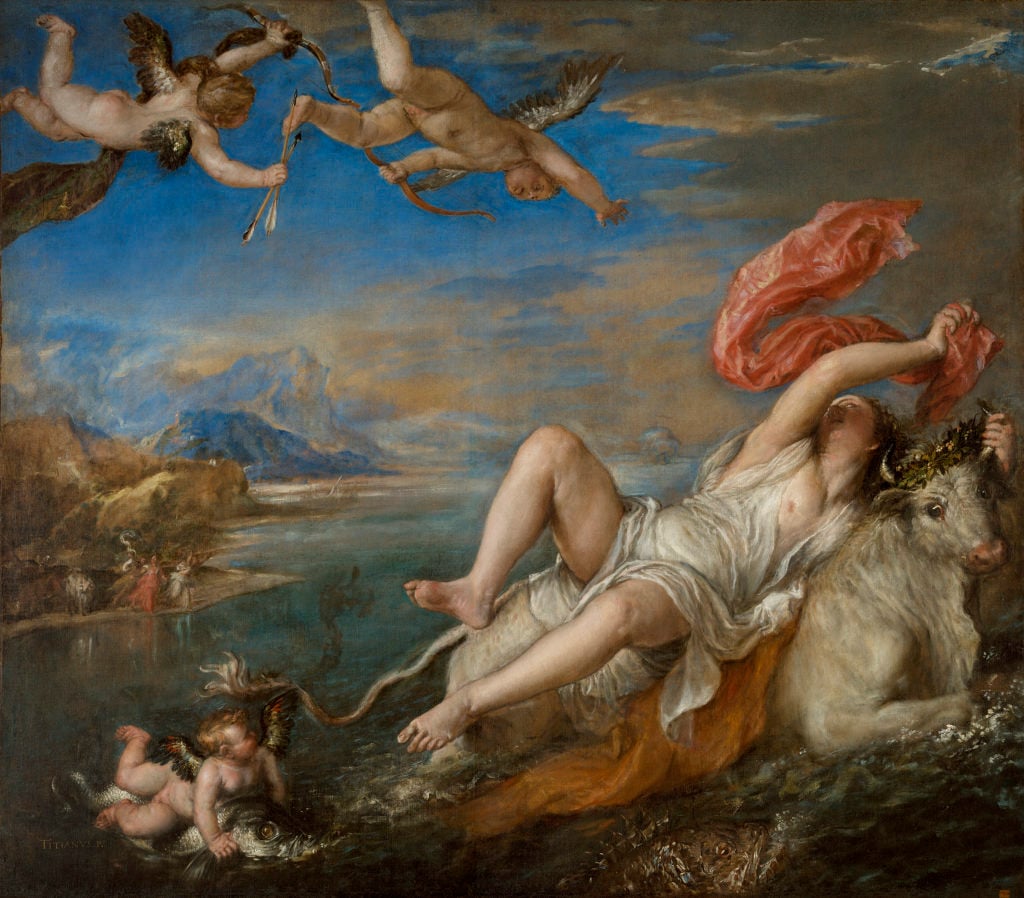
Titian, The Rape of Europa (ca.
1560–62). © Isabella Stewart Gardner Museum, Boston .
Instead, surrounded on all sides by Philip’s paintings, I was
struck by a strong sense that the walls of the gallery had opened
up to reveal a world beyond. Titian must have had that effect in
mind: He wrote to Philip about planning all the poesie to
suit a single chamber; later, planning another series of works, he
asked Philip for details about the room they would be shown in, and
its lighting, so that the light and space in the room and the
paintings would mesh. All that was pretty much the norm for Italian
art around 1550—I once wrote hundreds of pages outlining that
norm—so what matters about the poesie isn’t that they open
up onto a world beyond the wall, but the kind of world I
witnessed them opening onto in London.
That was a world of wide open spaces that spread out far beyond
the humans in the paintings’ foregrounds, and that offered both
threat and promise. And then, under the influence of recent
research by the art historian Alexander Nagel, I suddenly realized
that those were precisely the new spaces that Titian and his peers
were living and thinking in, thanks to the worldwide conquests that
the kings of Spain had been making and the new vistas—conceptual,
mostly, but also geographic, economic, cultural, even
zoological—that their fierce colonizing opened up beyond Europe.
The world felt bigger than ever before, with nature more present
but also less known; faced with an expanding globe, the European
psyche was confronted with a greater sense of promise, but also
with less stability. That psyche is at work in the
poesie.
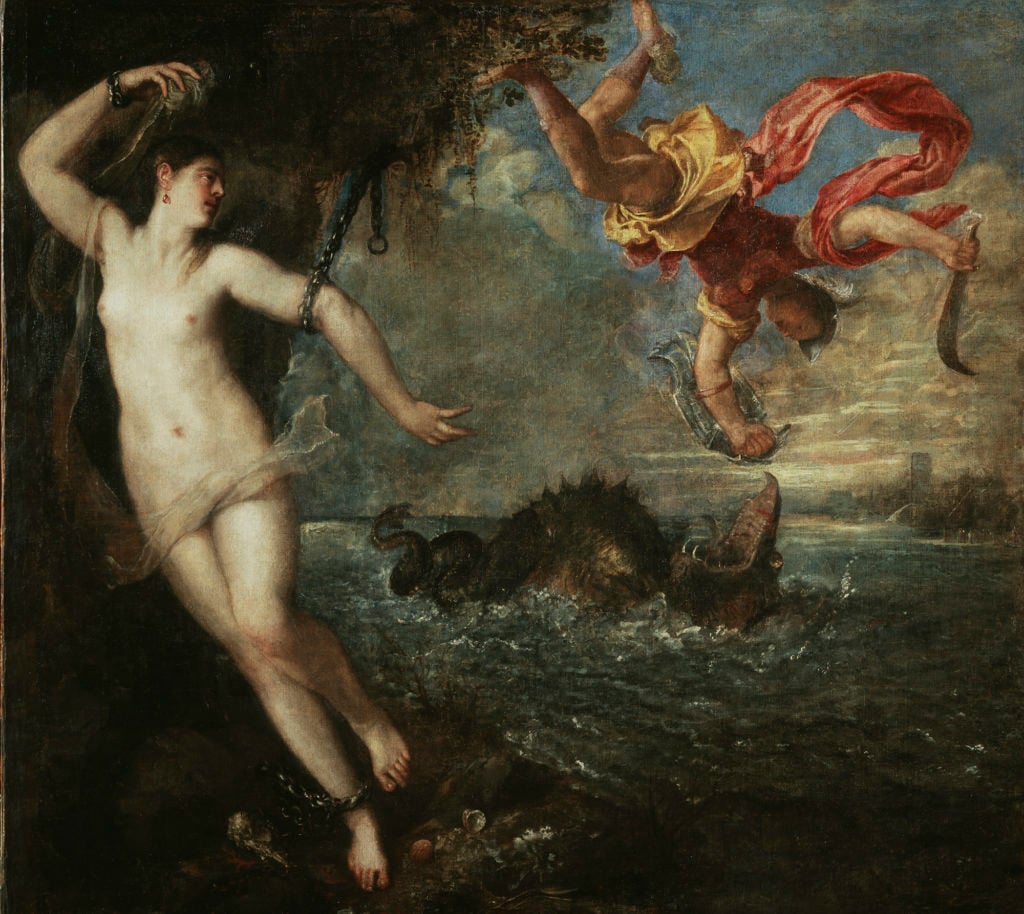
Titian, Perseus and Andromeda
(ca. 1554-56). © The Wallace Collection, London. Photo: The
National Gallery, London.
Titian began the commission modestly, with retreads of two older
works, but in the first of the great poesie that he
designed expressly for Philip—delivered just months after the
prince was named king of Spain and its colonies, in 1556—we are
shown the moment from Classical myth when the hero Perseus descends
from the skies to kill a sea monster about to snack on the
Ethiopian princess Andromeda, chained naked to a rock as a
sacrifice. For all the appeal of the sexy princess and her savior
in the painting’s foreground, the natural setting around and behind
them is just as compelling: Fierce cliffs give way to foreign
waters made wild by the thrashing monster, splashily rendered in
hectic paint. Nature could hardly be more energized and alarming,
despite placid blue skies that beckon in the distance. (They were
bluer before their paint faded.)
Three years later, when Titian delivered a pair of new paintings
to Philip, they contained similar tensions. One depicts the moment
when the hunter Actaeon accidentally comes upon Diana, the virgin
goddess, bathing with her nymphs in a stream. It illustrates the
shock and horror felt on all sides—all nicely captured by Titian.
But as my eyes and mind wandered back into the impressively open
space beyond this staffage, I couldn’t help noticing, once
again, that it was full of unsettled valleys and untamed peaks—very
different from the placid Adriatic scenes that Titian had used to
back up most of his earlier depictions of Classical myth. Titian
made the setting from Actaeon continue, as a single
landscape, right into the next painting in his series, showing
Diana casting out her nymph Callisto after she was raped and made
pregnant by Jupiter. A lightning strike in the rocky background
makes clear that nature is troubled here, too.
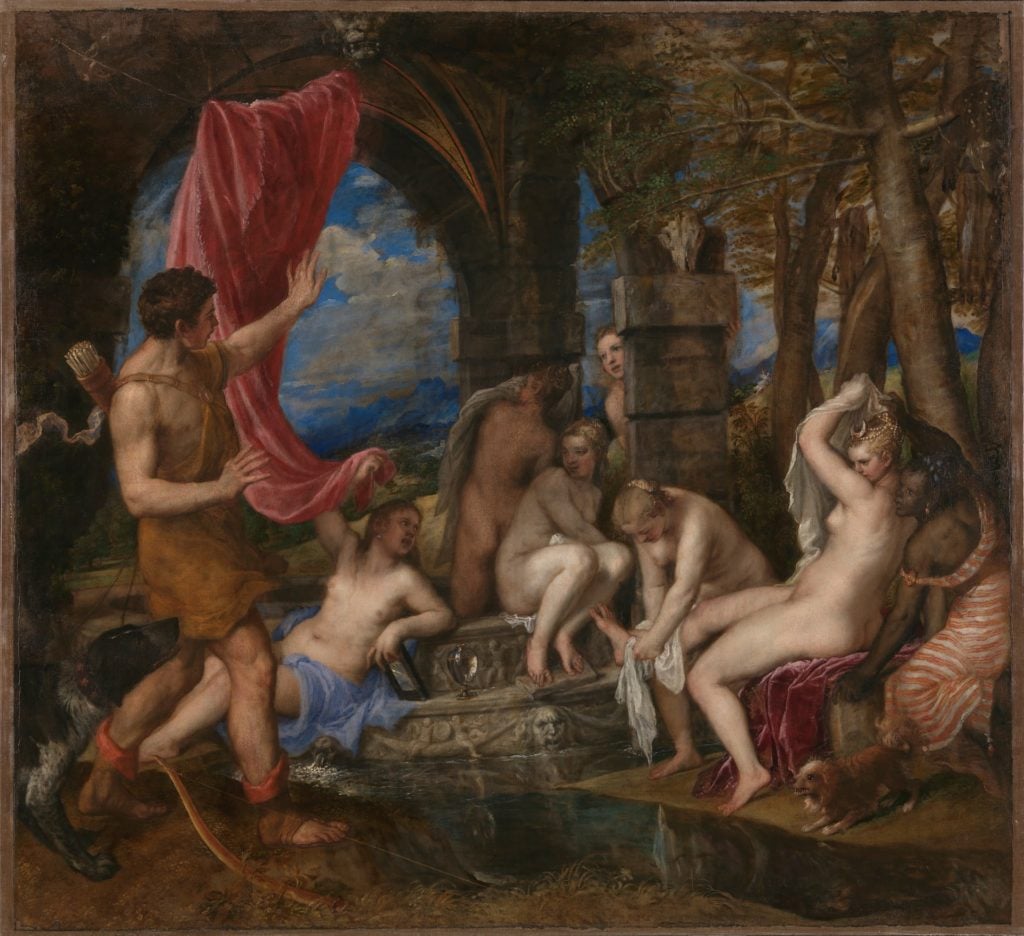
Titian, Diana and Actaeon
(1556–59). ©The National Gallery London/the National Galleries of
Scotland.
That trouble becomes utterly evident—fully foregrounded, you
might say—in The Rape of Europa, last of the
poesie that Titian sent to the Spanish (and American, and
African, and Asian) king, in the spring of 1562, telling Philip it
was the culmination of the whole project. The painting is about yet
another unfortunate damsel who, this time, goes wandering by the
seaside—with wildly threatening peaks in the distance, once
again—and decides to pet a particularly handsome and docile-seeming
bull that is actually Jupiter on the rape again. Europa finds
herself carried away across the roiling waters on the bovine god’s
back, into seas that contain such strange creatures as
Centropristis striata. That sea bass is distinctly foreign
and threatening, with spiny looks that Titian took great care to
capture, but as it happens, it is also very tasty, and hints at the
resources to be grabbed on new shores.
By the time Titian was painting his myths for Philip, hundreds
of ships were heading for the North Atlantic cod banks and sending
the salted fish back to feed Europe. Venetian cooks would soon be
whipping up their signature baccalà.
Other European adventurers, this time much further south, were
sending back the first stores of brilliant cochineal dye, extracted
from a New World beetle. Titian used that new color on the
cherry-red wrap that billows out, flag-like, from Europa’s hand as
Jupiter carries her off. (And let’s not forget that this departing
“flagbearer” shared her name with the continent where Philip was
crowned. “Europe Heads Abroad” might not be the craziest title for
the painting.)
In Titian’s Perseus, the hero’s equally striking cloak
is also done in cochineal; it flies from his shoulder like the
ensign on a conquistador’s ship.
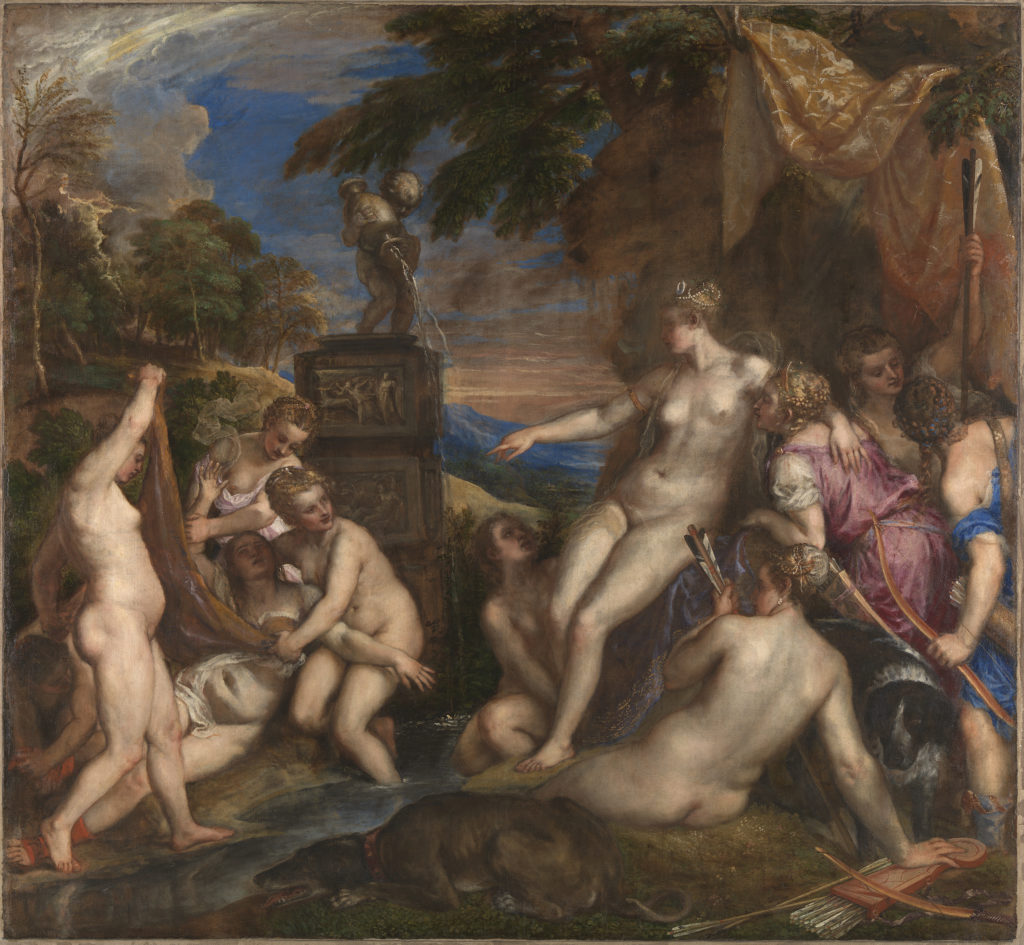
Titian, Diana and Castillo
(1556-59). © The National Gallery London / The National Galleries
of Scotland.
There’s yet another, more ominous import on view in Philip’s
poesie. X-rays of Diana and Acteon reveal that,
late in the day, Titian repainted one of Diana’s pink-skinned
attendants as a black African, like the ones flowing through Venice
at just that moment on their way to slavery in Philip’s New World
colonies. African slaves were being shipped in to replace native
forced labor since the locals were dying off from European diseases
and depredations. The profits they had been forced to produce—the
gold and silver they had mined—were what funded Philip’s lavish new
buildings and art. The violence that produced those doubloons seems
to bubble up into the poesie they bought.
I’m not claiming that Titian deliberately set out to paint
hamfisted parables of his patron’s changing realities. (That would
be a true fish tale.) I’m asking for his poesie to be
understood in terms of the environment they were born into—in terms
of the changing contexts, both real and psychic, that most impacted
their maker and patron. Titian traveled with Philip and had been
knighted by his father; he was deeply invested in the culture and
values of his patron’s court, meaning that he was confronted,
daily, with that court’s newly enlarged world, both more available
and less stable. And that was a world that Europeans could own and
stabilize in their art. Thanks to Titian, painted space may extend
beyond the walls of Philip’s chamber, but in the end it’s under the
control of the painter who opened it up. The flux in these
paintings’ expressive brushwork, newly invented by Titian, captures
the flux in Philip’s volatile new reality—and in doing so, freezes
it.
In 1562, Europe could no longer claim a place at the center of
the terrestrial globe. But when Philip stood surrounded by the
painted fables that he’d commissioned, he became the fixed point
that their untamed worlds revolved around.
The post A Remarkable Exhibition in London Reveals How the
Renaissance Painter Titian Once Captured the Troubled Psyche of a
Colonial King appeared first on artnet News.
Read more https://news.artnet.com/exhibitions/titian-fables-national-gallery-london-1812411
Further reading


Leave a comment