
Disgraced Dealer Helge Achenbach Was Once the Toast of Germany’s Art World. In a New Memoir, He Details His Spectacular Fall
If you belong to the VIP crowd
that, during a typical year, lines up outside of Art Basel’s main
entrance each June, it’s probably hard to imagine that ritual
changing fundamentally anytime soon. But according to former art
dealer Helge Achenbach, once a familiar presence in the Swiss
fair’s aisles who tumbled from grace after being convicted of
defrauding clients, the art market’s breaking point is
near.
In his recently published
German-language memoir, Helge Achenbach: Self-Destruction,
Confessions of an Art Dealer, Achenbach predicts a
paradigm shift for the market—one that might well be underway
already. The former German art advisor, who presided over the
Rhineland’s art circle for four decades and who, at the peak of his
career, befriended influential figures like Gerhard Richter, Jeff
Koons, and David Chipperfield, thinks the old art world will
transform (and, given the current global health situation, there is
a good chance he’s right).
Achenbach’s own world changed
dramatically in 2015, when he was sentenced to six years in prison
for defrauding clients out of millions of dollars. Though his own
reign may be over, the tone of his memoir suggests he’s betting
time will soon be up for others in his cohort, too.
“The rule of the old white
men—the Koonses and Gagosians—to whom
I once belonged, will be over sometime,” Achenbach writes. “Perhaps
the art market will also split: Here, the decorative art for the
rich and the super-rich, there, the political, socially relevant
art.” Achenbach now works
near Düsseldorf as a project manager for the non-profit association
Culture Without Borders e.V., which is committed to helping
endangered cultural workers in war and crisis zones.
“Seeking revenge with the art
scene shouldn’t be a motive,” he writes at the beginning of the
book. But, he says, he does aim to offer “an authentic account of
the art market, about myself, but also about the people I have met
and the way deals are often done.” However, contrary to the book’s
dishy title, Achenbach does not reveal much dirt on the art world,
and it falls flat from being as scandal-inciting as it promises.
Prior to publication, Achenbach submitted the manuscript for review
to a Berlin lawyer’s office (they are credited in the imprint),
which probably did not contribute to the production of a detailed
and revelatory book. So, it is little surprise that the author
fails to reveal any shady backdoor dealings and refrains from
calling out his former business partners.
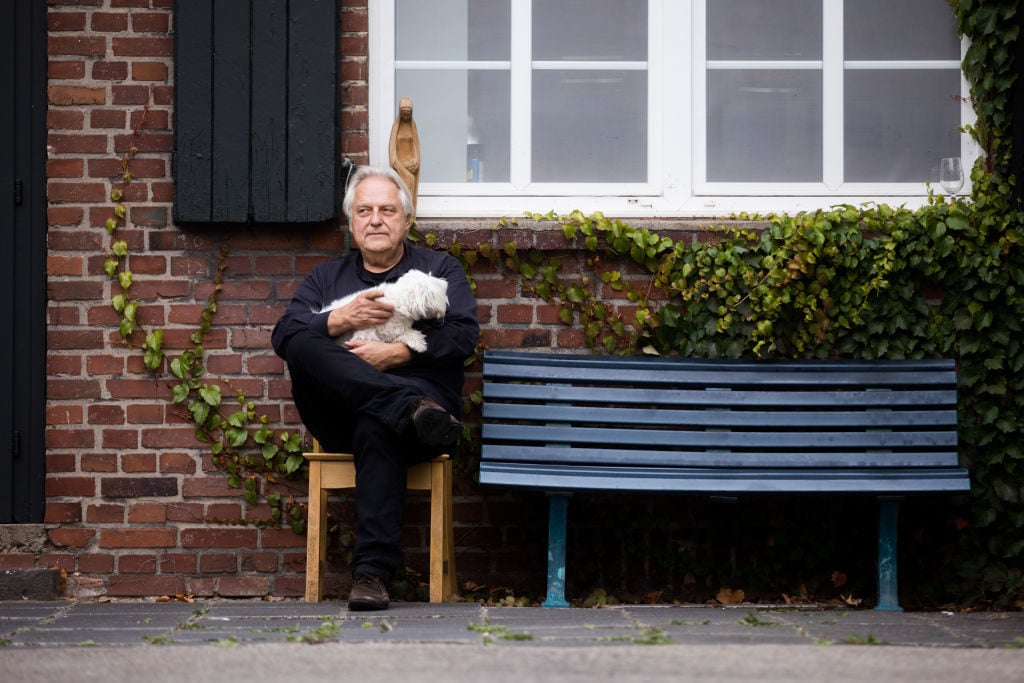
Helge Achenbach of the Kunsthof. Photo:
Rolf Vennenbernd/dpa via Getty Images.
The Tale of Trial
Achenbach’s trial and conviction
captivated Germany’s art world. In a court hearing in 2015, the
disgraced advisor admitted to altering copies of invoices from
galleries when forwarding them to his clients, calling the forged
documents “collages.” The victim of his fraud was the discreet
billionaire Berthold Albrecht, an heir to the Aldi group, a major
discount supermarket operation in Europe. After four years in
prison, Achenbach left jail on probation in June 2018, owing
Albrecht €16.1 million ($17.3 million) in damages for overcharging
him for a slew of works by Picasso, Richter, and Ernst Ludwig
Kirchner.
His new memoirs could be seen as
the third part of an odd trilogy on the rise, triumph, and fall of
a German art-world icon. In 1995, Achenbach published a volume of
interviews and essays before a coffee table-sized book in 2013
called Helge Achenbach:
The Art Agitator. But,
in comparison, Self-Destruction‘s
post-jail tone is much more reflective, if not
muted.
“It is all the more important
that there are scapegoats,” writes Achenbach in his latest book. “I
am one—and rightly so, of course. I have damaged the
market with my ‘collages’… My narcissism has played an important
role in this. But there is also a culture of the art market that
encourages cynicism and corruption, where honesty doesn’t pay. The value of art is arbitrary, there are few
rules or supervisors, and no balance sheets and ratings that
establish values. There is no protected job description for art
consultants, no price brakes, and often no distinct payment morale
of the buyers.“
Despite his setbacks,
Achenbach’s penchant for self-promotion does not appear to have
waned. Even though he is no longer actively consulting, Achenbach
still likes to present himself as an artful dealmaker. “I think my
strength is that I can talk to a CEO as much as to an artist. I can
bring the two together and achieve a great deal of persuasion,” he
once told the magazine Texte zur Kunst. Years later, he’s still fascinated by the
steep price increases of a well-chosen painting. He remembers
hanging one of Richter’s “Candle” paintings in his living room for
a few years, which he bought for 18,000 Deutsche Marks
(roughly €9,000 or $9,684), before flipping it to a friend. “Today,
the painting is worth €30 million ($32 million),” he writes. “The
skyrocketing prices were defining for me at the time.
Unfortunately, at some point, it became all about performance and
returns.”
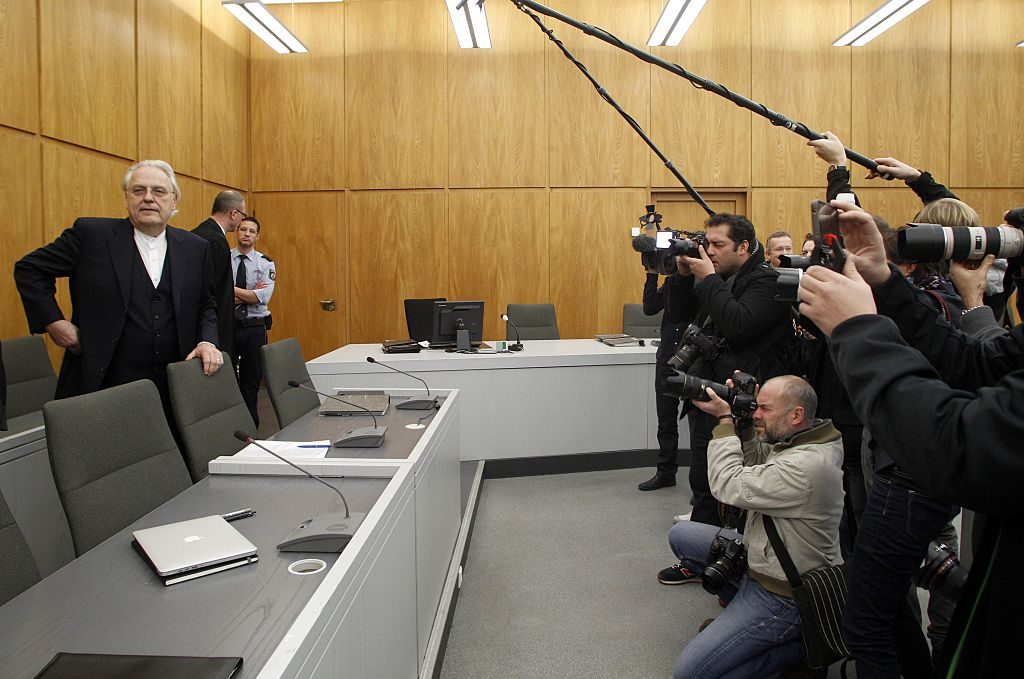
Defendant Helge Achenbach waits for the
opening of his trial on December 9, 2014. Photo: Roland
Weinrauch/dpa/AFP via Getty Images.
The Monkey Bars
Of all the artists he collected,
traded, and knew, Achenbach says the now-deceased German painter
Jörg Immendorff was “the dearest” to him. Their lifelong friendship
started in 1973. “In his contradictions, I felt a spiritual
kinship. Jörg was a leftist who loved the sweet capitalist life, a
boundless egomaniac who cared a lot about others, a player who
refused to always analyze everything and keep an eye on it. Until
the end, Jörg was also a big child. An extravagant anarchist, a
little gangster, a wonderful human being.”
Over the years, the two became
partners in several joint ventures. In the early 2000s, Achenbach
helped Immendorff source the money to produce an army of odd bronze
monkey sculptures after his dealer Michael Werner refused to
support their production (“Werner thought they were kitsch,”
recalls Achenbach). Those sculptures turned out to be
bestsellers.
Achenbach used the Immendorff
monkeys also as landmarks for his gastronomic endeavors: In May
2003, he opened the “Monkeys Island” in Düsseldorf on a wasteland
on the banks of the Rhine. Later, he ran three upscale-restaurants
under the brand name “Monkey’s” in Düsseldorf’s city
center.
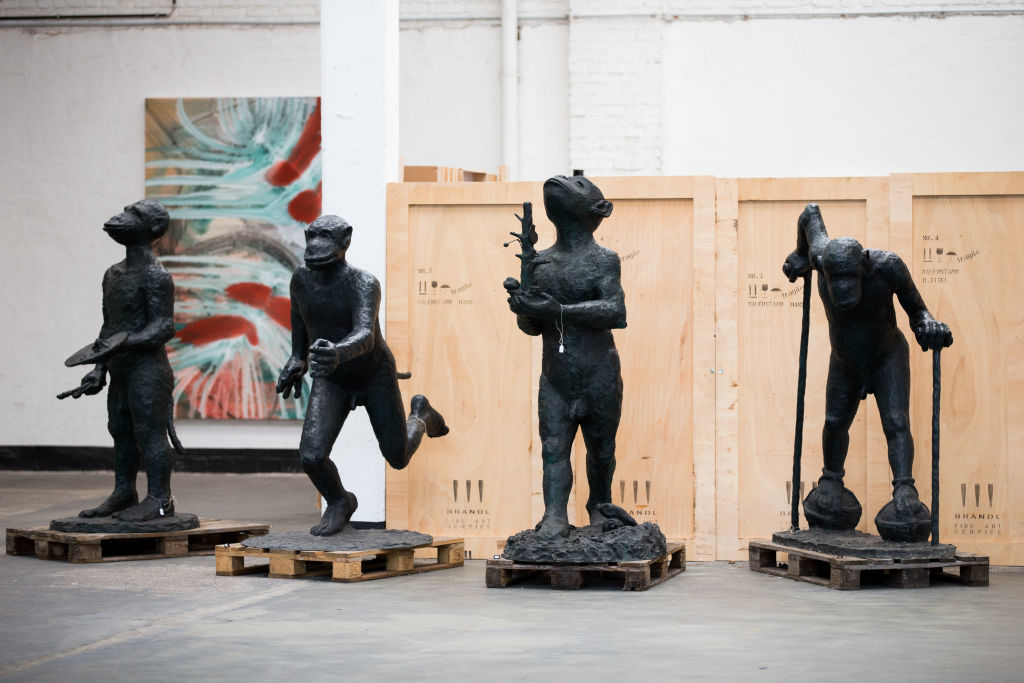
Sculptures by artist Joerg Immendorff
and other art works are seen prior to the insolvency auction of art
works of incarcerated art advisor Helge Achenbach in a storage
facility in Duesseldorf, Germany, 15 June 2015. Photo: Rolf
Vennenbernd/picture alliance via Getty Images.
The restaurants were, according
to Achenbach, not only frequented by well-off artists,
businesspeople, soccer players, and politicians, but also by Tom
Cruise, Demi Moore, and Naomi Campbell. The art-crammed restaurants
promoted “fine art dining” as a baroque pleasure. But Achenbach
says he never made any money with them. On the contrary, because he
“constantly gave dinners and generously invited everyone, but had
no real control, business got out of hand.” He says he lost €10
million ($11 million) on the project.
Later, the monkey sculptures
would be besieged by legal issues. When visiting Immendorff’s
workshop, Achenbach remembers finding out he was producing more
monkeys than was typical for limited editions.
“I can say with certainty that
there are casts of three monkey motifs beyond the specified
edition,” he writes, adding that the “collectors do not seem to
care too much.” He looked the other way, and their friendship
continued. When Immendorff married painter Oda Jaune in 2000,
Achenbach was his best man. Tellingly, Achenbach’s selective memory
leaves out a major legal conflict with Jaune that was to come. In
2012, Immendorff’s widow took Achenbach to court, successfully
demanding her share of €500,000 in art sales.
Despite losing favor with many
of Germany’s art elite—not to mention its courts—Achenbach seems
indomitable. He quotes Karl Lagerfeld in describing his longtime
business strategy: “Throwing money out the window brings money back
in through the front door.”
Helge Achenbach:
Selbstzerstörung. Bekenntnisse eines Kunsthändlers
is now available in German
through Riva Verlag
Munich.
The post Disgraced Dealer Helge Achenbach Was Once the Toast
of Germany’s Art World. In a New Memoir, He Details His Spectacular
Fall appeared first on artnet News.
Read more https://news.artnet.com/art-world/helge-achenbach-review-1812207
Further reading


Leave a comment