
As a Prominent New Gallery Opens Its Doors in Hong Kong, Asia’s Art Market Sees Glimmers of Hope After a Prolonged Lockdown
On Tuesday afternoon, two dozen journalists gathered on Hong
Kong’s Hollywood Road for the launch of the new gallery Villepin.
Under normal circumstances, a gallery opening would not be unusual.
But when the world is devastated by the coronavirus pandemic,
bringing people together for the inauguration of a new art space
seemed to be not only out-of-sync with the times, but downright
risky.
Those who turned up were indeed well aware of the risks and took
many precautions. A large bottle of hand sanitizer was placed on
the reception desk. Hand shakes were replaced by a wordless Namaste
gesture. Everyone arrived with their face masks on while keeping at
a distance from each other, including gallery founders Dominique de
Villepin, the former Prime Minister of France who has spent 40
years building an art collection, and his son Arthur, an
entrepreneur and Hong Kong resident of 10 years. Their faces might
have been covered but, after nearly two months of social
distancing, the excitement of a reunion with colleagues from the
art world in front of the late 20th-century master Zao Wou-ki’s
paintings could not be concealed.
Hong Kong’s burgeoning art scene suffered a tremendous blow when
the novel coronavirus that originated in Wuhan, China, began to hit
the city in late January. Schools have been shut down. Offices and
public facilities, including government-run museums, were closed
until the beginning of the month. Art Basel Hong Kong and the
satellite fair Art Central, which were supposed to take place this
month, were cancelled after the World Health Organization declared
a global health emergency, on January 31. The cancellation of
Asia’s biggest art fair, the biggest occasion of the year for many
gallerists to make sales and meet new clients, deeply hurt the
industry in the region.
Nevertheless, the father-and-son team decided to press ahead
with the opening of Villepin. And nearly two months on, the virus
now known as COVID-19 is encroaching Europe and the United States,
whereas the plague appears to be coming under control in Asia. The
week of the opening of Villepin also saw a few other gallery
openings as well as the inauguration of Art Basel’s online viewing
room, a digital alternative to the Hong Kong fair. While the art
world in the West has ground to a halt, some museums in mainland
China and South Korea have started re-opening doors to
visitors—with strict precautions—though even that may not last
long.
Dominique de Villepin quickly rejected the idea that normalcy
had returned. “No one can be safe forever,” he told Artnet News. “A
change of attitude and integrating disciplined gestures into our
daily life are a must, in order to live a new, better life. And art
makes our life better.”
Indeed, shortly after our interview, it was reported that Asia
is facing a second wave of outbreak, brought on by
those returning from overseas. In just five days, the number of
infected cases in Hong Kong shot up by 72 percent, to 317, as of
Sunday. Now, both the M+ Pavilion and the Hong Kong Museum of Art
have shuttered again after briefly reopening.
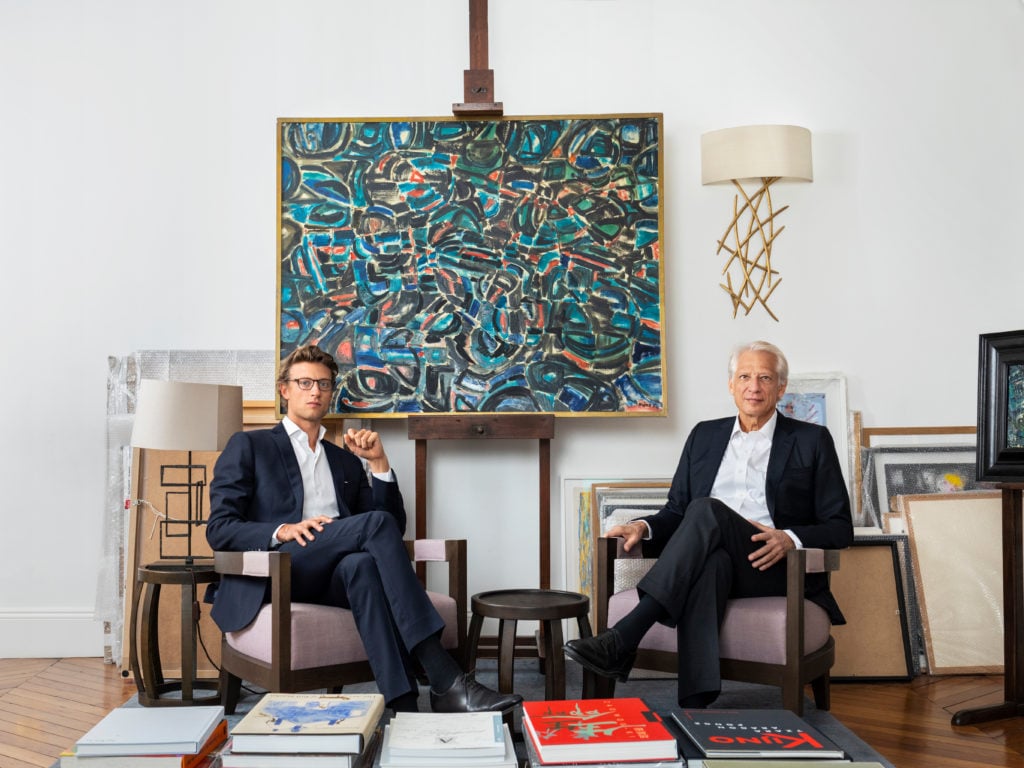
Arthur and Dominique de Villepin, 2020.
Photo by Sophie Palmier, courtesy of Villepin.
‘Friendship and Reconciliation’
Dominique de Villepin said that the gallery’s inaugural
exhibition of works by Zao, titled “Friendship and
Reconciliation,” is a timely one.
“There has been an accelerating trend in recent months, which is
the trend of nationalism, protectionism, and isolation,” de
Villepin said. “That has been the US policy since [Donald] Trump
took over, and even before that,” he said, referring to mounting
division brought by the country’s border closure and racism amid
the coronavirus scare.
“We have to measure the new world that we are facing, to deal
with this fear. Of course we should adapt, protect, and be
disciplined collectively. But fear should not take the lead. In
art, we can find the wiseness, the distance and the questioning
that art offers, to help us live through this moment in the best
way.”
The exhibition is more than just a presentation of paintings for
sale, though Zao has been an auction darling in recent years. It is
also an attempt to chart the artistic trajectory of an artist
coming to terms with his identity and of the long-running
friendship between Zao and the de Villepin family.
“The quest of [Zao’s] life was to find truth in art,” de
Villepin said. “Friendship has been a necessity for his creation.
He also saw the division of the world, between figuration and
abstraction, between East and West. Division should be put on the
side in order to give emphasis on reconciliation. It’s a huge
lesson that he has given us.”
The reconciliation in Zao’s art, de Villepin said, comes from
the fact that the artist belonged to three different art scenes in
the 20th and the beginning of the 21st centuries. “First, the Asian
scene and the Chinese scene, with his legacy and lineage inherited
from ancient Chinese painters. He was also a master of European
art, with his influence from Cézanne and Matisse. He also draws
references from the American scene, the New York school, the
gesture and the speed coming from Rothko and Pollock. He created a
new path by reconciling these influences.”
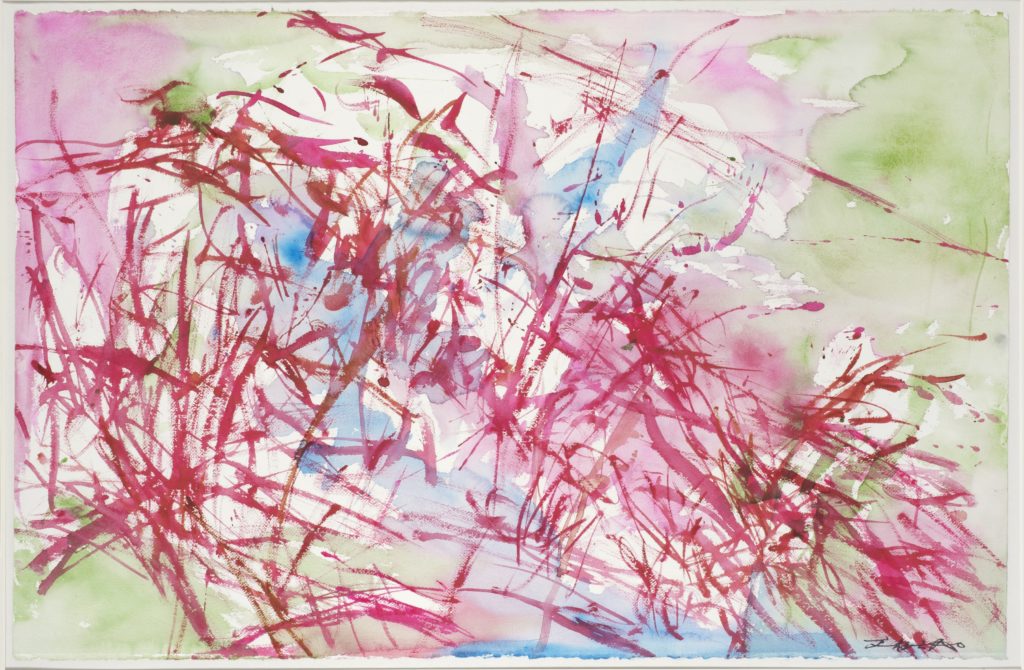
Zao Wou-Ki, Gaudigny (2007).
Copyright Zao Wou-Ki, courtesy of Villepin.
On display is a range of rare works, including large-scale oil
paintings, watercolors, Chinese inks and lithographs from the late
1940s, when Zao first moved to France from China. These works are
more figurative than his signature abstract paintings from the
1970s and his relatively colorful works in the early 2000s. One of
the watercolor paintings appeared on the cover of the menu at a
dinner reception that de Villepin hosted for then Chinese premier
Zhu Rongji in 2002, when de Villepin was France’s Minister of
Foreign Affairs.
Rare artist books by Zao from de Villepin’s family collection
are hidden in a private viewing room, including a playful
watercolor of Napoleon, which was a personal gift from Zao to de
Villepin, and the only known self-portrait of the artist. Family
photographs with Zao, such as one that saw the teenage Arthur de
Villepin posing with the artist, were hung on the walls of the
staircase inside the three-story space.
Arthur de Villepin said the gallery is designed like a home to
give visitors the feeling of setting foot in an art collector’s
home. “Our shows are more personal,” he said. “We hope to create
dialogue to bring people together.”
Opportunities in troubled times
Villepin is not the only gallery trying to make the most out of
these troubled times. On Wednesday, the day after the launch, Art
Basel’s online viewing room, the digital alternative to the
canceled Hong Kong fair, opened to VIPs at 6 p.m. local
time. The online iteration featured 235 of the 242 galleries
originally slated to appear in the live fair—almost 90 percent.
The first 20 minutes saw an overwhelming influx of users
temporarily paralyze the platform. Some optimistic gallerists and
collectors interpreted the brief website collapse as a reflection
of a global high demand to see art from one’s own homes.
Nevertheless, the art market is indeed worrying. The coronavirus
scare has caused the global financial market to tumble:
The Dow Jones Industrial Average crashed by 28
percent since mid-February after reaching a historic high and the
Dow fell by 2,999 points in one day. China, on the other hand, is facing a possible
economic contraction, despite its public claims that the disease is
under control. China’s National Bureau of Statistics revealed that
retail sales fell by 20.5 percent in January and February, and that
fixed asset investment plunged by almost 25 percent, compared to
the same period in 2019.
“The economic situation has definitely affected collectors,”
said Jia Wei of Boers-Li Gallery in Beijing and New York during the
virtual media preview of Art Basel’s online viewing room, which was
organized by six of the participating galleries. “People are
panicking and they do not feel good. Even if they have money to
spend on art, the process will be slow. But if the works are good,
and we can offer good service, sales can still be made. This is the
time for all stakeholders in the art market to work together.”
David Tung, director of Lisson Gallery’s Shanghai outpost and
the leader of the virtual media preview, said that the challenging
times have presented new opportunities “to innovate and develop new
things” such as the online viewing platform. “We intend to treat
this as a proper art fair. We have done a lot of experimentation to
try what looks best,” he said.
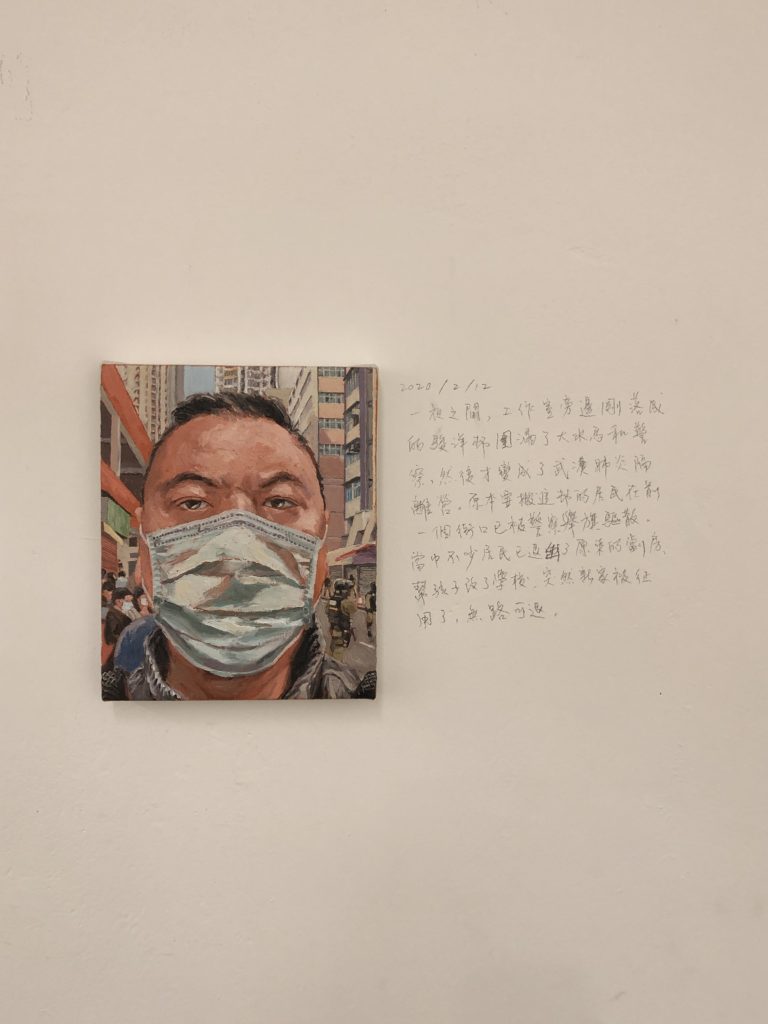
Chun Yeung Estate (2020) by Chow Chun
Fai. Courtesy of Gallery Exit.
Anthony Tao of Hong Kong’s Gallery Exit, which is showing in the
Art Basel online viewing room and just opened an exhibition of
artist Chow Chun-fai’s paintings of the ongoing Hong Kong protests
a week ago, said Chow’s new solo show was well-received and had a
good turnout. “People have been going through self-isolation for a
long while and they really wanted to get out,” he said. “Chow is a
well-known artist and the topic of his works are very relevant. The
audience is very responsible, wearing masks and keeping a distance
from each other.”
The market is challenging and sales could be slow, especially
for emerging artists, Tao said, “but this digital platform will
likely remain. It can be a very effective addition to the actual
fair when it returns to Hong Kong next year.”
Sales have reportedly been slow during the VIP days of the
online viewing room, but Hauser & Wirth said it sold eight works on
the first VIP day to collectors from both Asia and Europe,
including those by Josef Albers (for $600,000), Jenny Holzer
($350,000), Pipilotti Rist ($140,000), and three by Paul McCarthy
($274,000 to $300,000).
“Honestly, I think we’ve done quite well given the
circumstances. We had no presales and only a few inquiries last
week,” Iwan Wirth said in a statement. “We’re seeing more
engagement from Asia come through both our own and Art Basel’s
platforms which leaves me confident for our higher value works. The
Guston is already on hold. Stay tuned. Much is being said about
digital: It is just the new norm. We’ve done it for years and it
shows, our clients use it.”
Despite a series of challenges from political turmoil to the
coronavirus outbreak, some still have faith in Hong Kong. Art Basel
has pledged to return on March 25 to 27, 2021.
And Arthur de Villepin said his new Hong Kong gallery is a
long-term commitment: “Geographically, Hong Kong has a strategic
location being in the center of Asia-Pacific. And the city’s vibe
and energy are something you cannot experience anywhere else in the
world.”
The post As a Prominent New Gallery Opens Its Doors in Hong
Kong, Asia’s Art Market Sees Glimmers of Hope After a Prolonged
Lockdown appeared first on artnet News.
Read more https://news.artnet.com/market/hong-kong-art-market-hope-1810461
Further reading


Leave a comment