
The Gray Market: Why History’s Biggest Work-From-Home Experiment Could Eventually Benefit the Art Market (and Other Insights)
Every Monday morning, Artnet
News brings you The Gray Market. The column decodes important stories from the
previous week—and offers unparalleled insight into the inner
workings of the art industry in the process.
This week, looking toward a
possible new working-world order…
DISTANCE LEARNING
On Thursday, my colleagues Kate
Brown and Eileen Kinsella drilled into the challenges now
facing small and modestly sized galleries in the social-distancing era. The picture isn’t
pretty, and many of its pockmarks are present for a slew of small
businesses unrelated to art, too: the borderline-Kafkaesque
responsibility to continue paying rent on real estate that
officials have likely ordered you not to operate; the wrenching
reality of not being able to make payroll for upstanding employees;
the sudden need to pivot almost
exclusively to e-commerce.
I’m not going to try to drench
this new reality in chocolate sauce for you: many, if not most, people who make a living
doing much of anything related to art are in trouble for the short-
and medium-term, even on the nonprofit side. The New York
Times reported on
Wednesday that the Metropolitan Museum of Art projects it may stay
closed until at least July and lose up to $100 million. But
embedded in that story was an even more sobering projection from
Laura Lott, president and CEO of the American Alliance of Museums
(AAM): that one-third of museums it surveyed “will not reopen if
the crisis continues.”
For clarity, AAM members include
the likes of science museums, zoos, botanical gardens, and many
more art-unrelated institutions. This clarification may make the
future of cultural life in the US slightly less depressing, or
slightly more depressing, depending on your personal
perspective.
Whether we’re talking about the
culture industry, finance, or any other sector of the economy,
though, the main problem is that we have no consensus on how long
social distancing will need to last, largely because we have
distressingly
spotty data on the
disease. The good news is that people and businesses are now
beginning to re-emerge from
lockdown in some of the
East and Southeast Asian countries where it originated. The caveat
is that, by slowing the rate of infection, effective social
distancing also slows the pace of any community’s development of
herd immunity—meaning
that lockdowns may need to be reimposed if the rate of new
transmissions begins climbing again.
Writing for the New York
Times on Wednesday,
a trio of medical professionals asserted that “social distancing 2.0, 3.0, and, who knows,
maybe even 4.0 will very likely have to occur.” In the most extreme case, they estimate that
society’s pendulum may need to keep swinging like this for 18
months or more absent a vaccine, which probably wouldn’t be
developed and sufficiently distributed until at least fall
2021.
All of this explains why some
people are shifting from thinking about how the current health
situation will reshape the spring and summer, to thinking about how
it could transform life in
the developed world for good.
Hopefully, some of the potential
structural changes will apply to government, but others will almost
undoubtedly apply to business. One of the latter could be a
dramatic, permanent increase in the number of people working from
home. And although it’s little more than a far-off silver lining
amid the current crisis, that possibility could eventually
(emphasis on “eventually”) benefit the art market.
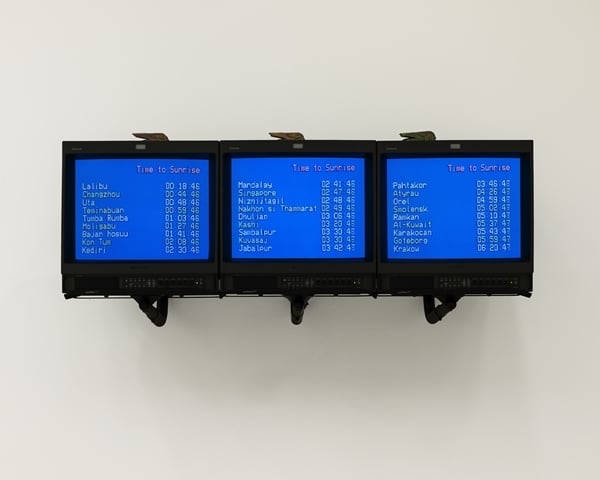
Installation view of Paul Ramírez Jonas,
Another Day (2003), in “Under the Same Sun: Art from Latin
America Today” at the Solomon R. Guggenheim Museum, New York.
Photo: David Heald © Solomon R. Guggenheim Foundation.
REMOTE CONTROL
Before I go any further, let me
say this: I am not suggesting that the possibilities I’m about to
lay out are anywhere near the most necessary ones to reinvigorate
the arts in a more equitable way. On that front, William S. Smith
wrote an excellent piece in Art in
America a few days
ago arguing that the best response to the shutdown of the cultural
sphere would be a contemporary update of the Federal Art
Project, the New Deal
program that, in conjunction with the Works Progress
Administration, directly paid artists in the US to create
individual pieces, collaborate on public artworks, and document
less visible genres such as craft and folk art.
The point, in his words, would
be to “reimagine art as a public good” rather than as a private
commodity or an investment vehicle—a proposal and underlying principle I’d
enthusiastically co-sign.
What I’m focusing on instead
here is a separate, strictly commercial avenue that could be paved
by a post-lockdown shift in the labor market. According to
data from the US
census, about 8 million
Americans (5.2 percent of the country’s employed population) worked
from home in 2017. The Federal Reserve found that figure to be
a threefold
increase from 15 years
earlier.
Skip ahead to this month, and
tens of thousands, and potentially millions, more workers are
engaged in emergency telecommuting.
While I haven’t been able to
find a reliable estimate for exactly how many more, the Bureau of Labor Statistics previously
estimated that 29 percent of the US labor force could theoretically
work from home all the time. That percentage would equate to almost
45 million Americans—close to 37 million more than were already
working remotely back in 2017, for an increase of more than 450
percent.
Again, this is strictly in the
US. Millions more people around the globe were already working from
home before 2020. But Bloomberg declared in early February that China was then
conducting “the world’s largest work-from-home experiment,” and the
laboratory’s size has magnified considerably since thanks to the
illness’s global spread.
Here’s the thing about giant
ruptures to the economy: they reveal all kinds of interesting data
points to employers. After the Great Recession forced an untold
number of business owners to carve costs to the bone marrow or die,
many found that they could earn as much—or even more—revenue with a
fraction of the full-time and part-time staff they were paying
before the crisis.
Instead, they realized, much of
that labor could be supplied by freelancers, gig workers,
outsourcing firms, and/or technology, for less money and no
benefits. And some of the workforce (think: middle managers) didn’t
have to be replaced at all. So when the world economy recovered,
many, if not most, employers were happy to carry on with their
newly lean operations rather than revert back to the costlier
pre-recession model.
I’m sorry to say that I
anticipate we’ll see something similar happen once public health is
restored. The most consequential and distressing effect will be
downsizing, with the ruthless pursuit of profit-maximization likely
leading to thousands upon thousands of supposedly non-essential
jobs being cut—a prospect that once again highlights the US’s need
for a stronger social safety net.
But a wave of long-term
work-from-home mandates will probably be a part of the picture,
too, and could even help reduce the number of layoffs deemed
necessary. Think about
the savings for business owners: less office space to rent, lower
cleaning and maintenance fees, smaller utilities bills, zero need
to supply accoutrements like water coolers or coffee to onsite
staffers. (If you think that last one is too minor a line item to
be deleted, let me assure you as someone whose office was
downgraded to a Brita filter in 2009: it’s not.) The smaller the
company, the more consequential the savings from permanently
shifting as much staff as possible to
telecommuting.
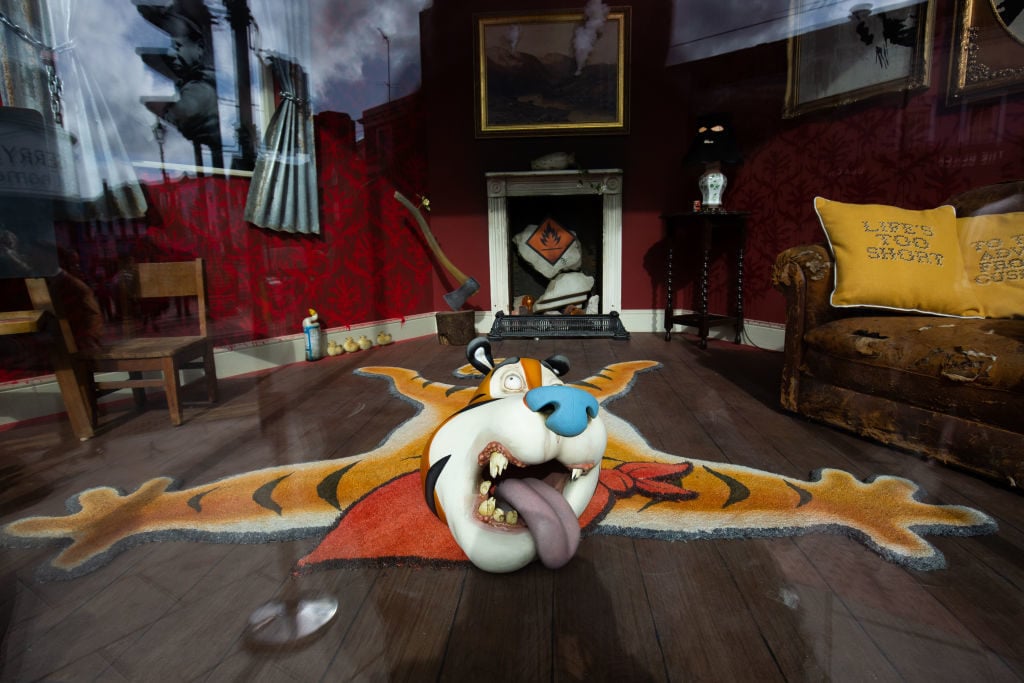
Installation view of the South London
pop-up that launched Banksy’s homeware line, Gross Domestic
Product, in 2019. Photo: Aaron Chown/PA Images via Getty
Images.
ROOM FOR IMPROVEMENT
So why might this pivot matter
to the art market?
It’s rarely a bad bet to assume
I’m riding a stranger wave than the rest of the population.
However, in my first 10 consecutive work-from-home days, I’ve
already rearranged two pieces of furniture, identified at least
three more I should add or upgrade, and, most importantly for this
column’s purposes, become acutely aware of how many empty walls are
left in my place.
I’m going to guess thousands of
new remote workers have already recognized similar shortcomings in
their homes, and that thousands, potentially even millions, more
will do the same by the end of the social-distancing era. When
you work from home, the state of your home takes on new importance.
If you disagree, wait until you’ve gone through another few weeks
of video conferences, particularly as they expand beyond coworkers
and clients to friends and potential lovers.
Not every member of this
demographic will decide to fill the void with fine art, of course.
But many others will—or, at least, could—once the world stabilizes
enough for discretionary spending to seem justified
again. If so, that
represents a huge opportunity for artists and dealers. Assuming,
that is, they’re genuinely committed to
finding clients outside the establishment who may buy only until their walls are full,
then disappear.
Pursuing those buyers is no
simple decision, especially since many of them would be more likely
to spend a few hundred dollars (or maybe a few thousand) on an
artwork instead of a few hundred thousand. It would also likely require
fundamentally different ways of marketing than the ones the art
trade has come to rely on (many of which the current health
situation has revealed to be more vulnerable than dealers liked to
recognize anyway). After all, a sharp rise in the number of
telecommuters could free up many more people to retreat from pricey
art hubs like New York, London, and Hong Kong to more livable
cities without hearty gallery districts or decent regional art
fairs.
Regardless, history’s most
expansive work-from-home experiment is going to warp life and
business for the long term. And while every artist and dealer
should primarily be thinking about getting through the present
first, the current emergency also highlights the importance of
thinking ahead, particularly if the people around you
aren’t.
That’s all for this week. ‘Til
next time, remember: for the time being, home is where the art is.
The post The Gray Market: Why History’s Biggest
Work-From-Home Experiment Could Eventually Benefit the Art Market
(and Other Insights) appeared first on artnet News.
Read more https://news.artnet.com/opinion/work-from-home-art-market-1811550
Further reading


Leave a comment