
Brand-Name Art Fairs Won’t Save the Art Market in This Crisis, But Regional Ones Might
This week, we will receive new
guidelines from the German government about how to operate a trade
show in the age of COVID-19. I can only guess at this point, but I
imagine we will be trading our packed vernissage for two days of
private viewings for VIPs and staggered time slots for the public.
I expect restricted online ticket sales, widened aisles, an ample
supply of masks, and single-direction visitor flow. In other words,
we will be regulating how, when, and under what circumstances
people can view the art at our fair.
With the right precautionary
measures, physical fairs will take place again. But I fear the age
of global travel will be severely impeded for several years to
come. However, this shift doesn’t mean the death of art fairs. It
just means a reinvention of them—or, perhaps more accurately, a
return to their roots.
History Lesson
It is worthwhile to look back to
the time when the first art fair was invented: Art Cologne was
founded in 1967 by gallerists Rudolf Zwirner and Hein Stünke, who
formed an association with 16 German art dealers (including
Artnet’s founder Hans Neuendorf). They presented what they termed
in German “Progressive Kunst” (progressive art), and the Kölner
Kunstmarkt—now known as Art Cologne—was born. Interestingly, it was
formed in response to a crisis: The market for contemporary art had
grown stagnant in West Germany. The founders were inspired by the
second documenta and felt a large commercial gallery-focused event
might reinvigorate commerce.
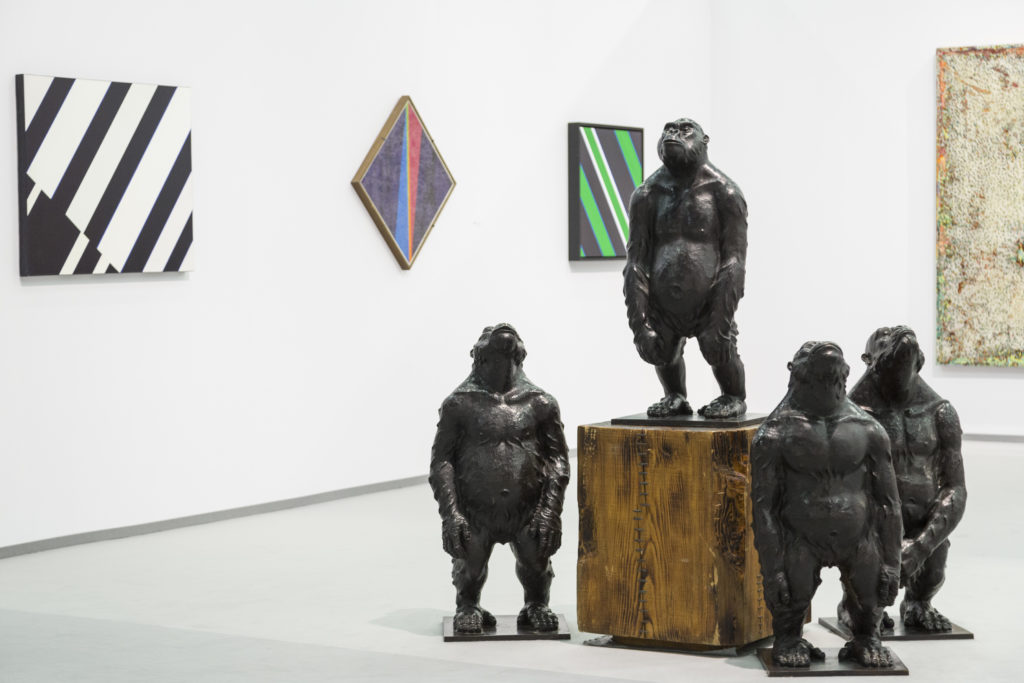
View from Art Cologne 2018. Courtesy
Koelnmesse.
They were surprised by their
success. More than one million Deutsche-Marks were generated during
the fair’s five-day
run. (For comparison, at the
time, a brand-new VW Beetle cost DM 5,150—about three times the
price of a decently sized Gerhard Richter oil painting.)
By the time I became the fair’s
second director in 2008, however, Art Cologne had fallen on hard
times and was no longer the fashionable destination it was in the
1980s. Despite all this, I
was fascinated by the fact that it still managed to draw 35,000
visitors and many of the more than 200 exhibiting galleries had
moderate or good sales. (It
is nearly impossible to extract precise figures from dealers, but
around 90 percent said they found the results
satisfactory.)
Although the global players were
largely missing in 2008, the fair still served its core purpose. My
goal was not to reinvent the art fair, but to build upon what was
already there, to reduce its size, restructure it, and to bring it
into the present. What I’ve learned in over a decade since taking
over Art Cologne is that a market which only caters to the
super-rich will leave little to no legacy. Art becomes a mere
luxury good. And while previous attempts to revitalize the fair
relied upon competing with Art Basel or newbies like Frieze, where
the focus was largely on contemporary art, I decided to focus on
the German market—specifically, the evolution of the German art
market from 1900 to today.
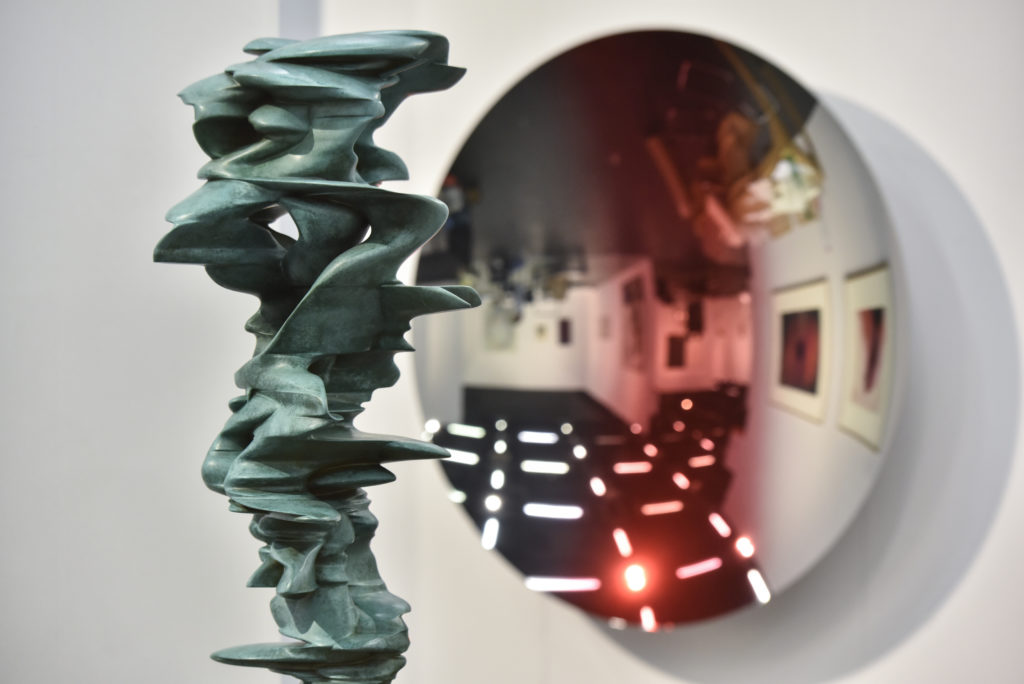
View of Art Cologne 2019. Courtesy
Kölnmesse.
Strength on the Margins
Today, Germany has around 1,000
commercial galleries, nearly half of which are in Berlin, followed
by between 50 to 100 in each of the major cities throughout
Germany. (Unlike the United States, where galleries are clustered
on the coast, Germany has a gallery system with dealers in every
major city across the country.)
There are plenty of global
players, like Sprüth Magers, Nagel Draxler, Daniel Buchholz, Johann
König, Eigen + Art, and others. But it is the countless other
galleries operating in Germany—particularly outside of the art
centers—that are the German art world’s true backbone. They are a
doorway for countless people when they first enter the market, and
the stewards of established collectors across Germany. Notably, the
barrier between regular people and art collectors is often blurred
in this country: Most art buyers are professionals, doctors,
dentists, and lawyers. There are few art consultants and art prices
tend not to exceed €150,000 ($161,860).
In a time of closed borders and
self-reliance, it is precisely these “local” galleries and
collectors from the surrounding regions that will help the art
market survive. Art fairs today will, for the most part, be able to
operate only on a regional level, considering that the time of
global travel is, for at least the time being, over.
Germany is well set up for this.
Arts and culture in Germany are considered essential, and are well
supported. Normal upper-middle-class people across Germany travel
to Cologne once a year and buy some contemporary art. The widening
gap between the poor and the rich and the gradual disappearance of
the middle class in the United States could spell the end of
contemporary art there, where it will no longer have any relevance
to “normal” people—not even the social climbers. So, it is
imperative that the art market sustainably supports well-to-do
professionals in acquiring art. Otherwise, we will make ourselves
obsolete as an industry.
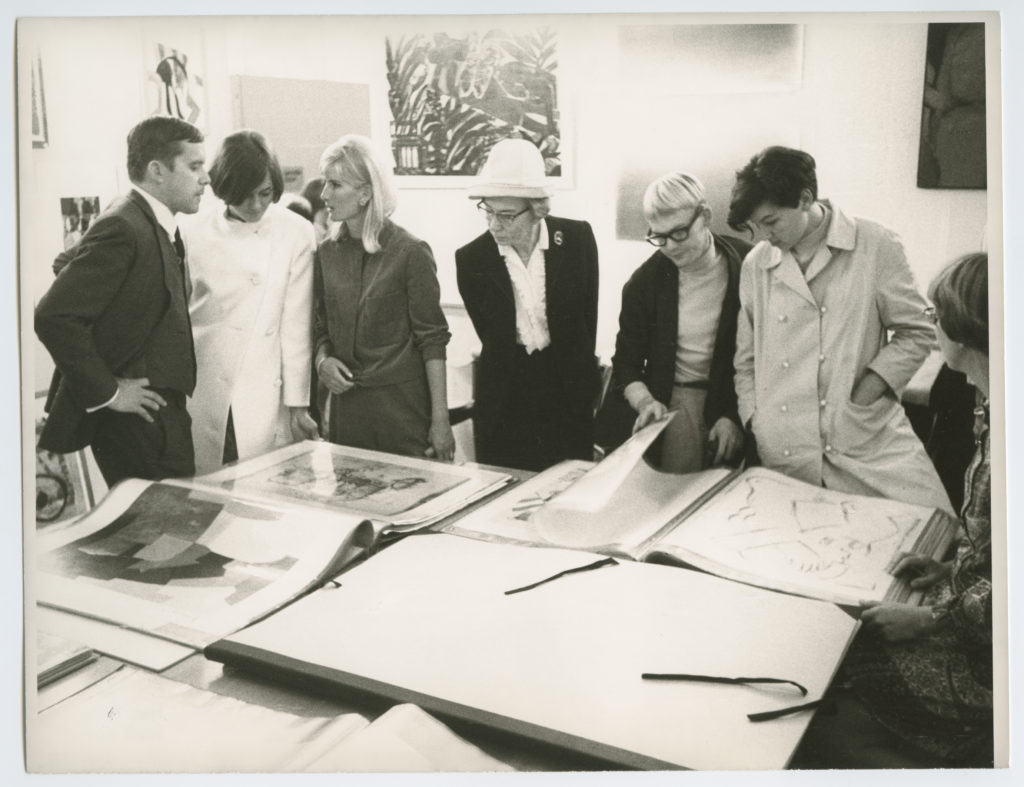
Collectors and dealers gathered around
artworks at Kunstmarkt Köln, which later became Art Cologne, in
1967. Photo: Peter Fischer.
There is evidence that if you
cultivate this local audience, they will come. Two years after I
took over Art Cologne, in 2010, the Icelandic volcano
Eyjafjallajökull erupted the day before the VIP preview. Air
traffic came to a halt and we had more than 400 cancelations from
our international VIPs. Despite this disaster, sales took place as
usual. I still don’t know for sure if the inability to travel
brought more people from greater Europe, or if it forced bored
Europeans to come visit the fair. Only about two percent of the 400
cancelations ever returned over the following years. Yet we
continued to experience success.
What the Future Holds
This March, we decided to
postpone the next edition of Art Cologne to November. Of this
year’s 175 exhibitors, about 45 percent come from Germany. Even if
we miraculously manage to contain the virus globally by the end of
the summer and there is no second wave in the fall, I am expecting
only the Europeans to show up this November, as it’s likely that
the EU will place travel restrictions on people coming from Asia,
Russia, and the Americas.
In any case, the nerve to call
an American art fair with 75 percent of American galleries
“international,” while referring to a fair like Art Cologne with 50
percent of galleries from Germany as “regional,” is a
falsehood, bred by American exceptionalism. But hopefully, as when
Art Cologne was first founded, art fairs of the future will have an
actual purpose and fill a need that is not easily replaced by a
move to the virtual.
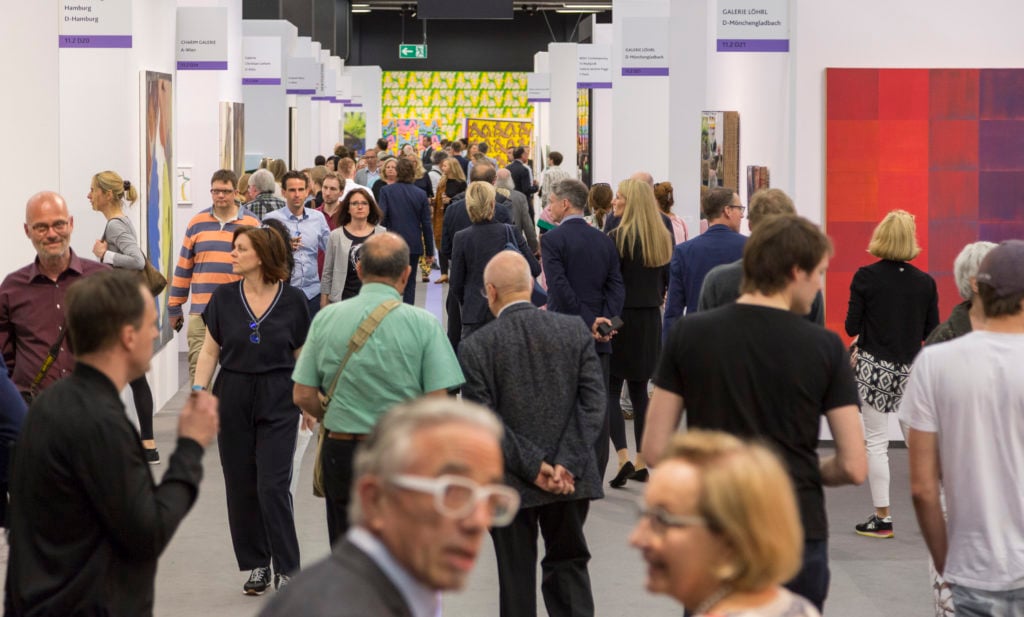
Art Cologne 2018.
In the end, I am confident that
people who love and value art need museums, art fairs, arts
associations, and the experience of personal contact with a wide
range of galleries. Once COVID-19 is over, I am convinced that we
will return to art fairs and large public gatherings. Online art
fairs miss the point, which is human exchange: meeting and
discussing, drinking and eating dinner together. We know people
will behave differently come autumn, and that visitors may avoid
packed booths or opt to drop by those with fewer visitors. This
might just be a silver lining. What is certain either way is that
this moment has made us re-evaluate how important culture truly
is.
It is impossible to reflect the
entire global art world in a single fair. All fairs are, in fact,
regional, have always been, and always will be. No fair is simply
big enough to accurately reflect the cultural production from
around the entire globe, even if it is online and therefore
essentially borderless. After looking at 45 galleries on Frieze New
York’s online platform, I burned out to a point of no
return.
When we try to make every fair
the same—all the same galleries, all the same artists and
artworks—we have the potential to overlook truly important art. By
restoring fairs to their original purpose of promoting their local
communities, local artists, and local collectors—those stalwarts
who were always there anyways—we can make sure the titans of the
future are not lost.
Daniel Hug is the director of Art Cologne.
The post Brand-Name Art Fairs Won’t Save the Art Market in
This Crisis, But Regional Ones Might appeared first on artnet
News.
Read more https://news.artnet.com/opinion/daniel-hug-art-cologne-fair-system-1855086
Further reading


Leave a comment