
Crystal Bridges Made Arkansas a Hub for American Art. Can a New Outpost Make It a Destination for Contemporary Work, Too?
Here’s an accelerated timeline that sums up the unexpected rise
of a massive art museum in the American South.
Throughout the early aughts,
Dayton Castleman finds
himself traveling back and forth from Chicago to Northwest Arkansas
to visit his parents, who had moved to Siloam Springs. In 2008,
Walmart heir Alice Walton bid to purchase an iconic painting
called The Gross
Clinic, by Thomas Eaken,
for a museum she plans to open in nearby Bentonville, causing a
national stir—not least of all because it would mean the piece
would move from Philadelphia to its new home in rural Arkansas.
(The sale ultimately did not go through).
Castleman, who had previously
assumed Walton’s Crystal Bridges Art Museum would simply be a
repository for scenes of the Wild West, starts to reconsider his
prejudices. Fast forward ten or so years and the artist now feels
such an enthusiasm for the venture that he’s relocated permanently
to Arkansas, moving there shortly after Crystal Bridges formally
opened its doors in 2011. He reasoned, at the time, that the
institution could do for Bentonville what the Guggenheim did for
Bilbao.
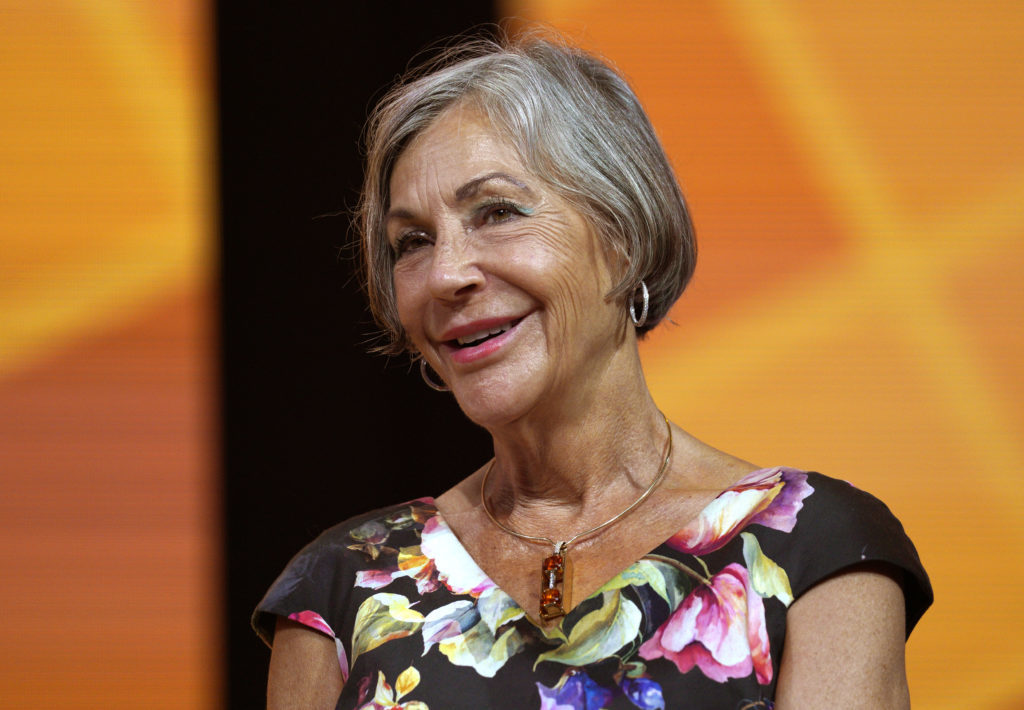
Alice Walton in Arkansas. Photo by Rick
T. Wilking/Getty Images.
The effects Crystal Bridges has
had on the region are more than clear. And later this month, the
museum is going one step further. It’s opening a satellite
contemporary art center, the Momentary, which, by all accounts, is
expected to further solidify the impact art has had on this town
that once counted the Walmart Museum as one of its biggest cultural
attractions.
Alice Walton, daughter to the
founder of Walmart (which is headquartered in Bentonville),
introduced the idea of Crystal Bridges in 2005, right after the
city released its 2004 Master
Plan to revitalize the
downtown. What was to follow has been described to me as the
institution serving an anchor, pillar, or gravitational center
around which everything else culture-related orbits. Calling the
Crystal Bridges one of the main drivers of these revitalization
plans would be an understatement given how much municipal and
private investment (including from the Walton
family), residential
development, tourist revenue, and population growth (which
impacts the family’s
businesses) have been
attributed to the museum.
“The Momentary obviously is an
extension of Crystal Bridges,” says Castleman, “the scaling up of
an existing institution that precipitated this change and has
really provided the scaffolding for this sort of urban
transformation.”
A Hub for the “Crazy Formation of a New Art
World”
The Momentary is tied to Crystal
Bridges in so many ways. The museum didn’t incorporate contemporary
art in its initial blueprint, which “basically makes the case for
the Momentary almost immediately, because you have a square footage
problem almost from the get go,” says University of Arkansas art
professor Sam King.
Crystal Bridges curator Manuela
Well-Off-Man, who joined the museum back in 2009, explains that the
collection was “supposed to end with American modernism.” The
arrival of director Don Bacigalupi that same year, she says,
shifted that equation.
By the time the plan for the
Momentary was announced, in 2016, Well-Off-Man says the curators, “were all
excited that this would be the answer to all the questions of, for
example: How can we include more regional artists? Or how can we
explore maybe some other art forms that wouldn’t be a good fit for
the museum because it’s not part of the mission?”
The Momentary is certainly more
flexible than its parent institution. Repurposed from an old Kraft
cheese plant, the 63,000 square foot contemporary art space will
include room for visual art, performing arts, and culinary
experiences. “They may be looking to connect with the region,”
suggests King, by “creating the space where somebody might go to
something that has sort of pop appeal, and then they stay for
something that is [more experimental.]”
The center expands on the
cultural footprint established by the Crystal Bridges, and has
opened within a decade of the museum’s arrival on the scene,
establishing a pace that has been completely unmatched by other
satellite offshoots of major institutions, like Tate Modern or Dia:
Beacon.
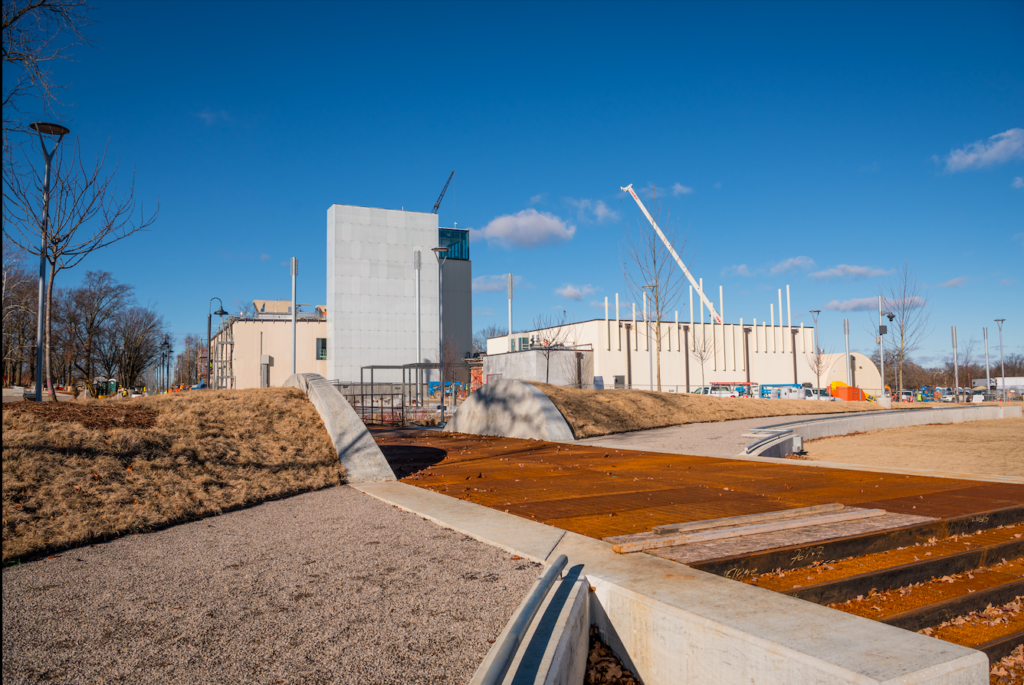
A view of the Momentary construction
site. Photo: Stephen Ironside, courtesy of the Momentary,
Bentonville, Arkansas.
When Bentonville drafted
its plan
for the district where the
Momentary is located, which conveniently connects downtown
Bentonville with Walmart’s relocated future
home office (with nearly “15,000
people in the home office area every day” says city official Brian
Bahr, “to ultimately support [the district]”), planners had already
made room for a robust arts component owing to the success of
Crystal Bridges in incubating a culturally rich community that now
includes restaurants, bars, and bike and hiking trails. The Walton
family swooped in with its idea to create the Momentary two years
later.
And that has happened a lot. The
family has spearheaded the development of this “ecosystem”—which,
along with these two institutions, includes the School of Art at
the University of Arkansas, established in 2017 using a
historically large foundation endowment, along with other art projects, grassroots and otherwise, in Northwest
Arkansas.
The Waltons have also played a
role in the affordable housing initiative for the (albeit nascent) artist community,
which will be located next to the Momentary. “Having another space
there for artists will be very synergistic,” according to Artspace
senior Vice President Wendy Holmes, who conducted a Walton Family
Foundation-supported market study on the needs of the community
(the double-edged
sword of arts-induced
gentrification.) If
there have been any flaws in how these initiatives have played out,
you’d be hard-pressed to hear them from anyone in the local
creative sphere. They feel too indebted to the Waltons for creating
an art world big enough to actually support them.
Castleman adds that for people
like him, creatives “who just want to be a part of this crazy
formation of a new art world,” and the chance to be influential in
a way they might never be in places like Chicago, Philadelphia, or
New York, an institution like the Momentary is important. It
“creates another sort of pillar of: This is how we conduct
ourselves,” he says.
A Chance to Spotlight Local Legends
A biennial-style show often is a
good way to raise the profile of an institution
and the area surrounding it.
The second iteration of “State
of the Art”—technically a quinquennial, running on a 5-year
cycle—will inaugurate the new space. The show debuted at Crystal
Bridges in 2014, and provided a lot of positive momentum and
enthusiasm, according to Well-Off-Man, for its budding contemporary
art program.
This year, “State of the Art”
will take over both institutions. The weight of the inaugural show
was, many noted, subsumed by its premise, with a number or articles
(and even a documentary) focusing in on how founding director Don
Bacigalupi and curator Chad Alligood traversed the country to
select artists for it.
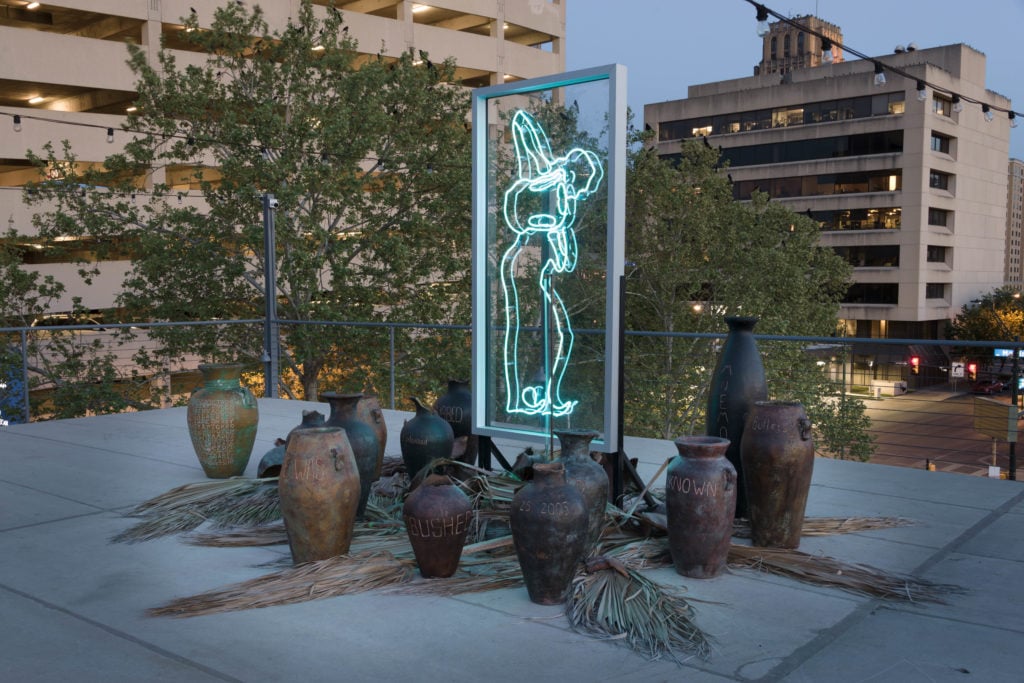
Installation view of Sama Alshaibi’s
The Cessation in “State of the Art 2020.” Courtesy of Sama
Alshaibi; originally commissioned by Artpace San Antonio. Photo:
Seale Photography Studios. ©Artpace San Antonio.
Since at its core, the show will
always be committed to “representing artists from the 48 contiguous
states,” Glenn says, it’s possible that the institution’s idea of
making sure to not to leave anyone out—especially those who’ve been
historically overlooked—has given way to a realization that filling
gaps isn’t a one-time proposition each cycle. Instead of
emphasizing the miles they’d traveled, this curatorial team—led by
Studio Museum in Harlem alum Lauren Haynes, who works for both
institutions, and Crystal Bridges’s contemporary art curators
Allison Glenn and Alejo Benedetti—took it slowly. They allowed
themes to “rise to the top,” Haynes says, and narrowed down their
selections accordingly. Some work they saw wasn’t right for “State
of the Art,” she says, but might resurface in a later show at the
Momentary.
According to participating Fayetteville-based artist Anthony
Sonnenberg, they’ve done “a great job of finding those artists that
have been kind of local legends in their communities, but for
whatever reason have not gotten full success.” That includes
artists such as Dallas-based Frances Bagley and Georgia legend
Larry Walker (who happens to be Kara Walker’s father), situated
alongside lesser-known artists who are beyond “emerging,” like
Ronald Jackson, who Glenn visited in Spotsylvania, Virginia.
Crystal Bridges is unburdened by
any real legacy issues. That makes it easier for the museum and its
new contemporary art offshoot to chart a course “that does not have
any prior precedent,” says King. Apart from not having to reckon
with much baggage, he continues, they can represent the
contemporary moment somewhat unabated.
“They have no reason to do
anything other than what works today,” he says.
The Momentary in Bentonville, Arkansas opens to the public
on Saturday, February 22.
The post Crystal Bridges Made Arkansas a Hub for American
Art. Can a New Outpost Make It a Destination for Contemporary Work,
Too? appeared first on artnet News.
Read more https://news.artnet.com/art-world/the-momentary-crystal-bridges-1776441
Further reading


Leave a comment