
Despite Government Crackdowns on Freedom of Expression in Turkey, Billions of Dollars Are Being Invested In New Museums
At the inauguration of the
Contemporary Istanbul art fair this year, fair chairman Ali
Güreli expressed confidence that Turkey would soon
become one of the top five major art hubs in the world, declaring,
“We expect that the forthcoming years will be marked by the
introduction of Istanbul into the first five arts and culture
metropoles in the world.”
But it is difficult, even
wandering the beautiful streets of Istanbul, to forget about the
country’s recent and hard conservative turn. As of
February, 157 journalists
were locked up in Turkish prisons, according to the European Federation of Journalists, and
guarantees of freedom of speech are protected only
intermittently.
Last summer, Turkish authorities
imprisoned the singer
Jiyan for spreading “terrorist propaganda,” after she voiced
the word “Kurdistan” in her lyrics, referring to the rough
geo-cultural historical region with a majority Kurdish population,
which includes parts of southeastern Turkey. Meanwhile, censorship
of television and media is escalating, with the government passing
new laws last spring to force digital streaming services to get
approval from the government’s media watchdog, in order to crack
down on perceived “immoral” content such as smoking and drinking,
and social media sites such as Facebook and Twitter are
intermittently blocked in the name of “national security,” the
Economist
reports.
So how far can a country’s art scene really go
in an environment where free expression is so staunchly stamped
out?
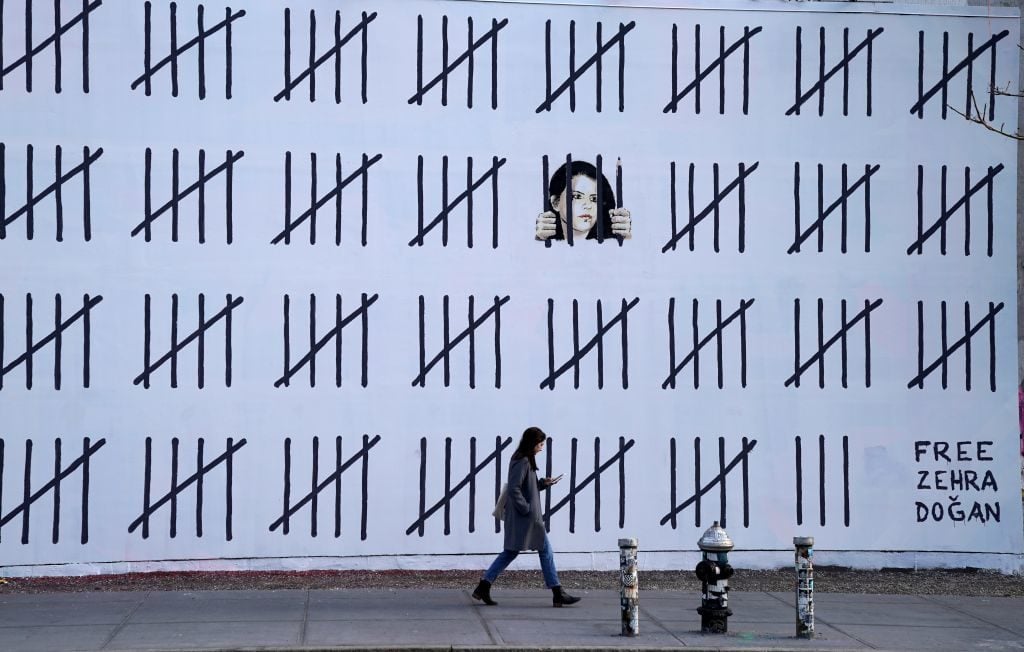
An artwork by Banksy in New York drawing
attention to the imprisonment of Zehra Dogan, a Kurdish painter
from Turkey. Photo by Timothy A. Clary/AFP/Getty Images.
Art and Freedom
Not long ago, Turkey’s
contemporary art scene was blooming, and many artists were unafraid
to address the plight of Turkey’s religious and ethnic minorities.
Between 2008 and 2013, the country’s art market also enjoyed
relative good health, and attracted a number of international collectors and
galleries to invest in the scene.
But after President Recep Tayyip
Erdoğan rose to power in 2014, the country shifted direction.
Erdoğan quashed his opponents, arrested critics and opposition
journalists, and removed outspoken detractors from positions of
power.
Demonstrations against the rapid
urban development of the country escalated into mass protests,
leading to a government crackdown. After a failed coup attempt in
2016, the country’s reputation was further stained by the deaths of
several hundred people.
Since then, the economy has
contracted, inflation and unemployment have soared, and
international collectors and curators, who just a few years before
had vaunted the country’s potential, stopped coming to the
once-celebrated Istanbul Biennial. Bigger galleries closed, and
artists began to move away, particularly to Berlin.
Artists who have remained have
carefully tried to avoid the fate of Kurdish artist and journalist Zehra
Doğan, who was recently freed from prison after three years for
painting a watercolor of a military attack. After her arrest, the
Turkish judiciary said her art “exceeded the limits of artistic
criticism.”
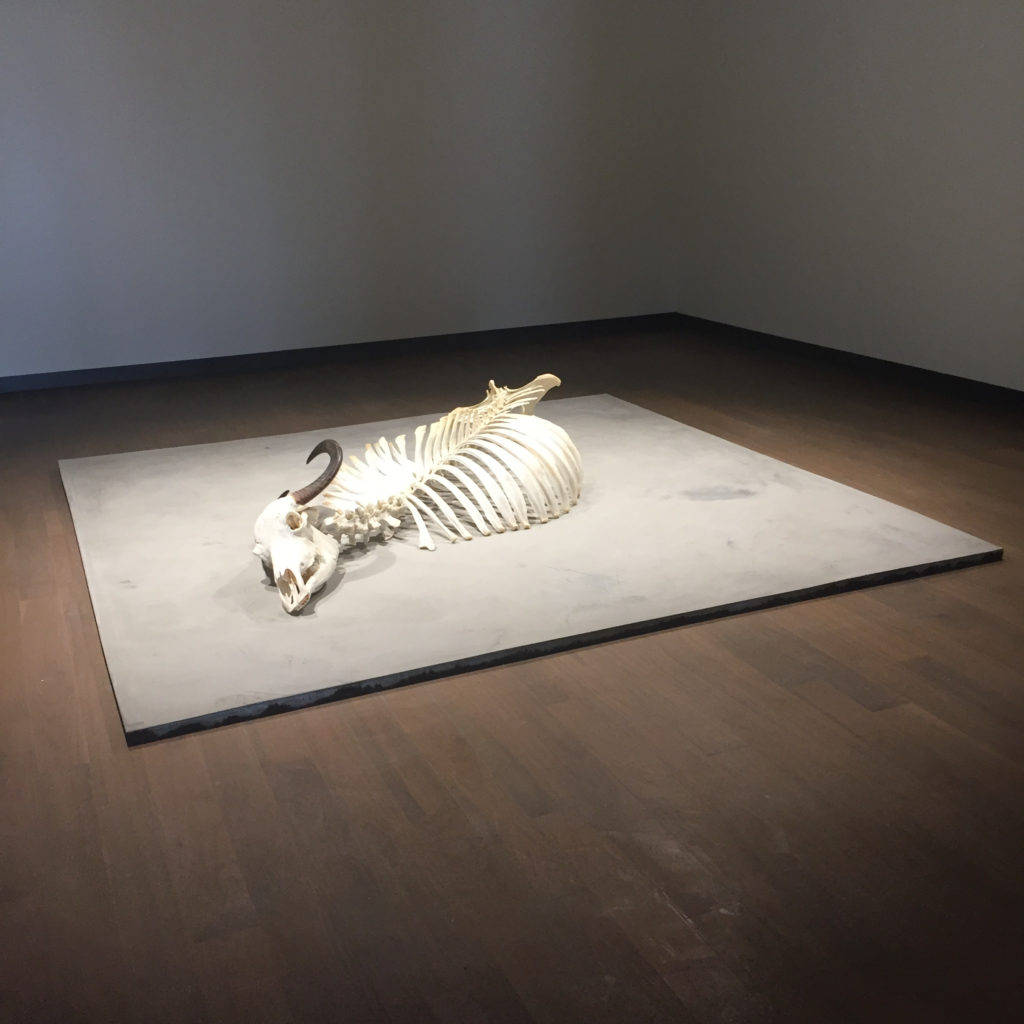
Ozan Atalan’s work Monochrome
in the Istanbul Biennial. Photo by Naomi Rea.
Mounting Contradictions
“There is a huge contradiction
between the art and culture world, the intellectuals, and the
government,” Hasan Bülent
Kahraman, a Turkish writer and formerly a senior advisor in the
country’s ministry of culture, tells artnet News.
“Contemporary art, be it in the
[US] or London or Turkey, is always very political, very harsh,
very severe, very tough, very adversarial,” Kahraman says. “It is
natural that any political power will have a distaste for art,” he
says.
At the Contemporary Istanbul art
fair, much of the work was decorative and politically safe. Yet
there were a few notable exceptions, among them İz
Öztat’s poignant work The Whip of Justice, which subtly
references the government’s suppression of protest and freedom of
expression. Within the first two days of the fair, the piece sold
to the Moscow Museum of Modern Art.
The Turkish artists included in this year’s Istanbul
Biennial—curated by Nicolas Bourriaud and centered on the theme of
humanity’s impact on the environment—were also critical of the
government. Elmas Deniz called attention
through her work to the
disappearing rivers and creeks in the city.
Meanwhile, Ozan
Atalan’s work Monochrome, which included a sculpture of an animal
carcass, criticized the
displacement of roaming water buffalo by the construction of the
new Istanbul airport, among other building
projects.
"background: #FFF; border: 0; border-radius: 3px; box-shadow: 0 0 1px 0 rgba(0,0,0,0.5),0 1px 10px 0 rgba(0,0,0,0.15); margin: 1px; max-width: 540px; min-width: 326px; padding: 0; width: calc(100% - 2px);">
View this post on Instagram
Kahraman is optimistic about the
future of Istanbul’s art scene. He anticipates a new wave of
international cultural development will wash in as a result
of Turkish capitalists
investing in the market.
And there are already fruits
from their efforts. The Koç Foundation, an arm of Koç
Holding, Turkey’s biggest industrial conglomerate, expanded its
Arter Museum with a splashy new building that opened last week. In
total, private funders
have invested the equivalent of $5 billion into art and culture
institutions such as the Evliyagil Museum, a nonprofit gallery
founded by collector Sarp Evliyagil that promotes and sells the
work of young artists.
Other cultural institutions are
slated to open within the next five years, such as
the Istanbul Painting and Sculpture Museum in 2020.
But it is difficult to imagine
Erdoğan making any liberalizing reforms. His government has thus
far encouraged the revival of traditional art techniques such as calligraphy
and ceramics through initiatives such as the festival of Ottoman
and Islamic arts and crafts, which Erdoğan launched in
Istanbul last year. Changes, it seems, will have to
come from without. In June, Ekrem Imamoglu, an opponent
of Erdoğan, was inaugurated as Istanbul’s new mayor and
promised to uphold democratic
institutions.
“The future of Turkey depends on the understanding and
endorsement of [culture] by all players in society,”
says Güreli, the chair of Contemporary Istanbul. “The private
and public sectors need to work within the framework of longterm
strategies.”
The post Despite Government Crackdowns on Freedom of
Expression in Turkey, Billions of Dollars Are Being Invested In New
Museums appeared first on artnet News.
Read more https://news.artnet.com/art-world/turkey-art-scene-1649563
Further reading


Leave a comment