
The Gray Market: Why Thousands of Unsold New York Condos Should Worry High-Dollar Art Dealers (and Other Insights)
Every Monday morning, artnet
News brings you The Gray Market. The column decodes important stories from the
previous week—and offers unparalleled insight into the inner
workings of the art industry in the process.
This week, showing that the top
of the art market isn’t suffering alone…
BLANK SPACE
On Friday, the New York
Times fleshed out a
sobering finding: that about one in four condo units completed in
New York City since 2013 remain empty and available, with the
majority of them in luxury towers. As it turns out, this statistic
chimes with the performance of premier fine-art auctions around the
world in 2019.
The condo-vacancy figure comes
from a new study
of 16,200 condos in 682 buildings
by NYC-only online real-estate lister StreetEasy. More jarring
still, the site’s senior economist, Grant Long, notes that he
thinks his team’s estimate is actually “really conservative,” since
it only counts buildings with sales contracts already closing. That
means the data excludes the thousands of condos still under
construction that are only likely to worsen the glut of high-dollar
vacancies once complete.
Of particular interest to me was
one supporting stat much closer to the present than the overall
figures. According to Stefanos Chen of the Times, “From
January to late August, there was a 35 percent drop in the number
of contracts signed for new development at or above $4 million,
compared to the same period last year.”
Why do I care about this figure?
I’m glad I can pretend you asked!
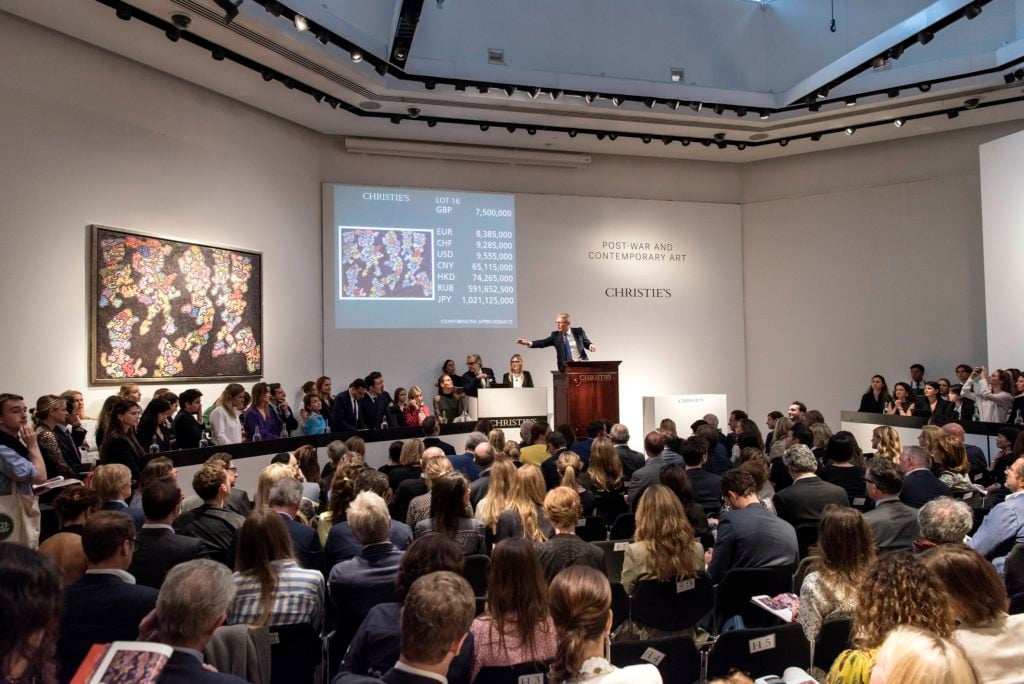
At $11.1 million, a work by Jean
Dubuffet was the top lot of the night at Christie’s London Post-War
and Contemporary evening auction in June. Image courtesy of
Christie’s.
SUGAR, WE’RE GOIN’ DOWN
In the new fall 2019 edition of
the artnet Intelligence Report—click
through and smash that download button if you haven’t already—one
of our headline findings from the first half of the year shows the
auction market treading an eerily similar path.
In her patented Data Dive
section, my colleague Julia Halperin noted that auction sales of
artworks priced at $10 million and up contracted by 35 percent
compared to the equivalent period in 2018. That’s right—the exact
same percentage plummet that StreetEasy’s study found in sales of
condos priced at $4 million and up this January through
August.
In fairness, it wasn’t just the
$10 million-plus cohort of auction lots that faltered during 2019’s
opening frame. Sales actually declined in all price bands except
the cheapest ($10,000 and under). And while it’s a bit spooky to
see an identical percentage drop for multimillion-dollar assets in
these two different markets, I’m not suggesting that art at auction
and condos in New York are mirror images of one another. These
aren’t even the same metrics, after all. In the condo market, we’re
talking about, effectively, sell-through rate for assets above a certain price, whereas in
the art market, we’re dealing with a year-over-year
comparison of total sales
value generated by
assets above a certain price.
Despite the apples-to-oranges
factor, though, the general consonance between these two markets
matters, especially in light of another detail in the
Times’s reporting on NYC’s condo-sales cataclysm.
Even for condos priced at $4 million or more, the loftiest reaches
of the price hierarchy seem to be the most difficult to sell. For
instance, the developer behind the Bjarke Ingels-designed XI condo
towers in West Chelsea—the ones that lean like they’ve been
spaghetti-legged by too many tequila shots—claimed “his sales have
been moving ‘wonderfully’ in part because their core product, $4
million to $8 million apartments, has a higher demand than some of
the larger, pricier condos built elsewhere.”
If that’s true more widely, the
phenomenon tracks even more closely to the queasy performance we’re
seeing for artworks above $10 million at auction. And frankly, I’d
be a little surprised if it weren’t.

Construction continues on New York
luxury condos in September 2019, even as thousands of units across
the city remain unsold. (Photo by Spencer Platt/Getty Images)
THE MEANING OF STRIFE
What I’d suggest here is fairly
straightforward: We should not view the drastic underperformance at
the peak of the auction market or New York’s condo market as
isolated phenomena. We should instead view them as linked outcomes
flowing from the decisions being made by many of the same
ultra-wealthy, investment-minded people who have helped inflate
demand in both markets this century, and especially since the start
of the recovery from the 2008 financial crisis.
Granted, lately each of these
markets has been facing headwinds inapplicable to the other. Chen
of the Times
calls attention to “recent limits
on state, local, and property tax deductions, as well as changes to
the mansion tax, which has risen from a flat 1 percent on
million-dollar sales to a staggered rate of up to 3.9 percent for
sales above $25 million.” On the art side, Halperin notes that
“since big-ticket works are increasingly going to their guarantors
with little competition, consignors have become more inclined to
sell privately rather than in a public auction.”
Yet there are other tectonic
shifts clearly quaking both markets, including the Chinese state’s
increased scrutiny of its citizens’ wealth. The
Times specifically mentions “the retreat of
international buyers from China and elsewhere” as a significant
contributor to the luxury-condo sales lapse. Similarly, just last
Monday, Pace founder Arne Glimcher explained in a public talk at the 92nd
Street Y that the
mega-gallery exited
Beijing partly because
“everyone is afraid to show wealth under Xi [Jinping],” meaning
that, in his estimation, most of the people who acquire art on the
mainland today are tourists. (Remember, the party’s anti-corruption
bloodhounds aren’t strictly sniffing around in-country purchases.)
Brexit, that continuing political grease fire, certainly isn’t
helping anyone selling high-dollar condos or high-dollar art,
either.
And with several economic
indicators and nearly every media outlet, including the
Times, feeding steadily building fears of a general
recession just ahead, I’m also certain some of the world’s
plutocrats have already been acting on the death-spiral psychology
that contributes to economic downturns. People with excess capital
tend to get conservative about spending once they get spooked that
a contraction might hit, and by depriving the economy of their
spending, the same people make their worries much more likely to
come true. It would be hilarious if it weren’t tragic for so many
everyday people.
In the end, this is another
golden reminder that many, if not most, of the buyers spraying
millions of dollars at trophy artworks have been viewing them as
alternative investments on the same order as luxury condos in the
Empire City (and, let’s be honest, should be). You can certainly
doubt Glimcher’s sentiment in telling author Michael Shnayerson, his counterpart in
the 92nd Street Y talk, “This market has nothing to do with art.
It’s become a hedge, and I don’t like it.” But you shouldn’t doubt
his underlying analysis. And in that sense, the trouble at the apex
of New York’s condo market impacts the art world a lot more than
most of us wish it did.
[The New York
Times | artnet Intelligence
Report]
That’s all for this week. ‘Til
next time, remember: If you stay on top long enough, eventually
there’s only one other direction to move.
The post The Gray Market: Why Thousands of Unsold New York
Condos Should Worry High-Dollar Art Dealers (and Other
Insights) appeared first on artnet News.
Read more https://news.artnet.com/opinion/gray-market-unsold-condos-1651264
Further reading


Leave a comment