
Germany Is Giving Out Tens of Millions of Euros to Cultural Workers Hit by Its Faltering Economy. Some Say It’s Not Nearly Enough
Last month, after the German economy started to sag
following a nationwide coronavirus lockdown, the country’s
federal and state governments sprang into action and issued tens of
billions of euros to their citizens in an effort to prop up
businesses and help individuals pay their bills.
The city-state of Berlin, Germany’s art capital and home to
at least 20,000
artists, issued €1.3
billion in loans and handouts to small business owners
and freelance workers, directly benefitting small galleries, arts
organizations, artists, and other cultural
producers. With minimal
information—little more than a mailing address, tax ID, and banking
details—150,000 applicants sought funding online and woke up the
next day with anywhere between €5,000 and €14,000 in their bank accounts. International and local
press outlets were delighted.
“There will be enough for
everyone,” Berlin’s culture minister, Klaus Lederer, assured the
state, and a flood of positive press coverage celebrated German
efficiency and ingenuity.
But just two weeks later, the excitement is starting to wane.
Artists say there is troubling fine print attached to new federal
funds being doled out, which don’t take into account the full needs
of culture workers in quite the same way as the first rush of local
money in Berlin did. What’s more, recent tax hikes on art
sales are doubly crippling galleries as they struggle to stay
afloat.
“We have been hit with the loss of Berlin Gallery Weekend, Art
Cologne, and now Art Basel,” says the dealer Johann König. “I have
40 staff to take care of. Why does the German government think that
art dealers are bad?”
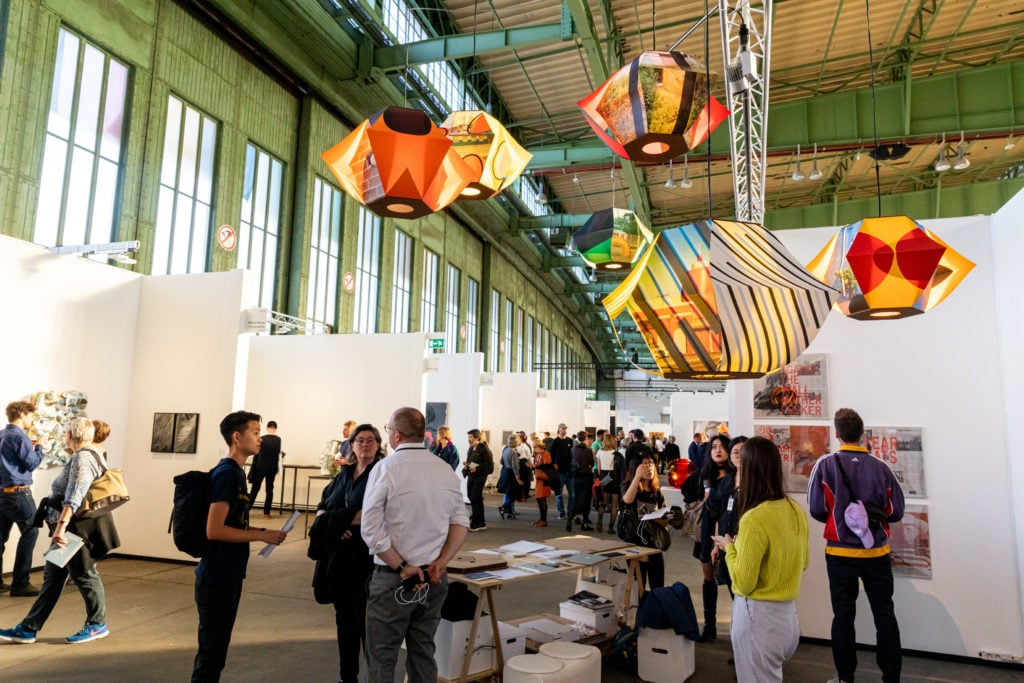
A view from the 2019 edition of the
now-defunct Art Berlin fair. © Clemens Porikys.
Reading the Fine Print
In mid-March, the federal government and several German states
presented separate plans to bail out businesses and
freelancers. Monika Grütters, the country’s culture minister,
pledged that cultural workers would be able to tap into
a €50 billion federal stimulus package: individuals would be
eligible for up to €9,000 in individual one-time grants, and
small businesses could apply for up to €19,000 in individual
one-time loans.
Meanwhile, the state government in Berlin promised upwards
of €100 million—a number that grew to €1.3 billion within weeks—in
the form of €5,000 one-off grants
and €15,000 one-off loans. Both federal and state
programs included other benefits such as tax deferrals.
But due to the ad hoc nature of
the bailout programs, many did not grasp their various rules and
stipulations. According
to the results of a survey published last week by the Berlin
Artists’ Association, 32 percent of 1,744 Berlin-based
respondents said they did not understand the differences between
the two programs. The distinction, in fact, is
important: applicants have only been allowed to apply either for
federal or state relief, but not both.
Furthermore, those who applied for funding from the state of
Berlin benefitted from the government’s slashing of red tape.
Applicants needed only very limited documentation; did not need to
prove any loss of income; and could use government funds to pay for
costs of living a well as running their businesses. Money was delivered within days, and fraudulent
claims are expected to be sorted out at the end of the tax
year.
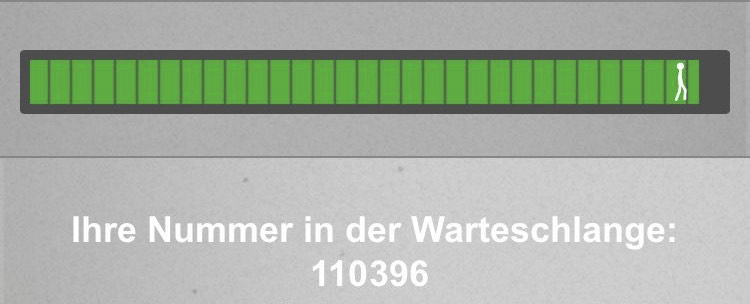
“Your number in the line is 110,396.” A
screenshot from an online application for Berlin state stimulus
grants, courtesy artist Zuzanna Czebatul.
On the other hand, the federal program—which is now the only one
available after the Berlin pot ran dry on April 6—has many more
hurdles. Anyone applying without a German passport must present a special document
issued by a state office no more than four weeks ago, which could
be difficult—or even dangerous—to obtain amid the
lockdown.
Crucially, federal funding can
also only be used for business costs, not for personal expenses
such as health insurance contributions or residential rent.
But for artists and other creatives, the boundaries between
personal and business expenses are sometimes not so clear, and some
are complaining that the application requirements fail to take into
account the realties faced by cultural workers.
Some say that if artists remain unable to apply for federal
relief, they will be pushed into controversial welfare programs, which
demand that applicants participate in meetings and prove that they
are looking for work. The program is designed to keep people
uncomfortable enough to edge them back into employment. (Its slogan
translates its dual motives: “demand and support.”)
“Many [federal stimulus]
applications from artists are currently being rejected,” according
to a report in Süddeutsche
Zeitung, noting that
artists are being referred to welfare programs. That
fact is a “slap in the
face of every freelancer,” Berlin music council president Peter
Stieber told the newspaper.
Although Berlin has been widely lauded for its state program, it
has run into its own issues. According to the survey from the Berlin
Artists’ Association, just over 33 percent of respondents said
that they did not apply for money because they were missing
information, and nearly 20 percent were missing the necessary
identification. Sixty percent of the applicants who were not able
to apply for myriad reasons said they needed the grants to secure
their livelihoods.
Local organizations are now
lobbying the government to create a special program just for
artists. A petition signed by more than
400,000 people and directed at Germany’s finance minister, Olaf
Scholz, is demanding universal
basic income in place of loans and tax deferrals. Another petition, signed by 300,000 people, is asking
for the government to better acknowledge the unique working
conditions for creatives. Organizations like the Berlin Artists’
Association are also asking the government to loosen rules on what
it counts as business expenses.
“Many of these artists live on
the edge of subsistence anyway, but the current mass cancellation
of events threatens to push them over this edge,” one petition
reads, noting that current regulations requiring applicants to
prove a loss of income leaves out too many
people. “Society
may be able to do without cultural life for some time. But if it
does so for too long, we could end up in a situation with nobody
left to revive it.”
So far, however, the pleas have
fallen on deaf ears.
“Even if there is no special
program just for culture, the federal government’s aid program is
especially tailored to the needs of the creative milieu,” Grütters,
the culture minister, insisted in an interview last week
with Der
Spiegel.
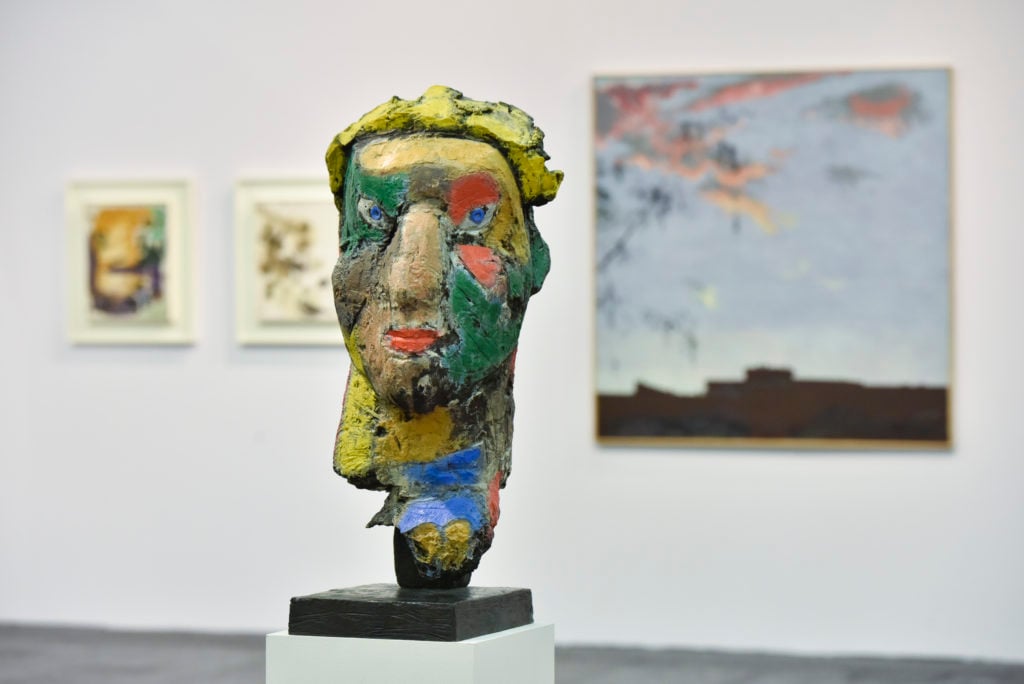
Michael Werner’s booth at Art
Cologne.
Jump-Starting the Art Market
Meanwhile, dealers are facing
their own troubles. The German government has confirmed that
lockdown restrictions will be extended into May, meaning that the
economy has at least several more weeks of near-total
stasis.
And while some see Germany’s
relatively cool-headed management of the crisis as a sign that it
could come out the other side as an art-market center, there are numerous hurdles to get
over.
“The emergency aid program was a
very welcome and successful measure that enabled the galleries to
survive the initial period. However, it will only bring temporary
relief,” says a spokesperson from the Federal Association
of German Galleries and Art Dealers. “The art market is already under extreme strain
due to a multitude of new laws and regulations. Long-term measures
are therefore needed to help galleries and art dealers and thus
also the artists and the German art market.”
Among the relatively recent laws that are hitting dealers hard
is a 2014 measure that raised taxes on art sales from 7 to 19
percent. On top of
this, there is a 4.2 percent tax that supports health and pensions benefits for artists,
which dealers must pay when compensating their artists.
For the time being, most of these costs are being shouldered by
galleries, says Berlin-based
art dealer Sebastian Klemm. “One can easily calculate the annual amount
that is lost in our balance, and which cannot be invested in
employment, more ambitious projects, building up stock, or to cover
the heavy rent increases of the last four to five
years.”
Carolin Leistenschneider, a dealer at the Contemporary Fine Arts
gallery, says such problems have paralyzed businesses—and scared
away collectors.
“As a consequence, art collections can’t grow anymore in Germany
and are being placed or moved abroad,” she says, adding that the
taxes on art sales are much more favorable in Switzerland (8
percent) and the UK, which levies a 5 percent tariffs on artworks
imported from the EU.
A reduced tax rate is the best solution, says the spokesperson
from the Federal Association
of German Galleries and Art Dealers. “German cultural policy can now finally do
something meaningful, necessary, and fair for the art
market.”
But it is unlikely that a tax break is in the
cards, especially in light of
the economic crisis, which is leading to deep deficits for local
and federal governments. On top of that, reduced tax revenues are bound
to hurt cultural organizations and events that benefit from
government support in the years to come.
“Collapsing tax revenues in the
near future and increasing debt will put massive pressure on
cultural funding,” Olaf Zimmermann, the managing director of the
German cultural council, wrote in a letter to the Berlin
Artists’ Association.
In the meantime, the country’s art world remains in limbo:
while varying bailout programs
have helped, they won’t solve every problem.
In an op-ed written
by Kristian Jarmuschek and Birgit Maria Sturm from the German
Association of Galleries and Art Dealers, the dealers put the situation in stark terms: Germany’s emergency
programs, they wrote, “are
beneficial for the time being, but in the end amount to nothing
more than the proverbial drop in the
ocean. Operation
successful—patient dead?”
The post Germany Is Giving Out Tens of Millions of Euros to
Cultural Workers Hit by Its Faltering Economy. Some Say It’s Not
Nearly Enough appeared first on artnet News.
Read more https://news.artnet.com/market/germany-bailout-issues-1834791
Further reading


Leave a comment