
The Gray Market: Why America’s Art-World Shutdown Is Reaching a Breaking Point (and Other Insights)
Every Monday morning, Artnet
News brings you The Gray Market. The column decodes important stories from the
previous week—and offers unparalleled insight into the inner
workings of the art industry in the process.
This week, looking to the masses
for guidance in our weird niche…
NORTHERN EXPOSURE
On Friday, the New York
Times examined the
tensions facing the upstate New York art institutions that will
reopen first under governor Andrew Cuomo’s impending rollback of
public-health restrictions. Yet data from elsewhere in the country
suggests that these art centers’ efforts to reopen smoothly and
safely will be undermined by out-of-towners desperate for a return
to normal life. And the conflict epitomizes why business owners
across the US, whether operating inside or outside the arts, will
largely be placed in an impossible position as spring transitions
into summer.
The crux of the initial dispute
is Cuomo’s four-phase
plan to reopen New York
state’s economy, which has effectively been frozen for nearly two
months. The good news for Dia:Beacon and other upstate art
institutions is that the governor’s roadmap recognizes the vast
differences in public-health statistics among the state’s 10
regions. So as long as the Hudson Valley, for example, manages to
meet Cuomo’s various statistical benchmarks for hospitalization
rates and related metrics, its businesses will be nudged out of
hibernation regardless of New York City’s progress (or lack
thereof).
The bad news? First, museums and
other art institutions are currently grouped among the businesses
that will only be permitted to reopen during the fourth and final
phase of the recovery process. That places them alongside schools,
gyms, and other centers for education and
recreation—a categorization
that doesn’t necessarily compute based on square footage or
visitors’ activity within it.
But even if arts institutions
succeed in lobbying the state for inclusion in an earlier phase of
the economic thaw, as some are hoping to do, another danger looms.
Here’s Julia Jacobs of the Times:
Arts administrators tend to
be more reticent about opening up again if they risk that New
Yorkers from downstate will travel north. Governor Cuomo has warned
that arts venues will not be allowed to open if they draw
significant numbers of people from outside the region, becoming
what he termed “attractive nuisances.”
Side note: If there isn’t
already a self-aware punk band forming somewhere in New York under
the name Attractive Nuisances, my last shred of hope for the future
will disintegrate.
That point aside, I think this
stipulation spells trouble for upstate art centers, let alone their
down-south cousins. And the reason is that we already have hard
evidence that large numbers of people are ready to chuck extreme
caution into the wood-chipper for the opportunity to reclaim a
handful of the old normal.
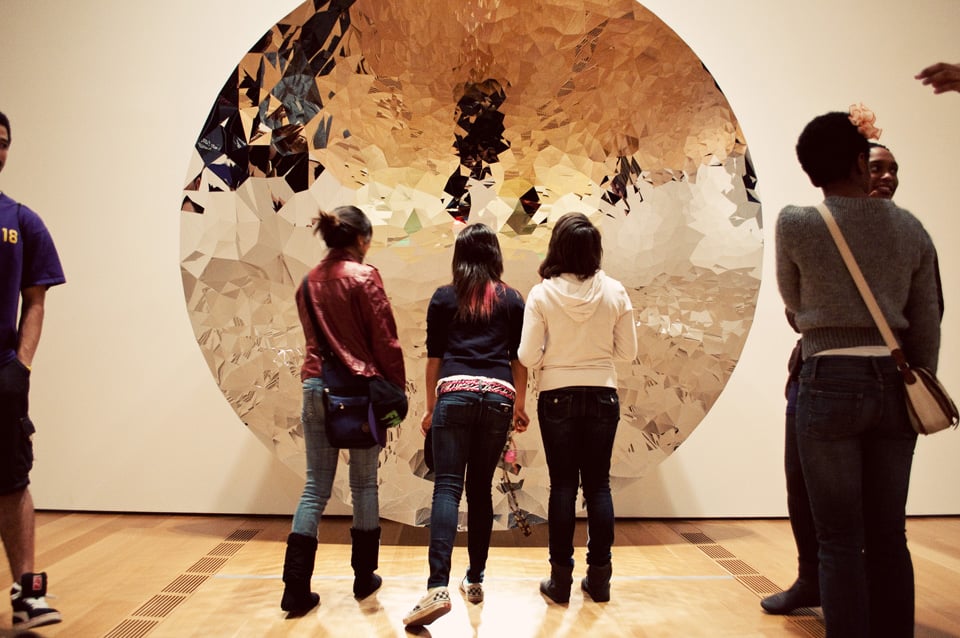
Visitors in front of a work by Anish
Kapoor. Photo courtesy of the High Museum of Art, Atlanta.
GEORGIA ON MY MIND
On Thursday, the Washington
Post reported that
Georgia, one of the first states to reopen non-essential businesses
such as dine-in restaurants, hair salons, and gyms, welcomed nearly
550,000 out-of-state visitors in its first full week after liftings
its lockdown. Using anonymized smartphone location-tracking data,
researchers at the University of Maryland found the influx
represented a 13 percent daily increase from the week preceding the
state’s shutdown.
While there are caveats to the
study, the results suggest that arts institutions in upstate New
York are very likely to become exactly the kind of “attractive
nuisances” that Cuomo warned against. Data showed that the vast
majority of visitors to early-opening Georgia (92
percent, to be exact)
came from neighboring states where
the same types of businesses stayed largely or totally shuttered.
And while the figures did not clock visitors’ specific
destinations, researchers concluded that most inbound visitors came
on “personal trips” rather than to return to
work.
The reason for this last
conclusion is noteworthy, too. Despite receiving permission from
the governor’s office to resume normal operations, very few Georgia
business owners actually chose to exercise that right. In fact,
a separate
study led by
economist Raj
Chetty found almost no
difference in the number of small businesses open, the number of
hours worked by small-business employees, and consumer spending in
the weeks immediately before and after the shutdown’s declared end.
The same held true not just in Georgia, but in all four states that
lifted their commercial restrictions on or around April 24.
(Alaska, Oklahoma, and South Carolina round out the
quartet.)
Both of those findings reinforce
my intuition that art enthusiasts living in downstate New York and
the tristate area will indeed flock to the spacious, world-class
institutions upstate as soon as possible. After all, they won’t
have any other outlets besides the infinite scroll of artworks
flattened onto backlit screens—and how many of them have been
satisfied by that option since mid-March?
Yes, many cosmopolitan museums
and commercial galleries are undoubtedly kicking and clawing at
their closed front doors in anticipation of the day that it’s safe
to responsibly welcome patrons again. But the research by Chetty
and his team highlights an often-overlooked reality about this
process: while “reopening the economy” is most often treated as a
bureaucratic decision made entirely by the government, it actually
requires private enterprise to agree with public officials about when the coast is clear
enough to begin operating again.
And based on what we’re seeing
inside and outside the art world, that is by no means a given here
in the US.
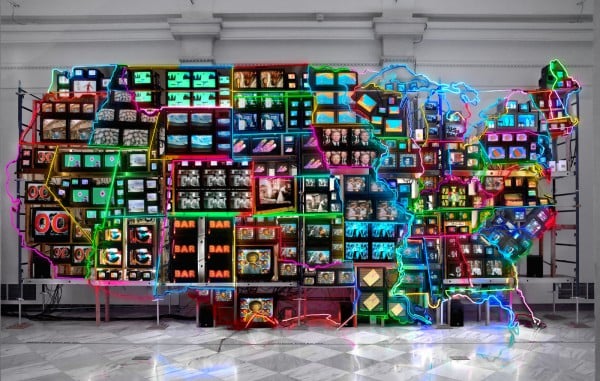
Nam June Paik, Electronic
Superhighway: Continental U.S., Alaska, Hawaii, 1995. Photo:
Courtesy of the Smithsonian American Art Museum.
AGREE TO DISAGREE
In every reference point I’ve
included above, the common element is friction. Some upstate art
institutions want to open sooner than Cuomo’s administration will
currently allow. Meanwhile, Georgia’s governor wanted his state’s
businesses to open sooner than most business owners could stomach—
and thousands of would-be customers from neighboring states
apparently agreed with the man making declarations from the safety
of the governor’s mansion rather than the ones who would have to
bear the health consequences if he’s wrong.
Who’s right in these situations?
I have no idea! Unlike in Berlin, Seoul, and other foreign locales, where eager
audiences have already materialized for appointment-based gallery
viewings, the US’s amateurish
public-health response means we still don’t know nearly enough about
the threat itself to be able to identify the boundary between
acceptable and unacceptable risks. This forces decision-makers at
most US art institutions, commercial galleries, and non-art
businesses to throw darts blindfolded.
The only thing I’m sure of is
that we’re nearing a breaking point. After Deloitte released a
somewhat unnerving report on
Sotheby’s finances last
week, CEO Charles Stewart seemed to play defense by emailing
clients to tout the house’s online successes and pledge it is
“actively preparing for the reopening of our galleries in New York
and London.” Cuomo’s four-phase plan to reopen New York state would
have to proceed almost flawlessly in the next seven weeks for that
to happen in time for the marquee spring auctions now scheduled for
late June… and it was not a great sign that the governor clarified
over the weekend that he has the authority to push back phase one’s start
date from May 15 to June 6, should conditions on the ground
necessitate it.
If billionaire-owned Sotheby’s
is feeling pressured to act, imagine how many independent small
businesses must feel like the breath is being crushed out of their
lungs. In fact, two galleries in California have already
openly defied the state’s shutdown
orders by reopening early (and one had to close again
after repeated police warnings). The cracks are starting to
show.
With financial losses mounting
at nonprofit and for-private businesses, and the American
unemployment rate reaching Great Depression
levels, my sense is that
desperation is prowling the streets on all sides. Buyers and
sellers, museums and visitors, market observers and
participants—nearly everyone without a vast cushion of wealth has
been made vulnerable by the shutdown and its root cause.
Millions of people have proven
willing to sacrifice for the sake of caution over the past several
weeks. But with little strong reason to believe that a safe and
controlled end is truly in sight, there is a point at which
maintaining preventive measures becomes as untenable as the risks
those measures are meant to mitigate.
When it comes to art, though,
one person’s would-be escape is another person’s livelihood and
wellbeing, and one governor’s decree is another business-owner’s
bad advice to contradict. All of these forces are on a collision
course, and no state official, medical expert, or industry analyst
can tell you what will happen once they meet. But for better or
worse, we’re on the cusp of finding out.
[The New York
Times | The Washington
Post]
That’s all for this week. ‘Til
next time, remember the immortal words of Tom Petty: the waiting is
the hardest part.
The post The Gray Market: Why America’s Art-World Shutdown
Is Reaching a Breaking Point (and Other Insights) appeared
first on artnet News.
Read more https://news.artnet.com/opinion/gray-market-shutdown-breaking-point-1857651
Further reading


Leave a comment