
The Unexpected Lesson Hidden in an Important New History of ‘Art Strikes’ + Two Other Illuminating Reads From Around the Web
“Art Strikes: An
Inventory” by Stuart Martin, Mute

Disney Animators on strike May 29, 1941.
Image via Wikimedia Commons.
Based on notes for an uncompleted book, Stuart Martin’s great
history of the idea of “art strikes” is not just a catalogue but a
lineage, with an important focus on how different actions have
inspired one another. It ranges in time from a 1916 protest by
Stuart Davis and other artists over their treatment by the
socialist journal The Masses, to last year’s actions at
museums in England and Wales where artworks were veiled in
solidarity with the Global Climate Strike.
I had not heard heart of the Artist Tenants Association Strike
of 1961, where activists called on New York artists to refrain from
showing their work publicly to protest against evictions from SoHo
lofts. The call drew support from Jasper Johns, Alex Katz, Willem
de Kooning, Robert Motherwell, Fairfield Porter, and Ad
Reinhardt. Evidently it made some impression on the mayor of
New York, Robert Wagner, who agreed to stop the evictions. It also
was a possible inspiration for the more famous 1970 New
York Artists’ Strike Against Racism, Sexism,
Repression and War.
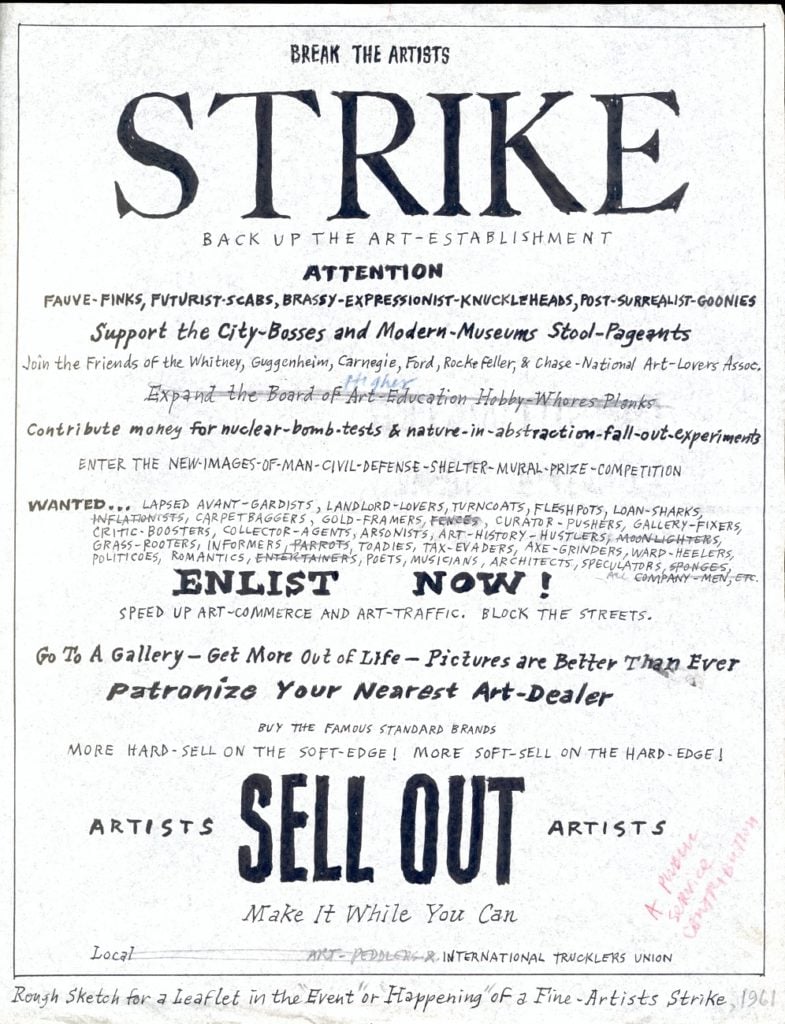
Ad Reinhardt’s satirical sketch for an
artist strike, made during the Artist Tenants Association Strike of
1961, which mocks anyone who defies the strike as helping the
system. Ad Reinhardt papers, 1927-1968. Archives of American Art,
Smithsonian Institution.
There’s plenty to be inspired by in this inventory, while
admitting that, as an accounting of available traditions to draw
upon, it does not exactly convince that the “art strike” idea is
particularly wieldy, and it may even more obscure than
illuminate. As Martin writes, most of these actions don’t
actually involve anything that resembles a “strike,” i.e. workers
uniting to shut down a workplace in order to get an employer to
improve conditions.
Most often, the various “strikes” are really actions of lone
artists or small groups simply using the language of collective
action as an amplifier. And more often than not, the language
combines the kind of grandiosity and obscurity that you don’t
normally associate with actually organizing people, e.g. the 1991
call for a “general art-strike” signed by Michel Ritter, Chris
Straetling, and Tamás St. Auby which aimed to, among other things,
establish a basic income for artists paid for out of military
budgets. It rallied artists by declaring that “[t]he Strike as such
is an aesthetic-ethical operation on the deformed body of the
reigning Myth.”
A 1941 strike by Disney
animators stands out as one of the only examples that
technically counts as a workplace strike. But given that Disney
animators work directly for a boss and don’t own their own
intellectual property, unlike fine artists, the Disney strike’s
inclusion makes me think that actually collective actions by all
kinds of other “creative” workers—from set decorators
to photojournalists to game developers—could
have fit comfortably here and worked even better as examples of
“art strikes” than the kinds of symbolic performance and moral
agitation that do make Martin’s cut.
That makes me think that the “heterogeneity” and “profound
distinctions and contradictions” Martin detects in his list of
examples tells you something about the preconceptions that define
how the underlying object itself has been marked out: the “art”
part of “art strike” is specifically those practices that fit in
the exotic sweet spot that is neither exactly alienated work nor
purely self-directed imaginative activity. It’s a mongrel made of
both, and that fact produces a confusion in the form of actions
that are waged in its name.
“The Covid-19
‘Infowhelm’” by Heather Houser, New York Review of
Books
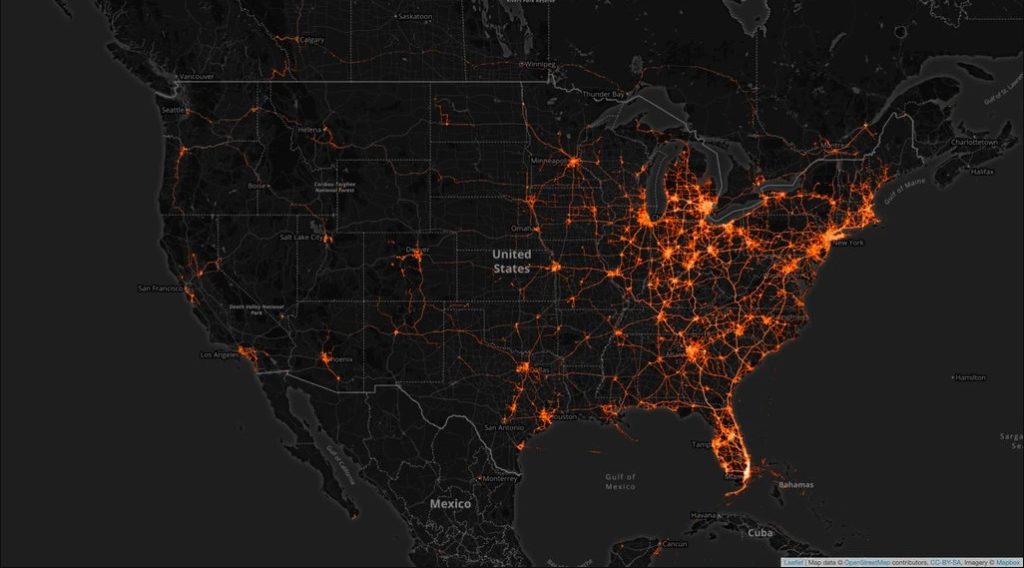
Image generated by Tectonix GEO and
X-Mode Social analyzing secondary locations of anonymized mobile
devices that were active at a single Fort Lauderdale beach during
spring break. Courtesy Tectonix GEO.
Heather Houser is the author of the new book Infowhelm: Environmental Art
and Literature in an Age of Data (Columbia University
Press, 2020), focusing on what art can bring to the battle for
environmental justice. Here she applies the concept of being
“infowhelmed”—a useful if slightly ungainly construction that means
exactly what you think it does—to the deluge of urgent facts about
the unspooling public health crisis.
Data journalism and data visualizations are meant as ways to cut
through a lot of disconnected, disordered, baggy information and
give clarity to it. Houser, however, cautions that the language of
crisp quantification can actually obscure the biases and
unconscious messages these images pick up and carry along with them
into the public mind (and presumably—though it’s not said here—she
thinks that more creative ways of presenting data might better make
these visible).
“‘More Baby Goats’: Why We
Love Animal Cams in Quarantine” by Orit Gat,
Frieze
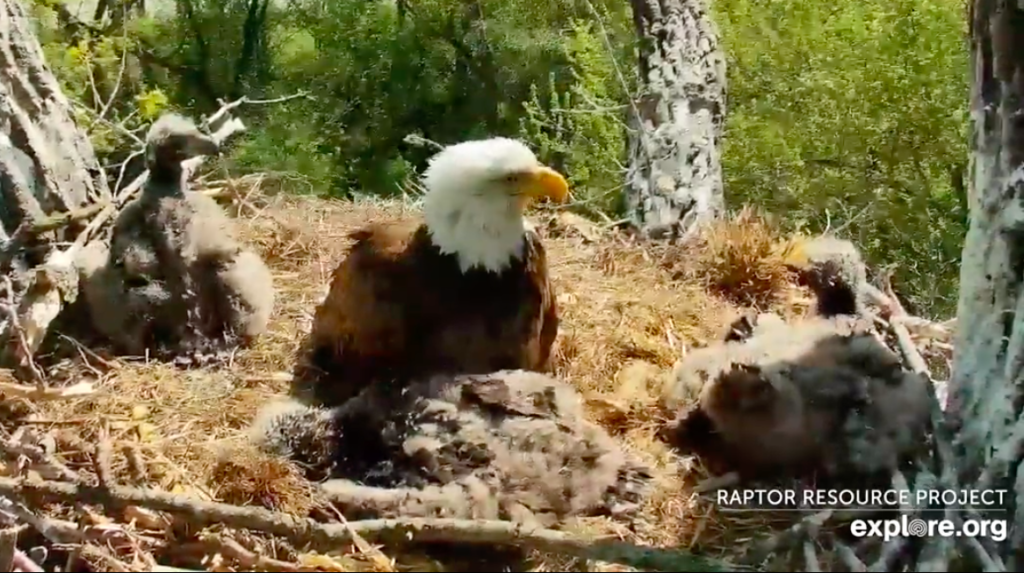
Screenshot of the legendary Decorah
Eagles livestream.
Orit Gat takes a look at the rage for happy animal stories amid
the pandemic, which has seen even my own engineer dad dedicate
himself to making videos of nesting chickadees.
What does it all mean? The simplest answer, of course, is that
animals make people happy and people want happy things in a sad
time. Gat also makes the case that its popularity now serves as a
way to recover a sense of shared experience in a dispersed time,
and that the plotless reality of unfiltered creatures provides
a kind of relatable mass allegory at a moment when a lot of people
have been separated from the ordinary motivating narratives of
life.
The raccoons are returning to the libraries.
Nature is healing. pic.twitter.com/TI3B2LQhGX— Anna Mazzola (is taking some time out) (@Anna_Mazz) April 20, 2020
I’ve also been thinking that there is a darker side to the trend
(and not just because not all that viral animal content is so warm and fuzzy). A
lot of the early stories of animal sightings during lockdown
actually had a dark undertone of the “humans were the virus all
along” kind (which has already now itself become something to goof on).
Images of animals taking over desolated cities are staples of
dystopian fiction. I can’t help but think that part of the traction
of these stories is that they give the thrill of that familiar
end-times trope.
The post The Unexpected Lesson Hidden in an Important New History
of ‘Art Strikes’ + Two Other Illuminating Reads From Around the
Web appeared first on artnet News.
Read more https://news.artnet.com/opinion/art-strikes-1857153
Further reading


Leave a comment