
What Art Defined the Civil Rights Era? We Asked 7 Museum Curators to Pick One Work That Crystallized the Moment
In honor of Martin Luther King
Jr. Day, we tasked curators across the country with the difficult
task of choosing a single work of art that they feel defines the
ethos of the Civil Rights Era. Their choices present a
kaleidoscopic and occasionally surprising group of works that span
continents and centuries—from iconic photographs to ritual
sculptural objects.
See the
works and read the
curators’ insights below.
Joe
Minter’s Children In Jail (2013)
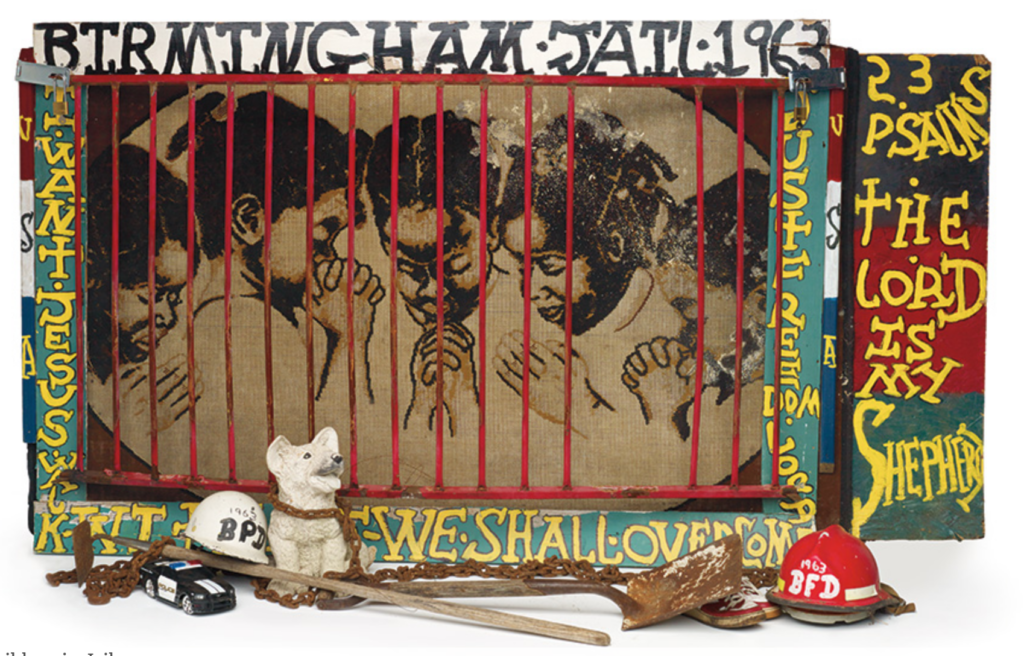
Joe Minter, Children In Jail
(2013). Courtesy of Souls Grown Deep.
This contemporary work by Joe
Minter reflects back on Birmingham, Alabama’s Children’s Crusade:
On May 2, 1963, more than 1,000 students skipped school and took to
the streets from the doors of the 16th Street Baptist Church, and
for days faced police violence and dog attacks, brutal sprays of
fire hoses, and mass arrests. Ultimately, more than 3,000 children
took part in the direct actions. More than 500 children were jailed
by Alabama Public Safety Commissioner Bull Connor, including 75
kids crammed into a cell meant for eight adults, and still others
locked into animal pens at the fairgrounds for days on end. Thanks
to their sacrifices and the widespread media images of brutalized
black children, President Kennedy took notice, the city negotiated
with Martin Luther King Jr., jailed demonstrators were freed, and
Connor lost his job.
In Minter’s multi-part
sculpture, a seemingly domestic image of praying children is placed
behind bright red bars. The violence of Birmingham’s police and
fire departments is indicated by the strewn hats and smiling dog
statue, laced with rusted chains alongside tools that Minter uses
to refer to 400 years of labor and oppression inflected on Blacks
by whites. A makeshift cage traps three baby dolls, representing
kids in cages who fought “JUST TO B FREE.”
I’m still struck by my memory of
this work, five years after seeing it at the Montgomery Museum of
Fine Arts in Alabama. And, as a side note, I’ll add that every
person living in the US should visit Montgomery’s Legacy Museum and
National Memorial for Peace and Justice, the Equal Justice
Initiative’s racial injustice museum and elegiac monument to more
than 4,400 lynching victims—African American men, women, and
children.
—Carmen Hermo, associate
curator, Brooklyn Museum
Will
Count’s Elizabeth Eckford of The Little Rock Nine
(1954)
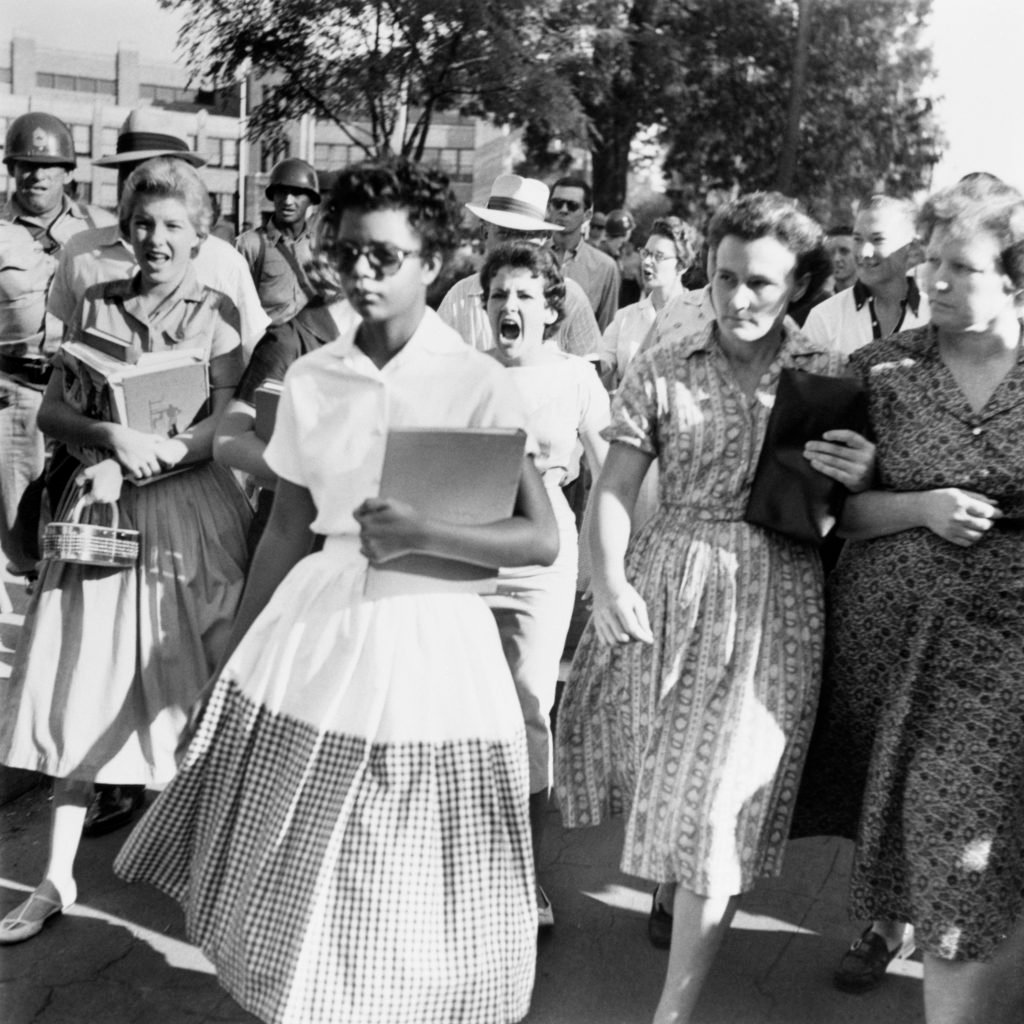
Will Count, Elizabeth Eckford of The
Little Rock Nine (1954). Courtesy of Getty Images.
It can be argued that there is
no more important medium to the Civil Rights movement than that of
photography. The documentation of violences enacted upon black
people in the south—in private lunch counters, in public parks and
bridges, in educational spaces, and so forth—and the subsequent
mass dissemination of this imagery, heightened public awareness of
such abuses and galvanized a public’s increasing demand for
judicial and legislative action that would enforce the equality of
African Americans. Indeed it said that the mass reproduction of
Charles Moore’s infamous photograph of Civil Rights protesters
being high-pressure water hosed at a spring 1963 action directly
impacted the passage of the Civil Rights Act in 1964.
Yet as scholars and curators
like Leigh Raiford, Maurice Berger, and Connie Choi have written,
the usage, status, and function of photography during the movement
was much more complicated than mere documentary realism. For
instance, there was not uniformity around how these images were
read and understood by all publics, even intra-racially; nor did
all images themselves evince the larger context in which these
actions took place or offer up the full scope of the movement’s
participants. Indeed, as Raiford argues, black people increasingly
turned to photography as a tool for shaping and presenting their
own images to themselves, not just an imagined white
public.
Of course, photography in this moment also calls forth questions
of spectacle, and that of the ethics surrounding the circulation of
images that feature violence being enacted upon, or violated, black
persons. When has an image served its “purpose”? How do the
reproduction of these images serve to shape public consciousness
over time in ways more complex than mere “awareness”?
In this image, a group of young
white women and men are angry. This is gleaned from the facts of
the faces: of the menacing glares, of the mouth agape in rage. A
slight step ahead of them is the target of this terror: a young
black woman, looking forward through her sunglasses, clutching her
binder in hand.
There are the things that a
photograph can and cannot say. For instance, it had always been the
plan for the group of students chosen to integrate Little Rock
Central High School in the fall of 1957 to arrive together. One of
the “Little Rock Nine,” 15-year-old Elizabeth Eckford had
ultimately arrived at the wrong meeting place, not
having received word of a shifted meeting plan. In this
photograph, she makes her way through a mob of hundreds, with her
gaze directed forward through her sunglasses, as she clutches her
binder in hand, alone. This mob—which includes Hazel Bryan, who
shouts aspersions at her back, and the National Guard deployed to
terrorize the integrating students—prevents her from entering
school on this day. It would take the deployment of troops at the
command of the president to allow safe (physical) entrance for
Eckford and the other eight, some weeks later. The traumatic events of this day will go on to
effect Eckford into her adulthood.
When I see this photograph, I
think of the ordinary and the extraordinary, of youth and of
bravery. How a young, ordinary girl, was forced to occupy a posture
of extraordinary bravery in the face of a violence that was
extraordinarily hostile and in part extraordinary in its
ordinariness. I sit with what that means.
— Ashley James,
associate curator of contemporary art, Solomon R. Guggenheim
Museum
Elizabeth
Catlett’s Homage To My Young Black Sisters
(1968)
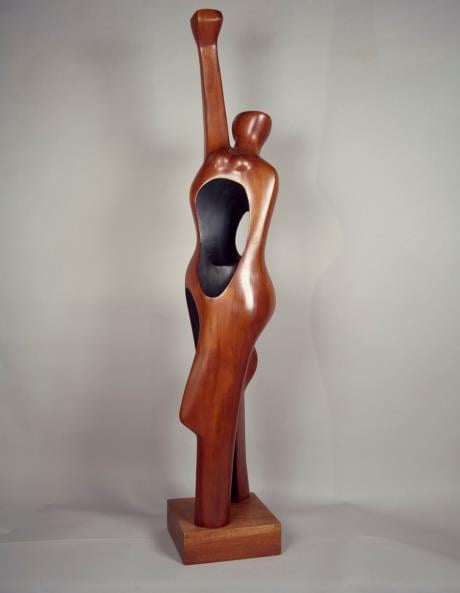
Elizabeth Catlett, Homage To My
Young Black Sisters (1968)
Homage to My Young Black
Sisters represents the influence of hundreds of everyday young
women who participated in grassroots organizing and revolutionary
activity during the Civil Rights era. Catlett often identified with
these women because she, too, was consistently beleaguered by the
US government for her revolutionary political ties and eventually
forced to relinquish her American citizenship, in 1962. The gesture
of the sculpture is clear. Its clenched fist and dominant stance
shouts Black Power in the wake of Jim Crow segregation. Catlett
speaks openly to her audience with this work, revealing that the
pulse of the Civil Rights era began with black women.
—Kelli Morgan, associate
curator of American art, Indianapolis Museum of Art at
Newfields
Gordon
Parks’s Ethel Sharrieff, Chicago, Illinois
(1963)
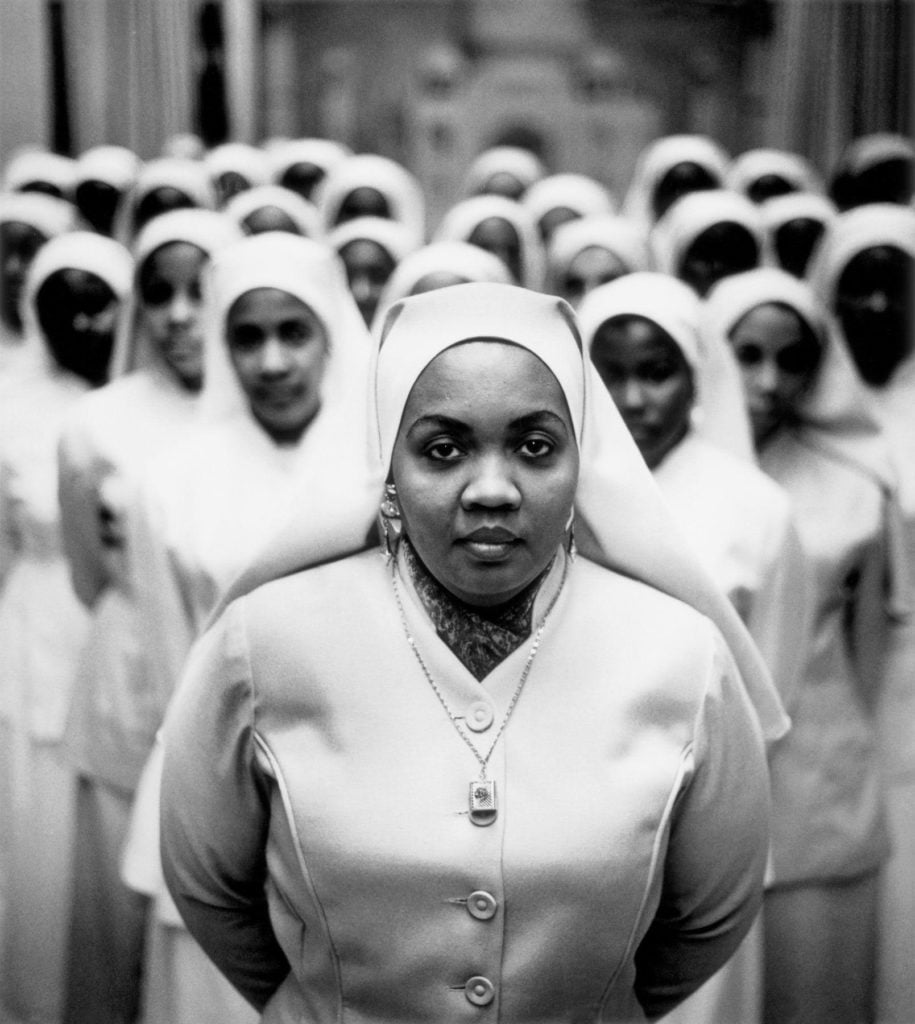
Gordon Parks, Ethel Sharrieff,
Chicago, Illinois (1963).
No other visual medium defined the
Civil Rights movement than documentary photography, particularly
the black-and-white images of male leaders, cordons of marchers
under turbulent skies, or black children in their Sunday best
blasted with G-forces by the Birmingham fire department. Gordon
Parks, one of the great chroniclers of the era, made the important
decision to equally document black people in their communities,
often in moments of peace and self-sufficiency. His “Black Muslims”
series for Life magazine was a wake-up call for
many non-black Americans who were fascinated and alarmed by the
group. Park’s portrait Ethel Sharieff for the
magazine feature stands as an iconic image of the series and the
Civil Rights era. A single woman set against an army of sisters
encapsulates all the resolve, communitarianism, and new
consciousness the moment was brewing, without falling back on any
proscribed clichés.
—Naomi Beckwith, senior curator, Museum of Contemporary Art,
Chicago
Frank
Bowling’s Night Journey (1969–70)
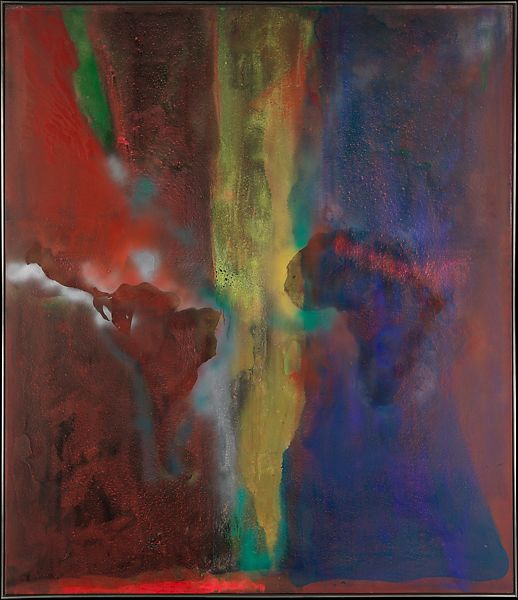
Frank Bowling, Night Journey
(1969–70). Courtesy of the Metropolitan Museum of Art.
It’s a tall—even impossible—task to summarize the Civil Rights
Era with a single work of art. The best I can do is to highlight a
few of my favorites (across media) and admit to a particular
favorite in the Met collection. I love so many of Gordon Parks’s
photographs from the period, especially Department Store,
Mobile, Alabama (1956), an image that never loses its power.
Elizabeth Catlett’s Black Unity (1968) is a great
sculptural icon of the period. David Hammons’s body prints, such as
The Door (Admissions Office) (1969), are difficult to
surpass in their inventiveness and visceral impact. A favorite of
mine at the Met is Frank Bowling’s Night Journey
(1969-70), a beautiful painting in the artist’s “Map” series.
Bowling masterfully employs his staining and pouring techniques to
ruminate on the forced sea journeys endured by enslaved people
taken from West Africa to the Americas and West Indies.
—Randall Griffey, curator, the Metropolitan Museum of
Art
David
Hammons’s The Door (Admissions Office)
(1969)
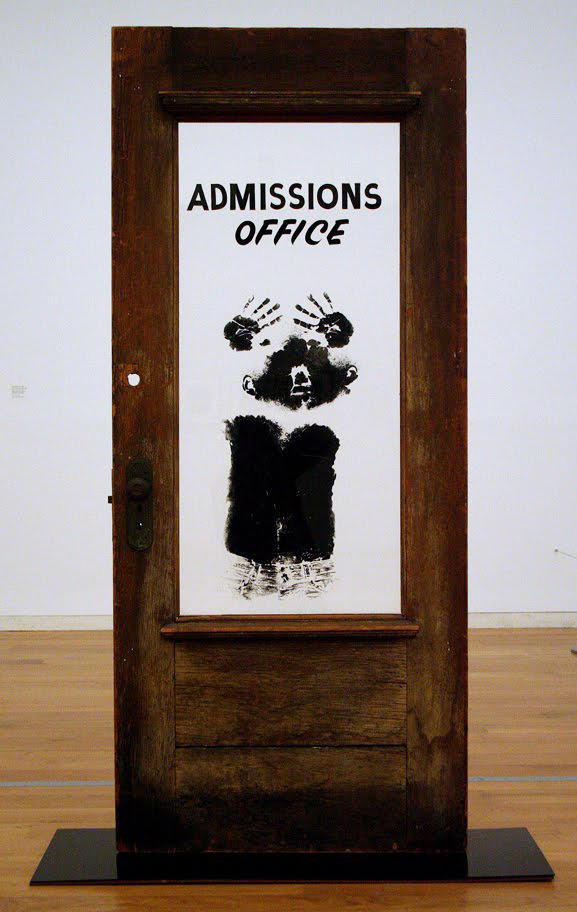
David Hammons, The Door
(Admissions Office) (1969). Courtesy of Collection of Friends,
the Foundation of the California African American Museum, Los
Angeles.
With the ridges of fingerprints
and curls of hair still visible in the dried black oil, a human
Rorschach test is printed upon a transparent windowed admissions
door. Hand-prints halo above the image of a double face; the
gesture is one, often futile, made in pleas for safety, one which
remains important in protests of communal recognition. David
Hammons’s The Door (Admissions Office) (1969) not only
critically comments on the blockades of academia, civil rights, and
nationhood, but speaks directly to the political commitments and
legacy activism of youth in the country.
This work continues to reaffirm
the presence of barricades and borders that remain closed but could
be easily opened, if only for the single turn of a wrist. This
work, often generously loaned by the California African American
Museum, continues to be emblematic of artistic interventions of the
Civil Rights era and has been a part of significant exhibitions
such as “Crosscurrents: Africa and Black Diasporas in Dialogue,
1960-1980” at the Museum of the African Diaspora, San Francisco;
“Witness: Art and Civil Rights in the Sixties” at the Brooklyn
Museum, and is now on view as a part of the international tour of
“Soul of a Nation.”
—Emily A. Kuhlmann,
director of exhibitions and
curatorial affairs, Museum of the African
Diaspora
Congolese’s Nkisi Nkondi
(Power Figure)
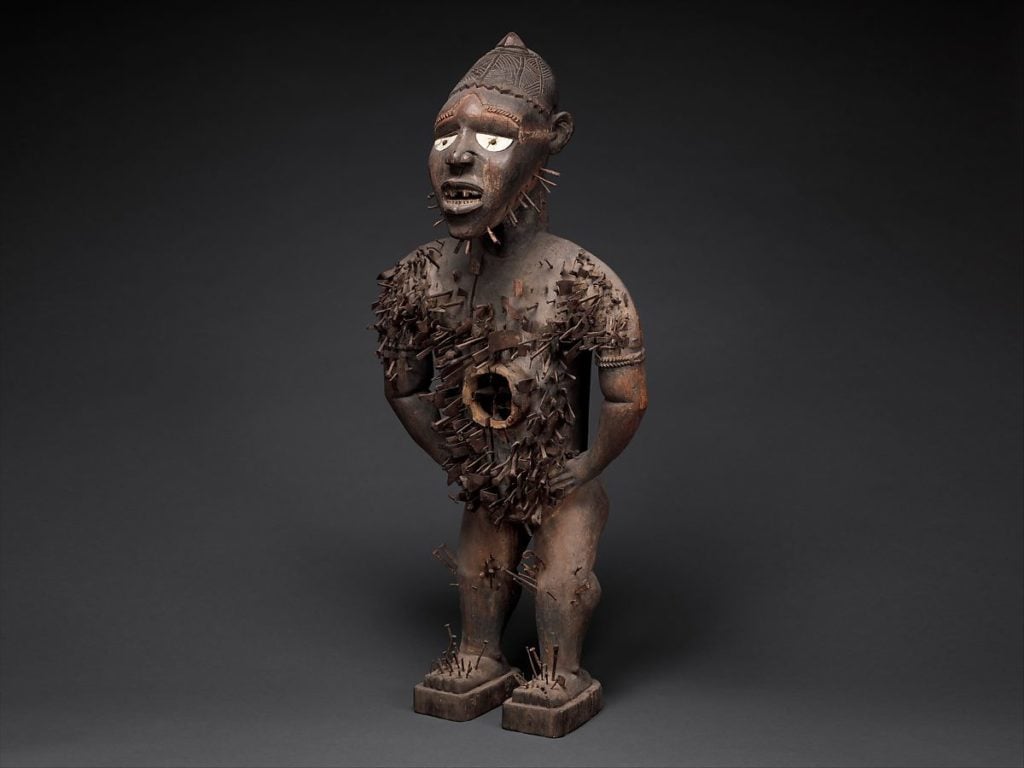
Nkisi Nkondi, 19th century, Republic of
Congo, Angola, Chiloango River region. Wood, plant fiber, iron,
resin, ceramics, textile, pigment. Yombe artist. Courtesy of the
Metropolitan Museum of Art.
Often referred to as a power
figure, nkisi
was a container that held
the bilongo
(medicine) that purified the self
and community in “Kongo” culture. This figure mediated the sacred
and profane spheres, addressing social concerns and warding off
evil spirits. It’s jarring presence endured many driven nails that
bind promises and seal deals. No other symbol could have
encapsulated the Civil Rights movement in this country. Despite all
the tribulations, progress was made in archiving some of the
aspirations that defined the cause at that time.
—Ndubuisi C. Ezeluomba,
Françoise Billion Richardson curator of African art, New Orleans
Museum of Art
The post What Art Defined the Civil Rights Era? We Asked 7
Museum Curators to Pick One Work That Crystallized the Moment
appeared first on artnet News.
Read more https://news.artnet.com/art-world/artworks-that-define-the-civil-rights-era-1755375
Further reading


Leave a comment