
These 10 Artists Found Inspiration in Isolation, From a Bedridden Frida Kahlo to an Imprisoned Egon Schiele
The myth of the solitary genius
is being put to the test in 2020 as artists around the world are
forced into isolation. Though undue pressure to create while on
lockdown may be counterproductive (as the New
York Times says, quit stressing!), artists of the past have noted the
importance of uninterrupted concentration on productivity.
“It seems to me that today if the
artist wishes to be serious,” Edgar Degas once noted, “he must once
more sink himself in solitude.”
We’ve heard about Shakespeare
penning King
Lear during the
plague and Sir Isaac Newton developing calculus in quarantine.
Throughout history, visual artists, too, have channeled experiences
of confinement into artistic growth.
Here are 10 artists who found
creativity during imprisonment, exile, and other periods of
isolation.
Ruth
Asawa
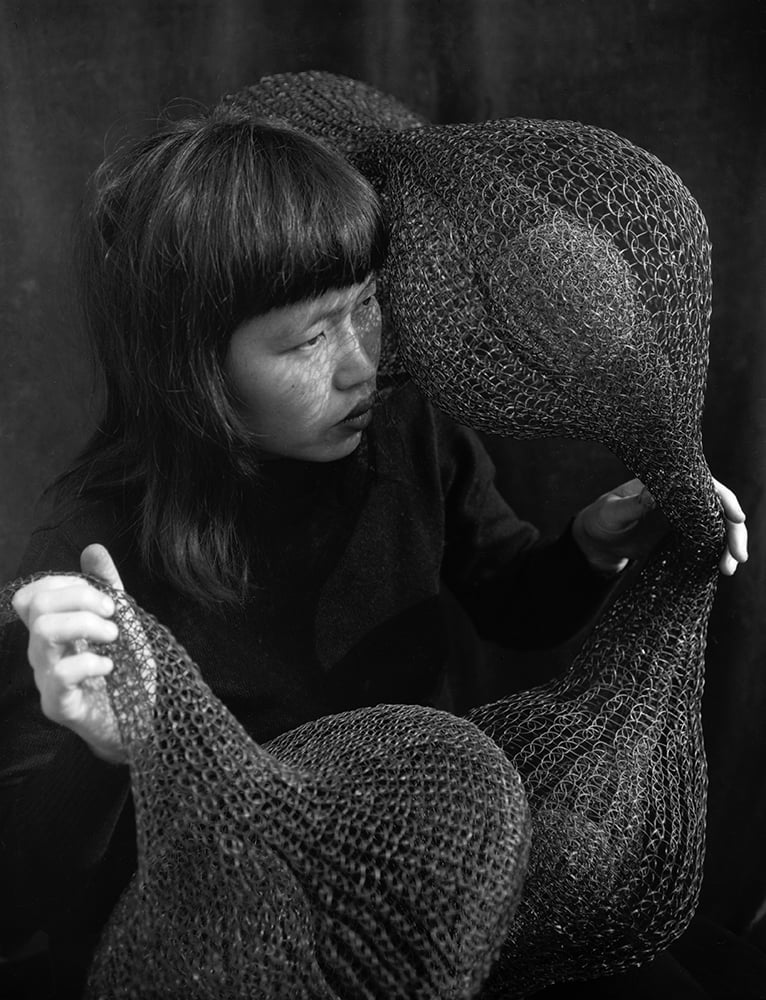
Ruth Asawa holding a
Form-Within-Form sculpture (1952). Photo Imogen Cunningham
© 2017 Imogen Cunningham Trust, artwork © Estate of Ruth Asawa.
Ruth Asawa is famous for her
enigmatic, almost mystical woven basket sculptures, which she
likened to medieval chain mail. She went on to become a student of
Josef Albers and an arts education advocate who spearheaded the
creation of San Francisco School of the Arts. But before all that,
the California-born Asawa had her earliest artistic experiences
while she was a teenager interned in Japanese detention camps during World War II. First
entering a camp in 1942 at the age of 16, she lived at the Santa
Anita racetrack for five months before being sent to Rohwer,
Arkansas, for her 18-month detention. Though she was forced to live
in repurposed horse stalls and tar paper-covered barracks, the
teenage Asawa nevertheless managed to find some inspiration by
befriending several Disney cartoonists (also interned) who taught
the artist the fundamentals of drawing. Reflecting on her
experiences, Asawa remarked, “I hold no hostilities for what
happened; I blame no one. Sometimes good comes through adversity. I
would not be who I am today had it not been for the internment, and
I like who I am.”
Edvard Munch
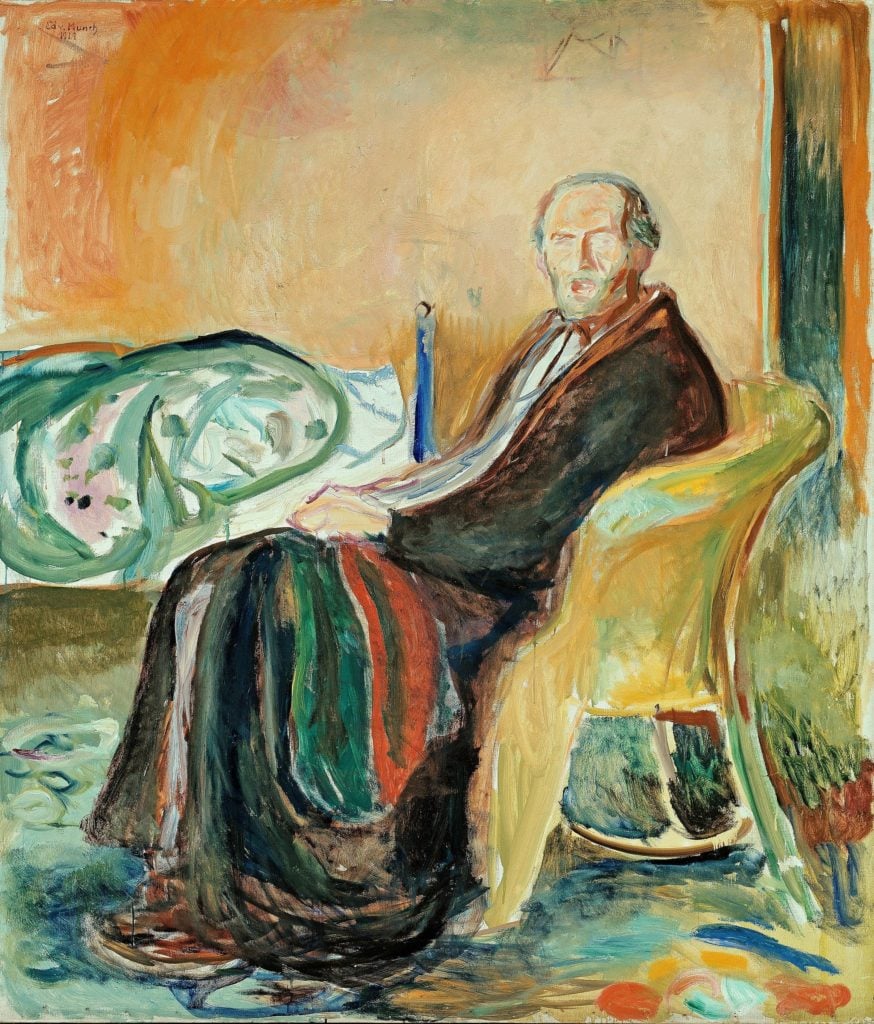
Edvard Munch, Self-Portrait with the
Spanish Flu (1919).
Though many artists struggled to visually
define the ravages of the Spanish Flu, Edvard Munch was not one
of them. The painter of The Scream contracted the illness himself, and—with
his known enthusiasm for the morbid—unsurprisingly turned his gaze
to his own sickly likeness, painting Self-Portrait with the Spanish Flu
(1919), along with several other
convalescent self-portraits. Munch, then in his mid-50s, seems to
have had a more resilient constitution than he may have depicted.
Unlike Egon Schiele and Gustav Klimt, who are believed to have died
from complications of the flu, Munch recovered and lived on some 25
years more.
Frida Kahlo
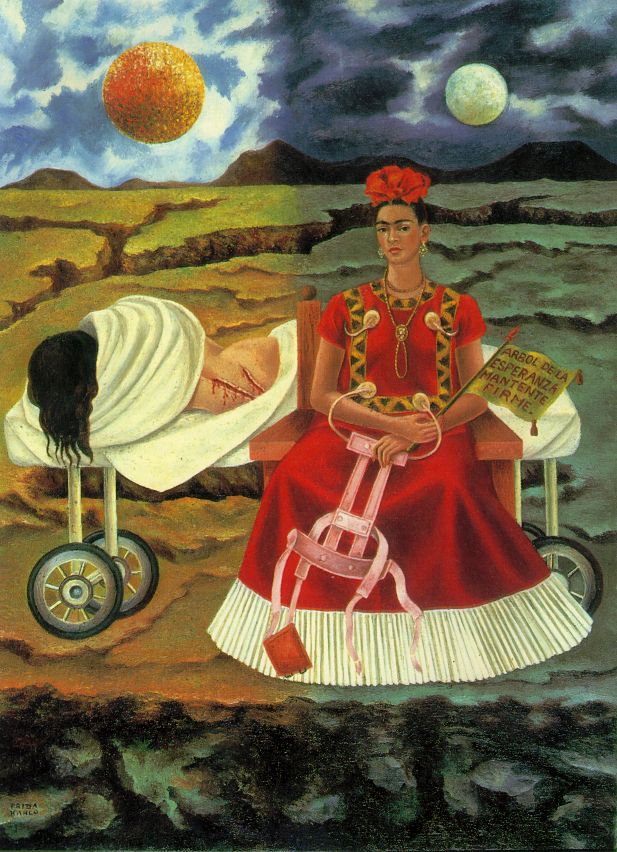
Frida Kahlo, Tree of Hope
(1946).
Early in her life, Frida Kahlo
suffered two significant physical traumas that would leave her
confined to her bed for long periods. At the age of six, she
contracted polio. The illness forever damaged her leg and caused
her pain throughout her life. Then, 12 years later, as a student,
she was severely injured when the bus she was riding on collided
with a streetcar, hurling her from the vehicle and fracturing her
spine and pelvis. Up until that point, Kahlo had planned to study
medicine, but during her lengthy recovery, she turned her energies
toward art. She painted her first self-portrait from her bed.
Throughout her all-too-brief life, Kahlo would periodically become
unable to leave her room due to illness; in order to adapt, she had
an easel and mirror made for her bed, so she could continue
painting.
Gülsün
Karamustafa
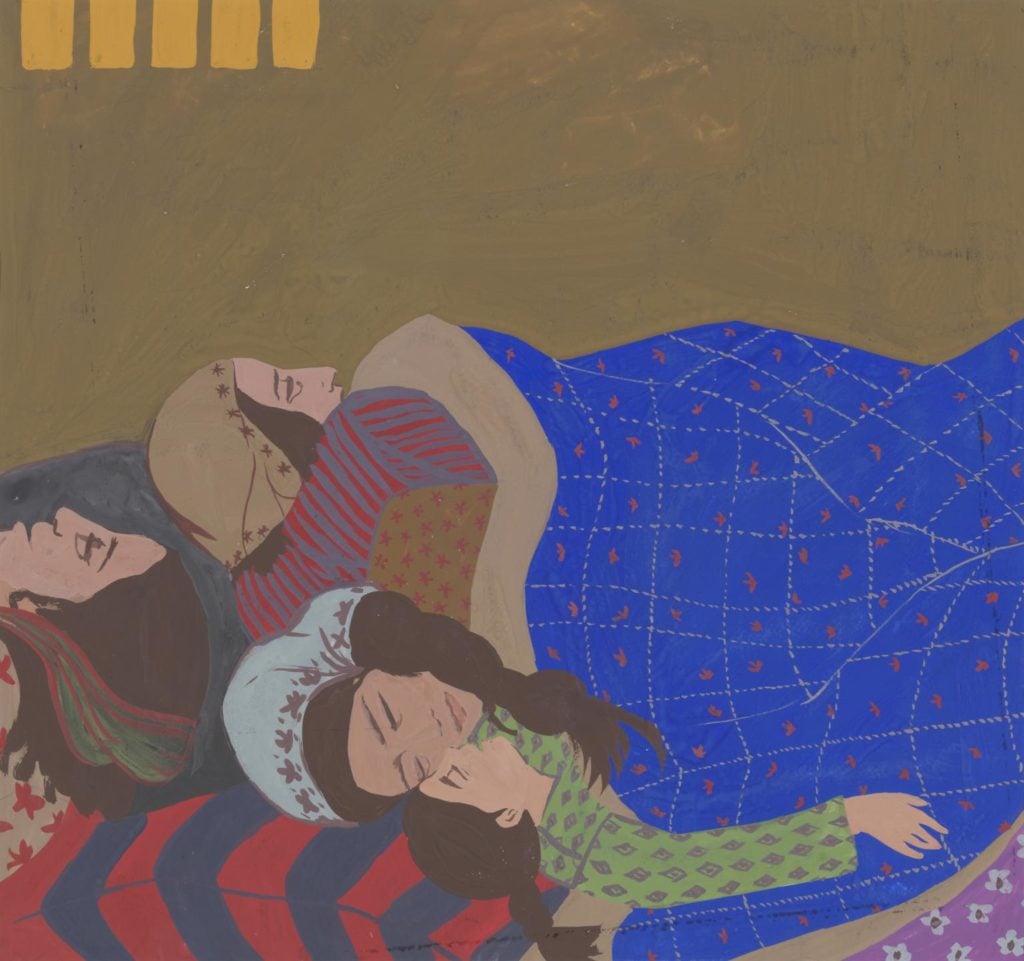
Gülsün Karamustafa, Prison Paintings
6 (1972). Courtesy of the Tate.
A powerful voice in Turkey’s contemporary art scene, Gülsün
Karamustafa creates works that weave together social-political
commentary, autobiography, pop culture, and Turkish folklore
through collage, costume, masks, and props (she first worked as a
stage designer). During the 1971 Turkish coup, the artist was
arrested and imprisoned for assisting political dissidents. After
her release, and banned from leaving the country for 16 years, she
painted her powerful “Prison Painting” series—15 works made from
memory that depict tender, intimate moments in the lives of her
fellow prisoners. “I made them in order to remember, in order to be
able to keep [what happened] in mind,” the artist later
remarked.
Egon
Schiele
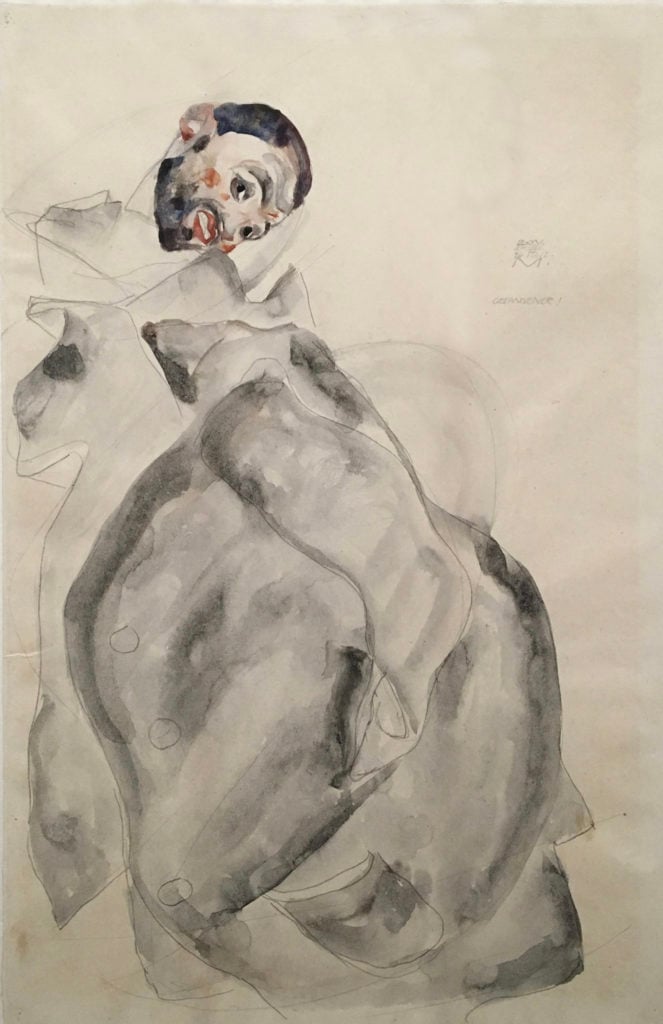
Egon Schiele, Prisoner! (April
24, 1912). Courtesy of the Albertina.
Egon Schiele lived an
unconventional lifestyle both by the standards of his time and
ours. He and his teenage mistress and muse Wally were often
ostracized as they moved throughout Austria. But it was Schiele’s
emaciated, contorted, and unflinchingly sexualized portraits that
most scandalized the public. In April 1912, that discomfort boiled
over when Schiele’s home and studio were ransacked by local
constables on the hunt for evidence of immorality. More
than 100 of Schiele’s
drawings were seized and the artist was imprisoned for 24 days
while awaiting trial on charges of pornography.
Schiele’s imprisonment proved to
be perhaps the most profound and emotionally damaging event in the
artist’s short life, but he channeled his sentiments into his
“Prison Drawings”—a series of psychologically raw compositions that
are considered among the most important of his career. Though
Schiele was ultimately cleared of the charges against him, he was
nevertheless sentenced to an additional three days’ imprisonment
following the trial for “failing to keep erotic nudes in a
sufficiently safe place.”
Barbara Ess
![Barbara Ess, Fire Escape [Shut-In Series] (2018-2019). Courtesy of Magenta Plains.](https://news.artnet.com/app/news-upload/2020/05/be_040-2-993x1024.jpg)
Barbara Ess, Fire Escape [Shut-In
Series] (2018-19). Courtesy of Magenta Plains.
fire-escape photo long before the rest of us. The American
photographer and musician has been making moody, shadowy
photographs with a pinhole camera for decades, capturing all manner
of life, from late-night scenes of New York City in the 1980s to,
more recently, life on the US–Mexico border.
In 2018, Ess found herself holed
up in her apartment with a bad case of bronchitis that lasted for
over a month. With a much smaller (and literal) creative aperture,
the artist turned to the views from her apartment and the small
details of her daily domestic sphere. With that, her Shut In”
series was born—a set of small prints Ess marked up with
silver, black, and white crayons
and later scanned and enlarged.
Joseph Beuys
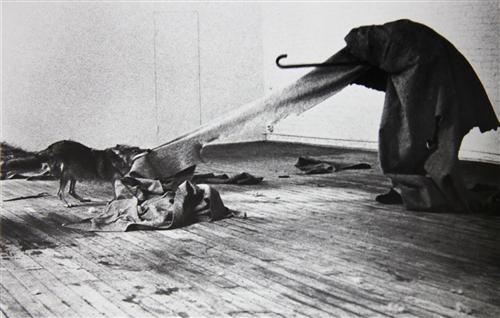
Joseph Beuys, I Like America and
America Likes Me (1974).
Photo: Joseph Beuys.
In 1974, Joseph Beuys brought
the call of the wild indoors with his
performance I Love
America, and America Loves Me. For three days, the German-born artist lived in a New York gallery
with a wild coyote. Beuys considered the coyote the embodiment of
untamed American individualism and the confinement was intended as
the artist’s symbolic reconciliation with nature. Surprisingly—and
after a period of tearing at Beuys’s unusual felt vestment—the
animal became tolerant of the artist’s presence, even accepting a
hug at the end of the performance.
Tracey Emin
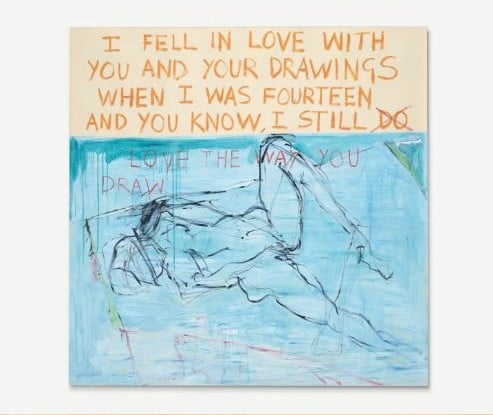
Tracey Emin, Exorcism of the Last
Painting I Ever Made (1996). Courtesy of Christie’s.
Upping the ante on gallery
quarantines, in 1996, YBA Tracey Emin set herself up in a locked
Stockholm gallery for two weeks with nothing but a batch of blank
canvases and her art supplies. Stark naked (we’re not sure why),
Emin could be seen furiously creating through a set of wide-angle
lenses installed on the gallery walls. First delving into imagery
inspired by artists she loved (Schiele, Munch, Yves Klein), Emin
eventually worked through their legacies to arrive at her own
deeply autobiographical visual language. The project, called
Exorcism of the Last Painting I
Ever Made, resulted in
12 large-scale canvases,
seven body paintings, and 79 drawings and sketches—and would prove
to be one of the most significant milestones in her career. The
body of work sold at Christie’s in 2015
for £722,500.
Claude Cahun and Marcel
Moore
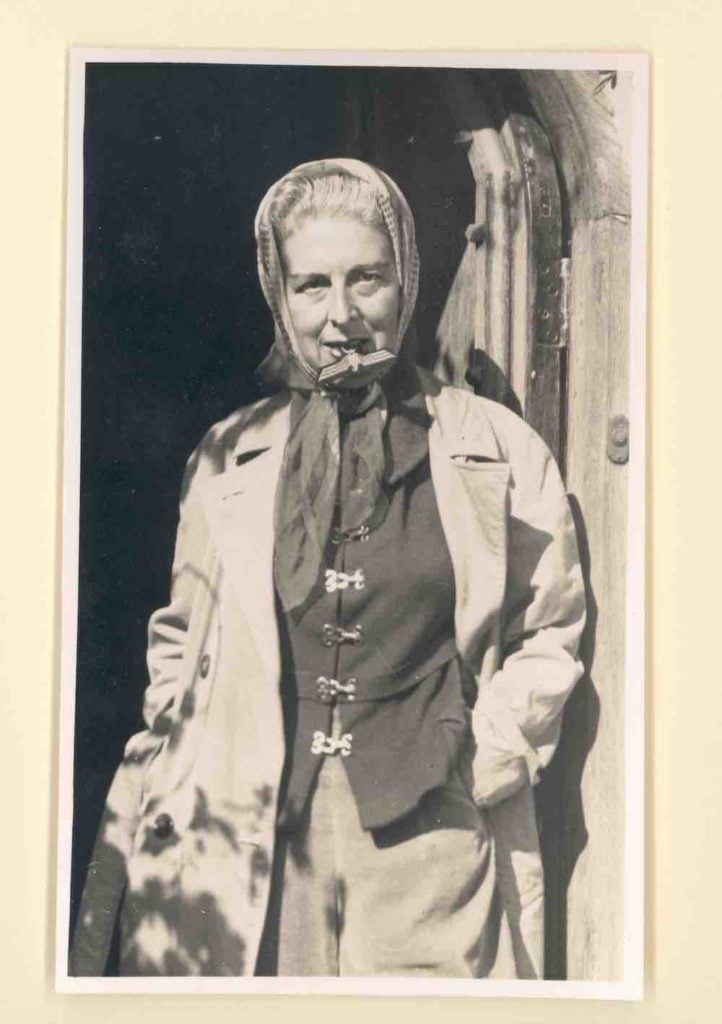
Claude Cahun, Self-Portait
(1945).
Stepsisters, lovers, and
avant-garde artists Claude Cahun (born Lucy Schwob) and Marcel
Moore (born Suzanne
Malherbe) sought out isolation—but it didn’t go quite as expected.
Facing increased anti-Semitism in Paris (Cahun’s father was
Jewish), the pair moved to the Jersey Islands off of England in
1937, but by the end of the decade it became clear to all that the
Nazis would take control of the area. Though many inhabitants fled,
Cahun and Moore decided to stay, and—under a military lockdown that
lasted from 1940 to 1944—staged Dada-inspired interventions
intended to create dissent within German military ranks. (They’d
dress as men and sneak notes about the absurdity of war into
soldiers’ uniform pockets, for instance.)
When the two were eventually
found out and arrested in 1944, Nazi officials had a hard time
believing that they had managed the widespread campaign alone. In
their 50s at the time, Cahun and Moore were sentenced to death, but
the punishment was never carried out. Though they were ready to be
martyred for their cause, the lifelong companions would go on to
create role-playing, gender non-conforming artworks until the end
of their lives. One particularly remarkable photographic
self-portrait from 1945 shows Cahun clenching a Nazi eagle badge
between her teeth.
The post These 10 Artists Found Inspiration in Isolation,
From a Bedridden Frida Kahlo to an Imprisoned Egon Schiele
appeared first on artnet News.
Read more https://news.artnet.com/art-world/artists-who-found-inspiration-in-isolation-1863522
Further reading


Leave a comment