
Why a New Yorker Cartoonist Is Up in Arms About Appropriation Art + Another Illuminating Idea From Around the Web
Every week, I scan the media for interesting conversations about
art. This week, the best stories included a debate about
appropriation art and an unexpected riddle about America’s most
popular painting.
“Stop, Thief! My Cartoon
Gets Appropriated,” by David Sipress,
NewYorker.com
Ace New Yorker cartoonist David Sipress has a bone to
pick with Karl Haendel.
Or, really, he thinks Haendel has picked a bone from
him: Sipress is dismayed to discover that the LA-based artist has
appropriated whole a Sipress New Yorker cartoon—or rather,
Haendel made an exact graphic drawing of it, signature and all, and
incorporated it into a larger installation
describing Sipress’s image as “a Jewish-American
themed cartoon from the New Yorker.”
(Haendel’s installation, called the Mazel Tov Group,
was on view at the Henry Art Gallery last year; social
media brought the appropriation to Sipress’s attention.)
I happen to like Haendel’s graphite work, which has an elegantly
brainy, seductively aerated quality. Sipress’s article is fun to
read nevertheless, partly because he fully acknowledges the
viscerally personal nature of his disgust at being appropriated,
and responds irreverently, with mockery and also more cartoons.
Generally, where you fall on “appropriation” depends on whether
you are more likely to be appropriated, or to benefit by
appropriating. Artists and anyone moving images around on the web
generally defend appropriation as creatively transformative. But
photographers, for instance, tend to hate appropriation (as do,
evidently, cartoonists), since their images are routinely ripped
off.
Here’s Sipress’s take on the affair, which references a
Sotheby’s lot featuring the Haendel installation in question:
In my research for this essay, I came across an auction estimate
for the “Mazel Tov Group” of between forty thousand and sixty
thousand dollars. Yikes! My original drawing of the
“Jewish-American themed cartoon from The New Yorker” was
bought a few years ago, for a tiny fraction of that estimate. But,
then again, it was only the real thing. I’ll get over it. One
friend tells me that I should be “flattered” to be used in this
fashion. Obviously, I’m not there yet.
It’s an obvious point, but it’s not made enough: you can’t
overstate how much money and profit comes into what gets considered
fair. The visceral irritation of Sipress is also a reflection of
the perceived relative status and security of different kinds of
media.
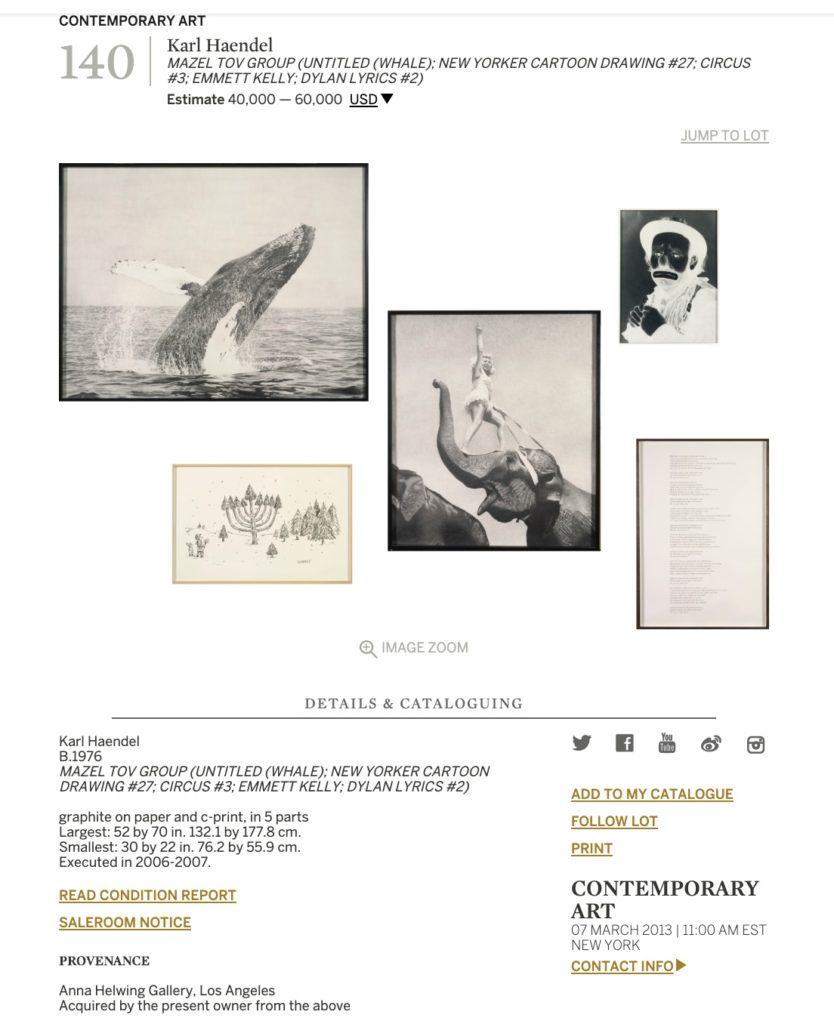
A screenshot of a Sotheby’s lot
featuring an estimate for Karl Haendel’s Mazel Tov Group,
cited by David Sipress.
When I was a docent at the Walker Art Center, a curator
instructed us how to explain classic-era “Pictures” art
by figures like Richard Prince, Sherrie Levine, et
al., to the public.
The curator said that in the 1980s, these artists had gone on an
“image strike,” refusing to add images to the world as a form of
protest against the capitalist image machine. Appropriation was
framed, in other words, as a tool of the little guy, whose
hijacking was a dissident act against advertising, old-school art,
etc.
That appropriation-as-a-tool-of-the-underdog justification
probably never fit the public’s image of what was going on in art
galleries. But in that moment, it had at least a kind of rhetorical
power as a defense that it may lack now.
In the last 10 years, there has been a dramatic shift in how
images circulate. For all of the ‘90s and most of the ‘00s, “free
culture” was viewed not just as a nice thing, but practically as a
political cause to champion. In the 2010s, however, with the
definitive commercialization of the web and the centralization of
its profits by a few companies, “free culture” came to be seen more
and more as another way to destroy the businesses of anyone who
made a living off anything that could be easily copied: journalism,
photography, music, etc.
Instead of providing a productive critique of Big Media
capital—of restrictive copyright laws and monolithic media
voices—appropriation art’s defense of itself now sounds a lot like
the logic of Big Internet capital, which wants to have access
to everything, for free, without producing anything itself, and
sell itself as a tool for everyone else to do the same.

The Wu-Tang Clan’s one-of-a-kind album
Once Upon a Time in Shaolin
Image via Wikimedia Commons.
In the face of this, art remains one of the last business models
out there.
Thus, the Wu-Tang Clan a few years ago resorted to selling off
an album as a unique auction item (with disastrous results) specifically because
that seemed to be a more viable business model than anything else
available. The more tech and finance have sucked up the goods of
the new economy, the more they have to spend on luxury goods and
pet projects.
And this means, pardoxically, that “appropriation” in art will
sound less radical (because everyone on the internet is copying and
pasting images all the time), while at the same time certain
defenses of “appropriation” are going to sound more and more like
opportunistic justifications about how culture should be free (for
tech to profit off of).
I don’t think it’s a zero-sum game. It’s possible that,
economically, Sipress’s original cartoons and reputation will grow
by becoming mixed and mashed up in art, gaining new levels of
meaning and thus new value to new audiences. But I do think
it’s worth wondering whether artists, critics, and curators don’t
need some new ways to talk about appropriation art, given the
changing place of both art and appropriation in the image
economy.
“Best of the Best,”
Art.com Magazine
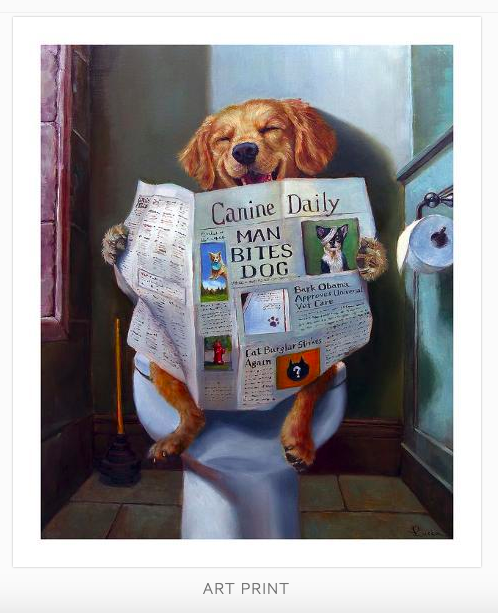
Screenshot of Lucia Heffernan’s Dog
Gone Funny on Art.com.
I have seen America’s favorite painting. It is Dog Gone
Funny.
This comes courtesy of the latest copy of Art.com
Magazine, the free mailer from the Walmart-owned art prints
site. Flipping through it, as I do every month, I come upon its
list of most popular prints. Number two, for reference, is Mark
Rothko’s Untitled (Violet, Black, Orange, Yellow on White and
Red) from 1949, licensed from the Guggenheim collection.
But sitting pretty atop the list is this painting, by Utah artist Lucia Heffernan, of a cackling Golden
Retriever reading the newspaper whilst on the toilet.
I refrain from commenting on the whole list, though it’s worth
noting that colorful abstractions and funny animals are the winning
formulae on Art.com, and comforting and inspirational are the
dominant emotional tones.
Let us simply pause to pay homage to Dog Gone Funny,
truly a masterpiece for our time. Heffernan specializes in
humanized animals of a goofy—and sometimes slightly odd,
more-adult-than-you-would expect—variety. (50 Scents of
Grey, for example, features a dog reading a smutty book of
the same title, with a canine butt on the cover that reads,
“Scratch and Sniff.”)
In Dog Gone Funny, she has clearly tapped straight into
America’s aesthetic main nerve, combining toilet humor and
anthropomorphic animals. It is a post-Dogs Playing Poker
masterpiece.
Like that legendary painting, though—whose protagonists turn out to be
Freemasons, did you know?—there are unexpected layers. Would
you believe me if I told you that Dog Gone Funny contains
a political riddle for our time?
Our protagonist is reading his hometown newspaper,
the Canine Daily. We cannot see what is amusing the
dog so much. The headline is “MAN BITES DOG.” Below the fold, the
story is “Cat Burglar Strikes Again.” There is also a picture of a
fire hydrant, another little spritz of pee humor.
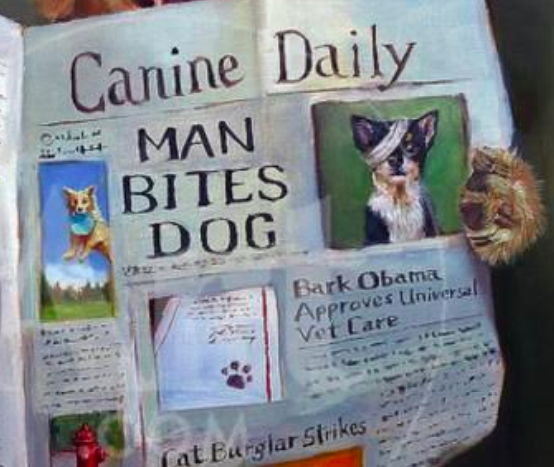
Lucia Heffernan, Dog Gone Funny
(detail) from Art.com.
But the second story down is “Bark Obama Approves Universal Vet
Care,” accompanied by a picture of a paw print of the canine
president signing the bill. It’s actually positioned below a photo
of a terrier with a bandaged eye, which seems to also go with “MAN
BITES DOG,” so it could be that this momentous act of free
veterinary care was triggered by a galvanizing act of unexpected,
news-making, human-on-dog aggression.
What, I wonder, does America think when it sits on the toilet
every day and contemplates Dog Gone Funny? (And
that’s definitely where people are looking at it; if you have a
friend who has Dog Gone Funny in their den or bedroom,
have a talk with them.)
Don’t get me wrong, I know that America mainly doesn’t think too
hard about this picture. But it’s not like the headline is “Dogald
J. Trump Builds Anti-Cat Wall.” It’s
specifically exactly the opposite of that.
What thought floats through the mind? I mean, the human
Affordable Care Act wasn’t really universal
healthcare, and its gains have been slowly strangled and
undercut. But our dog
friend is laughing; the vibes are positive. Why is this America’s
art in 2020?
Is it nostalgia for an alternate, optimistic world—before the
Trump times? Is it some kind of unprocessed suburban misconception
that Obama “solved healthcare”? Or does it represent some kind of
ambient popular idea that actual universal healthcare is just a
fundamentally positive
thing—like a happy dog, perhaps?
Healthcare is the hottest political issue of the age. For whom
does the dog laugh?
The post Why a New Yorker Cartoonist Is Up in Arms About
Appropriation Art + Another Illuminating Idea From Around the
Web appeared first on artnet News.
Read more https://news.artnet.com/opinion/new-yorker-appropriation-art-1776543
Further reading


Leave a comment