‘You Can Slow Down Time in Virtual Reality’: Why This Artist Is Using VR to Recreate Lost Ecosystems in the Era of Climate Change
The last Kaua’i ‘ō’ō bird died in 1987. After the species went
extinct, a user uploaded a recording of the Hawaiian bird’s unique
mating call to YouTube in 2009 and it has since been played by
humans more than a half-million times since.
One of them was the Danish-born, New York-based artist Jakob
Kudsk Steensen, who uses Virtual Reality as a tool to remix
and create a new kind of landscape that is not bound to time or
space, and that recalls the irretrievable, lost nature of
history.
For his recent
installation RE-ANIMATED (2018-19), which was on
view in the Future Generation Art Prize’s exhibition in Venice
during last year’s biennale, Steensen brings the Kaua’i ‘ō’ō bird
back to life via an imagined virtual-reality world.
We spoke with Steensen about how he captures an irreconcilable
sense of loss in his work and the collective memories that exist
between the parallel digital and physical worlds, all through the
lens of VR technology.
Your VR work RE-ANIMATED was inspired by
the environmental catastrophe that occurred in 1826 when a ship
carrying horses to Mexico stopped in Kauai and introduced
malaria-carrying mosquitoes into the island’s ecosystem, rendering
dozens of birds extinct. In a poetic intervention, you virtually
recreate one of these extinct birds and Kauai’s lost ecosystem.
What was it about this ecological event that made you want to make
this work, and how did you go about doing it?
Four years ago, I came home from a long day of work and was
randomly looking at things on the internet, and then I came across
this recording of the bird. It was the voice recording of the last
Kaua’i ‘ō’ō bird that existed on Earth. The bird’s mating call was
uploaded to YouTube and was listened to by people more than a
half-million times.
I then read through the comments. There were more than 2,000
very emotional comments to this call. It was as if I had this
picture of 2,000 people sitting alone, in front of the computer,
responding emotionally to this recording of this extinct bird, and
it struck me as something really specific to our time.
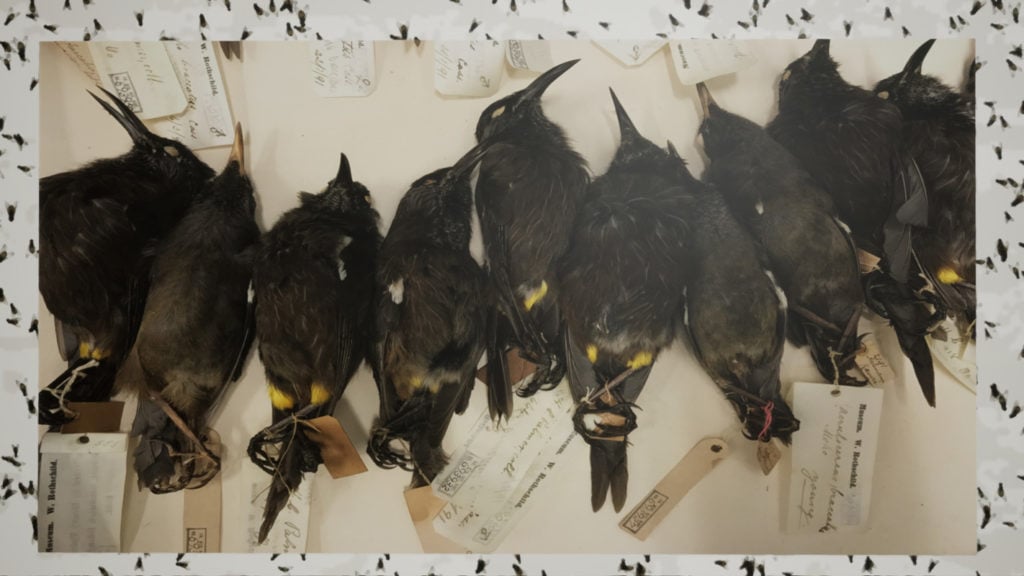
Jakob Kudsk Steensen, RE-ANIMATED
(2018). Future Generation Art Prize, 2019 Venice Biennale. Courtesy
of the artist.
There’s another layer of this story, which is personal, and I
don’t want to go into details, but it’s about family and losses.
Even though I grew up in a digital time and am used to archiving
things with social-media pictures and everything, people still die
and vanish and can never come back.
If you think about that, we are living in a time where we’re
trying to bring back extinct species, which is a weird relationship
with our past. We have a collective anxiety that everything will
vanish, and more and more nature is being destroyed.
I started this project by going to the Museum of Natural
History, which collected this bird in the 1800s. So I collected all
the materials, the feathers, along with the big archive of plants
and trees with all sorts of different species, and I used this
archive to recreate the whole landscape. And then I used the
satellite images of the island, and then traveled to this island
and explored myself. It’s a very slow and laborious process, but
that’s how I usually work on a project.
I like that you describe yourself as a “digital
gardener.” It’s very poetic and speaks to your work of recreating
lost landscapes to raise awareness about climate change. What is
your opinion on VR as a medium for creativity? What is its
potential and what are its limits?
VR is a very interesting medium because it’s corporal—you have
to use your body. And my interest is also to bring certain virtual
landscapes to people who normally don’t use computers. I make works
that are very accessible—you just put on a headset, and that’s it.
Everyone knows how to move their head and body. So, all of a sudden
you can show your art in an intuitive way.
I tried to use minimally complicated controls, I tried to make
it very intuitive and playful. And that’s something that speaks to
the nature of VR—you can take a virtual media and make it a human
language. That’s how I look at it. It speaks to you on a human
level.
In a way, paintings and projections on screen are
one-directional. It is an old way of looking at the world, like the
perspective in Western art history. Installation is perhaps a
better analogy to VR. Walking into a physical space in an
installation is similar to the VR experience; that’s also why I
built installation around my work sometimes, when the conditions
allowed.
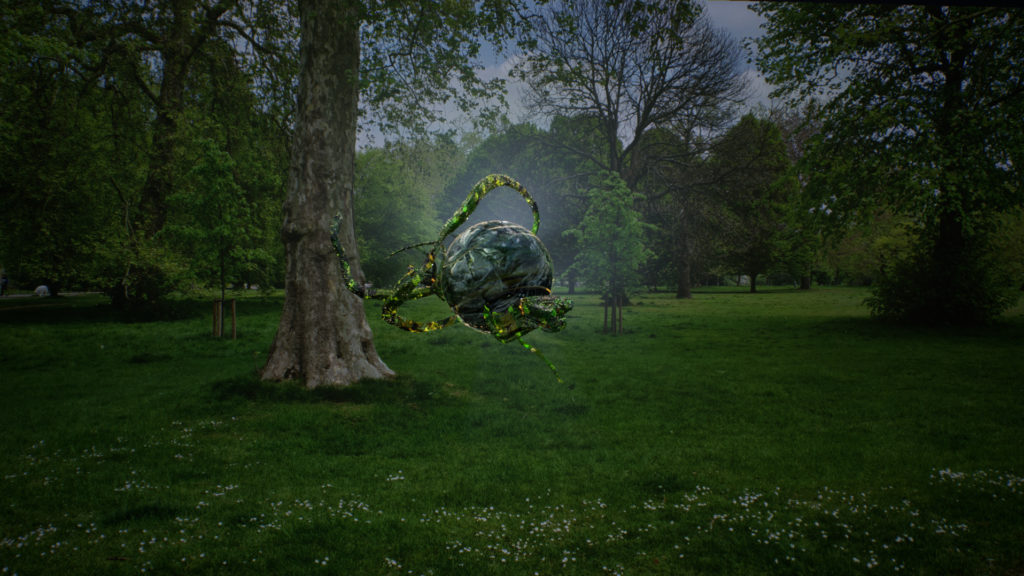
Jakob Kudsk Steensen, The Deep
Listener (2019), VR visualization. Courtesy of the artist.
What about the limits of VR as a medium?
The limits of VR as medium would be the size of the audience. I
have eight headsets now, and after each exhibition they just broke
down because the technology is so new. All these complications can
play in when dealing with a big audience.
Immersive virtual technologies have enabled us to
experience both distant locales and imagined worlds like never
before, and your works are great examples of storytelling in VR.
However, it seems no one has yet fully cracked the code of creating
a truly participatory narrative experience where the viewer has
real agency. What do you think needs to happen to get VR to take
the leap into the next frontier of storytelling? How do you see
this medium evolving over time?
When I show in film festivals, people talk a lot about
storytelling, but for me, the way I have been creating my work is
almost like moving away from that. A story is a narrative, but I am
looking for the experiential part of it, like the senses of the
body. Before you understand the medium—for example, how VR relates
to the human body—regardless of the story you want to tell, it’s
going to fall apart. If you’ve never played video games or created
3D, it can be quite challenging to use this medium well, because
you might make something like when you’re looking at 2D on a
screen, but you actually need to think about how the body moves in
your eyes.
Regarding AR [augmented reality] and VR, the first and foremost
challenge is to understand how human bodies are navigating in a
space. And I believe before you understand that, it’s hard to
utilize the medium in a compelling way. And you also need to
respect your audience. Imagine this: All of a sudden, their body is
part of your art; they are no longer just standing, watching, or
listening. You’re inviting them to use their bodies to explore the
world you created, and I think that really requires a lot of
attention and respect.
If you are just violently throwing another human into a 3D world
and they don’t know how to move themselves, that’s when a lot of
clashes happen.
You have to think about the human, not the technology. When I
design, I think about where the person will be looking and I create
a virtual scene. I think about what kind of feeling I want to
convey, and then I add the colors, light, and the atmosphere. I
think about how I want people to hear, and then I use the
technology around to achieve that, instead of trying to force
something into the technology. In the past two years, the
technology has evolved super fast and the audience now is more used
to the medium as well. I am optimistic. I think in the end it just
takes time.
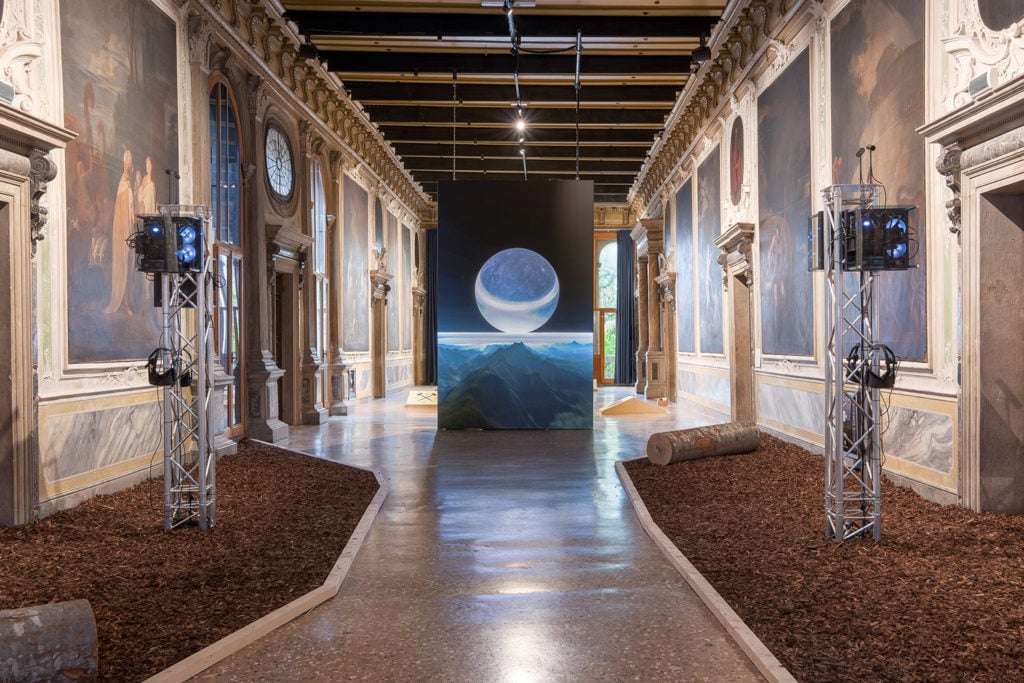
Jakob Kudsk Steensen, RE-ANIMATED
(2018). Future Generation Art Prize exhibition during the 2019
Venice Biennale. Courtesy of the artist.
The way you incorporate audio, 2D images, and 3D
animation into a holistic VR experience is not through a linear
narrative. Your work conveys the eerie, unsettling sense of jumping
around in time. What is your intention here?
My interest lies in exploring different space and time in
natural history. These spatial transformative technologies like VR
are a very powerful medium when you’re interested in past natural
histories because you can literally 3D scan the whole landscape.
And I use satellite images, and I digitize plants that I collected
in nature and put them on the landscape. I literally go to
landscapes and collect organic materials, I collect and photograph
them, and transform that into virtual spaces. In other words, I
build imaginary landscapes based on the actual materials I
collected.
The technologies allowed me to show things to you—for example,
how past landscapes can change overtime, how you can look from the
scale of a beetle, how you can change your perspective. These
things are what this technology is very good at. You can also jump
around in time and you can slow down time in virtual reality—you
can change your scale in different dimensions.
Your work The Deep Listener at the
Serpentine Galleries last year (commissioned in collaboration
with Google Arts & Culture and Sir David Adjaye) involved
creating an AR experience of the
Kensington Gardens surrounding the
gallery. Through extensive research and work with
biologists, you focused on one species in each of the five spots
you chose and recreated the visual and sonic experiences that users
interact with. Where did the inspiration for this
work come from?
It takes place in the whole park in London and there are five
different locations. You have to go there with your phone. When you
arrive at the location, you find these large creatures that are
based on the different species in the park that lived at this
location, each with different visualized audio recordings. When you
physically move around with the phone in your hand, you’re also
changing the speed of the audio, as if you’re changing the speed of
time as you walk through the park and interact with the audio.
It basically allows you to hear things you usually don’t hear
with your phone. Like bats, for example. When you walk around,
you’re changing how fast the audio is playing, and the pitches, so
your ears wouldn’t hear these sounds usually. There’s an App you
can download and will always be available to use when you visit the
park. Everyone can download it.
Where do you find the most inspiration for your work
these days?
My inspirations are usually based on the conversations with my
friends and biologists, then I go and spend many months in the
landscape. I am always out exploring places and talking to people.
For example, I spend two months researching the species, and then I
find five locations that I want people to go to and explore.
Starting next month, I will be spending nine months in the
landscape and collaborating with my wife. We are trying to create a
project together. We are going to Sorrel Island; it’s an island in
between Europe and the States where the tectonic plates meet, where
three continents meet in one spot, and they formed a mini
continent, deep in the sea. We are going to see if we can
work with the robots there—the robots that are collecting data for
scientists—and then from there we can create a new landscape.
Your works evolve around nature and its histories, and I
am curious whether you think we are in the best of times or the end
of times? One oddity of our current era is that extreme pessimism
about the world coexists with extreme optimism.
There are two answers to that: One is, statistically, we are at
a point where we don’t have something truly comparable to the past.
It’s hard to predict what will happen in the future because of
that. We have a lot of knowledge and tools available, but at the
same time, it could just go the completely opposite direction.
I think we’re at the middle point between this utopia and
dystopia. We are at a point in time when they are clashing
together, and barely holding right now, and it could go many
different ways. That’s also why I’m making works that combine
different times. It’s more emotional and psychologically
challenging—that’s the kind of ground I have been trying to create.
In my works, I tried to create from this old realistic landscape
and transform it into something new in the future. All my works
exist in the middle of this coexistence of times.
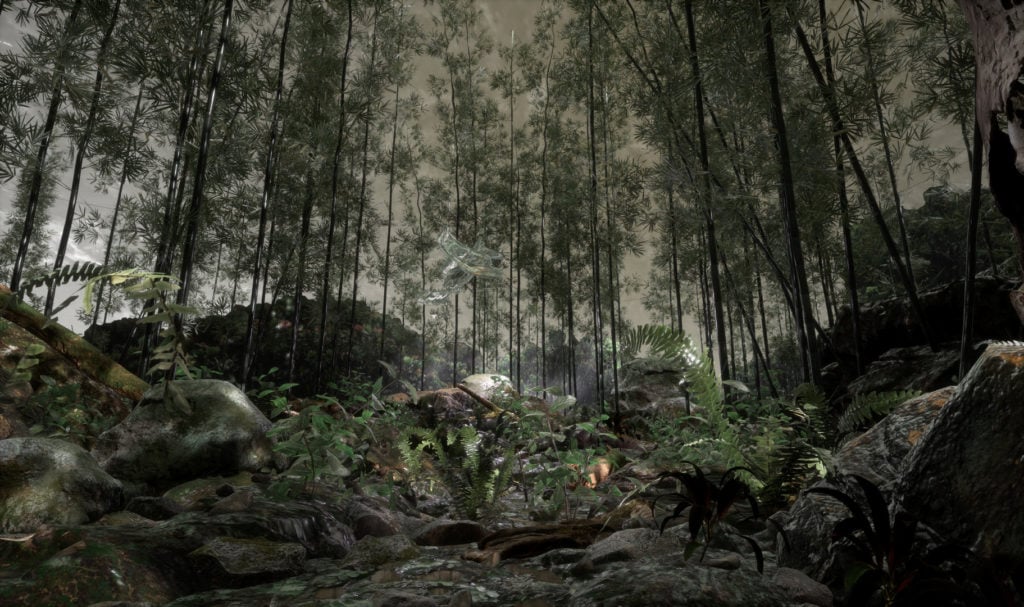
Jakob Kudsk Steensen, RE-ANIMATED
(2018) film still. Future Generation Art Prize, 2019 Venice
Biennale. Courtesy of the artist.
Secondly, I do believe that much more has to be done, and we
need to actually spread the messages, as well as to give resources
to people. Consequently, I am thinking more and more about how, as
an artist, can my projects help to achieve that? How can they be
more specific than in the past, to help share the stories about
places that need to have more work be done?
Recently I have been talking to this NGO in Panama that protects
the frogs there. And we were talking about how there are 12
different species of frogs that are all extinct in the wild because
of a fungus. Because there’s a fungus crisis spreading out, and the
fungus is making all frogs extinct, all frogs will disappear
eventually, from Panama to South America. And people still don’t
know how to stop it.
This NGO is collecting the frogs that survived the fungus and
preserving them, working to see how they can become resistant and
then releasing them back to the wild. If they release these frogs
back to the wild, all of them will die, unfortunately, because the
politics has changed. The NGO doesn’t work with the Smithsonian
anymore; as a result they are facing financial difficulties to
continue the preservation program.
It’s pretty obvious if they don’t continue to get financed,
eventually there will be no frogs in Panama in the future. It’s a
fact. And these things I find more and more relevant to share with
people. I still want to make art that’s emotional and
powerful, but I am also thinking about how to connect to the
stories that are happening right now in our world.
The post ‘You Can Slow Down Time in Virtual Reality’: Why
This Artist Is Using VR to Recreate Lost Ecosystems in the Era of
Climate Change appeared first on artnet News.
Read more https://news.artnet.com/art-world/jakob-kudsk-steensen-vr-1748265
Further reading


Leave a comment